 ‧ Agnes Kazaryan ‧
March 13, 2026
‧ Agnes Kazaryan ‧
March 13, 2026  622 ‧
622 ‧
 0
0
TikTok has over 1.5 billion monthly active users – and a significant share of them discover products they never knew they wanted through their For You feed. If you sell products online and you are not running TikTok ads yet, you are handing that traffic to your competitors for free.
Quick answer: TikTok ads are short-form video and display placements shown to targeted audiences across TikTok’s platform. You define your audience inside TikTok Ads Manager, upload a video, set a budget, and TikTok’s algorithm delivers your ad to users most likely to buy. Standard In-Feed campaigns start at around $20/day.
This guide covers every TikTok ad format available in 2026, how to set up TikTok Ads Manager from scratch, what a realistic TikTok ads strategy looks like for ecommerce sellers, and the mistakes that quietly drain budgets before a campaign ever gets traction. Whether you are completely new to paid advertising or looking to sharpen a campaign already running, you will find practical answers here.
The good news is that you do not need a big agency budget or years of ad experience to get TikTok working for your store. What you do need is a solid understanding of how the platform works, which formats suit your goals, and how to run tests without wasting money in the process.
What are TikTok ads?
TikTok ads are paid placements that businesses buy to reach users on TikTok’s platform. Unlike organic posts that depend entirely on algorithmic reach, paid TikTok advertising guarantees your content is shown to an audience you define – by age, location, interests, behaviors, and purchase intent.
The entire campaign process lives inside TikTok Ads Manager, TikTok’s self-serve dashboard where you build campaigns, define audiences, upload creative, set budgets, and track performance. It works on similar principles to Meta Ads or Google Ads, but with one important difference: TikTok users respond poorly to anything that looks like a traditional commercial.
The more your ad blends into the organic feed, the better it tends to perform.
For ecommerce sellers – especially those running dropshipping businesses – TikTok ads have become one of the fastest routes from zero to first sale. The platform’s shopping integrations, direct product link support, and pixel-based conversion tracking all reduce the friction between ad impression and completed purchase.
Why this works in 2026: TikTok’s algorithm rewards content that generates genuine engagement. Ads that perform well organically receive preferential treatment from the paid system too – meaning a strong creative asset compounds in value over time rather than simply burning budget at a flat rate.
How much do TikTok ads cost?
TikTok advertising cost depends on the format you use, how competitive your target audience is, and the quality of your creative. The platform uses an auction-based bidding model: you set a cost cap per result, bid for clicks, or let TikTok optimize automatically toward your conversion goal.
Most independent ecommerce sellers work with In-Feed Ads, Spark Ads, and Collection Ads. TopView and Branded Hashtag Challenge formats are reserved for significantly larger budgets. For most beginners, $20–$50 per ad group per day is a practical starting point that generates enough data to optimize within 7–10 days.
Your actual cost-per-click and cost-per-purchase will vary based on creative quality, niche competitiveness, and landing page experience. A strong, native-feeling video can significantly reduce your effective CPM over time compared to a polished but generic production – TikTok’s algorithm rewards content users genuinely engage with.
One note on daily minimums: TikTok enforces a $20/day minimum at both the campaign level and the ad group level for most self-serve campaign types. Testing two ad groups simultaneously requires a minimum of $40/day. Budget accordingly before scaling, and expect to spend $200–$300 total before drawing reliable conclusions from any new campaign.
TikTok ad formats you need to know
TikTok offers a range of paid ad formats, each designed for different campaign objectives and budget levels. Knowing which format fits your goal – traffic, awareness, or direct conversions – is the foundation of any effective TikTok ads strategy in 2026.
Video-based formats
In-Feed Ads
In-Feed Ads are the standard TikTok ad format and the starting point for virtually every ecommerce advertiser. These short video ads appear natively between organic posts in the For You feed, formatted to look and feel like regular TikTok content. Users can like, comment, share, and follow your account directly from the ad – making them a conversion tool and a brand-building tool at the same time.
For TikTok ads for dropshipping specifically, In-Feed Ads are the go-to choice. They support multiple call-to-action button types (Shop Now, Learn More, Get Quote), allow video lengths of 9–60 seconds, and integrate directly with the TikTok Pixel for full conversion tracking. The $20/day minimum makes them the most accessible entry point on the platform.
Earning potential: Optimized In-Feed Ad campaigns in ecommerce niches typically deliver CPMs of $2–$10, with conversion rates of 1–3% for products with strong visual demonstration value.
TopView Ads
TopView Ads appear as the very first thing a user sees when they open TikTok – a full-screen, auto-playing video placement with no competing content in frame. They run for up to 60 seconds and deliver maximum attention at the cost of maximum investment.
TopView placements at scale are typically purchased through TikTok’s managed services team, with entry costs in the thousands per day. A self-serve auction version exists at lower budget points but does not carry the same guaranteed first-impression positioning.
For independent dropshipping sellers, TopView Ads are not a realistic starting format – but knowing where they sit helps you understand the full range of what TikTok’s advertising ecosystem offers.
Branded Hashtag Challenge
Branded Hashtag Challenges invite TikTok users to create their own content around a branded theme or action, with the challenge surfaced on TikTok’s Discover page. When a challenge gains traction, it generates enormous amounts of earned media as users become voluntary content creators for the brand.
The official promoted version requires a minimum investment of around $150,000 for a standard six-day package – firmly in the territory of established brands with dedicated campaign budgets. Running an unofficial organic hashtag campaign alongside your paid In-Feed Ads can work well without that spend, as long as you have a compelling concept that gives people a genuine reason to participate.
Important note: You do not need a Branded Hashtag Challenge to build brand awareness on TikTok. Consistent In-Feed Ads combined with an active organic presence will achieve comparable awareness goals at a fraction of the cost for most ecommerce businesses.
Interactive and display formats
Spark Ads
Spark Ads are one of the most effective formats for ecommerce sellers working with content creators. Instead of building a separate ad creative from scratch, you boost an existing TikTok post – either from your own account or a creator’s account with their permission.
The ad runs from the original posting account, so all engagement (likes, comments, shares, follows) accumulates permanently on the original post rather than disappearing when the campaign ends.
For dropshipping sellers, Spark Ads unlock the ability to amplify authentic creator reviews and unboxing videos as paid placements. This combines the credibility of genuine user content with the reach of paid distribution – and it consistently delivers stronger performance than equivalent branded creative across most product categories.
Collection Ads
Collection Ads pair a video or image ad with an instant storefront gallery that opens inside TikTok without redirecting the user to an external browser. When someone taps the ad, they see a curated product feed – a lightweight version of your store – built directly within the app. For sellers with multiple related products, this dramatically reduces the friction between seeing a product and completing a purchase.
Collection Ads integrate with product catalogs via TikTok Pixel or direct platform integrations with Shopify and WooCommerce. They perform best when the product gallery is tightly curated around a single theme rather than showing a broad, generic selection.
Why this works in 2026: Every additional click or redirect in the purchase journey reduces conversion rates. Collection Ads remove the browser redirect that typically accounts for 30–50% of drop-off between ad click and purchase completion.
How to set up TikTok Ads Manager step by step
TikTok Ads Manager is the self-serve platform where every paid campaign is built, managed, and measured. Getting the technical foundation right from the start – particularly your pixel setup – saves considerable time and budget down the line.
- Create your TikTok for Business account: Go to ads.tiktok.com and register with your business email. You will need to verify your account details and add a payment method before your first campaign can go live. Choose your time zone carefully during setup – it cannot be changed later and affects how daily budgets reset and how reporting aligns with your real-world sales day.
- Install the TikTok Pixel: Navigate to Assets > Events > Web Events inside Ads Manager. The TikTok Pixel tracks user actions on your store – page views, add-to-cart events, checkout initiations, and purchases. Install it via manual code, the Shopify or WooCommerce native integration, or Google Tag Manager. Verify it is firing correctly on your purchase confirmation page before launching any conversion campaign.
- Build your campaign structure: TikTok uses a three-level hierarchy. At the Campaign level, you set your objective (Conversions, Traffic, Reach) and overall budget cap. At the Ad Group level, you define your audience, placements, schedule, and daily budget. At the Ad level, you upload your video creative, write your copy, and choose your CTA button and destination URL.
- Define your audience: At the Ad Group level, you can target by age, gender, location, language, interests, behaviors, device type, and connection type. For initial testing, start with a broad audience and let TikTok’s algorithm find the responsive segments. Add interest and behavioral targeting layers once you have 7–14 days of performance data to guide your decisions.
- Upload your creative: TikTok recommends 9:16 vertical video at 1080×1920 resolution for In-Feed Ads, between 9 and 30 seconds for best completion rates. The first 1–3 seconds are critical – the hook must stop the scroll immediately. Add your CTA button, select your destination URL, and preview the ad in TikTok’s simulator before submitting.
- Set budgets and submit for review: Use daily budget at the Ad Group level for maximum control during testing. Start with $20–$30 per ad group per day and run for at least 5–7 days before making any changes. TikTok’s moderation team typically approves ads within 24 hours, though high-volume periods can extend this to 48 hours.
One area beginners consistently underestimate is the learning phase. After launch, TikTok’s system needs time to identify which users in your target segment are most likely to convert. This process typically takes 7–14 days and requires at least 50 conversion events per ad group before the algorithm can optimize reliably.
During this window, avoid editing campaign settings, pausing and restarting ad groups, or changing budgets by more than 20% – any significant change resets the learning phase and wastes the progress already made.
Important: Never launch a conversion campaign without first confirming your pixel is tracking purchase events correctly. Running a week-long test with a broken pixel means you will have no conversion data to optimize from, regardless of how much you spend.
TikTok ads strategy that actually works in 2026
Running ads on TikTok is straightforward. Running ads that return more than they cost requires a deliberate approach. These are the principles that separate ecommerce sellers who scale consistently from those who exhaust their budget without meaningful results.
Lead with creative, not targeting
On TikTok, your creative is your most powerful targeting tool. The algorithm is sophisticated enough that broadly targeted campaigns with excellent video consistently outperform narrowly targeted campaigns with average creative.
Before adjusting audience filters, ask whether your video hooks the viewer in the first two seconds, demonstrates the product clearly, and gives a compelling reason to click. If the creative is weak, no targeting adjustment will fix the underlying problem.
Test multiple creatives simultaneously
Standard practice for TikTok ads ecommerce is to launch 3–5 different video variations per ad group at the start of every new campaign. Let TikTok’s system identify the strongest performer over 5–7 days, then pause the underperformers and create new challengers against the winner. This structured testing approach – rather than endlessly editing individual ads – is how consistent performers are found and scaled.
Use UGC-style content
User-generated content – videos that look like a real person sharing a genuine recommendation rather than a brand commercial – consistently outperforms polished studio-produced ads across virtually every ecommerce niche on TikTok.
You can film this style yourself at home, commission UGC creators on platforms like Billo or Fiverr, or use Spark Ads to promote actual creator reviews. The lo-fi aesthetic is not a compromise; it is a deliberate performance strategy that aligns with how TikTok users consume content.
Use Smart Performance Campaigns after the learning phase
Once your pixel has collected enough conversion events – typically 50+ purchases per ad group – TikTok’s Smart Performance Campaign (SPC) mode can automate bidding, creative selection, and audience targeting simultaneously.
This consistently reduces cost-per-purchase at scale once the system has enough signal to work with. Budget for at least 30–45 days of consistent spending before evaluating whether SPC mode is ready to activate.
Retarget warm audiences and build lookalikes
Once you have traffic data, two audience types consistently outperform cold interest targeting. Custom Audiences built from website visitors – especially product page viewers and abandoned carts – represent your highest-intent segment and typically convert at a fraction of the cost of cold traffic.
Lookalike Audiences built from your buyer list extend that efficiency to new users who share similar characteristics to people who have already purchased.
Pro Tip: For stores with limited pixel data, a 60-day video view retargeting audience (users who watched 75%+ of any of your TikTok videos) often outperforms website visitor retargeting in the early months because it requires a smaller dataset to function.
A well-executed TikTok ads strategy is not a single configuration you set once – it is an iterative process of testing, learning, and adjusting based on real performance data. The sellers who win on TikTok are not the ones with the biggest budgets; they are the ones who test the most systematically.
Mistakes to avoid with TikTok ads
TikTok advertising has its own set of pitfalls that catch even experienced digital marketers off guard. Some are policy violations that result in account suspension. Others are strategic errors that quietly drain budget without ever triggering a formal warning.
Key principle: TikTok’s advertising ecosystem rewards authenticity. Shortcuts that undermine genuine engagement – through misleading claims, fabricated social proof, or compliance workarounds – will damage your ad account health, your audience trust, and your long-term results.
- Do not make unverifiable performance claims: Phrases like “lose 10 kg in two weeks” or “earn $500/day guaranteed” will cause your ads to be rejected. Beyond policy issues, these claims attract low-quality clicks and poor conversion-to-review ratios that compound into long-term credibility damage.
- Do not use copyrighted music in paid ads: Organic TikTok posts have access to TikTok’s full music library under a creator license. Paid ads do not. Always source audio from TikTok’s Commercial Music Library or royalty-free platforms for any content you plan to run as a paid placement. Repeated violations can result in account suspension.
- Do not fake engagement signals: Purchasing followers, views, or comment activity to artificially inflate a post you plan to promote as a Spark Ad violates TikTok’s policies and can lead to permanent account termination. TikTok’s detection systems are effective and regularly updated.
- Do not ignore your ad comment section: TikTok’s algorithm factors engagement quality into distribution. Unanswered negative comments or unaddressed spam reduce your ad’s relevance score over time, increasing your effective CPM. Monitoring ad comments is an active part of campaign management.
- Do not make major changes during the learning phase: Editing budgets by more than 20%, swapping creatives, or modifying audiences during the first 7–14 days resets the learning phase. This is one of the most common and costly mistakes beginners make – and it is entirely avoidable with patience and a clear testing plan.
The legitimate approach to TikTok advertising is a straightforward one: show real products to real audiences, let performance data guide every decision, and build a store that converts the traffic you pay for. Everything else is noise.
How to choose your TikTok ads approach
TikTok advertising is not a single strategy – it is a set of tools that can be configured very differently depending on where you are starting from and what you are trying to achieve. Here is a straightforward breakdown by experience level.
Complete beginner
If you have never run paid ads before, start with one In-Feed Ad campaign, one ad group, and 3 video variations. Target a broad interest audience, set $20–$30/day, and run for 7 days without making any changes. Your goal in the first 30 days is not profitability – it is understanding how TikTok responds to your product and creative. Expect to invest $150–$300 in the learning phase before any meaningful optimization is possible.
Intermediate / part-time seller
If you have an established store and some ad experience, focus on building your pixel dataset and moving toward Smart Performance Campaigns over 60–90 days. Use Spark Ads with UGC creator content alongside your direct-response campaigns to build social proof in parallel. Your benchmark for scaling is a blended ROAS of 2–3x sustained over at least two weeks – not a single strong day.
Advanced / full-time goal
If TikTok ads are your primary acquisition channel, invest in a structured creative testing framework from the start. At spending levels of $200+/day, the difference between a 2x and a 4x ROAS translates directly into sustainable profit versus breakeven. At this level, combine TikTok ads with email post-purchase flows, SMS retargeting, and loyalty offers to maximize revenue generated per acquired customer.
Not sure where to start?
The most common reason TikTok ad campaigns underperform is not poor targeting or weak creative – it is sending paid traffic to a store that is not built to convert. If your product pages load slowly, lack social proof, or make the checkout process unclear, no ad strategy will overcome it. Getting your store right before or alongside launching paid ads is the highest-leverage move available to any ecommerce beginner.
TikTok’s advertising platform will continue to evolve in 2026 – new formats, smarter automation, and deeper shopping integrations are already in active development. Sellers who build solid stores and learn the fundamentals of paid traffic now will be best positioned to take advantage of every new feature as it launches.
AliDropship: Your complete all-in-one solution for starting dropshipping in 2026
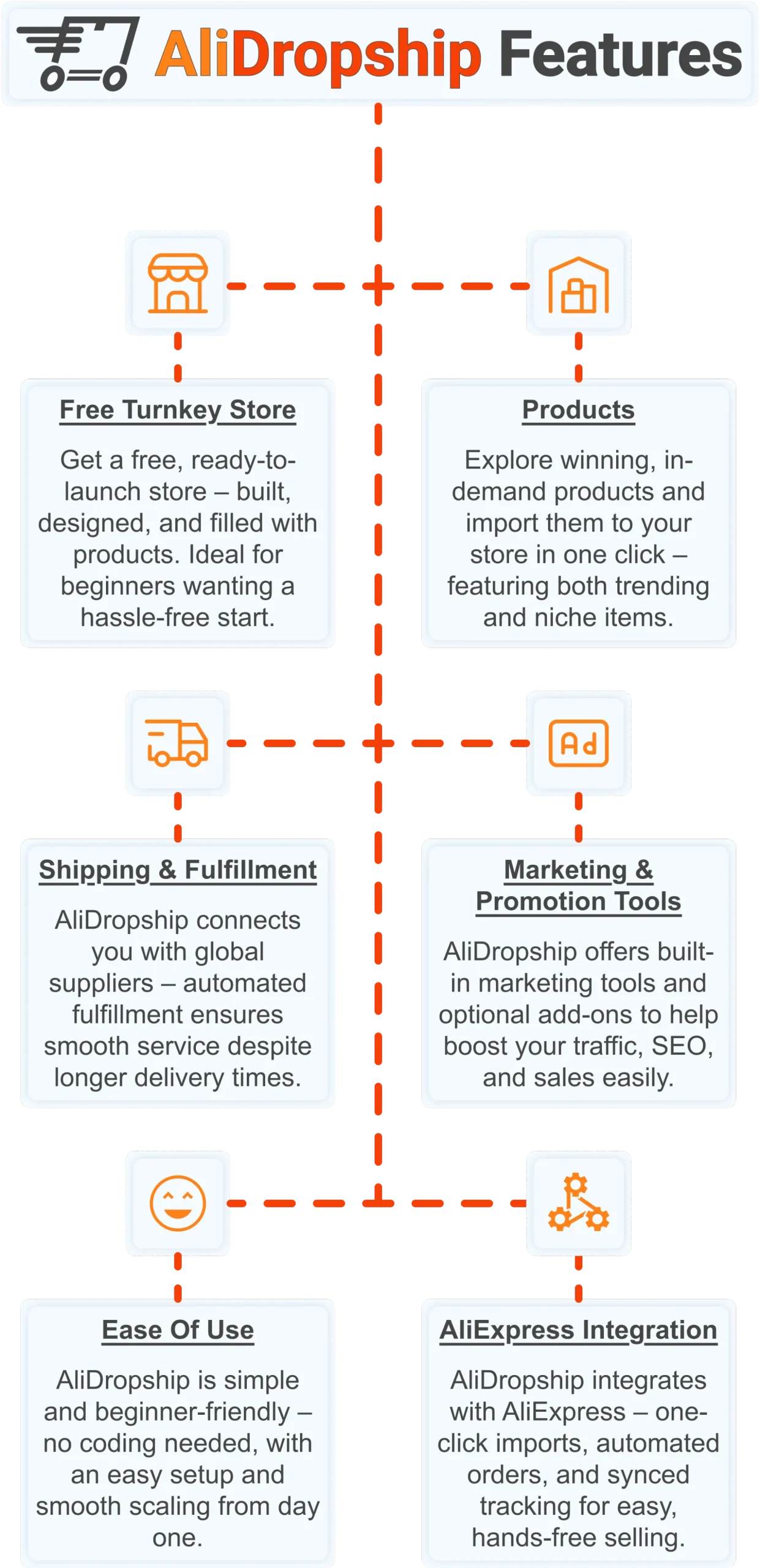
If you want the simplest possible way to start dropshipping – especially if you are brand new – AliDropship remains one of the most beginner-friendly tools available in 2026. It brings together store creation, product imports, automation, and marketing into a single streamlined system designed to help you launch quickly and grow confidently.
Free turnkey store ️
Get a free turnkey store – built, designed, and filled with products. Ideal for beginners wanting a hassle-free start, the store comes fully optimized to attract customers right away, saving you time on setup. Plus, it includes professional design elements to give your business a polished, trustworthy look from day one. This ready-made foundation makes it easy to move seamlessly into product selection.
Products
Once your store is set up, you can explore winning, in-demand products and import them in one click – featuring both trending and niche items. This wide selection lets you cater to diverse customer interests and test what works best. Regular updates ensure you always have fresh products, keeping your store competitive and relevant. With great products in place, smooth shipping becomes the next essential step.
Shipping & fulfillment
AliDropship connects you with global suppliers, and automated fulfillment ensures seamless order processing despite international delivery times. Customers receive real-time tracking updates, which builds confidence and trust in your store. Once shipping is handled reliably, you can focus on promoting your store and attracting traffic.
Marketing & promotion tools
To maximize sales, AliDropship offers built-in marketing tools and optional add-ons that help boost traffic, SEO, and conversions. From email campaigns and discounts to social media integration, these tools empower you to reach and retain customers without needing prior marketing experience. With promotion strategies in place, managing your business becomes simpler and more efficient.
Ease of use
AliDropship is beginner-friendly – no coding needed, with an intuitive dashboard that guides you through every step. Easy setup and smooth scaling let you expand your store without stress. As your business grows, adding new features, products, and marketing campaigns remains hassle-free, giving you more time to focus on sales.
AliExpress integration
Finally, AliDropship integrates seamlessly with AliExpress, enabling one-click imports, automated orders, and synced tracking. Your inventory stays up-to-date with the latest products and prices, while automated order processing frees you from manual tasks. Combined with the turnkey setup, reliable shipping, and built-in marketing tools, this integration ensures your dropshipping business is fully equipped for growth and success.
Frequently Asked Questions
How much do TikTok ads cost per day for ecommerce sellers?
Standard In-Feed Ads, Spark Ads, and Collection Ads all require a minimum of 20 per day at both the campaign and ad group level. Testing two ad groups simultaneously requires a minimum of 40 per day. For most beginners, 20 to 50 per ad group per day is a practical starting point that generates enough data within 7 to 10 days. Expect to spend 200 to 300 total before drawing reliable conclusions from any new campaign.
How long does the TikTok ads learning phase take?
The learning phase typically takes 7 to 14 days and requires at least 50 conversion events per ad group before the algorithm can optimize reliably. During this window, changing budgets by more than 20 percent or swapping creatives resets the learning phase entirely. Complete beginners should expect to invest 150 to 300 in this phase before any meaningful optimization is possible. Smart Performance Campaign mode typically activates only after 30 to 45 days of consistent spending.
What is the difference between In-Feed Ads and TopView Ads on TikTok?
In-Feed Ads are the standard format, starting at 20 per day, and appear natively between organic posts in the For You feed. They support video lengths of 9 to 60 seconds and integrate directly with the TikTok Pixel for conversion tracking. TopView Ads appear as the first thing a user sees when opening the app, with self serve auction costs starting around 50 per day and managed placements running 1000 or more per day. TopView is not a realistic starting format for most independent dropshipping sellers.
How many video creatives should a TikTok ads campaign test at launch?
Standard practice is to launch 3 to 5 different video variations per ad group at the start of every new campaign. TikTok needs 5 to 7 days to identify the strongest performer before underperformers should be paused. The first 1 to 3 seconds of each video are critical, since the hook must stop the scroll immediately. Optimized In-Feed campaigns typically deliver CPMs of 2 to 10 dollars, with conversion rates of 1 to 3 percent.
What mistakes cause TikTok ad accounts to get suspended or underperform?
Making unverifiable performance claims, such as promising a specific dollar amount earned per day, causes ads to be rejected under TikTok policy. Using copyrighted music in paid ads instead of TikToks Commercial Music Library can trigger repeated violations and account suspension. Faking engagement signals by purchasing followers or views can lead to permanent account termination. Making major changes during the 7 to 14 day learning phase is one of the most common and costly mistakes beginners make.
TikTok ads can fill your store with buyers – but only if the store is built to convert from day one. Get your free AliDropship store today and have everything ready before your first campaign launches.
 Previous post
