 ‧ Agnes Kazaryan ‧
March 13, 2026
‧ Agnes Kazaryan ‧
March 13, 2026  876 ‧
876 ‧
 0
0
Two platforms dominate every “how to start an online store” conversation in 2026 – WordPress and Shopify. Both are powerful, both are widely recommended, and both have genuine strengths. But the question most people actually want answered isn’t which one is more popular. It’s which one is right for them.
Quick answer: Shopify is the faster, more beginner-friendly route to launching an ecommerce store. You can be live within a day with minimal technical setup. WordPress paired with WooCommerce gives you more control, lower long-term costs, and deeper customization – but it takes more time and technical confidence to configure. For most beginners starting a dropshipping business in 2026, Shopify wins on speed; WordPress wins on flexibility.
Neither platform is objectively better in every situation. The right choice depends on your goals, your budget, and how much time you’re willing to invest before your first sale. This guide breaks down exactly what each platform offers – from cost and ease of use to dropshipping compatibility – so you can make a clear, informed decision without second-guessing yourself.
Before getting into the detail, it’s worth understanding why the WordPress vs Shopify debate gets searched millions of times every year. Most people asking the question are weighing a very specific tradeoff: complete control vs. managed simplicity. The answer is rarely black and white, but it’s almost always clear once you know what type of builder you are.
What is the WordPress vs Shopify debate really about?
At their core, WordPress and Shopify are two fundamentally different kinds of tools that happen to overlap in one area: selling products online. WordPress is an open-source content management system (CMS) that powers roughly 43% of all websites on the internet.
It was originally built for blogging and content publishing, with ecommerce added later through plugins – most notably WooCommerce. Shopify, by contrast, was built from the ground up as a dedicated ecommerce website builder. Every feature on the platform exists to help you sell.
That architectural difference explains almost everything you’ll notice when comparing the two. WordPress is a blank canvas with essentially unlimited possibilities. Shopify is a purpose-built selling machine with guardrails that make the early stages much simpler. Neither approach is wrong – they’re designed for different kinds of people building different kinds of stores.
When people search WordPress vs Shopify, they’re usually trying to answer one question: which platform gets me selling faster with the least amount of friction? The honest answer is that it depends on whether you want complete ownership and customization, or a clean, functional store up and running in the shortest possible time. Both platforms can absolutely get you there – they just take different roads to the same destination.
How much can you realistically earn with an online store?
This is the question that actually matters. Platform choice influences your setup experience, but the bigger driver of your earnings is always your niche, your products, and how consistently you market your store. Here is a realistic breakdown of what ecommerce store owners typically earn depending on their approach and effort level.
These figures reflect realistic ranges across both platforms. A well-configured Shopify or WooCommerce store targeting a specific niche can realistically reach the intermediate tier within three to six months of consistent effort. Results depend heavily on product selection, traffic strategy, and how often you optimize your listings.
One note on the higher figures: The $500+/day range reflects stores with paid advertising budgets, a team to manage operations, and often multiple product lines. For a solo beginner, aim for $30–$80/day as a realistic first milestone within 60–90 days of launch – that’s a more honest target than the headline numbers you’ll see in YouTube thumbnails. Both WordPress and Shopify can support stores at every tier of this table. The platform you choose affects your setup time and flexibility, not your earning ceiling.
WordPress for ecommerce – what you actually get
WordPress ecommerce is powered almost entirely by WooCommerce, a free plugin that transforms any WordPress site into a fully functional online store. With over 3.9 million active stores worldwide as of 2024, it’s the most widely used ecommerce solution on the planet by sheer install count.
The WooCommerce vs Shopify question is essentially a sub-question of the broader WordPress vs Shopify one – and it deserves attention because the plugin is genuinely impressive in what it can do when set up properly.
Getting started with WordPress and WooCommerce
Unlike Shopify, WordPress does not include hosting. You need to purchase a hosting plan separately – from providers like SiteGround, Bluehost, or Kinsta – and then install WordPress and WooCommerce yourself.
Managed WordPress hosts simplify this process considerably, but it’s still an extra step that Shopify doesn’t require. Expect to spend $10–$30/month on hosting for a new store, on top of any paid plugins or premium themes you add over time.
Where WordPress genuinely shines is its plugin ecosystem. There are over 59,000 plugins available, covering everything from SEO tools and email marketing to custom checkout flows and subscription billing. If you can imagine a feature, there’s almost certainly a plugin for it.
The trade-off is that managing multiple plugins adds complexity – and poorly maintained ones can create security vulnerabilities or slow your site down meaningfully.
For dropshipping specifically, WordPress users typically integrate tools like AliDropship or DSers to connect with AliExpress suppliers. These plugins handle product imports, automated ordering, and inventory sync – the same core functions that Shopify apps provide, but running on your own self-hosted infrastructure that you fully own and control.
On total cost: WordPress is technically “free,” but running a professional store adds up quickly. Between hosting ($15–$30/month), a premium theme ($50–$100 one-off), and essential plugins ($50–$200/year), a well-equipped WooCommerce store typically costs $200–$400/year in total.
There are no platform-level transaction fees on top of payment processor fees, which is a genuine long-term advantage over some Shopify plans.
Earning potential: A well-optimized WooCommerce dropshipping store can match Shopify in revenue – $30–$150/day is realistic within 3–6 months for a focused niche with consistent traffic. Platform cost doesn’t cap your ceiling, but it does affect your margin from day one.
Who WordPress ecommerce works best for
WordPress is the stronger choice if you already have a content-heavy website and want to add a store, if you need highly specific functionality not available in Shopify’s app ecosystem, or if you want full ownership and control over every aspect of your site’s code and data.
It rewards people with technical confidence and patience during setup. If that sounds like you, WooCommerce is worth every hour of the learning curve.
Shopify for ecommerce – what you actually get
Shopify is a fully hosted ecommerce website builder. You pay a monthly fee and get hosting, security, checkout, and a clean dashboard – all managed for you. There’s no server to configure, no plugins clashing with each other, and no hosting provider to troubleshoot.
For most beginners weighing WordPress vs Shopify, this simplicity is the single biggest selling point – and it’s hard to overstate how much time it saves in those critical first weeks when momentum matters most.
Getting started with Shopify
Shopify’s onboarding process is genuinely beginner-friendly. You can have a functional store with products, payment processing, and a custom domain live within a single day. The platform walks you through every step, and its theme editor is drag-and-drop with no code required.
There’s a 3-day free trial, and paid plans start at $39/month on the Basic tier – which covers hosting, SSL, and the full checkout system in one place.
For dropshipping, Shopify is a particularly strong combination in 2026. Apps like DSers, AutoDS, and Zendrop integrate directly with the platform to automate product sourcing, order fulfillment, and inventory management.
The Shopify App Store has over 8,000 apps – many free or low-cost – specifically designed for dropshipping workflows. The ecosystem is mature, well-documented, and actively maintained by a large developer community.
Why this works in 2026: Shopify has invested heavily in its one-page checkout experience, which is proven to reduce cart abandonment. For a dropshipping store where most buyers are first-time visitors, that checkout optimization translates directly into more completed orders per hundred visitors.
On cost: Shopify’s Basic plan is $39/month, and the Shopify plan recommended for growing stores runs $105/month.
One important detail – if you don’t use Shopify Payments as your payment gateway, Shopify charges an additional transaction fee of 0.5%–2% per sale depending on your plan tier. For high-volume stores, this adds up meaningfully. For beginners testing their first products, it’s rarely a deal-breaker in the early months.
Earning potential: Shopify dropshipping stores regularly hit $50–$150/day within 60–90 days of launch when paired with a solid niche and a basic traffic strategy. The platform’s checkout efficiency gives you a slight conversion edge over a self-hosted WooCommerce setup in the early stages.
Who Shopify works best for
Shopify is the better choice for most beginners who want to start an online store quickly, for people testing a dropshipping idea without a large upfront investment, and for sellers who prioritize a smooth customer checkout experience over deep technical customization.
The platform is purpose-built for selling, and it shows in almost every detail – from abandoned cart recovery to mobile checkout optimization.
WordPress vs Shopify: A direct side-by-side comparison
Here is a clear breakdown of both platforms across the criteria that matter most to anyone starting an online store or evaluating the best ecommerce platform in 2026. Use this as your decision reference.
The table makes one thing clear: Shopify wins on accessibility and launch speed, while WordPress wins on flexibility and long-term cost control.
For most beginners focused on dropshipping, the Shopify column looks more immediately appealing – but for anyone with existing technical skills or a content-driven strategy, WordPress with WooCommerce is a genuinely competitive alternative that grows with you.
How to get the most out of whichever platform you choose
The WordPress vs Shopify debate often distracts people from the more important work: building, optimizing, and marketing their store. Here are the strategies that move the needle regardless of which ecommerce platform you go with.
Pick a focused niche from day one
A general store that sells everything competes with Amazon and rarely wins. A niche store targeting a specific audience – ergonomic pet accessories, minimalist home office gear, outdoor fitness equipment – can rank on Google, build a loyal audience, and convert at a far higher rate.
Validate your niche before you build by checking Google Trends, Reddit communities, and AliExpress bestseller categories to confirm real demand before you invest time and money into setup.
Treat SEO as a long-term asset
Both WordPress and Shopify support solid on-page SEO. WordPress has a slight edge thanks to plugins like Rank Math and Yoast SEO, but Shopify’s built-in tools are more than adequate for most stores.
Focus your energy on product descriptions, category page copy, and a blog that answers questions your target customers are already searching for. Consistent SEO effort compounds over 6–12 months into meaningful, cost-free traffic that doesn’t disappear when you stop paying for ads.
Optimize product pages before you launch
Most new store owners launch with default product descriptions copied directly from their supplier. This is a major missed opportunity. Rewrite your product titles and descriptions in your own voice, emphasize benefits over features, and use high-quality images showing the product in context.
On Shopify or WooCommerce, this takes a few hours per product – and strong product pages are the single highest-leverage thing you can do before driving any traffic to your store.
Use email marketing from the start
Email is one of the most cost-effective channels in ecommerce, with industry benchmarks showing an average return of $36–$42 for every dollar spent. Both platforms integrate cleanly with tools like Klaviyo, Mailchimp, and Omnisend. Set up a welcome sequence and an abandoned cart flow from day one – these two automations alone can recover 10–15% of lost sales without any ongoing manual effort on your part.
Start with organic traffic, then layer in paid
Paid advertising on Meta or Google can scale a store quickly, but it requires a real budget and a tolerance for testing in the early stages. For most beginners, the safer path is to start with organic channels – SEO, Pinterest, TikTok – and use early results to validate which products actually convert. Once you know what works, paid traffic amplifies proven winners instead of funding expensive guesswork at the beginning.
Legal and ethical considerations when starting an online store
Whichever platform you choose, there are legal and ethical fundamentals every new store owner should address before accepting their first payment. Skipping these steps can lead to account suspensions, chargebacks, or regulatory disputes that are far more costly than the hour it takes to handle them upfront.
What to have in place before launch
Both Shopify and WordPress/WooCommerce require you to publish a privacy policy, refund policy, and terms of service before payment processors will approve your account. Both platforms provide templates, but customize them to reflect your actual policies rather than using generic boilerplate.
If you’re dropshipping, your refund policy must account for longer international fulfillment timelines – a standard 30-day return window is generally acceptable, but be specific about what happens during processing time.
Important: Most major payment processors including Stripe and PayPal review your policy pages during account setup. Missing or vague policies are a common reason for account holds in the first 30 days of trading – it’s one of the most avoidable problems new store owners face.
What to avoid
Fake reviews, misleading countdown timers, and artificially inflated “original prices” are among the most common grey-area tactics used by new store owners trying to lift conversions quickly. Beyond being unethical, these tactics are increasingly targeted by consumer protection regulators in the US, EU, and UK.
They also erode the trust that is ultimately your most valuable long-term asset. Sustainable ecommerce stores grow on authentic reviews, transparent pricing, and honest product descriptions – not manufactured urgency.
Key principle: Build a store you would genuinely feel comfortable buying from yourself – that single standard filters out most bad practices before they cause you problems.
Which platform is right for you? Recommendations by reader profile
The clearest way to resolve the WordPress vs Shopify comparison is to match each platform to the type of person asking the question. Here is a practical breakdown based on experience level and goal.
Complete beginner
If you’ve never run an online store and want to start selling as quickly as possible, Shopify is the more forgiving entry point. The guided setup, clean dashboard, and strong support documentation mean you spend less time troubleshooting and more time on the work that actually generates revenue.
The monthly fee is higher than WordPress hosting alone, but it buys you significant time savings and peace of mind during those critical first months when momentum matters most.
Intermediate seller with content experience
If you already have a WordPress blog or website and want to add ecommerce, WooCommerce is the logical extension. You already understand the dashboard, you likely have hosting in place, and the plugin integrates cleanly with your existing content setup.
The WooCommerce vs Shopify question tips firmly toward WooCommerce when you’re building on an existing WordPress foundation – the setup cost in time and money drops dramatically when the infrastructure is already there.
Dropshipping-focused seller
For pure dropshipping use cases, Shopify has a genuine edge in 2026 thanks to its polished app ecosystem, one-page checkout, and the volume of dropshipping-specific integrations available. That said, AliDropship on WordPress is a legitimate and well-supported alternative – particularly for sellers who want to avoid monthly platform fees and transaction charges over the long term.
Both are viable; Shopify gets you there faster, WordPress keeps more margin in your pocket over time.
Technical builder or agency developer
If you’re building stores for clients, managing multiple sites, or need granular control over your code, hosting environment, and database, WordPress is the natural choice. The open-source nature of the platform means you own everything – and for a developer working at scale, that ownership matters in ways that Shopify’s closed ecosystem simply can’t match, however polished its API has become.
Final thoughts – how to make the right call for your situation
There’s no universally correct answer in the WordPress vs Shopify debate – but there is almost always a right answer for you, once you’re honest about your starting point and your goals. Here’s how to think about it based on where you’re at right now.
If you’re a complete beginner who wants to start selling as fast as possible with the least technical friction, go with Shopify. The monthly cost is worth it for the time and headaches it saves you in the first 60–90 days. Getting your first sale matters more than optimizing your cost structure on day one.
If you’re an intermediate seller with some content or WordPress experience, WooCommerce is the stronger long-term play. Lower running costs, full ownership of your data, and a plugin ecosystem that can match almost any functionality you need as your store grows.
If you’re dropshipping-focused and want to move fast, Shopify’s native app integrations make the sourcing and fulfillment workflow seamless from day one. If you’re playing a longer game and want to maximize margin, AliDropship on WordPress gives you the same core capability without the monthly subscription eating into your profits.
Whichever platform you choose, the fundamentals stay the same: pick a focused niche, write honest product pages, build your email list early, and treat SEO as a long-term compounding asset. The platform is your foundation – everything you build on top of it determines whether the store actually succeeds.
AliDropship: Your complete all-in-one solution for starting dropshipping in 2026
If you want the simplest possible way to start dropshipping – especially if you’re brand new – AliDropship remains one of the most beginner-friendly tools available in 2026. It brings together store creation, product imports, automation, and marketing into a single streamlined system designed to help you launch quickly and grow confidently.
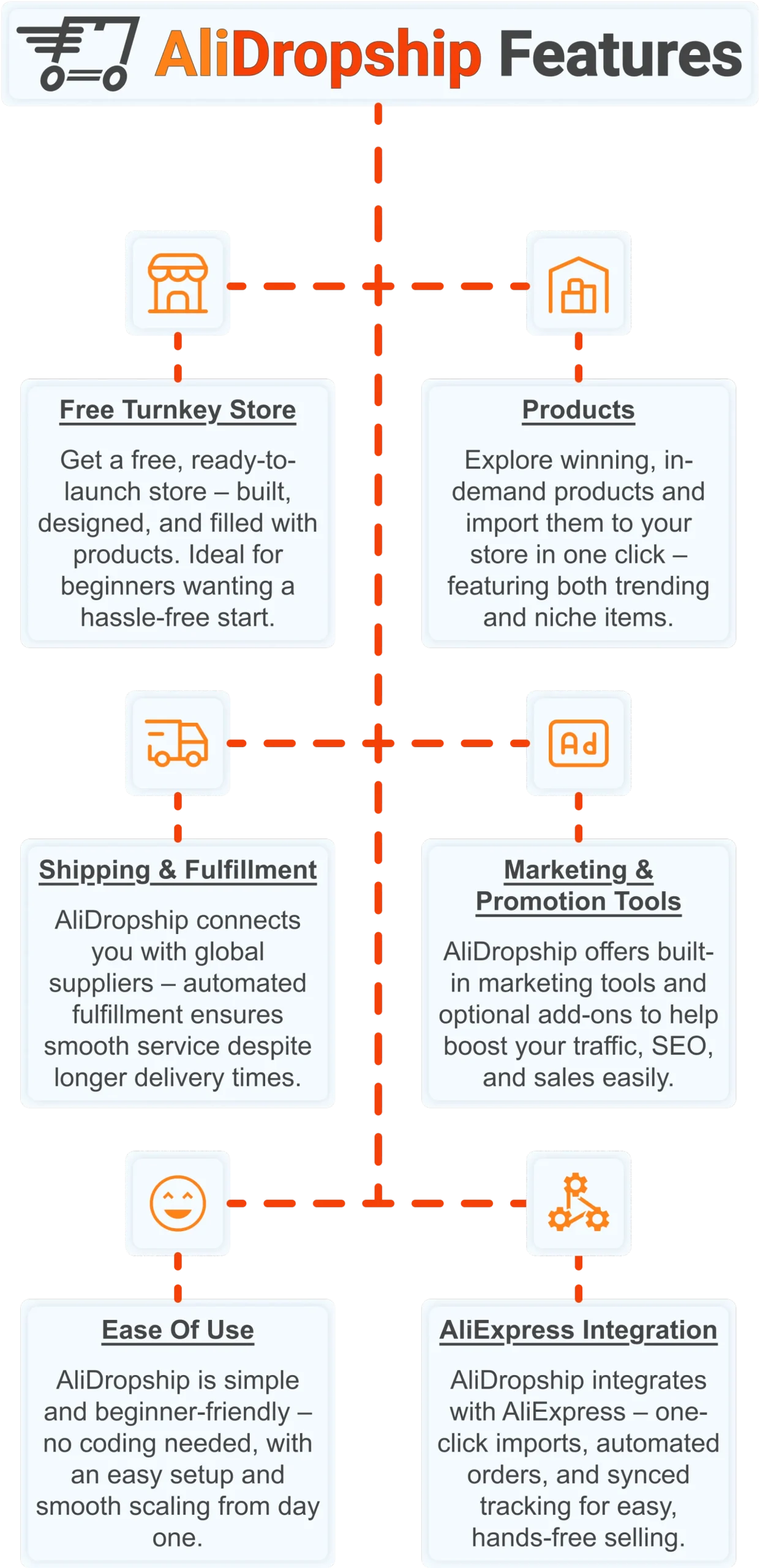
Free turnkey store ️
Get a free turnkey store – built, designed, and filled with products. Ideal for beginners wanting a hassle-free start, the store comes fully optimized to attract customers right away, saving you time on setup. Plus, it includes professional design elements to give your business a polished, trustworthy look from day one. This ready-made foundation makes it easy to move seamlessly into product selection.
Products
Once your store is set up, you can explore winning, in-demand products and import them in one click – featuring both trending and niche items. This wide selection lets you cater to diverse customer interests and test what works best. Regular updates ensure you always have fresh products, keeping your store competitive and relevant. With great products in place, smooth shipping becomes the next essential step.
Shipping & fulfillment
AliDropship connects you with global suppliers, and automated fulfillment ensures seamless order processing despite international delivery times. Customers receive real-time tracking updates, which builds confidence and trust in your store. Once shipping is handled reliably, you can focus on promoting your store and attracting traffic.
Marketing & promotion tools
To maximize sales, AliDropship offers built-in marketing tools and optional add-ons that help boost traffic, SEO, and conversions. From email campaigns and discounts to social media integration, these tools empower you to reach and retain customers without needing prior marketing experience. With promotion strategies in place, managing your business becomes simpler and more efficient.
Ease of use
AliDropship is beginner-friendly – no coding needed, with an intuitive dashboard that guides you through every step. Easy setup and smooth scaling let you expand your store without stress. As your business grows, adding new features, products, and marketing campaigns remains hassle-free, giving you more time to focus on sales.
AliExpress integration
Finally, AliDropship integrates seamlessly with AliExpress, enabling one-click imports, automated orders, and synced tracking. Your inventory stays up-to-date with the latest products and prices, while automated order processing frees you from manual tasks. Combined with the turnkey setup, reliable shipping, and built-in marketing tools, this integration ensures your dropshipping business is fully equipped for growth and success.
Here’s the FAQ section and JSON-LD schema for the WordPress vs Shopify article:
Frequently Asked Questions
How much does it cost to run a WooCommerce store compared to Shopify?
A well equipped WooCommerce store typically costs 200 to 400 per year in total, including hosting, a premium theme, and essential plugins. Shopify Basic plan costs 39 per month, while the Shopify plan recommended for growing stores runs 105 per month. WordPress hosting alone typically runs 10 to 30 per month on top of any paid plugins or premium themes. There are no platform level transaction fees on WooCommerce beyond payment processor fees, unlike some Shopify plans.
How long does it take to launch a store on Shopify compared to WordPress?
Shopify setup time typically runs 1 to 2 days, since the platform includes hosting, security, and checkout all managed in one place. WordPress and WooCommerce setup takes several days to weeks, since hosting must be purchased separately and configured manually. A functional Shopify store with products, payment processing, and a custom domain can go live within a single day. WordPress currently powers roughly 43 percent of all websites on the internet as of 2026.
Does Shopify or WordPress charge transaction fees on sales?
Shopify charges an additional transaction fee of 0.5 to 2 percent per sale if a store does not use Shopify Payments as its gateway. WordPress and WooCommerce charge no platform level transaction fees beyond standard payment processor fees. For high volume stores, the Shopify transaction fee adds up meaningfully over time. For beginners testing their first products, this fee is rarely a deal breaker in the early months.
Which platform is better for dropshipping, WordPress or Shopify?
Shopify has a genuine edge for dropshipping in 2026 thanks to its polished app ecosystem, one page checkout, and dropshipping specific integrations like DSers and AutoDS. The Shopify App Store has over 8000 apps, many free or low cost, designed specifically for dropshipping workflows. AliDropship on WordPress remains a legitimate alternative for sellers who want to avoid monthly platform fees and transaction charges long term. Shopify gets a store selling faster, while WordPress keeps more margin in the sellers pocket over time.
How much can a beginner realistically earn from a dropshipping store on either platform?
A basic dropshipping store at the beginner level typically earns 20 to 60 per day after 60 to 90 days on either platform. An optimized niche store at the intermediate level can reach 80 to 200 per day after 3 to 6 months of consistent effort. Shopify dropshipping stores regularly hit 50 to 150 per day within 60 to 90 days when paired with a solid niche and basic traffic strategy. A well optimized WooCommerce dropshipping store can match Shopify in revenue, with 30 to 150 per day realistic within 3 to 6 months.
Whether you land on WordPress or Shopify, AliDropship removes the hardest part of starting entirely – the store is already built, stocked, and ready to sell. Claim your free AliDropship turnkey store and start dropshipping today.
 Previous post
