 ‧ Agnes Kazaryan ‧
March 14, 2026
‧ Agnes Kazaryan ‧
March 14, 2026  690 ‧
690 ‧
 0
0
Selling digital products is one of the most accessible ways to build income online in 2026. No warehouse. No shipping label. No inventory headaches. You create something once – or skip creation entirely – and it can sell repeatedly to customers around the world.
But if you have never run an online business before, knowing where to start can feel overwhelming. What actually counts as a digital product? Where do you sell it? And how much can you realistically make?
Quick Answer: A digital product is any item delivered electronically – ebooks, templates, software, courses, and more. To sell digital products, you need a product (or a ready-made catalog), a storefront, and a way to collect payment. The fastest beginner path is a platform that bundles all three.
The appeal is real – but it is easy to get pulled into hype that glosses over the practical side. Before diving into the how, it pays to get clear on the what. The type of digital product you choose shapes everything else: your audience, your platform, your pricing, and your workload.
What is a digital product?
A digital product is any item that exists in digital format and is delivered to the buyer electronically. No physical manufacturing, no postage, no stock to manage. The buyer completes a purchase and receives a download link, access credentials, or a file directly. That is the entire fulfillment process.
Digital products cover an enormous range of categories – from a three-page PDF checklist priced at $5 to enterprise software licensed at thousands of dollars per year. What ties them together is the delivery method and the near-zero cost of reproduction. Once a product exists, selling another copy costs almost nothing.
This is why digital products appeal so strongly to beginners. There is no cost of goods per sale, no supplier relationship to manage, and no logistics chain to oversee. Your margin on each sale is close to the full sale price, minus platform fees.
Why this works in 2026: Global demand for downloadable content, online education, and software tools has grown consistently for over a decade. Buyers are comfortable purchasing digital goods, and the infrastructure to sell them – payment processors, file delivery systems, storefronts – has never been more accessible.
How much can you realistically earn selling digital products?
Before setting expectations, it is worth being direct: selling digital products is not a guaranteed income stream, and results vary significantly based on effort, niche, and how you drive traffic. That said, the earning ceiling is genuinely high compared to most other online income methods – because each sale carries almost no overhead.
Here is a realistic breakdown by approach:
Self-created products can earn more per unit, but they require significant upfront time and skill. A ready-made catalog store trades some per-unit margin for a dramatically lower barrier to entry – products are already there, and your job is to drive traffic and convert visitors.
One note on the ceiling figures: The upper ranges above reflect stores or creators operating at full-time effort with an established audience. Most beginners in their first 60–90 days will earn less while building traffic. Treat early sales as proof of concept, not a final income figure.
Digital product examples: What you can actually sell
One reason beginners stall is that “digital products” feels abstract. Breaking it into categories makes it far more concrete – and helps you spot where your own skills or interests might fit.
Information and educational products
This is the largest and most accessible category for beginners. If you know something useful – how to budget, how to cook a specific cuisine, how to pass a certification exam – you can package that knowledge and sell it.
Ebooks and PDF guides
Written guides on a focused topic are among the easiest digital products to create and sell. A well-structured 20–40 page PDF on a specific niche problem – meal planning for athletes, beginner investing explained, freelance contract templates – can sell consistently at $9–$29 a copy.
The key is specificity: broad topics have too much competition, while niche topics serve a motivated buyer who is already looking for exactly what you offer.
Earning potential: $100–$500/month with consistent traffic to a focused niche.
Online courses and video lessons
Courses carry a higher price point – typically $47–$297 or more – which means fewer sales are needed to generate meaningful income. The tradeoff is production effort: you need video content, a course structure, and usually a platform like Teachable or Gumroad to host it. For complete beginners, this is often a second-stage product after building an audience around a simpler product first.
Earning potential: $500–$3,000/month for an established course with active promotion.
How-to guides and resource bundles
Shorter than a full course but more structured than a basic ebook, how-to guides fill a useful middle ground. Think step-by-step tutorials, resource libraries, or reference documents that help someone accomplish a specific task faster. These work well as entry-level products priced at $5–$15 – a low commitment for the buyer, and a foot in the door for repeat purchases.
Templates, tools, and creative assets
Not every digital product is built around education. A large segment of the market wants done-for-you assets they can use directly – without learning a skill first.
Spreadsheet and document templates
Budget trackers, project planners, business proposal templates, social media content calendars – people pay real money for well-designed templates that save them time. Platforms like Etsy and Gumroad have proven markets for these. A single template can sell hundreds of times with zero additional work after the initial build.
Earning potential: $50–$400/month per template at consistent volume.
Design assets and graphics
Canva templates, logo kits, icon packs, social media graphics, and presentation themes all fall here. If you have design skills – or access to design tools – this is one of the most scalable digital product types. Buyers are typically businesses and creators who want professional-looking materials without hiring a designer.
Software, plugins, and digital tools
This is the highest-ceiling category – and the highest-skill category. Browser extensions, WordPress plugins, automation scripts, and SaaS tools can generate recurring subscription revenue. For complete beginners without coding experience, this is not a day-one option, but it is worth knowing as a long-term path.
Earning potential: $1,000–$10,000+/month for established software tools with a paying user base.
How to sell digital products: A step-by-step guide for beginners
Knowing what to sell is only half the picture. Here is how the actual process works – from choosing a product to making your first sale.
Step 1: Choose your product or catalog
If you have a skill or knowledge area, pick one specific problem to solve and build a focused product around it. If you do not have a product yet – or want to move faster – look for platforms that provide a ready-made catalog. The latter is the most practical option for complete beginners because it eliminates the creation bottleneck entirely.
Step 2: Pick a platform or build a storefront
You have two main routes: sell through a marketplace (Etsy, Gumroad, Creative Market) or build your own store. Marketplaces give you built-in traffic but take a percentage cut and limit your branding. Your own store gives you full control over customer relationships, pricing, and presentation – and generally produces better long-term margins.
Important note: Building your own store used to require technical knowledge. In 2026, platforms exist that set up a fully functional digital product store for you – storefront, product catalog, and payment processing – without any coding required.
Step 3: Set your pricing
Digital product pricing is more psychological than cost-based. A $7 ebook signals “quick read,” a $47 guide signals “serious resource,” and a $197 course signals “transformation.” Match your price to the perceived value and depth of the product. If you are using a ready-made catalog, your platform may already have pricing guidance built in.
Step 4: Drive traffic to your store
No store sells itself. The three most reliable beginner traffic channels are SEO content (blog posts and YouTube videos targeting questions your buyers are already searching), Pinterest (especially effective for visual products like templates), and social media (building an audience in the niche your products serve).
Paid ads are an option once you have validated that your store converts – but they are not a beginner starting point.
Step 5: Optimize and scale
Once you have your first sales, look at what is converting and do more of it. Add related products, improve your product descriptions, and test different price points. Digital product businesses compound well – each piece of content you publish can continue driving traffic and sales for months or years after you write it.
Legal and ethical considerations when selling digital products
Digital products have a reputation for grey areas online – particularly around content quality, licensing, and refund policies. Protecting your business and your buyers from day one is not just good ethics. It is also good strategy.
Key principle: Sell products that genuinely deliver on what you promise, and your refund rates, chargebacks, and customer service headaches will stay low.
What to avoid absolutely
Do not resell or repackage copyrighted content without a proper license. Do not use misleading income claims in your marketing – phrases like “make $500 a day guaranteed” attract the wrong buyers and invite chargebacks. Do not hide your refund policy or bury it in fine print. These practices damage trust, generate disputes with payment processors, and in some cases create legal liability.
What to do instead
Use products you have the rights to sell – either created by you or sourced through a platform that provides a commercial license. Be specific and honest in your product descriptions: what the buyer gets, what format it comes in, how they access it, and what they can do with it. State your refund policy clearly on the checkout page.
Important: If you are using a ready-made catalog from a platform, confirm that your license covers resale before listing. Reputable platforms provide explicit commercial resale rights with their product catalogs – if this is not stated clearly, ask before you list.
How to choose your approach based on where you are right now
There is no single best way to sell digital products – but there is a best way for where you are right now. Here is how to match your situation to a practical starting path.
Complete beginner with no product and no audience: Your fastest path is a ready-made catalog store. You skip the creation phase entirely, launch quickly, and put all your energy into traffic and conversion. This gives you real-world experience – pricing, customer questions, what converts – without needing to build anything from scratch first.
Intermediate seller with a specific skill or knowledge area: Start with one focused product – an ebook, a template pack, or a short guide – priced at $9–$29. Validate that people will pay for it before investing time in something larger. Use a simple platform like Gumroad or your own store, and build your audience around the topic over time.
Advanced seller with ecommerce or retail experience: Adding digital products is one of the cleanest ways to expand revenue without adding inventory. A digital product catalog can serve as an upsell, a standalone channel, or a way to test new markets with no upfront cost. Retail digital transformation does not mean abandoning what works – it means layering in zero-inventory products alongside your existing offer.
Final thoughts: Picking the right path for your goals
Knowing how to sell digital products is useful. But choosing the right entry point for your specific situation is what actually gets you moving.
If you are a complete beginner with no product and no audience, the fastest path is a ready-made catalog store. Focus on traffic and conversion – not creation. If you have a specific skill or knowledge area, start with one focused product priced at $9–$29 and validate demand before building anything larger.
If you have time but a limited budget, organic traffic channels like SEO content and Pinterest cost almost nothing and compound over time.
The common thread across all three paths: start small, stay honest about what your product delivers, and treat your first 60–90 days as a learning phase. Digital product income becomes more passive as your traffic grows – but it is never passive from day one.
AliDropship: Your complete all-in-one solution for starting dropshipping in 2026
If you want the simplest possible way to start dropshipping – especially if you are brand new – AliDropship remains one of the most beginner-friendly tools available in 2026. It brings together store creation, product imports, automation, and marketing into a single streamlined system designed to help you launch quickly and grow confidently.
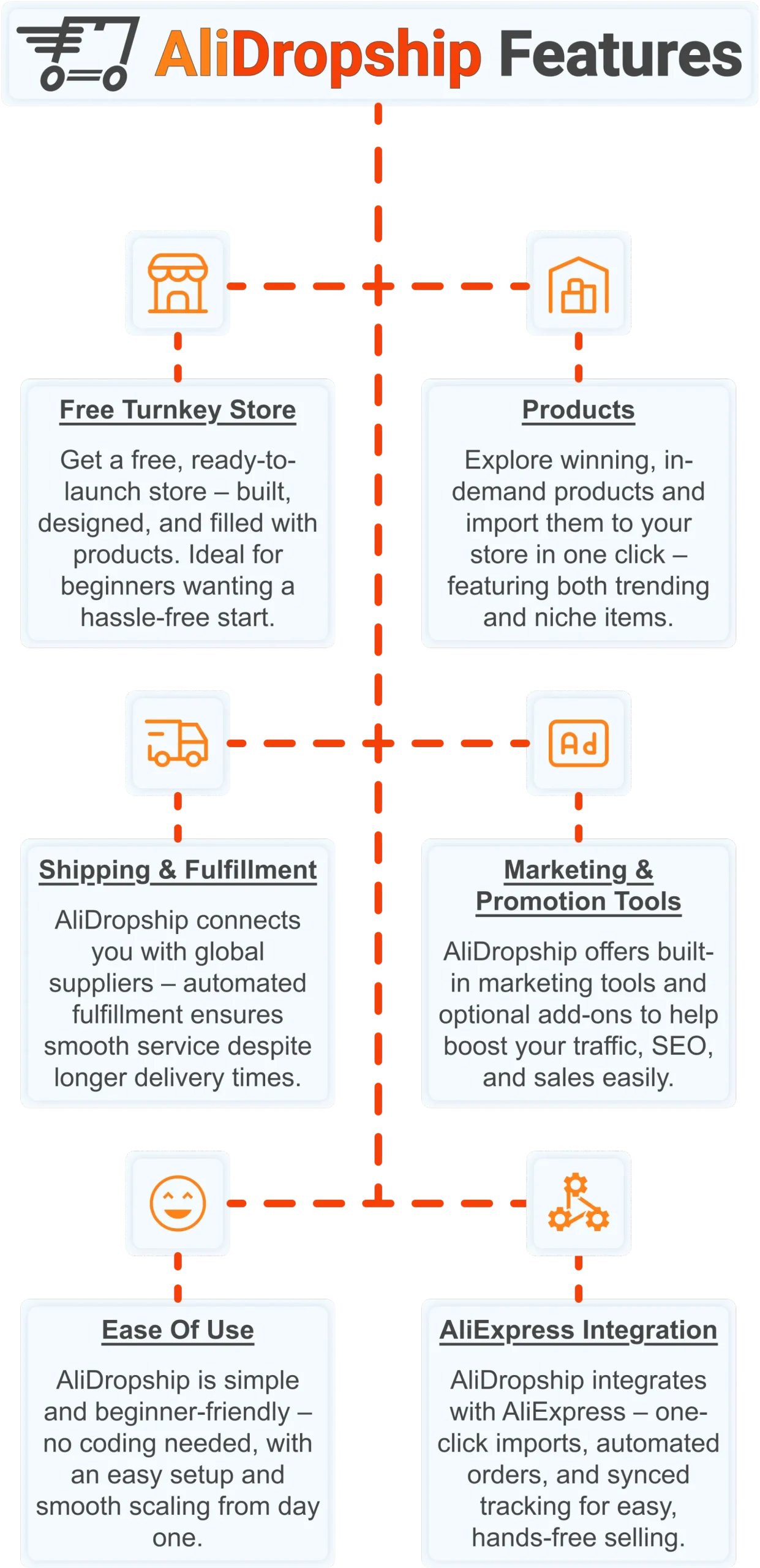
Free turnkey store ️
Get a free turnkey store – built, designed, and filled with products. Ideal for beginners wanting a hassle-free start, the store comes fully optimized to attract customers right away, saving you time on setup. Plus, it includes professional design elements to give your business a polished, trustworthy look from day one. This ready-made foundation makes it easy to move seamlessly into product selection.
Products
Once your store is set up, you can explore winning, in-demand products and import them in one click – featuring both trending and niche items. This wide selection lets you cater to diverse customer interests and test what works best. Regular updates ensure you always have fresh products, keeping your store competitive and relevant. With great products in place, smooth shipping becomes the next essential step.
Shipping & fulfillment
AliDropship connects you with global suppliers, and automated fulfillment ensures seamless order processing despite international delivery times. Customers receive real-time tracking updates, which builds confidence and trust in your store. Once shipping is handled reliably, you can focus on promoting your store and attracting traffic.
Marketing & promotion tools
To maximize sales, AliDropship offers built-in marketing tools and optional add-ons that help boost traffic, SEO, and conversions. From email campaigns and discounts to social media integration, these tools empower you to reach and retain customers without needing prior marketing experience. With promotion strategies in place, managing your business becomes simpler and more efficient.
Ease of use
AliDropship is beginner-friendly – no coding needed, with an intuitive dashboard that guides you through every step. Easy setup and smooth scaling let you expand your store without stress. As your business grows, adding new features, products, and marketing campaigns remains hassle-free, giving you more time to focus on sales.
AliExpress integration
Finally, AliDropship integrates seamlessly with AliExpress, enabling one-click imports, automated orders, and synced tracking. Your inventory stays up-to-date with the latest products and prices, while automated order processing frees you from manual tasks. Combined with the turnkey setup, reliable shipping, and built-in marketing tools, this integration ensures your dropshipping business is fully equipped for growth and success.
Frequently asked questions
What is a digital product and why is it appealing to sell?
A digital product is any item that exists in digital format and is delivered to the buyer electronically, such as an ebook, template, course, or software tool. There is no cost of goods per sale, no supplier relationship to manage, and no logistics chain to oversee, so margin on each sale stays close to the full sale price minus platform fees. Digital products range enormously in price, from a three page PDF checklist priced at 5 dollars to enterprise software licensed at thousands of dollars per year. Once a product exists, selling another copy costs almost nothing, which is why this model appeals so strongly to beginners.
How much money can you realistically earn selling digital products?
Self created ebooks or guides typically earn 200 to 800 dollars per month with high effort spent on both creation and marketing. Online courses earn considerably more, ranging from 500 to 3000 dollars per month, though they require very high effort in production and sales funnel building. A ready made digital catalog store earns 30 to 120 dollars per day at scale with comparatively low effort, since products are already provided. Most beginners in their first 60 to 90 days will earn less while building traffic, so early sales should be treated as proof of concept rather than a final income figure.
What are the most popular types of digital products to sell?
Ebooks and PDF guides are among the easiest to create, with a well structured 20 to 40 page guide on a specific niche problem selling consistently at 9 to 29 dollars a copy. Online courses carry a higher price point, typically 47 to 297 dollars or more, meaning fewer sales are needed to generate meaningful income. Spreadsheet and document templates such as budget trackers or project planners can sell hundreds of times with zero additional work after the initial build, earning 50 to 400 dollars per month at consistent volume. Software, plugins, and digital tools represent the highest ceiling category, with established tools generating 1000 to 10000 dollars or more per month from a paying user base.
What are the basic steps to start selling digital products online?
Choose a specific problem to solve and build a focused product around it, or use a ready made catalog to skip the creation phase entirely. Pick a platform such as Etsy, Gumroad, or Creative Market for built in traffic, or build your own store for full control over customer relationships and better long term margins. Set pricing based on perceived value, since a 7 dollar ebook signals a quick read while a 197 dollar course signals a transformation. Drive traffic through SEO content, Pinterest, or social media, since paid ads are an option only once a store has already proven it converts.
What legal and ethical rules apply when selling digital products?
Reselling or repackaging copyrighted content without a proper license creates legal liability and should be avoided entirely. Using misleading income claims in marketing, such as promising 500 dollars a day guaranteed, attracts the wrong buyers and invites chargebacks from payment processors. Hiding a refund policy or burying it in fine print damages trust and generates disputes that can escalate into serious account problems. If using a ready made catalog from a platform, confirming that the license covers resale before listing anything is essential, since reputable platforms provide explicit commercial resale rights.
If you are ready to start selling digital products, having a fully built store with products already loaded removes the biggest beginner hurdle. Claim your free store and start selling digital products today.
 Previous post
