 ‧ Agnes Kazaryan ‧
March 15, 2026
‧ Agnes Kazaryan ‧
March 15, 2026  2905 ‧
 0
0
The global 3D printing market is on track to pass $44 billion in 2026 – and a growing share of that revenue is going to solo operators running home-based businesses with one or two desktop printers. If you already own a machine, or you are seriously considering getting one, you have more genuine income potential at your fingertips than most people realize. The real question is not whether 3D printing can make money. It is which model fits your time, your skills, and your specific income goal.
Quick answer: The most profitable 3D printing business ideas in 2026 include selling custom products on Etsy and Amazon, offering local print-on-demand services, producing niche replacement parts, and building a branded product store around a specific hobby community. Most solo operators earn $500–$3,000/month part-time. Full-time sellers with a focused niche push $5,000–$10,000/month or more after 12–18 months of consistent effort.
This guide covers the best 3D printing business ideas organized by model type – with honest earning ranges, effort levels, and a clear breakdown of what works for beginners versus advanced operators. Before diving in, it helps to understand why the timing is good right now. Material costs have dropped sharply over the past two years, desktop printers are more reliable than ever, and buyer demand for personalized, hard-to-find physical products keeps growing on every major marketplace.
What is a 3D printing business?
A 3D printing business uses additive manufacturing technology to produce physical items – either for direct sale, on demand for clients, or as part of a broader product or service offering. Unlike traditional manufacturing, you do not need a factory, a team, or significant upfront inventory. A single printer, a spool of filament, and a reliable design file are enough to produce sellable goods from a spare room.
In practice, a 3D printing business can take many shapes. You might sell finished products through an online store, offer custom printing as a service, license digital design files to other makers, or combine printing with dropshipping to build a hybrid income stream. The model you choose determines your working hours, your margins, and how fast you can scale.
What sets 3D printing apart from most other home businesses is the ability to serve hyper-specific niches. A customer looking for a custom miniature base for a tabletop game, a replacement bracket for a discontinued appliance, or a personalized desk organizer in a specific color is unlikely to find it at a big-box retailer. That gap is exactly where small 3D printing businesses win.
How much can you realistically earn from a 3D printing business?
Earnings vary significantly depending on what you sell, where you sell it, and how much time you put in. Here is an honest breakdown of the most common approaches:
The figures above reflect realistic ranges for solo operators within their first 12 months. Marketplace sellers on Etsy typically earn $300–$2,500/month once they have an established shop with reviews. Operators running their own niche store with consistent SEO and social traffic can push well past $5,000/month after 6–12 months of focused work.
One note on the higher figures: The $8,000–$10,000/month ceiling generally requires multiple printers running simultaneously, an established customer base, and a product line that has been tested and refined over time. These are achievable targets – but they are 12–24 month goals, not week-one outcomes.
Selling physical 3D printed products online
This is the most common entry point – and for good reason. You source or design STL files, print the items, and list them for sale on Etsy, Amazon Handmade, eBay, or your own store. Margins are typically strong because material costs are low and the perceived value of custom, handcrafted items is high.
Custom home décor and gifts
Personalized home décor is one of the top-selling categories for 3D printed products. Think custom nameplates, geometric wall art, planters, candle holders, and decorative storage boxes. Gift items – personalized keychains, wedding favors, baby shower tokens – sell especially well in the lead-up to holidays and events. The appeal is simple: buyers want something that looks custom-made without paying a premium price.
To compete effectively, focus on a specific aesthetic – minimalist, Scandinavian, cottagecore – rather than trying to appeal to everyone. A tightly themed shop converts better and builds repeat customers faster than a generic catch-all store.
Earning potential: $400–$2,000/month from a focused Etsy shop with 20–40 active listings and consistent five-star reviews.
Tabletop gaming miniatures and accessories
The tabletop gaming community – Dungeons and Dragons, Warhammer, and similar games – is one of the most loyal and high-spending buyer groups for 3D printed items. Custom miniatures, terrain pieces, dice towers, card holders, and storage solutions are in constant demand. Many players do not own a printer and are happy to pay $15–$60 for quality printed pieces.
The real advantage here is community-driven marketing. Post your work on Reddit (r/DnD, r/PrintedMinis), Discord servers, or Facebook groups and you will generate organic traffic with zero ad spend. Shops that build a genuine presence in these communities report steady repeat orders and strong word-of-mouth referrals from day one.
Earning potential: $600–$3,000/month for sellers who specialize in one game system and build a loyal community following.
Functional replacement parts and organizers
One of the most underrated 3D printing business ideas is solving real, practical problems. Replacement parts for discontinued appliances, custom brackets, cable management clips, drawer organizers, and tool holders are all high-intent purchases – buyers are actively searching for them and willing to pay a fair price to fix a specific problem.
This model works particularly well on eBay and Amazon, where buyers search by function rather than aesthetics. A well-listed replacement knob for a specific appliance model can generate consistent passive sales for months once listed, with minimal ongoing effort required.
Earning potential: $300–$1,500/month from a portfolio of 30–50 functional SKUs across one or two platforms.
Service-based 3D printing business ideas
If you would rather work with clients than manage product inventory, a service model gives you direct income without needing to maintain a full product catalog. Service-based models also tend to command higher per-order rates and build more durable client relationships over time.
Local print-on-demand service
Many small businesses, schools, architects, and product designers need one-off or small-batch prints but do not own a 3D printer. Offering a local print-on-demand service – where clients submit their own STL files and you handle the printing – is a low-friction way to generate steady income. Charge per gram of filament used plus a time or setup fee, and you can comfortably earn $30–$80 per job.
Market your service through local Facebook groups, community boards, and LinkedIn targeting local designers and startups. Platforms like Treatstock and 3DHubs also connect print service providers directly with buyers who are already looking. Local clients who are satisfied with your work tend to become repeat customers, particularly product designers and small manufacturers.
Earning potential: $500–$2,500/month depending on local demand and how many jobs you take on per week.
Prototyping and product development for small businesses
Startups, inventors, and small product companies regularly need physical prototypes before committing to expensive tooling or injection molding. A 3D printing business that positions itself as a rapid prototyping partner can charge $50–$300 per project depending on complexity, with retainer arrangements available for clients who iterate frequently.
This is the highest-earning service model in the space, but it also requires the most technical skill – both in operating higher-end printers and in communicating with clients about tolerances, materials, and design adjustments. If you have an engineering or industrial design background, this is a natural fit and a legitimate path to $10,000+/month.
Earning potential: $2,000–$10,000+/month for established operators with a B2B client base and a portfolio of completed projects.
Educational workshops and training
As schools, makerspaces, and community centers increasingly adopt 3D printing, demand is growing for people who can teach others how to use the technology. Running workshops – in person or via Zoom – on topics like getting started with FDM printing, designing for print with Tinkercad, or starting a 3D printing side hustle can generate $200–$800 per session.
Pair live workshops with a recorded course on Teachable or Gumroad for passive income on top of your live session fees. This model works especially well if you are already active on YouTube or social media, where tutorial content drives organic workshop enquiries and builds an audience you can sell to repeatedly.
Earning potential: $300–$2,000/month from a mix of live workshops and recorded course sales.
Digital and hybrid 3D printing business ideas
Not every 3D printing business requires you to print everything yourself. Digital and hybrid models let you earn from your designs and expertise without scaling your printer fleet one machine at a time – and they tend to have the best income-to-effort ratio once the initial work is done.
Selling STL design files
If you are skilled with CAD or design software like Fusion 360, Blender, or Tinkercad, selling digital STL files is one of the most scalable 3D printing business ideas available. Platforms like Cults3D, MyMiniFactory, Gumroad, and Etsy’s digital downloads section let you upload once and sell indefinitely. A popular file on Cults3D can generate $50–$500/month in passive income on its own – and a catalog of 50–100 quality files can build into a meaningful revenue stream without any additional labor.
The key to success in this space is niche specificity. Generic geometric shapes sell poorly. Files designed for a specific hobbyist community – cosplay prop makers, aquarium enthusiasts, RC car modders – command better prices and attract far more loyal buyers than generalist offerings.
Earning potential: $200–$2,000/month from a catalog of 30–80 niche-specific files with consistent new releases.
Dropshipping 3D printing supplies and accessories
You do not have to print anything to build a successful business around the 3D printing market. Dropshipping filament, resin, printer upgrades, build plates, and accessories to fellow makers is a genuine and growing opportunity. The 3D printing community actively buys consumables and upgrades, and many of these products are available from reliable global suppliers at margins that support a profitable store.
This model works best as a complement to a content or community strategy. A YouTube channel or blog about 3D printing that drives traffic to your own dropshipping store – stocked with the exact accessories your audience uses – creates a tight, high-converting funnel that earns while you sleep.
Earning potential: $500–$4,000/month from a focused accessories store with consistent traffic from SEO or social media content.
Branded niche product store
The most scalable of all 3D printing business ideas is building a branded store around a specific product category rather than a generic “3D printed stuff” shop. This means committing to a niche – pet accessories, cosplay props, gardening tools, desk setups – and developing a coherent product line with consistent branding, professional photography, and a clear value proposition.
Branded niche stores outperform general shops on every metric: conversion rate, repeat purchase rate, and average order value. Once you have validated a product line, you can expand by outsourcing printing to a print farm or transitioning proven SKUs to injection moulding for better margins at scale.
Earning potential: $1,500–$8,000/month for a focused niche store with 6–12 months of SEO and social traffic development behind it.
Legal and ethical considerations for a 3D printing business
3D printing opens up a lot of creative and commercial possibilities – but it comes with legal responsibilities every operator should understand before they start selling. Getting this right from the beginning protects you from costly mistakes down the line.
Intellectual property and design licenses
The biggest legal risk in the 3D printing business space is inadvertently selling items based on copyrighted or trademarked designs. Fan art of popular characters, replica props from films or games, and knockoffs of branded products are all legally problematic – regardless of how widely similar items appear on certain platforms.
Key principle: If a design is not yours, assume it is protected. Always verify the license of any STL file before printing and selling items based on it.
Stick to original designs, Creative Commons-licensed files with commercial permissions, or files where you have purchased a commercial license from the designer. Platforms like MyMiniFactory’s Tribes and Patreon offer commercial licensing options for popular designer catalogs. This is not an area to cut corners on.
Business registration and taxes
Once your 3D printing business generates consistent revenue, you will likely need to register it as a sole proprietorship or LLC depending on your country and state. In the US, the threshold for reporting self-employment income to the IRS is $400/year – well below what most active sellers earn. Keep records of material costs, printer depreciation, electricity, and platform fees, as these are all deductible business expenses.
Important: Marketplaces like Etsy issue a 1099-K once your annual sales exceed $600 in the US. Do not treat marketplace income as informal cash – report it properly from day one to avoid problems later.
How to choose the right 3D printing business model for you
Not every 3D printing business idea is the right fit for every person. Your starting point, available time, and income goal all determine which model makes the most sense. Here is a practical breakdown by experience level.
Complete beginner
Start with custom home décor or gift items on Etsy. The barrier to entry is low, the feedback loop is fast, and you will learn what sells – and what does not – within your first 30–60 days. Focus on 10–15 tightly themed listings rather than a broad catalog, and invest time in product photography and listing copy before worrying about paid ads. Your first goal is five reviews and your first repeat customer, not maximum revenue.
Intermediate / part-time operator
If you have been printing and selling for 3–6 months and have a working shop, consider adding STL file sales alongside your physical products. This creates a second revenue stream that earns while your printer is busy or offline. At the same time, start building a social media presence – Instagram, TikTok, or Pinterest – around your niche to reduce dependence on marketplace search traffic and its algorithm changes.
Advanced / full-time goal
Operators aiming for full-time income of $5,000–$10,000+/month should focus on one of two paths: building a branded niche product store with its own domain and SEO strategy, or developing a B2B prototyping service with a clear client acquisition system. Both require 12–18 months of consistent effort, but both are well-documented by operators who have achieved them. Communities like Reddit’s r/3Dprinting and r/Entrepreneur regularly feature detailed income reports from full-time makers who started exactly where you are now.
Why this works in 2026: Consumer demand for personalized and hard-to-find physical goods keeps growing, while printer hardware costs have dropped enough to make solo operation genuinely profitable at small scale – even with a single entry-level machine.
How to scale your 3D printing business beyond the printer
One of the most common growth ceilings for 3D printing businesses is physical capacity – you can only run so many printers in a spare room before logistics become unmanageable. Here is how experienced operators scale past that ceiling without losing their minds.
Outsource printing to a print farm
Print farms – large-scale printing operations that accept wholesale orders – let you scale volume without buying more equipment. Once your product designs are validated and your margins are clear, outsourcing production to a print farm frees you to focus on marketing, customer service, and product development instead of babysitting machines around the clock.
Add digital products alongside physical ones
Selling the STL files for your most popular physical products is a zero-marginal-cost upsell. Buyers who want to print the item themselves – or who are outside your shipping range – become customers through the digital file. This strategy works particularly well for tabletop gaming and cosplay product lines, where the community culture already values both physical prints and downloadable files.
Build content around your niche
A YouTube channel, blog, or TikTok account that documents your 3D printing process builds organic traffic, authority, and community simultaneously. Content creators in the maker space regularly monetize through affiliate links to printer hardware and filament, Patreon memberships, sponsored content from filament brands, and direct traffic to their own stores. Content is slow to build – but once it gains traction, it sends customers to your store at effectively zero cost per acquisition.
Transition top SKUs to other manufacturing methods
When a specific product consistently outsells everything else in your catalog, it may be worth exploring injection molding or cast resin manufacturing for that item. Per-unit cost drops significantly at volume, and your margins improve. This is a long-term play – typically relevant once a single SKU is selling 200+ units per month – but it is the path many successful 3D printing entrepreneurs take when moving from side hustle to full business.
Final thoughts: finding the 3D printing business idea that fits you
There is no single best 3D printing business idea – only the one that matches your skills, your available time, and the income goal you are working toward. Beginners do well starting with Etsy and a tightly focused product niche. Part-time operators build diversified income by layering digital file sales and social content on top of physical product sales. Full-time ambitions require either a branded niche store with a proper SEO strategy or a B2B service model with a clear client pipeline.
The good news is that the 3D printing space is still far from saturated. Most successful operators are not competing on price – they are competing on niche specificity, product quality, and community presence. Pick one model, commit to it for 60–90 days, and measure results before expanding. That focus is what separates the operators who build real income from those who stay stuck in the planning stage.
AliDropship: Your complete all-in-one solution for starting dropshipping in 2026
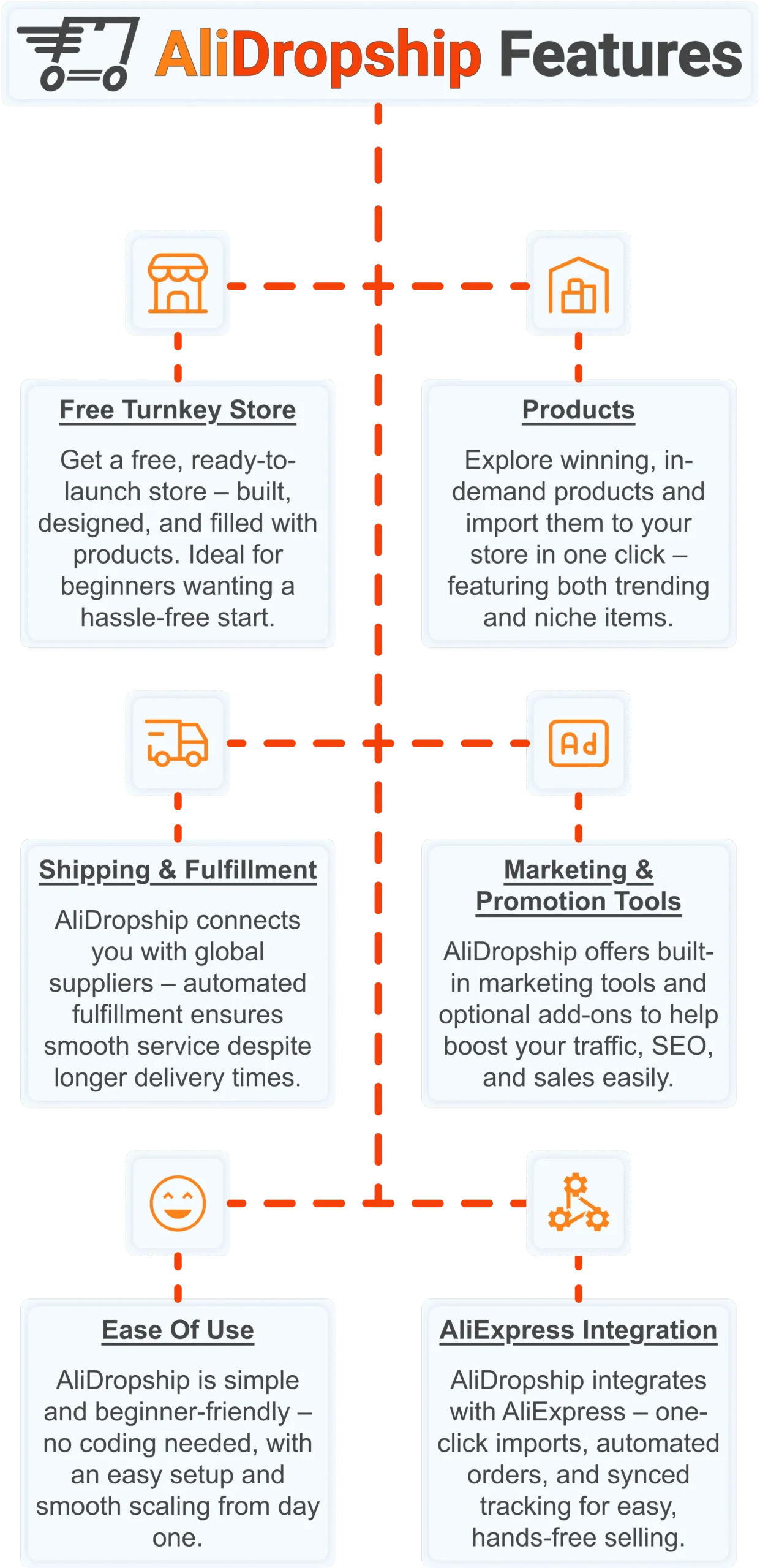
If you want the simplest possible way to start dropshipping – especially if you’re brand new – AliDropship remains one of the most beginner-friendly tools available in 2026. It brings together store creation, product imports, automation, and marketing into a single streamlined system designed to help you launch quickly and grow confidently.
Free turnkey store ️
Get a free turnkey store – built, designed, and filled with products. Ideal for beginners wanting a hassle-free start, the store comes fully optimized to attract customers right away, saving you time on setup. Plus, it includes professional design elements to give your business a polished, trustworthy look from day one. This ready-made foundation makes it easy to move seamlessly into product selection.
Products
Once your store is set up, you can explore winning, in-demand products and import them in one click – featuring both trending and niche items. This wide selection lets you cater to diverse customer interests and test what works best. Regular updates ensure you always have fresh products, keeping your store competitive and relevant. With great products in place, smooth shipping becomes the next essential step.
Shipping & fulfillment
AliDropship connects you with global suppliers, and automated fulfillment ensures seamless order processing despite international delivery times. Customers receive real-time tracking updates, which builds confidence and trust in your store. Once shipping is handled reliably, you can focus on promoting your store and attracting traffic.
Marketing & promotion tools
To maximize sales, AliDropship offers built-in marketing tools and optional add-ons that help boost traffic, SEO, and conversions. From email campaigns and discounts to social media integration, these tools empower you to reach and retain customers without needing prior marketing experience. With promotion strategies in place, managing your business becomes simpler and more efficient.
Ease of use
AliDropship is beginner-friendly – no coding needed, with an intuitive dashboard that guides you through every step. Easy setup and smooth scaling let you expand your store without stress. As your business grows, adding new features, products, and marketing campaigns remains hassle-free, giving you more time to focus on sales.
AliExpress integration
Finally, AliDropship integrates seamlessly with AliExpress, enabling one-click imports, automated orders, and synced tracking. Your inventory stays up-to-date with the latest products and prices, while automated order processing frees you from manual tasks. Combined with the turnkey setup, reliable shipping, and built-in marketing tools, this integration ensures your dropshipping business is fully equipped for growth and success.
If your 3D printing business ideas are pointing you toward physical products and niche markets, a dropshipping store is the natural next step – one that earns without tying you to a printer. Claim your free AliDropship store and $100 voucher to get started today.
Frequently asked questions
How much can a 3D printing business realistically earn?
Most solo operators earn 500 to 3000 dollars per month working part time, while full time sellers with a focused niche can reach 5000 to 10000 dollars per month or more. A B2B prototyping service has the highest ceiling, with established operators earning 2000 to 10000 dollars per month or higher. Etsy marketplace sellers typically bring in 300 to 2500 dollars per month once their shop is established with reviews. Reaching the top end of these ranges generally takes 12 to 24 months of consistent, focused effort.
What is the best 3D printing business idea for a complete beginner?
Custom home décor and gift items on Etsy are the easiest entry point because the barrier to entry is low and the feedback loop is fast. A focused Etsy shop with 20 to 40 active listings and consistent five star reviews can earn 400 to 2000 dollars per month. Beginners should aim for 10 to 15 tightly themed listings rather than a broad catalog during their first 30 to 60 days. The first real goal is five reviews and one repeat customer, not maximum revenue right away.
Can you make money selling 3D printed tabletop gaming miniatures?
Yes, tabletop gaming is one of the most loyal and high spending buyer groups for 3D printed products. Custom miniatures, terrain pieces, and dice towers are in constant demand, with buyers often paying 15 to 60 dollars for quality printed pieces. Sellers who specialize in one game system and build a loyal community following can earn 600 to 3000 dollars per month. Posting work in communities such as Reddit and Discord tends to generate organic traffic without any ad spend.
How much does a local 3D printing print on demand service earn?
A local print on demand service lets clients submit their own STL files while you handle printing, charging per gram of filament plus a setup fee. Operators can comfortably earn 30 to 80 dollars per job, with total monthly income ranging from 500 to 2500 dollars depending on local demand. Marketing through local Facebook groups and platforms such as Treatstock and 3DHubs helps connect providers directly with buyers. Satisfied local clients, especially product designers and small manufacturers, tend to become repeat customers.
What legal steps are required to run a 3D printing business?
Operators should verify the license of any STL file before printing and selling it, since fan art and replica props based on copyrighted designs are legally problematic. In the United States, the threshold for reporting self employment income to the IRS is 400 dollars per year. Marketplaces such as Etsy issue a 1099 K once annual sales exceed 600 dollars in the United States. Keeping records of material costs, printer depreciation, electricity, and platform fees is important since these expenses are deductible.
 Previous post
