 ‧ Agnes Kazaryan ‧
March 15, 2026
‧ Agnes Kazaryan ‧
March 15, 2026  755 ‧
755 ‧
 0
0
Shopify powers over 5 million online stores worldwide – and a good number of those owners are quietly earning $30–$80 a day from products they never touch. So the question is not whether you can make money on Shopify. The question is which method fits your budget, your schedule, and the time you can realistically put in.
Quick answer: You can make money on Shopify by dropshipping, selling physical or digital products, running a print-on-demand store, or offering Shopify-related services. Realistic earnings range from a few hundred dollars a month for beginners to several thousand for experienced sellers – but results depend heavily on your niche, traffic strategy, and how consistently you show up.
This guide covers how Shopify works, what it actually costs to get started, and which income methods are worth your time in 2026. Whether you are brand new or looking to scale, you will find an honest breakdown of what to expect.
What is Shopify and how does it work?
Shopify is a hosted ecommerce platform that lets you build and run an online store without writing a single line of code. You pick a theme, add your products, connect a payment processor, and you are ready to sell. The platform handles hosting, security, checkout, and order management in the background.
Understanding how Shopify works comes down to three moving parts: your storefront (what customers see), your back end (where you manage products, orders, and settings), and your traffic source (how people actually find you). Shopify handles the first two. The traffic side – SEO, paid ads, social media, or influencer marketing – is entirely on you, and it is usually where beginners either break through or stall out.
The platform connects with hundreds of apps covering everything from email marketing and upsell flows to dropshipping automation and loyalty programs. You do not need all of them on day one. Most successful store owners start lean, test their product-market fit, and add tools only once they can justify the cost.
How much can you realistically earn on Shopify?
Here is an honest side-by-side comparison of the main Shopify income methods in 2026.
The ceiling figures above reflect what is possible for sellers who treat their store like a real business – running tests, reinvesting profits into ads, and steadily improving conversion rates. Most beginners land in the $200–$800/month range during their first 3–6 months. Full-time income levels ($3,000–$5,000/month) typically take 12–18 months of consistent work to reach.
Important note: Any method that relies on paid ads requires a testing budget. Do not go into Shopify expecting to spend $39/month on a plan and immediately profit – the realistic starting investment including apps and ads is closer to $300–$500/month for the first 2–3 months.
How much does it cost to sell on Shopify?
One of the most common questions before committing to the platform is how much does it cost to sell on Shopify. The honest answer is more than most beginners expect once you factor in all the pieces.
Here is a realistic breakdown of what you are looking at in 2026:
Once you add a domain, a couple of apps, and even a modest ad budget, your real monthly outlay is closer to $150–$250. That is the realistic floor for a store you are actively trying to grow.
One note on Shopify website cost: The platform offers a discounted trial period for new accounts, giving you time to build and test your store before committing to full pricing. Use that window to validate your product idea before spending heavily on ads.
How to make money on Shopify: The main methods
There is no single path to earning on Shopify – and that flexibility is one of its biggest advantages. Below are the most proven income methods in 2026, with an honest look at what each requires to get started.
Dropshipping
Dropshipping is the most popular entry point for new Shopify sellers. You list products in your store, a customer places an order, and your supplier ships directly to them. You never hold inventory, pack boxes, or deal with logistics. Your margin is the difference between what the customer pays you and what you pay the supplier.
Getting started with dropshipping on Shopify
You need a Shopify store, a reliable supplier source (AliExpress is the most common for beginners), and a dropshipping app to automate order forwarding. The real work is finding a niche with enough demand but not too much competition, then building a store that converts visitors into buyers.
Winning niches in 2026 tend to be specific – think “posture correction for desk workers” rather than just “health products.” The narrower your focus, the easier it is to build targeted marketing and attract buyers who are already motivated to purchase.
The product testing phase
Most dropshippers go through a testing phase before finding a product that sticks. Expect to spend $5–$20 per day on Facebook or TikTok ads testing 3–5 products at a time. A product that gets consistent add-to-carts within the first $50–$100 of ad spend is worth scaling. One that does not is worth cutting and replacing – fast.
Why this works in 2026: TikTok’s organic reach still gives new stores a real shot at viral product exposure without a paid ads budget, making dropshipping accessible even for sellers starting with very little capital.
Earning potential: $30–$150/day once a winning product is found and ads are optimized – typically 60–90 days into consistent testing.
Print on demand
Print on demand (POD) works similarly to dropshipping – no inventory, no upfront product costs – but you are selling custom-designed items like t-shirts, mugs, phone cases, and wall art. A POD supplier like Printful or Printify handles production and shipping. Your job is to create compelling designs and build an audience that wants to wear or display them.
Getting started with print on demand
Connect a POD app to your Shopify store, upload your designs to product templates, set your prices, and publish. The margin on POD is thinner than dropshipping – typically $5–$15 per item – so volume and strong branding matter more here. Sellers who do well usually have a defined aesthetic or community angle (sports fans, niche hobbies, local pride) rather than generic designs.
Earning potential: $500–$2,000/month for sellers with a niche audience and consistent design output. Higher is possible with organic social traction.
Selling your own physical products
If you make something – candles, jewelry, skincare, woodwork, ceramics – Shopify is the most straightforward way to sell it online. You control the brand, the pricing, and the customer experience entirely. Margins are often the highest of any Shopify method, but so is the operational complexity: you are packing and shipping every order yourself, or paying someone to.
How to scale a handmade or private label business
Most successful product-based Shopify stores start with direct-to-consumer sales and then layer in wholesale or retail partnerships once volume justifies it. If you are making the product yourself, consider whether a private label route – manufacturing a product with a supplier and branding it yourself – might be a more scalable version of the same idea.
Earning potential: Highly variable – $1,000–$10,000/month is achievable for strong-brand physical product sellers, but margins and logistics complexity increase with volume.
Selling digital products
Digital products – ebooks, templates, presets, courses, printables – are some of the highest-margin items you can sell on Shopify. You create the product once and sell it unlimited times with zero fulfillment cost. Apps like Digital Downloads handle delivery automatically.
What digital products sell well on Shopify?
Products that solve a specific problem or save a specific type of time tend to convert best. Notion templates for project management, Lightroom presets for photographers, business plan templates for entrepreneurs, and budget spreadsheets for personal finance audiences are all consistent earners. The key is matching the product to an audience you can actually reach – through SEO, social media, or an email list.
Earning potential: $200–$3,000+/month depending on product quality, pricing, and traffic. Margins are near 100% once the product is created.
Affiliate marketing through your Shopify blog
Some Shopify store owners build a content-driven site – publishing SEO articles around a niche – and monetize through a mix of their own products and affiliate links. This is a slower build (expect 6–12 months before meaningful organic traffic) but creates compounding income that does not rely on paid ads.
Earning potential: $100–$1,500/month in affiliate revenue on top of product sales, once consistent SEO traffic is established.
Shopify services: building stores for others
If you learn how Shopify works well enough to build effective stores, you can sell that skill as a service. Store setup, theme customization, product page copywriting, and conversion rate optimization are all in demand on platforms like Upwork, Fiverr, and LinkedIn. This method requires no inventory, no ads, and no product – just demonstrated skills and a client pipeline.
Earning potential: $500–$3,000 per store build, depending on complexity and positioning. Retainer-based clients (ongoing maintenance, SEO, or ad management) can add $500–$1,500/month on top.
Tips for making more money on Shopify faster
Choose a niche before you choose a product
The biggest mistake new Shopify sellers make is picking a product first and trying to build an audience around it afterward. Flip the approach: identify a specific group of people with a specific recurring problem, then find or create a product that solves it. Your marketing, store design, and product descriptions all become sharper and more persuasive when they speak directly to one type of buyer.
Build for mobile from day one
Over 70% of Shopify store traffic comes from mobile devices. If your theme looks great on desktop but is clunky on a phone – slow to load, hard to navigate, checkout buttons buried – you are losing the majority of potential customers before they even see your products. Test every page on your phone before going live, and keep testing after every update.
Use email from your first sale
Email is the highest-returning marketing channel in ecommerce. Set up an abandoned cart sequence and a post-purchase follow-up before you launch. These two automations alone can recover 5–15% of abandoned carts and significantly increase repeat purchase rates – with no ongoing effort after the initial setup.
Do not scale ads before fixing your conversion rate
Sending more traffic to a store that is not converting is just spending more money on the same problem. Before increasing your ad budget, check your conversion rate (the industry average for Shopify stores is 1–3%). If you are below 1%, improve your product page – better photos, clearer copy, more social proof – before touching your ad spend. Doubling your conversion rate has the same effect as doubling your ad budget, at zero extra cost.
Reinvest early profits instead of cashing out
The stores that grow fastest in the first 12 months are the ones where the owner puts profit back into inventory, better ad creative, or a higher Shopify plan. Treating the first 6 months as a reinvestment phase rather than an income phase is the clearest differentiator between stores that plateau at $500/month and stores that break $5,000/month.
Legal and ethical considerations for Shopify sellers
Making money on Shopify means operating a real business – and that comes with real responsibilities. Most of the risks that trip up new sellers are avoidable with a little preparation upfront.
What to avoid absolutely
Do not sell counterfeit or replica goods. Shopify actively removes stores that sell knock-off branded products, and payment processors can freeze your account without warning. The short-term margin is not worth losing your store and your ability to process payments.
Do not use fake reviews or manufactured social proof. Beyond the ethical issues, platforms and regulators – including the FTC in the US – have become increasingly aggressive about fake testimonials. Build social proof the slow way: request reviews from real customers after purchase.
Key principle: Sustainable Shopify income is built on a real product people actually want – not on manipulated perception or grey-area tactics that collapse the moment a platform changes its policies.
What to do instead
Register your business properly – even as a sole proprietor – before your first sale. This protects you personally from liability, allows you to open a business bank account, and makes tax time significantly less stressful. Many countries allow you to register a simple business structure for under $100.
Use clear, honest product descriptions. Overselling a product’s capabilities leads to returns, disputes, and chargebacks – all of which hurt your payment processor standing and your bottom line. A product description that manages expectations accurately tends to produce happier customers and fewer refund requests.
Check local requirements for sales tax collection, particularly if you are selling to US customers across multiple states. Shopify has built-in tax tools that can help automate this once you know your obligations.
Which method is right for you?
Not every approach to making money on Shopify suits every type of person. Here is a quick breakdown based on where you are starting from.
Complete beginner
If you have never run an online store before, dropshipping or digital products are your lowest-friction entry points. You do not need inventory, upfront product costs are minimal, and the learning curve – while real – is manageable. Start with a tight niche, a clean store, and a small ad budget you can afford to lose while you learn. Give yourself 60–90 days before drawing any conclusions about whether a product or niche is working.
Intermediate / part-time seller
If you already have some ecommerce experience or a side business, print on demand or private label physical products can meaningfully increase your income per order. You understand the basics of traffic and conversion – the goal now is raising your average order value and building repeat purchase behavior through email and loyalty programs.
Advanced / full-time goal
If your goal is to replace a full-time income within 12–18 months, dropshipping with paid ads or a branded physical product store are the two most direct paths. Both require consistent reinvestment, willingness to test and cut products quickly, and a sharp focus on unit economics – knowing your cost per acquisition, average order value, and lifetime customer value at all times.
The sellers who reach $5,000–$10,000/month are not luckier than average – they track their numbers more closely and iterate faster than everyone else.
AliDropship: Your complete all-in-one solution for starting dropshipping in 2026
If you want the simplest possible way to start dropshipping – especially if you’re brand new – AliDropship remains one of the most beginner-friendly tools available in 2026. It brings together store creation, product imports, automation, and marketing into a single streamlined system designed to help you launch quickly and grow confidently.
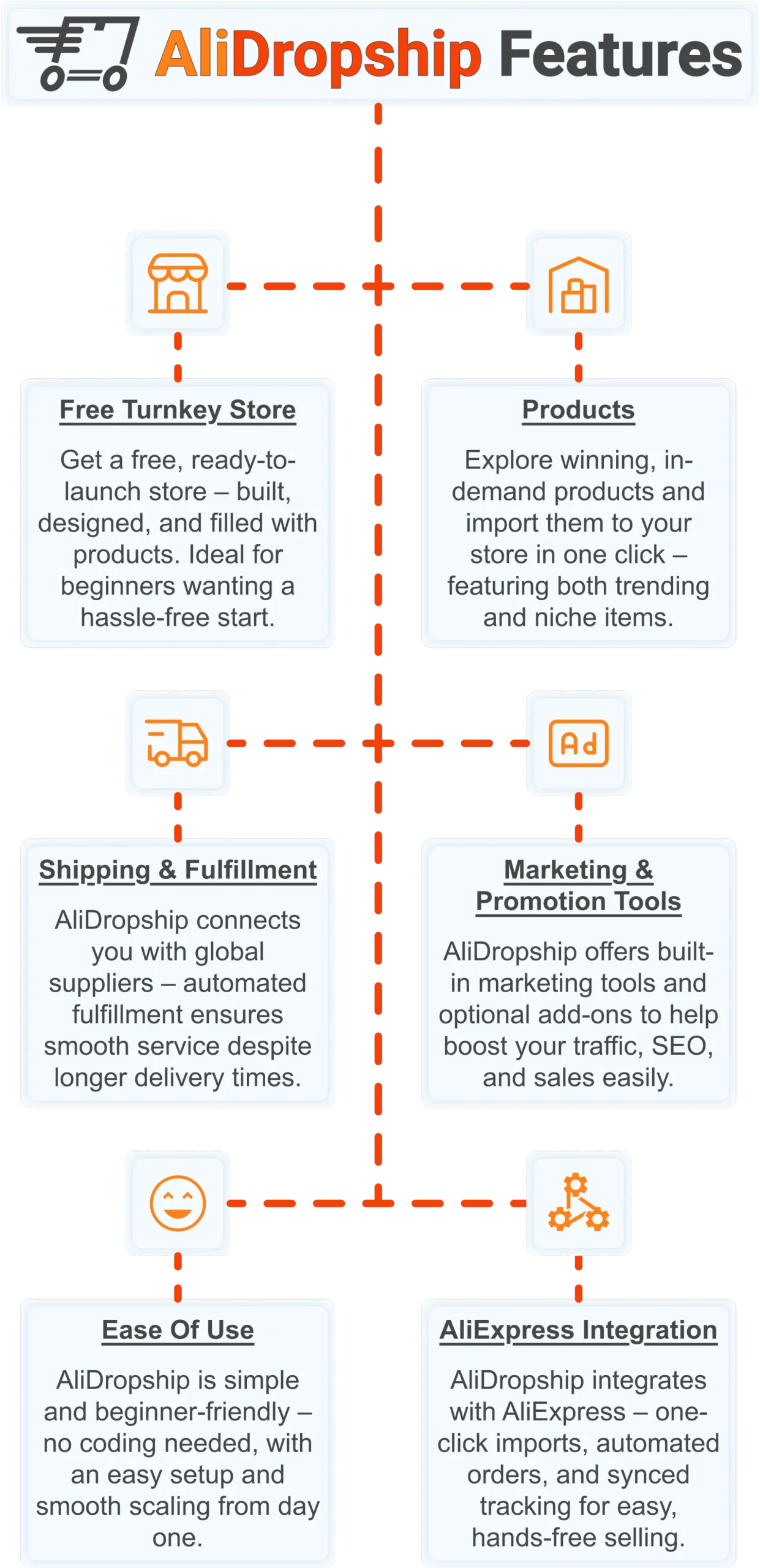
Free turnkey store ️
Get a free turnkey store – built, designed, and filled with products. Ideal for beginners wanting a hassle-free start, the store comes fully optimized to attract customers right away, saving you time on setup. Plus, it includes professional design elements to give your business a polished, trustworthy look from day one. This ready-made foundation makes it easy to move seamlessly into product selection.
Products
Once your store is set up, you can explore winning, in-demand products and import them in one click – featuring both trending and niche items. This wide selection lets you cater to diverse customer interests and test what works best. Regular updates ensure you always have fresh products, keeping your store competitive and relevant. With great products in place, smooth shipping becomes the next essential step.
Shipping & fulfillment
AliDropship connects you with global suppliers, and automated fulfillment ensures seamless order processing despite international delivery times. Customers receive real-time tracking updates, which builds confidence and trust in your store. Once shipping is handled reliably, you can focus on promoting your store and attracting traffic.
Marketing & promotion tools
To maximize sales, AliDropship offers built-in marketing tools and optional add-ons that help boost traffic, SEO, and conversions. From email campaigns and discounts to social media integration, these tools empower you to reach and retain customers without needing prior marketing experience. With promotion strategies in place, managing your business becomes simpler and more efficient.
Ease of use
AliDropship is beginner-friendly – no coding needed, with an intuitive dashboard that guides you through every step. Easy setup and smooth scaling let you expand your store without stress. As your business grows, adding new features, products, and marketing campaigns remains hassle-free, giving you more time to focus on sales.
AliExpress integration
Finally, AliDropship integrates seamlessly with AliExpress, enabling one-click imports, automated orders, and synced tracking. Your inventory stays up-to-date with the latest products and prices, while automated order processing frees you from manual tasks. Combined with the turnkey setup, reliable shipping, and built-in marketing tools, this integration ensures your dropshipping business is fully equipped for growth and success.
If you have been trying to figure out how to make money on Shopify, AliDropship gives you a faster, simpler path – with a free store already built and ready to sell. Claim your free turnkey store and $100 voucher and start your dropshipping business today.
Frequently asked questions
How can you make money on Shopify in 2026?
You can make money on Shopify by dropshipping, selling physical or digital products, running a print on demand store, or offering Shopify related services. Shopify powers over 5 million online stores worldwide, with some owners earning 30 to 80 dollars a day from products they never touch. Realistic earnings range from a few hundred dollars a month for beginners to several thousand for experienced sellers. Results depend heavily on niche selection, traffic strategy, and consistency.
How much can you realistically earn dropshipping on Shopify?
Dropshipping on Shopify has earning potential of 1000 to 10000 dollars or more per month for sellers who treat their store like a real business. Most beginners land in the 200 to 800 dollar per month range during their first 3 to 6 months. A product that gets consistent add to carts within the first 50 to 100 dollars of ad spend is generally worth scaling further. Full time income levels of 3000 to 5000 dollars per month typically take 12 to 18 months of consistent work to reach.
What does it really cost to start making money on Shopify?
The Shopify Basic plan costs 39 dollars per month, and a domain name adds roughly 1 to 2 dollars monthly when billed annually at 14 to 20 dollars per year. Apps for email marketing and upsells can range from 0 to 50 dollars or more per month, though many free tiers exist. Once a domain, a couple of apps, and even a modest ad budget are added, the real monthly outlay is closer to 150 to 250 dollars. Any method relying on paid ads requires a realistic starting investment closer to 300 to 500 dollars per month for the first 2 to 3 months.
What is the difference between dropshipping and print on demand on Shopify?
Dropshipping involves listing products in a store where a supplier ships directly to the customer after an order, with earning potential of 30 to 150 dollars per day once a winning product is found. Print on demand works similarly with no inventory, but focuses on custom designed items like t shirts and mugs, with earning potential of 500 to 2000 dollars per month. Print on demand margins are thinner than dropshipping, typically 5 to 15 dollars per item, so volume and strong branding matter more. Sellers who do well in print on demand usually have a defined aesthetic or community angle rather than generic designs.
How long does it take to reach consistent income on Shopify?
Most dropshippers go through a testing phase spending 5 to 20 dollars per day on ads while testing 3 to 5 products at a time before finding one that sticks. Full time income levels of 3000 to 5000 dollars per month typically take 12 to 18 months of consistent work to reach. Affiliate marketing through a Shopify blog is a slower build, requiring 6 to 12 months before meaningful organic traffic develops. Reinvesting profits during the first 6 months rather than treating it as an income phase is often the clearest differentiator between stores that plateau and those that scale.
 Previous post
