 ‧ Agnes Kazaryan ‧
March 15, 2026
‧ Agnes Kazaryan ‧
March 15, 2026  809 ‧
809 ‧
 0
0
Somewhere between 300 and 400 million people currently run some kind of online income stream – and that number keeps climbing. The question is no longer whether you can make money through websites to make money online. It’s which ones actually pay, how much you can realistically expect, and how long it takes to get there.
Quick answer: The best websites to make money in 2026 include freelance platforms like Upwork and Fiverr, content tools like YouTube and Substack, passive options like dropshipping and print-on-demand, and gig apps like TaskRabbit and Rover. Your best choice depends on the skills you have, the time you can commit, and whether you want active or passive income.
This guide breaks down the top platforms across every major category – with honest earning ranges, what it actually takes to get started, and a clear comparison to help you decide where to focus first.
What are websites to make money online?
Websites to make money online are platforms, marketplaces, or tools that let you generate income through the internet – by selling services, creating content, selling products, completing tasks, or building an audience you can monetize over time.
In 2026, these fall into a few broad categories: freelance marketplaces where you trade skills for pay, content platforms where you earn from views or subscriptions, ecommerce and dropshipping stores where you sell physical or digital products, and task-based apps where you earn by completing small jobs. Each model has its own earning ceiling, time investment, and learning curve.
The difference between someone who earns $200 a month and someone who earns $2,000 a month from the same type of platform is almost never luck – it’s consistency, positioning, and choosing the right model for their actual situation. That’s why the category you start with matters as much as the platform itself.
How much can you realistically earn?
This is the question most guides dodge with vague answers like “unlimited potential.” Here is a more honest breakdown based on what real users at each effort level actually report:
The ranges above are wide because results vary significantly based on skill level, niche, and time invested. Freelancers just starting out often earn $10–$25/hour before building a reputation. Dropshipping stores typically take 60–90 days to generate consistent revenue. Content creators rarely earn meaningful money before six months of consistent publishing.
One note on the ceiling figures: The upper-end numbers – $8,000 or $10,000 per month – represent full-time operators who have been at it for a year or more. Part-time effort produces part-time results. That’s not a reason not to start – it’s a reason to set accurate expectations and pick a model that fits your actual schedule.
Freelance marketplaces
Freelance platforms connect people who have skills with businesses and individuals who need work done. Writing, design, coding, video editing, virtual assistance, translation – if it can be done on a computer, there’s a marketplace for it.
Upwork
Upwork is the largest freelance marketplace in the world, with over 18 million registered freelancers and clients across more than 180 countries. It works on a proposal system – you browse open job posts and submit bids, or clients invite you directly once you have a strong profile.
The platform skews toward longer-term contracts and higher-budget projects. Beginners often struggle to land their first client due to competition, but once you have two or three positive reviews, the inbound work picks up significantly. Setting your rate too low at the start is a common mistake – it attracts low-quality clients and undervalues your profile.
Earning potential: $15–$150/hour depending on skill and track record, with top writers, developers, and consultants reaching $200–$300/hour.
Fiverr
Fiverr flips the model – instead of pitching for jobs, you create service listings called gigs and clients come to you. It suits people who can package their skills into repeatable deliverables: logo design, SEO audits, voiceovers, social media graphics, proofreading.
Getting traction on Fiverr takes patience. The algorithm favors listings with reviews, so your first 5–10 orders are the hardest to land. Many sellers use social media or their own network to drive initial traffic to their listing until the organic search kicks in.
Earning potential: $200–$2,500/month for part-time sellers, $3,000–$8,000/month for full-time top-rated sellers with multiple gig packages.
Toptal
Toptal is the premium tier of freelance platforms – it accepts only the top 3% of applicants after a multi-stage vetting process that includes skills tests, live problem-solving, and a trial engagement. If you pass, the clients are Fortune 500 companies and fast-growing startups paying premium rates.
This is not a starting point for most people, but it’s a clear ceiling to aim for. Developers, designers, and finance specialists with 3–5 years of experience who clear the screening regularly earn $80–$200/hour with minimal time spent finding clients.
Earning potential: $5,000–$15,000/month for full-time accepted freelancers, with senior engineers and architects earning beyond that.
E-commerce and dropshipping platforms
E-commerce has the highest income ceiling among websites to make money online – and dropshipping specifically removes the biggest barrier to entry, which is upfront inventory cost. You sell products, the supplier ships them directly to your customer, and you keep the margin.
Shopify
Shopify is the most widely used platform for building an independent online store. It handles payments, checkout, shipping integrations, and storefront design through a subscription model starting at $39/month. Most dropshippers connect to a supplier through apps like AliDropship or DSers.
The advantage of Shopify over marketplace selling is that you own the customer relationship and the brand. You are not competing on a shared search page with 50 other sellers. The trade-off is that you’re responsible for driving your own traffic – typically through paid ads, SEO, or social media.
Earning potential: $500–$3,000/month for part-time operators in their first year, $5,000–$20,000+/month for established stores with optimized ad spend and solid product selection.
Etsy
Etsy is the go-to marketplace for handmade goods, vintage items, digital downloads, and print-on-demand products. It has a built-in audience of over 90 million active buyers specifically looking for unique, non-mass-produced items – a significant advantage for new sellers who have no existing audience.
The most scalable approach on Etsy in 2026 is digital products: printable planners, wall art, templates, SVG files, and resume designs. These have zero fulfillment costs and can generate passive income once the listing is live and ranking. Print-on-demand integrations with Printful or Printify also work well here.
Earning potential: $100–$800/month for casual sellers with a small catalog, $2,000–$6,000/month for full-time sellers with 100+ listings and strong SEO.
Amazon FBA and Merch
Amazon’s reach is unmatched – over 300 million active customer accounts globally. Two models are relevant for people building online income without holding inventory. Fulfillment by Amazon (FBA) lets you source products and ship them to Amazon’s warehouses; Amazon handles storage, shipping, and returns. Merch by Amazon lets designers upload artwork that gets printed on t-shirts and other products with no upfront cost.
FBA requires capital to buy initial inventory and can get complex with Amazon’s fee structures. Merch is closer to passive income once designs are live, but competition has increased significantly and tier-based upload limits mean growth is slow at first.
Earning potential: FBA: $1,000–$8,000/month for experienced sellers with winning products. Merch: $50–$1,000/month for most designers, higher for those with breakout designs.
Content monetization platforms
Content platforms reward you for building an audience. The income is not immediate – it typically takes 6–18 months of consistent output before the numbers become meaningful – but once established, these income streams are among the most durable available.
YouTube
YouTube’s Partner Program allows monetization once a channel reaches 1,000 subscribers and 4,000 watch hours in the past 12 months. After that, you earn from ads, channel memberships, Super Chats, and merchandise shelves.
Ad revenue alone averages $1–$5 per 1,000 views depending on niche – finance and business channels earn significantly more than entertainment or vlogging channels. Most full-time YouTubers diversify beyond ads into sponsorships, affiliate links, and their own digital products.
Earning potential: $100–$500/month at 10,000 subscribers, $2,000–$10,000/month at 100,000 subscribers with sponsorships factored in.
Substack
Substack is a newsletter platform where writers charge monthly or annual subscriptions directly from their readers. It takes a 10% cut of subscription revenue, but the direct relationship with subscribers is a significant asset – your audience is yours, not the algorithm’s.
The model works best for writers who already have a following from another platform – X, LinkedIn, a blog – and want to monetize that audience with paid content. Starting from zero takes longer, but niche expertise in finance, tech, or politics tends to convert well.
Earning potential: $500–$2,000/month with 200–500 paid subscribers at $10/month, scaling significantly as the list grows.
Teachable and Udemy
Online course platforms let you package expertise into a sellable product. Teachable gives you full control of pricing and branding on your own storefront. Udemy gives you access to its 57+ million student marketplace but controls pricing and takes a larger revenue share.
The key insight is that a course is a one-time creation effort that earns repeatedly. A well-produced 3-hour course on a high-demand topic – productivity, Python, digital marketing, graphic design – can continue generating sales for years with minimal maintenance.
Earning potential: $200–$1,500/month on Udemy for mid-performing courses, $1,000–$10,000/month on Teachable for creators with an existing audience driving traffic.
Task-based and gig economy websites
These platforms pay you for completing discrete tasks – either in person or online. They are the fastest way to earn your first dollar online, but they have a hard ceiling because your income is directly tied to your time.
TaskRabbit
TaskRabbit connects people who need help with physical tasks – furniture assembly, moving, home repairs, cleaning – with locals who can do them. You set your own hourly rate and availability. The platform takes 15% of each job.
It’s genuinely useful as a bridge income while building a longer-term online income stream. Taskers in major metro areas can find steady work quickly, especially in furniture assembly – TaskRabbit’s IKEA partnership drives a lot of volume.
Earning potential: $20–$60/hour depending on task type and city, typically $800–$2,500/month for consistent part-time workers.
Rover
Rover is a marketplace for pet sitting, dog walking, and boarding. If you like animals and have availability during the day, it’s one of the lower-barrier ways to earn $15–$30 per walk or $40–$80 per overnight stay.
The limitation is obvious – it requires physical presence and is capped by hours in the day. But for people looking for supplemental income while building something else, it works reliably in suburban and urban areas.
Earning potential: $300–$1,200/month for consistent part-time walkers and sitters in mid-size cities.
Amazon Mechanical Turk and Prolific
These platforms pay for completing micro-tasks: data labeling, survey responses, image tagging, transcription, and research tasks. The pay is low – typically $6–$15 effective hourly rate – but the tasks are simple and require no prior skills.
Prolific, which focuses on academic research surveys, tends to pay better than MTurk and has a cleaner approval process. Neither platform is a serious income strategy, but they are legitimately useful for generating small amounts of cash with zero barrier to entry.
Earning potential: $50–$150/month for regular users, rarely more without significant hours invested.
Tutoring and knowledge-sharing platforms
If you have expertise in any subject – academic, professional, or even a hobby – there’s a platform connecting you with people willing to pay for your knowledge.
Preply and iTalki
Both platforms focus on language tutoring. Preply is broader and covers academic subjects too. iTalki specializes in language instruction and has a massive user base of language learners. You set your own rates, and the platforms take a percentage – typically 15–33% depending on the service tier.
Native English speakers teaching English as a second language are the most in-demand tutors on both platforms. Rates range from $10–$15/hour for community tutors just starting out to $40–$80/hour for professional tutors with certifications and strong reviews.
Earning potential: $400–$1,500/month for part-time tutors with consistent bookings, more for those who fill their calendar and raise rates over time.
Chegg tutors and Wyzant
These platforms connect academic tutors with students needing help in math, science, test prep, and other school subjects. Chegg operates more as a Q&A service where you answer questions for a set fee. Wyzant is closer to a traditional tutoring marketplace with hourly rates and session scheduling.
Both require subject expertise, but the earning rate is solid – especially for STEM subjects, which are in constant high demand during exam seasons.
Earning potential: $25–$80/hour depending on subject and experience, typically $500–$2,500/month for consistent tutors.
Legal and ethical considerations
Most of the platforms covered here are completely legitimate, but there are consistent areas where people run into problems – either because they cut corners or simply didn’t know the rules.
Key principle: Building online income through legitimate effort takes longer than shortcuts promise, but it also lasts. Shortcuts disappear the moment a platform updates its policies.
Tax obligations
Income earned through websites to make money online is taxable in most countries. Freelance income, Etsy sales, Shopify revenue, and YouTube ad payments all count. Keep records of what you earn, what you spend on your business, and which platforms you use. Many new earners are surprised at their first tax season – setting aside 20–30% of income from the start avoids an unpleasant surprise.
Platform terms of service
Every platform has rules around what you can sell, how you can market, and what counts as acceptable behavior. Fake reviews on Etsy or Amazon, artificially inflating your YouTube view count, or using bots on Fiverr to appear more active are all violations that lead to account suspension – sometimes permanent. The platforms invest heavily in detection, and accounts that get banned after months of building are a common story on Reddit and in seller forums.
Important: Never use a tactic on a monetization platform that you would not want the platform to know about. If it feels like bending the rules, it probably is.
Intellectual property
Print-on-demand sellers in particular need to be careful here. Using licensed characters, band logos, sports team insignia, or any copyrighted imagery – even altered versions – in designs uploaded to Merch by Amazon or Redbubble is a copyright violation that can result in immediate account termination and legal exposure. Use original designs or properly licensed elements only.
How to choose your path
Not everyone reading this is in the same situation. Here is a direct recommendation based on where you’re starting from.
Complete beginner: If you have no existing skills, no audience, and no capital, start with TaskRabbit or Rover for immediate cash while you learn. At the same time, open a Fiverr account and build a gig around something you can learn quickly – basic graphic design in Canva, data entry, or simple video editing. Use the first 30 days to generate income and learn the landscape before committing to a longer-term model.
Intermediate / part-time: If you have a marketable skill, prioritize Upwork or a direct client pipeline. If you have time but limited skills, start a dropshipping store with a done-for-you setup. The 60–90 day investment to get a store running and generating its first sales is far shorter than building a YouTube channel or a freelance reputation from scratch – and the earning ceiling is significantly higher.
Advanced / full-time goal: If your goal is replacing a full-time salary, the model that gets most people there is an owned e-commerce store or a content-driven brand with multiple monetization layers. Freelancing can replace a salary, but it requires constant client acquisition. A store or a content business scales without a 1:1 relationship between your hours and your income. Build one of these as your primary focus, then layer in freelance or tutoring income during the ramp-up period.
AliDropship: Your complete all-in-one solution for starting dropshipping in 2026
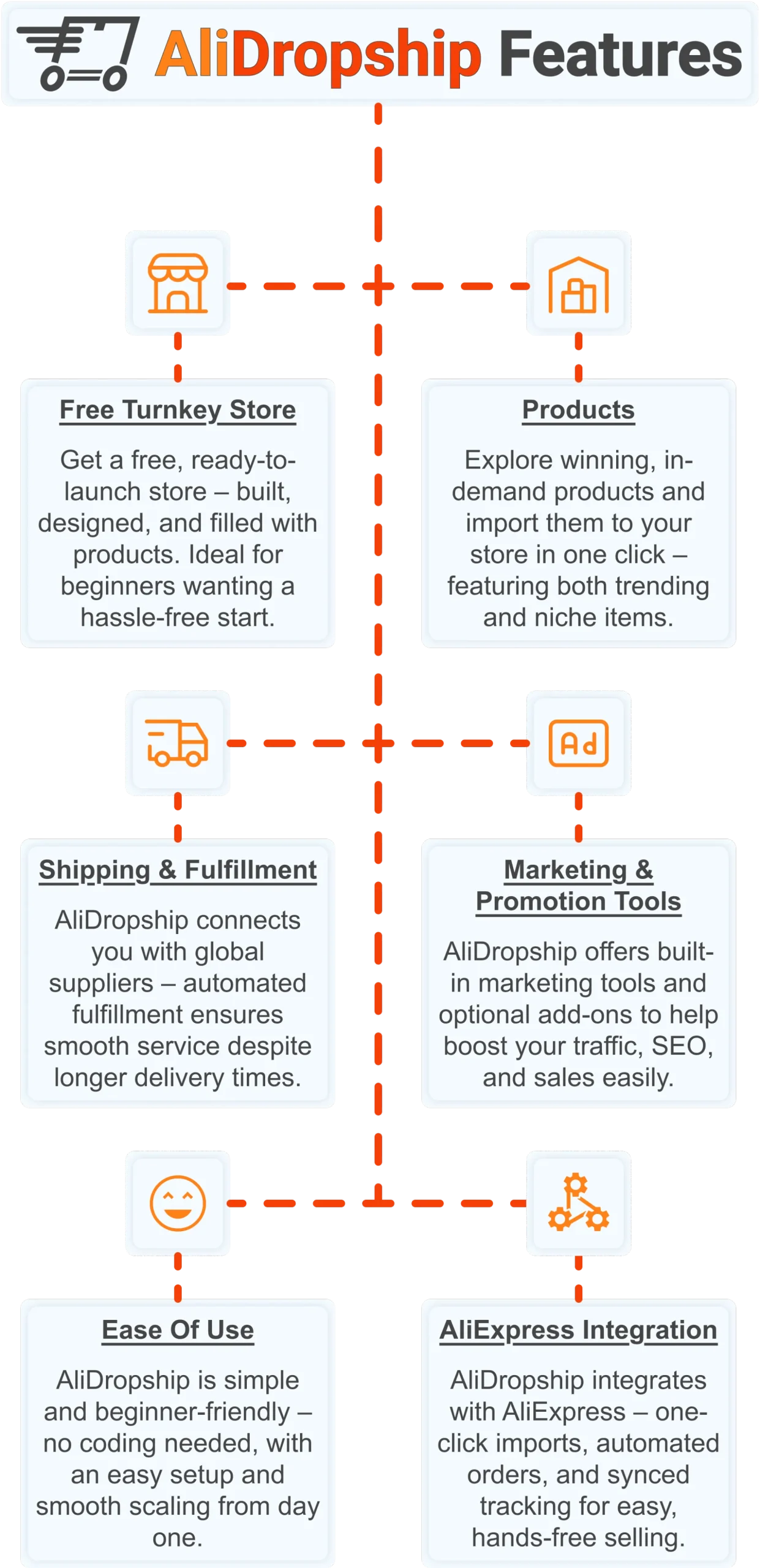
If you want the simplest possible way to start dropshipping – especially if you’re brand new – AliDropship remains one of the most beginner-friendly tools available in 2026. It brings together store creation, product imports, automation, and marketing into a single streamlined system designed to help you launch quickly and grow confidently.
Free turnkey store ️
Get a free turnkey store – built, designed, and filled with products. Ideal for beginners wanting a hassle-free start, the store comes fully optimized to attract customers right away, saving you time on setup. Plus, it includes professional design elements to give your business a polished, trustworthy look from day one. This ready-made foundation makes it easy to move seamlessly into product selection.
Products
Once your store is set up, you can explore winning, in-demand products and import them in one click – featuring both trending and niche items. This wide selection lets you cater to diverse customer interests and test what works best. Regular updates ensure you always have fresh products, keeping your store competitive and relevant. With great products in place, smooth shipping becomes the next essential step.
Shipping & fulfillment
AliDropship connects you with global suppliers, and automated fulfillment ensures seamless order processing despite international delivery times. Customers receive real-time tracking updates, which builds confidence and trust in your store. Once shipping is handled reliably, you can focus on promoting your store and attracting traffic.
Marketing & promotion tools
To maximize sales, AliDropship offers built-in marketing tools and optional add-ons that help boost traffic, SEO, and conversions. From email campaigns and discounts to social media integration, these tools empower you to reach and retain customers without needing prior marketing experience. With promotion strategies in place, managing your business becomes simpler and more efficient.
Ease of use
AliDropship is beginner-friendly – no coding needed, with an intuitive dashboard that guides you through every step. Easy setup and smooth scaling let you expand your store without stress. As your business grows, adding new features, products, and marketing campaigns remains hassle-free, giving you more time to focus on sales.
AliExpress integration
Finally, AliDropship integrates seamlessly with AliExpress, enabling one-click imports, automated orders, and synced tracking. Your inventory stays up-to-date with the latest products and prices, while automated order processing frees you from manual tasks. Combined with the turnkey setup, reliable shipping, and built-in marketing tools, this integration ensures your dropshipping business is fully equipped for growth and success.
Among all the websites to make money online in 2026, a dropshipping store gives you the clearest path to owning a real, scalable business. Get your free AliDropship store today and start building income you actually control.
Frequently asked questions
What are the best websites to make money online in 2026?
The best websites to make money online include freelance platforms like Upwork and Fiverr, ecommerce tools like Shopify and Etsy, content platforms like YouTube and Substack, and gig apps like TaskRabbit and Rover. Each category has a different earning ceiling and time investment depending on whether the income is active or passive. Freelancing can pay 500 to 5,000 per month, while dropshipping and ecommerce can reach 500 to over 10,000 per month with time. Choosing the right category depends more on consistency and positioning than on which specific platform is used.
How much can you realistically earn from websites to make money?
Earnings vary widely depending on the platform, the skill level involved, and the hours committed. Freelancers on Upwork or Fiverr often start at 10 to 25 dollars per hour before building a reputation, while dropshipping stores typically need 60 to 90 days to generate consistent revenue. Content creators on YouTube or a blog rarely see meaningful income before six months of steady publishing. The highest earning ranges, such as 8,000 to 10,000 per month, represent full-time operators who have been active for a year or more.
Is dropshipping one of the better websites to make money compared to freelancing?
Dropshipping and ecommerce carry one of the highest income ceilings among websites to make money, with potential ranging from 500 to over 10,000 per month as a store scales. Unlike freelancing, which requires constant client acquisition to sustain income, a dropshipping store can continue generating sales without a direct one to one relationship between hours worked and income earned. Shopify subscriptions for building an independent store start at 39 per month, and stores are commonly connected to suppliers through apps like AliDropship or DSers. Established stores with optimized ad spend and strong product selection can reach 5,000 to 20,000 or more per month.
Are gig economy websites like TaskRabbit and Rover a reliable way to earn money?
Gig economy websites such as TaskRabbit and Rover are reliable for fast, steady income but have a hard ceiling because earnings are directly tied to hours worked. TaskRabbit takes 15 percent of each completed job, and taskers in major metro areas commonly earn 800 to 2,500 per month for consistent part-time work. Rover users typically earn 15 to 30 dollars per walk or 40 to 80 dollars per overnight pet stay. These platforms work best as bridge income while building a longer-term online income stream.
What legal issues should I watch for when using websites to make money?
Income earned through freelance work, Etsy sales, Shopify revenue, and YouTube ad payments is taxable in most countries, and setting aside 20 to 30 percent of income from the start helps avoid problems at tax time. Every platform enforces terms of service, and violations like fake reviews or using bots to appear more active can lead to permanent account suspension. Print on demand sellers face additional risk from intellectual property violations, since using copyrighted characters or logos in designs can result in immediate account termination. Reddit and seller forums document many cases of accounts banned after months of building due to these same avoidable mistakes.
 Previous post
