 ‧ Agnes Kazaryan ‧
March 20, 2026
‧ Agnes Kazaryan ‧
March 20, 2026  591 ‧
591 ‧
 0
0
Your store did $50,000 last month. Congratulations – or condolences. Because until you run the numbers past cost of goods, ads, fees, returns, and shipping, you have no idea whether that figure paid your rent or buried you deeper. The distance between what lands in the bank and what you actually keep is the entire point of understanding revenue vs profit.
Quick Answer: Revenue is the total money your business brings in from sales before any expenses. Profit is what remains after every cost – product, shipping, ads, fees, taxes – is subtracted. A store can post huge revenue and still lose money, which is exactly why experienced operators track both metrics but make decisions based on profit.
In 2026, this distinction matters more than ever. Ad costs are climbing, return rates are rising, and net margins across ecommerce have tightened to 5–10% on paper, with many sellers actually running closer to 2–3% once every real cost is accounted for. If you are building a store this year, you need to read your financials the way a mechanic reads a dashboard – not just the speed, but the fuel gauge and temperature too.
This guide walks you through the full picture on revenue vs profit: clean definitions, the math behind each number, a realistic look at what store owners earn in 2026, the common traps that make revenue look better than it is, and how to use both metrics to run a sustainable business. By the end, you will be able to read any P&L and know whether the story the numbers tell is one of growth or quiet decline.
What revenue and profit actually mean
Revenue, sometimes called the top line or gross sales, is every dollar your business collects from customers during a given period. If you sold 500 units of a skincare product at $40 each, your revenue for that batch is $20,000. Nothing is subtracted yet. This is the number that looks great on a Shopify dashboard and in casual conversation, and it is also the number that has misled more ecommerce founders than any other metric.
Profit is what is left after expenses. The twist in the revenue vs profit conversation is that there are several kinds of profit, and mixing them up is where most sellers go wrong. Gross profit subtracts only the cost of goods sold (COGS) – the product, supplier fees, and inbound shipping.
Operating profit also subtracts running costs like ads, software, and payroll. Net profit subtracts everything, including taxes and one-off expenses. When someone says “profit” without specifying, they usually mean net profit, but it is worth asking every time.
Important note: A business can grow its revenue month after month and still be shrinking in profit. This happens when marketing costs scale faster than sales, or when discounting is used to hit a revenue goal. The metric that actually predicts survival is profit, not revenue.
How much can you realistically earn?
Let us ground this in actual numbers. The ecommerce profit picture in 2026 depends heavily on the model you pick, and the spread between revenue and net profit is wider than most beginners expect. Here is a realistic view of the three most common paths new sellers take.
These figures assume the store has reached some stability, usually 60–90 days of consistent operation with a validated product or niche. Most new stores do not turn a profit in month one – early ad spend, testing, and supplier deposits almost always push the first weeks into the red.
One note on these ranges: the ceilings only apply when the store is run with full-time attention, treated like a real business with proper tracking, and given enough runway to survive the unprofitable learning phase. Part-time sellers typically land in the lower half of each band, and that is perfectly fine if expectations are set accordingly.
What the table does not show is the hidden drag. Return rates in ecommerce hit 16.5% in 2025 and are trending toward 18% in 2026, meaning roughly one in six orders generates cost without generating a kept sale. Cost per click on major ad platforms is also up 18–22% year over year. If your model does not account for these forces, a healthy-looking revenue figure can turn into a small or negative profit in a single bad month.
The revenue vs profit formulas every seller should know
Before we go further, here are the three calculations you will use constantly. They are not complicated, but writing them down forces clarity, and clarity is where profitable businesses are built.
Revenue
Revenue is straightforward: units sold multiplied by selling price, summed across all products. If you ran a sale and refunded some orders, subtract the refunds to get your net revenue. Most store platforms show this figure by default on the dashboard.
Gross profit and gross margin
Gross profit equals revenue minus cost of goods sold. Gross margin is that figure expressed as a percentage of revenue. If you sell a product for $50 and it costs you $20 to source and deliver to your warehouse, your gross profit per unit is $30 and your gross margin is 60%. Gross margin is the single best early indicator of whether a product is worth selling at all.
Net profit and net margin
Net profit is revenue minus every cost. That means COGS, shipping, payment processor fees, ad spend, app subscriptions, returns, refunds, taxes, and any salary you pay yourself. Net margin is that figure as a percentage of revenue. A $50,000 revenue month with $5,000 in net profit is a 10% net margin, which is respectable for a dropshipping model and concerning for a digital products model.
Why this works in 2026: Platforms and ad networks increasingly reward stores that can sustain spend over time, and only profitable stores can do that. Operators who ignore net margin eventually run out of cash before their optimization work pays off.
Where the gap between revenue and profit actually comes from
Understanding where each dollar of revenue leaks away is the difference between guessing and running a business. Here are the five cost categories that swallow most of the distance between your top line and your bottom line.
Cost of goods sold
This is the product itself plus any direct fulfillment expense. In traditional retail it is obvious – you bought inventory at $10 and sold it at $30. In dropshipping it is the supplier invoice and any per-order shipping cost. In digital products it is almost zero after creation, which is why digital margins look so different. Squeezing COGS, through volume discounts or supplier negotiation, is often the fastest single lever to improve profit.
Advertising and customer acquisition
For most ecommerce stores in 2026, ad spend is the largest expense after product cost. A healthy store aims for a customer acquisition cost of no more than 25–35% of the average order value. Beyond that threshold, every new customer is eroding the store rather than building it. This is why return on ad spend (ROAS) is tracked so religiously – the ecommerce average sits near 2.87:1, meaning $2.87 in revenue for every $1 spent on ads.
Payment processing and platform fees
Stripe, PayPal, and Shopify Payments each take a small cut of every transaction, typically around 2.9% plus a fixed fee per order. Marketplaces like Amazon and Etsy take considerably more – Amazon alone can claim 15% or more per sale once fulfillment is included. These fees feel small on a single order and significant on a monthly P&L.
Returns and refunds
With average ecommerce return rates around 16–18% in 2026, and apparel categories exceeding 30%, returns are no longer a fringe concern. Each return costs you return shipping, restocking effort, potential product damage, and sometimes a product that cannot be resold at full price. Factoring an expected return rate into your pricing model from day one protects your margin.
Operating overhead
Software, apps, email marketing tools, customer service platforms, and any labor you pay for all fall in here. Individually these are small. Together, they often add up to more than beginners expect. A clean review every quarter – cancelling what you do not use and consolidating what overlaps – typically recovers 5–10% of margin with zero downside.
Common revenue traps that kill profitable stores
Some of the most dangerous moments in an ecommerce business come when revenue looks great. Here are the patterns to watch for in your own numbers.
Chasing top-line growth with discounts
Dropping prices to hit a revenue milestone is almost always a trap. Every percentage point of discount often takes two or three percentage points off net margin, because fixed costs do not shrink with your price. A $100,000 month at 30% off can be less profitable than a $70,000 month at full price.
Confusing ROAS with profitability
A 4:1 ROAS sounds strong, but if your product cost, shipping, and fees consume 70% of the sale, you are still losing money. ROAS measures ad efficiency, not business health. Always pair it with a net margin check.
Ignoring cash flow
A profitable store can still run out of money if payments from platforms take 7 to 14 days while ad and supplier bills come due immediately. Many operators discover this only when they cannot fund next month’s inventory. Profitability on paper does not guarantee liquidity, and the two need to be watched separately.
Treating all revenue as equal
A $50 sale to a new customer acquired through paid ads might carry less than $5 in profit. A $50 sale to a returning customer from an email list can carry $15 or more, because there is no acquisition cost attached. Not all revenue is built the same, and segmenting it by source is one of the most useful exercises a serious store owner can do.
Legal and ethical considerations
Reporting revenue and profit accurately is not optional. Tax authorities, payment processors, and potential investors all rely on these numbers being honest. Here is what to keep firmly on the right side of the line.
What to avoid
Do not under-report revenue to reduce tax bills, and do not inflate revenue figures when approaching buyers, lenders, or partners. Fake order inflation – running purchases through your own accounts to make a store look busier – is considered fraud on most platforms and can get you permanently banned. Padding profit by hiding legitimate expenses is equally risky and usually catches up in an audit or a due diligence process.
What to do instead
Use proper bookkeeping software from month one. Keep your business bank account separate from personal spending. If you use a home office or mixed-use phone, track the percentage honestly and claim only the legitimate business portion. When valuing or selling a store, present both gross and net figures with source documents – serious buyers check, and dishonesty tanks deals at the worst moment.
Key principle: Honest numbers compound. Inflated ones collapse. The stores that survive long enough to matter are always the ones with clean books.
Final thoughts: how to choose your focus
Understanding revenue vs profit is not a one-time lesson. It is a habit that shapes every pricing decision, every ad campaign, and every supplier conversation you have. Where you should put your attention depends on where you are in the journey.
Complete beginner
Focus on learning to read a basic P&L and calculating gross margin on every product before you list it. If a product cannot deliver at least a 40% gross margin after shipping and fees, it probably is not worth selling in 2026. Your goal in the first 90 days is not maximizing revenue – it is proving that the model works without losing money.
Intermediate or part-time
You should be tracking net profit monthly, not just revenue. Build a simple spreadsheet that subtracts every real cost, including your own time at a fair hourly rate. This is also the stage to segment revenue by source, so you can see which channels are actually contributing to the bottom line.
Advanced or full-time goal
At this stage, the metrics that matter are net margin trend, cash flow cycle length, customer lifetime value, and contribution margin by channel. A store doing $500,000 a year at 15% net margin is worth more than one doing $1 million at 4%, both in real income and in eventual sale value. Brand aggregators in 2026 pay 3x to 5x annual profit for strong independent stores, never for revenue alone.
Ecommerce in 2026 rewards operators who see through the headline numbers and build sustainably. Revenue is how you measure reach. Profit is how you measure reality. The best stores use both, but lead with the one that pays the bills.
AliDropship: Your complete all-in-one solution for starting dropshipping in 2026
If you want the simplest possible way to start dropshipping – especially if you’re brand new – AliDropship remains one of the most beginner-friendly tools available in 2026. It brings together store creation, product imports, automation, and marketing into a single streamlined system designed to help you launch quickly and grow confidently.
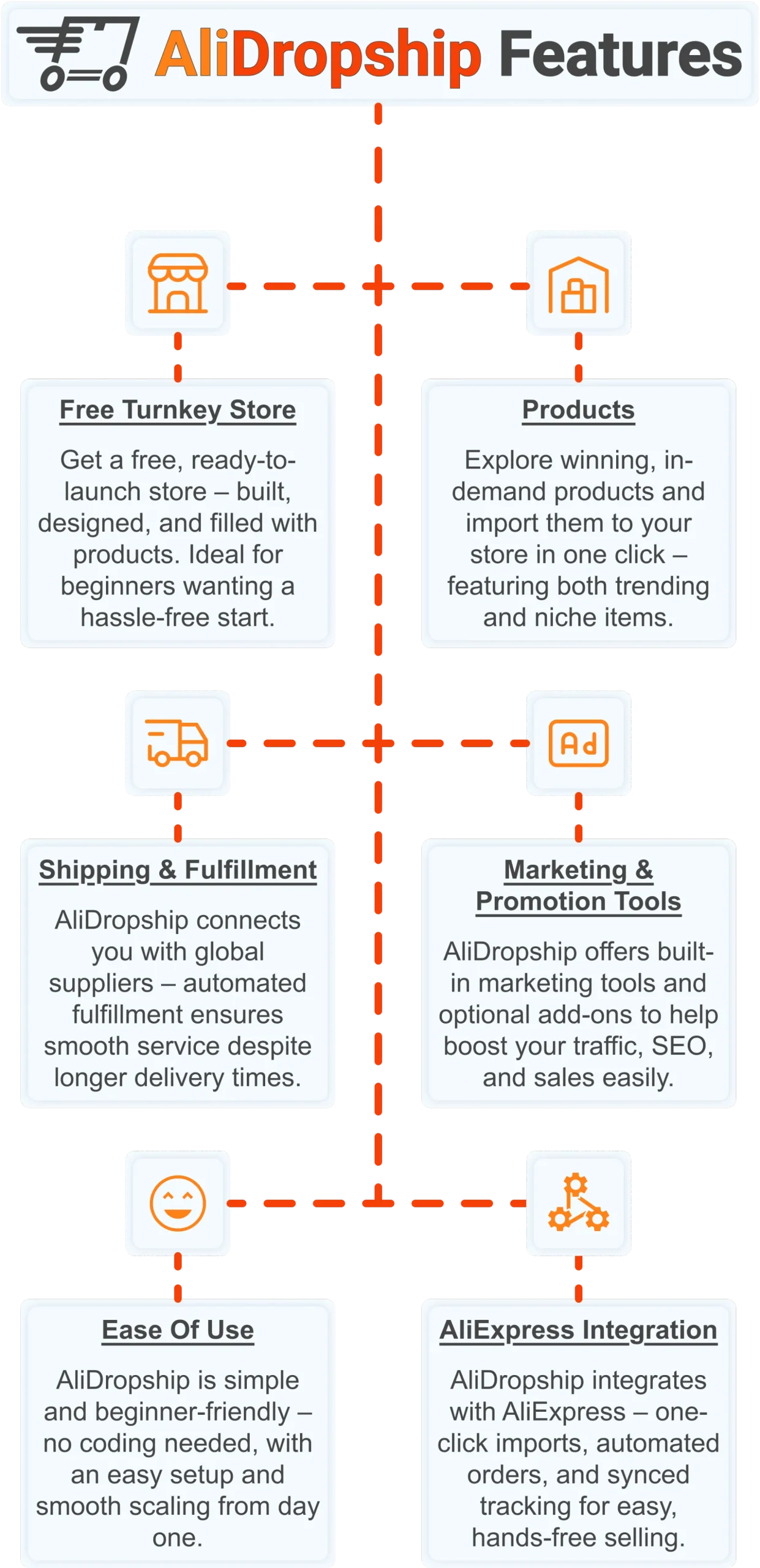
Free turnkey store ️
Get a free turnkey store – built, designed, and filled with products. Ideal for beginners wanting a hassle-free start, the store comes fully optimized to attract customers right away, saving you time on setup. Plus, it includes professional design elements to give your business a polished, trustworthy look from day one. This ready-made foundation makes it easy to move seamlessly into product selection.
Products
Once your store is set up, you can explore winning, in-demand products and import them in one click – featuring both trending and niche items. This wide selection lets you cater to diverse customer interests and test what works best. Regular updates ensure you always have fresh products, keeping your store competitive and relevant. With great products in place, smooth shipping becomes the next essential step.
Shipping & fulfillment
AliDropship connects you with global suppliers, and automated fulfillment ensures seamless order processing despite international delivery times. Customers receive real-time tracking updates, which builds confidence and trust in your store. Once shipping is handled reliably, you can focus on promoting your store and attracting traffic.
Marketing & promotion tools
To maximize sales, AliDropship offers built-in marketing tools and optional add-ons that help boost traffic, SEO, and conversions. From email campaigns and discounts to social media integration, these tools empower you to reach and retain customers without needing prior marketing experience. With promotion strategies in place, managing your business becomes simpler and more efficient.
Ease of use
AliDropship is beginner-friendly – no coding needed, with an intuitive dashboard that guides you through every step. Easy setup and smooth scaling let you expand your store without stress. As your business grows, adding new features, products, and marketing campaigns remains hassle-free, giving you more time to focus on sales.
AliExpress integration
Finally, AliDropship integrates seamlessly with AliExpress, enabling one-click imports, automated orders, and synced tracking. Your inventory stays up-to-date with the latest products and prices, while automated order processing frees you from manual tasks. Combined with the turnkey setup, reliable shipping, and built-in marketing tools, this integration ensures your dropshipping business is fully equipped for growth and success.
Frequently Asked Questions
What is the difference between revenue and profit in ecommerce?
Revenue is the total amount of money a store collects from sales before any costs are removed. Profit is what remains after expenses like product cost, shipping, ads, fees, and taxes are subtracted. A store can post 50000 dollars in monthly revenue and still lose money once every cost is counted. This is why experienced sellers make decisions based on net margin rather than the revenue figure alone.
How is gross profit calculated for a dropshipping store?
Gross profit equals revenue minus cost of goods sold, which includes the product and inbound shipping. For example a product sold for 50 dollars that costs 20 dollars to source and deliver leaves a gross profit of 30 dollars per unit. That works out to a 60 percent gross margin, which is a strong early signal that a product is worth selling. Most sellers use this figure before layering in ad spend and platform fees.
What net margin is realistic for a dropshipping business in 2026?
Dropshipping stores typically run a net margin of 10 to 15 percent once they reach 60 to 90 days of stable operation. That translates to roughly 30 to 150 dollars per day in earning potential at that stage. Private label brands can reach 15 to 30 percent net margin, while digital product stores often hit 50 to 80 percent. New stores frequently operate at a loss in the first month due to ad testing and supplier deposits.
How do returns affect profit margins in ecommerce?
Ecommerce return rates reached 16.5 percent in 2025 and are trending toward 18 percent in 2026, meaning close to one in six orders adds cost without a kept sale. Apparel categories can see return rates exceeding 30 percent, making the category especially risky for margin. Each return brings shipping cost, restocking effort, and sometimes product damage that prevents a full price resale. Factoring an expected return rate into pricing from the start helps protect overall profit.
Why is return on ad spend not the same as profitability?
Return on ad spend, or ROAS, measures how much revenue is generated per dollar spent on ads, with the ecommerce average sitting near 2.87 to 1. A strong ROAS of 4 to 1 can still mean a loss if product cost, shipping, and fees consume 70 percent of the sale price. ROAS only reflects ad efficiency, not whether the business is actually keeping money. Pairing ROAS with a net margin check is the only way to confirm real profitability.
Knowing the difference between revenue and profit is the theory – running a store that proves it every month is the practice. Claim your free turnkey store and start turning sales into real profit today.
 Previous post
