 ‧ Agnes Kazaryan ‧
March 20, 2026
‧ Agnes Kazaryan ‧
March 20, 2026  611 ‧
611 ‧
 0
0
Around $12 billion flowed through affiliate partnerships in 2025, and the number is still climbing. So when people search what is affiliate marketing, they are rarely hunting for a textbook definition. They want to know whether it is a real income path or another overhyped online hustle. The short answer: it is real, it works, and it is more accessible than ever – but it takes longer than most people expect to see meaningful results.
Quick Answer: Affiliate marketing is a performance-based model where you earn a commission by promoting someone else’s products or services. Every time a customer buys through your unique tracking link, you get paid – no inventory, no customer service, no product creation required.
This guide walks through everything you need to understand affiliate marketing from the ground up – how it works, the main types, realistic income ranges, and the pros and cons most “get started” guides skip over.
What is affiliate marketing, exactly?
Affiliate marketing is a partnership model built on one simple principle: you refer customers to a business, and when those customers buy, you earn a cut. You do not own the product, the store, or the brand. Your job is to connect the right audience with the right offer through content, recommendations, or advertising – and to do it consistently enough that the commissions add up.
The model involves three parties. The merchant (also called the advertiser or brand) owns the product and sets up the affiliate program. The affiliate (you) promotes it through a blog, YouTube channel, social account, email newsletter, or paid ads. The customer clicks your unique tracking link and completes a purchase – at which point the sale is attributed to you and your commission is recorded.
Most programs track sales through browser cookies or first-party tracking systems. When someone clicks your link, the system logs the referral. If that person buys within the cookie window – often 24 to 90 days depending on the program – you get paid. Simple in theory, and actually that simple in practice, once the traffic is there.
Why this works in 2026: Businesses prefer paying commissions on confirmed sales rather than gambling on ad spend that may not convert. That makes affiliate marketing one of the most cost-efficient acquisition channels for brands – and one of the few online income models where your earnings scale directly with your output.
How much can you realistically earn from affiliate marketing?
Here is the honest picture. Most beginners earn very little in the first 60–90 days. The affiliate marketers quoting five-figure monthly checks have usually been at it for two to four years and have built substantial organic traffic or large email lists. That does not mean you cannot earn well – it just means the timeline is longer than the average YouTube thumbnail implies.
The table below breaks down what realistic earning looks like at different effort levels.
These figures are realistic benchmarks, not guarantees. Earnings depend almost entirely on niche competitiveness, content quality, and how consistently you show up. A blog in a low-competition niche with 30–50 strong articles can realistically generate $500–$1,500 per month within 18 months.
One note on ceiling figures: The six-figure affiliate marketers you see online typically rely on large teams, years of SEO authority, or established email lists with 50,000-plus subscribers. For most part-time affiliates working solo, $500–$2,000 per month is the realistic ceiling in the first two years without paid traffic.
Full-time affiliate income – roughly $5,000–$15,000 per month and above – is possible, but it requires treating this as a real business. That means consistent content production, ongoing keyword research, link building, email list growth, and regular program audits to find better-converting offers. Most people who reach that level took three to five years to get there.
The main types of affiliate marketing
Not all affiliate marketing is the same. There are three core models, each sitting at a different point on the trust-and-involvement spectrum. Understanding which type you are operating in matters because it affects everything from your content strategy to your conversion rates.
Unattached affiliate marketing
In this model, you have no personal connection to the product you promote. You run paid ads – typically Google Ads or Meta Ads – pointing to a merchant’s landing page through an affiliate link. There is no niche authority, no audience relationship, and no product experience required.
The approach works when your ad targeting and offer economics are precisely dialed in. Margins can be tight because you are paying for every click. If the commission does not exceed your ad costs, you lose money. It can be profitable for experienced media buyers, but it is a high-risk starting point for beginners.
Earning potential: Variable – $0 to $5,000-plus per month, heavily dependent on ad spend discipline and offer selection.
Related affiliate marketing
Here you operate in a niche you know well but may not have personally used every product you recommend. A fitness blogger recommending supplements they have researched but not personally tested is a common example. Audience trust is higher because you have genuine niche authority.
This is the most common model for bloggers and YouTubers. You build an audience around a topic you understand deeply, then monetize through affiliate programs relevant to that audience. Conversion rates are significantly better than unattached marketing because your recommendations carry weight.
Earning potential: $300–$3,000 per month at 12–24 months for a consistent creator in a mid-competition niche.
Involved affiliate marketing
This is the highest-trust model. You personally use and genuinely endorse the product. Recommendations are based on real experience, and the audience senses the authenticity. This type converts the best because skepticism is lowest when someone is clearly speaking from genuine use.
Involved affiliate marketing is what most successful long-term affiliates eventually migrate toward. It requires more product research upfront, but the pay-off is audience loyalty and higher click-through rates. In 2026, with audiences more skeptical than ever, involved marketing is also becoming the most durable approach.
Why this works in 2026: Brands are collaborating with roughly a third more micro-influencers year over year precisely because smaller, genuine voices convert better than large, generic promotional accounts.
Earning potential: $500–$5,000-plus per month for creators with an engaged niche audience of 5,000–20,000 followers or subscribers.
How affiliate marketing actually works – step by step
If you are brand new, here is exactly how the process flows from signing up to getting paid. Each step builds on the previous one, and skipping ahead is the most common reason people quit before they see results.
Step 1 – Choose a niche
Your niche is the topic you will build content around. It should sit at the intersection of something you understand, something an audience actively searches for, and something where affiliate programs exist with decent commissions. Popular niches include personal finance, health and wellness, software and SaaS tools, ecommerce, and home improvement.
Narrow niches consistently outperform broad ones. “Best noise-cancelling headphones under $100” converts better than “best headphones” because the search intent is more specific and the audience is closer to buying.
Step 2 – Join an affiliate program
Most brands either run their own in-house affiliate program or list their offers on affiliate networks. Large networks include Amazon Associates, ShareASale, CJ Affiliate, Impact, and PartnerStack (for SaaS products). Joining is almost always free for affiliates.
When evaluating a program, check the commission rate, cookie window, average order value, and payout threshold. A 3% commission on a $30 product pays $0.90 per sale. A 30% commission on a $200 software subscription pays $60 per sale. The math matters enormously.
Step 3 – Create content that ranks or reaches
Your affiliate link earns nothing without traffic. Content is how you generate that traffic. For SEO-based affiliates, this means writing in-depth blog posts targeting keywords your audience searches. For video affiliates, it means producing review, tutorial, or comparison videos. For social affiliates, it means building an engaged following in your niche.
In 2026, quality and intent alignment matter far more than volume. One well-researched comparison article targeting a buyer-intent keyword can outperform ten thin posts on broad topics.
Step 4 – Place your affiliate links naturally
Affiliate links should feel like a logical next step for the reader, not a hard sell interrupting the content. In a product review, the link sits naturally near the verdict. In a tutorial, it appears when you recommend the tool that completes the job. In a comparison article, each product gets its own linked heading.
Always disclose that you earn a commission. This is a legal requirement in most countries (FTC in the US, ASA in the UK) and, importantly, it builds rather than destroys trust when done matter-of-factly.
Step 5 – Track, optimize, and scale
Once traffic arrives, your affiliate dashboard shows which links are clicking and which are converting. Use that data to double down on what works – stronger calls to action, better product placement, or targeting higher-intent keywords. The affiliates who scale reliably treat performance data as a feedback loop, not just a scoreboard.
Pros and cons of affiliate marketing – the honest breakdown
Affiliate marketing has genuine strengths. It also has limitations most “how to start affiliate marketing” guides gloss over. Here is both sides, plainly.
The real advantages
The biggest advantage is the low barrier to entry. You do not need to create a product, hold inventory, handle shipping, or deal with customer service. Your only job is to drive qualified traffic to someone else’s offer. That makes affiliate marketing genuinely accessible to anyone with a laptop and a few hours a week.
Affiliate income is also scalable and eventually semi-passive. An SEO article you wrote 18 months ago can keep earning commissions every single day without any additional effort on your part. That compounding effect is what makes affiliate marketing so attractive for patient, long-term thinkers.
Finally, the model is low financial risk. Unless you are running paid ads, your costs are primarily time. A blog on WordPress costs under $100 per year to run. A YouTube channel costs nothing. The worst-case scenario is that you build content that does not rank – and even that content can be improved rather than abandoned.
The real limitations
The most significant limitation is that you do not control the product. If the merchant changes their commission rate, closes their affiliate program, or goes out of business, your income stream disappears overnight – regardless of how much content you built. This has happened to entire affiliate sites when Amazon slashed its commission rates in 2020 and again in 2023. A quick look at any affiliate subreddit on Reddit will show hundreds of similar stories.
Affiliate marketing also has a slow ramp-up period. SEO-based content typically takes 6–12 months to rank meaningfully. Building a YouTube audience takes similar time. If you need income within 30–60 days, affiliate marketing is probably not the right starting point.
There is also a trust ceiling. Your commissions only exist as long as people trust your recommendations. One badly researched product pick can damage your audience relationship in ways that take months to repair. The best affiliates treat their recommendations as their reputation – which means saying “no” to high-commission products that are genuinely bad for their audience.
Important: Affiliate income is classified as self-employment income in most countries. You are responsible for tracking, declaring, and paying tax on commissions. Keep records from day one.
Legal and ethical considerations every affiliate needs to know
Affiliate marketing has a grey-area reputation in some corners of the internet, partly because some affiliates do cut corners. Here is what to avoid absolutely and what to do instead.
What to avoid
Never publish fake reviews. Writing a five-star review of a product you have never used, solely because it pays a high commission, is both unethical and increasingly detectable. Audiences are sophisticated in 2026. If your review reads like a press release rather than a real experience, trust evaporates and your conversion rate follows.
Do not hide your affiliate relationships. In the US, the FTC requires clear disclosure whenever you stand to earn from a recommendation. In the EU, similar rules apply under consumer protection law. A simple “this post contains affiliate links” sentence at the top of your article is sufficient and legally required.
Avoid cookie stuffing and forced clicks – tactics that artificially trigger affiliate tracking without genuine user intent. These violate every legitimate affiliate program’s terms of service and can result in account termination with forfeited earnings. Trustpilot reviews and affiliate forums are full of stories from people who lost months of work this way.
What to do instead
Promote products you have actually used or thoroughly researched. Give honest assessments including the downsides. Your audience will trust your positives far more when they know you are willing to flag negatives. Long-term credibility pays more than short-term commission chasing.
Build your content on a platform you own – primarily your own website or email list. Social media reach is borrowed. Algorithm changes can cut your traffic in half overnight. A domain and an email list are yours to keep regardless of what any platform decides.
Key principle: Sustainable affiliate income is built on trust. Anything that erodes trust – fake reviews, hidden affiliations, or misleading claims – accelerates the death of your earning potential.
Is affiliate marketing right for you?
The honest answer depends on your situation, your timeline, and what you are ultimately trying to build. Here is a breakdown by reader profile.
Complete beginners
If you are starting from zero – no audience, no niche authority, no website – affiliate marketing is viable but genuinely slow. Expect 60–90 days before your first meaningful commission and 12–18 months before a consistent monthly income appears. The right starting move is to pick one narrow niche, build a simple WordPress blog or YouTube channel, and produce two to three pieces of high-quality content per week. Do not start with paid ads until you understand which content converts.
Intermediate / part-time
If you already have an audience – a blog with some traffic, an email list, a social following in a niche – affiliate marketing is a genuinely efficient way to monetize what you have already built. Audit your existing content for buyer-intent keywords, identify the programs that align best with your audience’s needs, and retrofit affiliate links naturally into posts that already rank. Existing traffic is the fastest path to affiliate income.
Advanced / full-time goal
If you want affiliate marketing as your primary income within 12 months, the path requires treating it as a business from day one: dedicated time every day, a content calendar, an SEO keyword strategy, an email list building system, and regular program audits. At this level, combining affiliate marketing with your own products or services – such as an ecommerce store – is how the most consistent earners diversify their income and reduce dependency on any single program.
The broader landscape in 2026 is still growing. The affiliate industry as a whole has moved far beyond link-stuffed blogs into a mature partnership ecosystem involving creators, communities, and automated tracking systems. The opportunity is real. The question is whether you are willing to invest the time it genuinely takes to build it.
AliDropship: Your complete all-in-one solution for starting dropshipping in 2026
If you want the simplest possible way to start dropshipping – especially if you’re brand new – AliDropship remains one of the most beginner-friendly tools available in 2026. It brings together store creation, product imports, automation, and marketing into a single streamlined system designed to help you launch quickly and grow confidently.
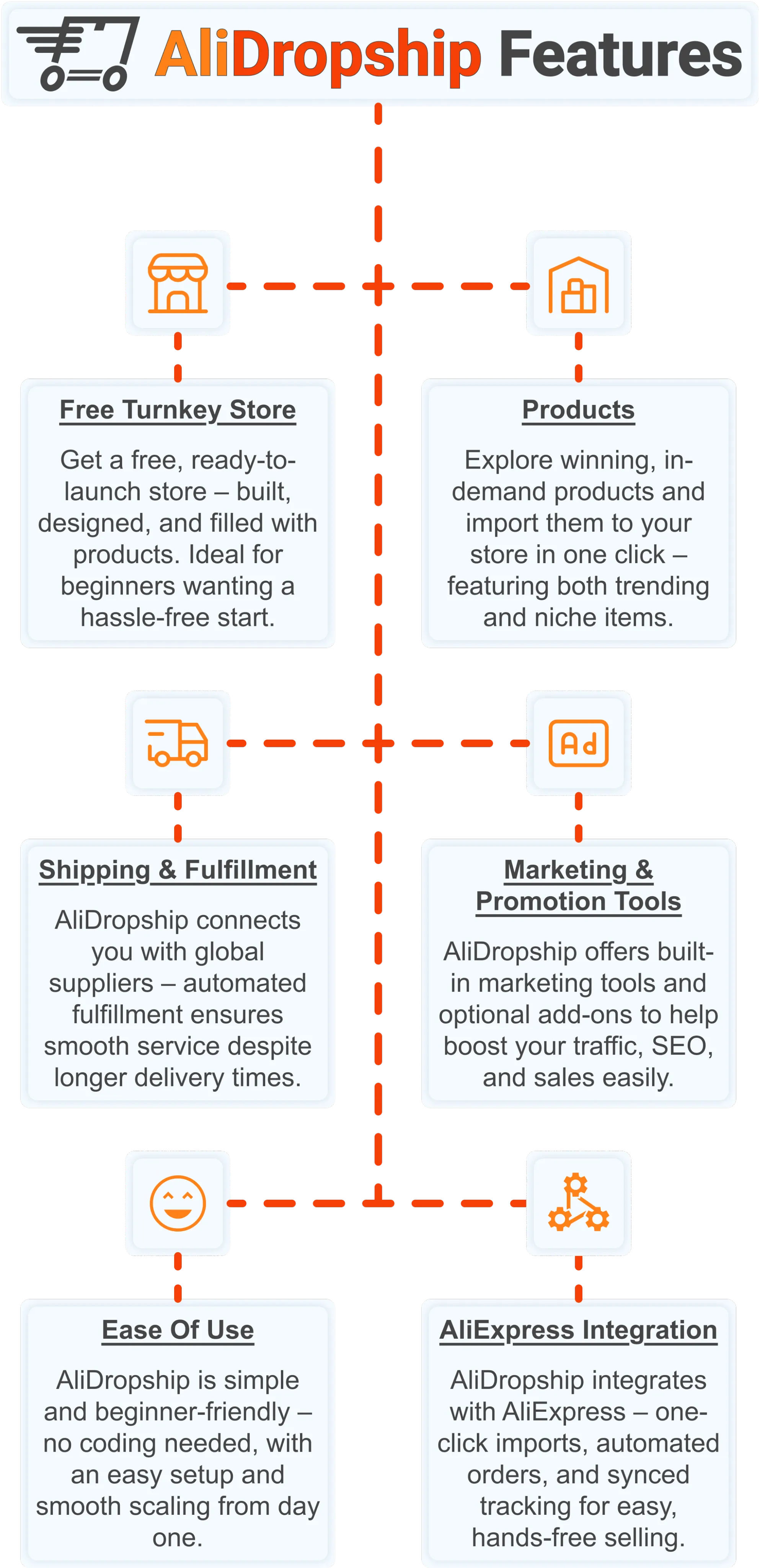
Free turnkey store ️
Get a free turnkey store – built, designed, and filled with products. Ideal for beginners wanting a hassle-free start, the store comes fully optimized to attract customers right away, saving you time on setup. Plus, it includes professional design elements to give your business a polished, trustworthy look from day one. This ready-made foundation makes it easy to move seamlessly into product selection.
Products
Once your store is set up, you can explore winning, in-demand products and import them in one click – featuring both trending and niche items. This wide selection lets you cater to diverse customer interests and test what works best. Regular updates ensure you always have fresh products, keeping your store competitive and relevant. With great products in place, smooth shipping becomes the next essential step.
Shipping & fulfillment
AliDropship connects you with global suppliers, and automated fulfillment ensures seamless order processing despite international delivery times. Customers receive real-time tracking updates, which builds confidence and trust in your store. Once shipping is handled reliably, you can focus on promoting your store and attracting traffic.
Marketing & promotion tools
To maximize sales, AliDropship offers built-in marketing tools and optional add-ons that help boost traffic, SEO, and conversions. From email campaigns and discounts to social media integration, these tools empower you to reach and retain customers without needing prior marketing experience. With promotion strategies in place, managing your business becomes simpler and more efficient.
Ease of use
AliDropship is beginner-friendly – no coding needed, with an intuitive dashboard that guides you through every step. Easy setup and smooth scaling let you expand your store without stress. As your business grows, adding new features, products, and marketing campaigns remains hassle-free, giving you more time to focus on sales.
AliExpress integration
Finally, AliDropship integrates seamlessly with AliExpress, enabling one-click imports, automated orders, and synced tracking. Your inventory stays up-to-date with the latest products and prices, while automated order processing frees you from manual tasks. Combined with the turnkey setup, reliable shipping, and built-in marketing tools, this integration ensures your dropshipping business is fully equipped for growth and success.
Frequently Asked Questions
What are the three main types of affiliate marketing?
Unattached affiliate marketing involves no personal connection to the product, typically using paid ads pointing to a merchant landing page. Related affiliate marketing means operating in a niche the affiliate knows well, even without having personally used every product recommended. Involved affiliate marketing is the highest trust model, where the affiliate personally uses and genuinely endorses the product. Involved marketing typically earns 500 to 5000 or more per month for creators with an engaged niche audience of 5000 to 20000 followers.
How much can a content blog realistically earn from affiliate marketing?
A content blog using SEO has earning potential of 200 to 3000 per month, taking 12 to 24 months to scale, with high upfront effort that becomes passive over time. A blog in a low competition niche with 30 to 50 strong articles can realistically generate 500 to 1500 per month within 18 months. For most part time affiliates working solo, 500 to 2000 per month is the realistic ceiling in the first two years without paid traffic. Full time affiliate income of roughly 5000 to 15000 per month and above typically takes three to five years to reach.
How does the affiliate marketing commission and cookie window system work?
Most programs track sales through browser cookies or first party tracking systems, logging a referral when someone clicks a unique link. If the customer buys within the cookie window, often 24 to 90 days depending on the program, the affiliate gets paid. A 3 percent commission on a 30 product pays 0.90 per sale, while a 30 percent commission on a 200 software subscription pays 60 per sale. Roughly 12 billion dollars flowed through affiliate partnerships in 2025, and the figure is still climbing.
What are the biggest risks of relying on affiliate marketing income?
The most significant limitation is not controlling the product, meaning a merchant changing commission rates or closing a program can eliminate income overnight. This happened when Amazon slashed its commission rates in 2020 and again in 2023, affecting entire affiliate sites. Affiliate marketing also has a slow ramp up period, with SEO based content typically taking 6 to 12 months to rank meaningfully. Affiliate income is classified as self employment income in most countries, requiring the affiliate to track and pay tax on commissions.
How does an affiliate program cookie window and average order value affect earnings?
When evaluating a program, the commission rate, cookie window, average order value, and payout threshold all matter. Related affiliate marketing in a mid competition niche typically earns 300 to 3000 per month at 12 to 24 months for a consistent creator. Unattached affiliate marketing using paid ads has variable earning potential of 0 to 5000 or more per month, heavily dependent on ad spend discipline and offer selection. Brands are collaborating with roughly a third more micro influencers year over year because smaller, genuine voices convert better than large, generic promotional accounts.
Affiliate marketing teaches you how to drive traffic and turn an audience into buyers – skills that pay off even more when you own the product side too. Claim your free AliDropship store and put those skills to work building a business that is fully yours.
 Previous post
