 ‧ Agnes Kazaryan ‧
March 21, 2026
‧ Agnes Kazaryan ‧
March 21, 2026  739 ‧
739 ‧
 0
0
Affiliate marketing is one of the most searched online income models – and one of the most misunderstood. The concept sounds almost too clean: recommend a product, someone buys it through your link, you earn a commission. No inventory, no customer service, no upfront product costs. But most beginner guides skip straight to income screenshots and skip over how the mechanics actually work.
Quick answer: How does affiliate marketing work? You – the affiliate – promote another company’s product using a unique tracking link. When a visitor clicks that link and completes a qualifying action (usually a purchase), the merchant’s system records the conversion and credits your account with a commission. The whole process runs through an affiliate program or network that handles tracking, attribution, and payouts automatically.
This guide breaks down every working part of the system: how tracking works, where commissions come from, which models pay the most, how to drive traffic, and what realistic earnings look like for someone starting from zero in 2026.
What is affiliate marketing and how does it work?
Affiliate marketing is a performance-based earning model where you receive a commission for driving a specific action – most commonly a purchase – for another business. The relationship involves three core parties: the merchant (the company selling the product), the affiliate (you), and the customer (the person who buys). A fourth player – an affiliate network or in-house tracking platform – usually sits in the middle, managing tracking infrastructure, dashboards, and payment processing.
Here is exactly how the process flows. You join an affiliate program and receive a unique referral link tied to your account. You place that link inside content you publish – a blog post, a YouTube video, a social media post, an email newsletter. A visitor reads your content and clicks the link. Their browser stores a tracking cookie, which tells the merchant’s system that this visitor came from you.
If they complete a purchase within the cookie window – typically anywhere from 24 hours to 90 days depending on the program – the sale is attributed to your account and a commission is logged. Once your balance hits the minimum payout threshold, the network sends the money to you.
The mechanism is straightforward. The hard part is building a traffic source that actually sends purchase-ready visitors to your links – and that takes time, consistency, and content that earns genuine trust.
Why this works in 2026: Global affiliate marketing spend is projected to surpass $15 billion this year. Merchants rely on affiliates for cost-efficient, performance-only customer acquisition – meaning they only pay when a result is delivered. That dynamic makes the model stable even in tighter ad-spend environments.
How much can you realistically earn with affiliate marketing?
This is the question most beginner guides either dodge or inflate. The honest answer depends on three variables: your traffic volume, your niche, and the commission structure you’re working with. Here is a realistic breakdown by platform and experience level.
Most beginners running a blog or a small social account realistically earn $30–$80/month in their first six months, assuming consistent output and a focused niche. Crossing $500/month consistently typically takes 12–18 months of sustained effort.
One note on ceiling figures: The affiliates earning $10,000+ per month are outliers. They’re running large content operations, high-traffic comparison sites, or heavily optimized paid funnels – built over years, often with a team. For most part-time affiliates, $200–$800/month after 12 months of consistent work is a more grounded benchmark to plan around.
The key players in affiliate marketing
Before you pick a program or publish a single piece of content, it helps to understand exactly who you’re dealing with and what role each party plays in the ecosystem.
Merchants and product owners
The merchant is the company or individual who owns the product or service being promoted. They set the commission rate, define what counts as a qualifying conversion, decide the cookie duration, and control when and how affiliates get paid. Merchants range from solo creators selling a $27 digital guide to Fortune 500 companies with structured partner programs.
What they all share is a need for traffic and conversions they don’t have to pay for unless the result is delivered – which is exactly what a well-placed affiliate provides.
Important note: Always read the merchant’s program terms before promoting. Some restrict which traffic sources you can use – for example, prohibiting paid search on branded keywords – which can get your account terminated if you miss it.
Affiliate networks vs direct programs
You can join affiliate programs in two ways: through a dedicated affiliate network, or directly through a merchant’s own in-house program.
Affiliate networks act as intermediaries that host multiple merchants in one dashboard. You apply once, get approved, and can promote hundreds of brands from a single account. Well-known networks include ShareASale, CJ Affiliate (Commission Junction), Impact, Rakuten Advertising, and PartnerStack. Networks handle all the tracking infrastructure and consolidated payouts, which makes them easier for beginners to manage.
Direct programs are run entirely by the merchant. Amazon Associates is the most widely used example – you apply on Amazon’s site and promote products across their full catalogue. Other examples include Shopify’s affiliate program, NordVPN, and Bluehost. Direct programs sometimes offer higher commissions because there’s no network fee in the middle, but you manage each relationship separately.
The affiliate – your role in the chain
As the affiliate, your job is to connect the right audience with the right product at the right moment. You do that through content – articles, videos, newsletters, posts – that earns trust and delivers genuine value before asking anyone to click anything. The more relevant and useful your content is to purchase-ready readers, the higher your conversion rate will be.
Affiliates who treat their audience as a revenue source tend to burn out fast. Those who genuinely help people find what they’re looking for tend to build income that lasts.
Step-by-step: How to start affiliate marketing from scratch
Here is the full beginner process laid out in clear stages. Each one builds on the last.
Step 1 – Choose your niche
Your niche is the topic area you’ll build content around. The most important thing is the intersection of three factors: something you can write or talk about consistently, an audience that actually spends money, and affiliate programs with meaningful commission rates. Popular beginner-friendly niches in 2026 include personal finance, health and wellness, software and SaaS tools, home improvement, and outdoor gear.
Avoid going too broad (“fitness”) or too narrow (“resistance bands for left-handed people over 50”). A good niche has enough search volume to generate traffic but is specific enough for you to become a trusted voice. Tools like Google Trends, Ahrefs, and even Reddit can quickly show you what people in a given niche are actively searching for and spending on.
Step 2 – Find affiliate programs that fit
Once you have a niche, look for programs that match it. The fastest approach is to search “[your niche] + affiliate program” in Google. You can also browse networks like ShareASale or Impact and filter by category.
Before applying anywhere, look at three things: commission rate (higher isn’t always better – 3% on a $500 product beats 30% on a $5 one), cookie duration (longer gives your audience more time to convert), and payment terms (minimum threshold, payment method, and frequency).
For absolute beginners, Amazon Associates is the most common starting point because the product catalogue covers almost any niche and approval is straightforward. The downside is low commission rates – 1–5% on most categories – and a 24-hour cookie. As your traffic grows, shifting to higher-ticket programs in the same niche typically makes more financial sense.
Step 3 – Build a platform to publish content
You need somewhere to publish content and embed your links.
The three most reliable platforms for beginners are a blog or website (the most durable long-term asset – SEO articles rank on Google and can deliver traffic for years), a YouTube channel (free to start, strong for product reviews and tutorials), and an email newsletter (a list of engaged subscribers converts at a higher rate than almost any other channel because the audience opted in to hear from you specifically).
Social media platforms like TikTok, Instagram, and Pinterest can complement these but should not be your only channel. Algorithms shift, accounts get suspended, and you don’t own the audience. A blog or email list gives you far more control over the long term.
Step 4 – Create content that earns clicks
Content is the engine of affiliate marketing. The formats that convert best for affiliate links are product reviews, comparison articles (“X vs Y”), best-of roundups (“best tools for [niche]”), and tutorial posts that solve a specific problem and naturally recommend a product as the solution.
The key is matching content to reader intent. Someone searching “best running shoes for flat feet” is very close to buying – that’s high-intent, commercial content. Someone searching “how to run faster” is in research mode and much less likely to buy today. Both types of content have value, but affiliate links belong in content that serves purchase-ready readers. Focus your early efforts on review and comparison formats.
Important: The FTC requires affiliates to disclose their relationship with merchants. A short, clear statement near the top of your content – something like “This article contains affiliate links. If you click and buy, I may earn a commission at no extra cost to you” – satisfies this requirement and builds trust rather than undermining it.
Step 5 – Drive traffic to your content
Traffic determines everything else. Without visitors, your links earn nothing.
The main channels available to affiliate marketers are organic search (SEO articles optimized for keywords your audience uses – free traffic that takes 3–9 months to build), social media (faster to start but algorithm-dependent), email marketing (high conversion rates because the audience already trusts you), and paid ads (faster results, but if your commission per conversion is lower than your cost per click, you lose money).
Most beginners start with SEO or social because both are free. SEO builds the most durable traffic over time – if you can commit to publishing consistently for 6–12 months, it tends to produce the best long-term return.
Step 6 – Track performance and optimize
Once content is live and generating clicks, the next step is understanding what’s actually working. Most affiliate dashboards show clicks, conversions, and earnings per link. Use that data to identify which articles or videos earn the most, which products convert at the highest rate, and where visitors drop off before clicking.
The most effective optimization levers are: moving affiliate links higher in the content (links buried below the fold get significantly fewer clicks), testing different call-to-action wording around your links, improving page load speed (slow pages kill conversion), and refreshing older content with updated product recommendations. Small consistent changes compound into meaningful income gains over 6–12 months.
Affiliate marketing models: Which one pays best?
Not all affiliate marketing works the same way. There are four distinct commission models, and understanding each one helps you choose programs that match your content strategy and income goals.
Pay-per-sale (PPS)
The most common model. You earn a commission when a referred visitor completes a purchase. Commission rates range from 1% (Amazon on some categories) to 50%+ on digital products and SaaS tools. This model rewards affiliates who send genuinely purchase-ready traffic – so it pays best when your content targets high-intent, commercial-stage readers.
Earning potential: $50–$500/month for a beginner blog in months 6–12, scaling with traffic volume and niche commission rates.
Pay-per-lead (PPL)
You earn a commission when a referred visitor completes an action short of a purchase – typically signing up for a free trial, filling in a quote form, or downloading a lead magnet. The commission per action is lower than a full sale, but the conversion rate is higher because the barrier for the visitor is lower. Insurance, finance, and software companies use this model most frequently.
Pay-per-click (PPC affiliate)
You earn a small amount every time someone clicks your affiliate link, regardless of whether they buy. This model is rare because it’s easy to abuse, and affiliate networks have largely moved away from it. Earnings per click are fractions of a cent to a few cents – so it only scales at very high traffic volumes and is not a viable starting strategy for most affiliates.
Recurring commissions
One of the most powerful models for long-term income. When you refer a customer to a subscription product – software, a membership, a SaaS tool – you earn a commission every month they remain subscribed, not just on the initial payment.
SaaS affiliate programs frequently pay recurring rates of 20–40%. A single referred customer staying for 12 months might generate 12 commissions instead of one. Building a portfolio of recurring-commission referrals creates genuinely compounding income over time.
Earning potential: $200–$2,000/month is achievable for affiliates with a focused content strategy around high-ticket SaaS products and a readership of 5,000–15,000 monthly visitors after 18–24 months.
Legal and ethical rules every affiliate must follow
Affiliate marketing has a reputation problem in parts of the internet – and that reputation exists for real reasons. There’s a meaningful difference between affiliate marketing done with integrity and the grey-area tactics that get accounts banned, audiences burned, and domains penalized by Google.
What to avoid absolutely
Fake reviews: Writing or publishing reviews for products you haven’t used, or manufacturing positive sentiment to drive conversions, violates FTC guidelines and destroys audience trust the moment someone buys a product that doesn’t match your description. Reddit communities spot fake review patterns quickly, and Google’s algorithm has specifically targeted thin, untrustworthy affiliate content in recent core updates.
Cookie stuffing: A black-hat technique where an affiliate loads tracking cookies onto a visitor’s browser without a genuine click – claiming commission credit for sales they had nothing to do with. This is fraud. Affiliate networks permanently ban accounts for it and some have pursued legal action.
Misleading income claims: Posting dashboard screenshots showing extreme daily earnings to sell a course or recruit affiliates is deceptive and violates advertising standards in most countries. If you talk about earnings, disclose the context honestly – including how long it took, how much effort went in, and how typical or atypical the results are.
Non-disclosure: Failing to tell your audience that you earn a commission if they buy through your link is a legal violation under FTC regulations in the US and equivalent rules in the EU, UK, and Australia. Disclosure is not optional.
What to do instead
Key principle: Only recommend products you have genuine knowledge of, disclose your affiliate relationships clearly, and let the quality of your content do the selling.
Sustainable affiliate income is built on trust – and trust is built through honest, useful content over time. Affiliates who write thorough, accurate reviews, update content when products change, and acknowledge product weaknesses alongside strengths consistently outperform those chasing quick commissions.
The long-term approach is also the one that survives algorithm changes, because Google continues to reward genuinely helpful product content and penalize manipulative thin affiliate sites.
How to choose the right approach for your situation
Affiliate marketing isn’t one-size-fits-all. The right starting point depends entirely on where you are right now – your available time, existing skills, and income goals.
Complete beginner: If you have no existing audience, no website, and no technical background, start with a single platform and a single niche. A WordPress blog with 2–3 articles per week, focused on a specific sub-niche with clear buyer intent, is the most reliable beginner path. Join Amazon Associates or one large network (ShareASale or Impact) first. Don’t spread across multiple platforms in the first three months – depth beats breadth at the start.
Intermediate / part-time affiliate: If you already have some content published and a trickle of traffic, the focus shifts to optimization and higher-value programs. Audit your existing content for conversion rate, swap lower-commission programs for higher-ticket or recurring-commission alternatives, and start building an email list so you own your audience. At this stage, $100–$400/month is achievable, and doubling that within six months is realistic with consistent effort.
Advanced / full-time goal: For someone targeting affiliate marketing as a primary income source, the game is diversification and systems. Multiple content channels, multiple affiliate programs across related niches, and ideally some recurring-commission products providing baseline monthly income regardless of content output. At this level, treating it like a business – with a content calendar, regular analytics reviews, and quarterly strategy updates – is what separates those earning $2,000/month from those stuck at $200.
One important note: The most resilient online income models don’t rely on a single revenue source. Many successful affiliates eventually add their own products, a course, or a dropshipping store to their income stack – so a single algorithm update or program closure doesn’t wipe out everything they’ve built.
AliDropship: Your complete all-in-one solution for starting dropshipping in 2026
If you want the simplest possible way to start dropshipping – especially if you’re brand new – AliDropship remains one of the most beginner-friendly tools available in 2026. It brings together store creation, product imports, automation, and marketing into a single streamlined system designed to help you launch quickly and grow confidently.
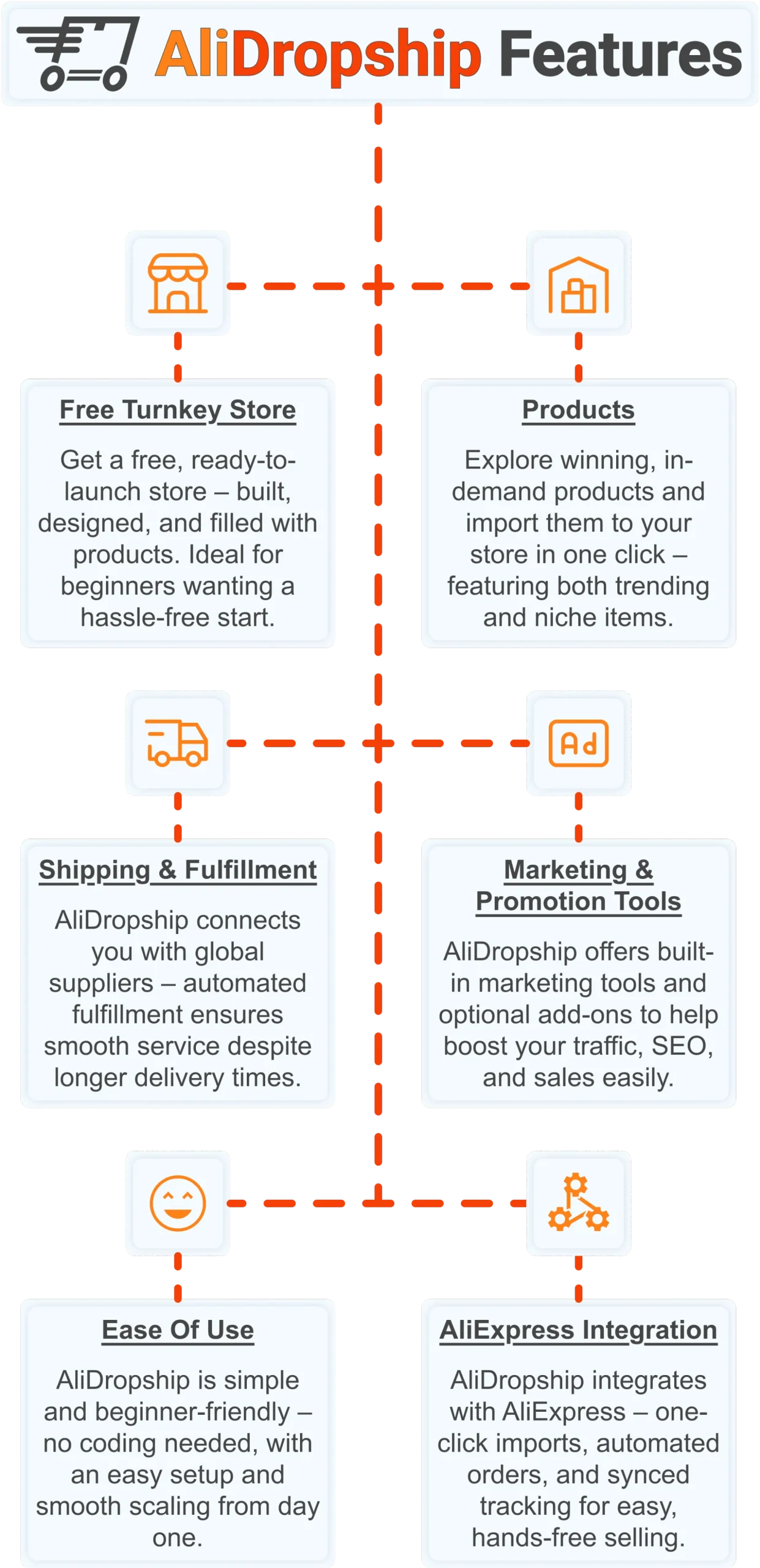
Free turnkey store ️
Get a free turnkey store – built, designed, and filled with products. Ideal for beginners wanting a hassle-free start, the store comes fully optimized to attract customers right away, saving you time on setup. Plus, it includes professional design elements to give your business a polished, trustworthy look from day one. This ready-made foundation makes it easy to move seamlessly into product selection.
Products
Once your store is set up, you can explore winning, in-demand products and import them in one click – featuring both trending and niche items. This wide selection lets you cater to diverse customer interests and test what works best. Regular updates ensure you always have fresh products, keeping your store competitive and relevant. With great products in place, smooth shipping becomes the next essential step.
Shipping & fulfillment
AliDropship connects you with global suppliers, and automated fulfillment ensures seamless order processing despite international delivery times. Customers receive real-time tracking updates, which builds confidence and trust in your store. Once shipping is handled reliably, you can focus on promoting your store and attracting traffic.
Marketing & promotion tools
To maximize sales, AliDropship offers built-in marketing tools and optional add-ons that help boost traffic, SEO, and conversions. From email campaigns and discounts to social media integration, these tools empower you to reach and retain customers without needing prior marketing experience. With promotion strategies in place, managing your business becomes simpler and more efficient.
Ease of use
AliDropship is beginner-friendly – no coding needed, with an intuitive dashboard that guides you through every step. Easy setup and smooth scaling let you expand your store without stress. As your business grows, adding new features, products, and marketing campaigns remains hassle-free, giving you more time to focus on sales.
AliExpress integration
Finally, AliDropship integrates seamlessly with AliExpress, enabling one-click imports, automated orders, and synced tracking. Your inventory stays up-to-date with the latest products and prices, while automated order processing frees you from manual tasks. Combined with the turnkey setup, reliable shipping, and built-in marketing tools, this integration ensures your dropshipping business is fully equipped for growth and success.
Frequently asked questions
How does affiliate marketing work in simple terms?
Affiliate marketing works by giving you a unique tracking link to place in your content, so when a reader clicks it and completes a purchase, the merchant credits your account with a commission. The process runs through an affiliate network or in house program that handles tracking, attribution, and payouts. A tracking cookie records the referral, and cookie windows typically last between 24 hours and 90 days. Global affiliate marketing spend is projected to surpass 15 billion dollars this year, which shows how widely merchants rely on this performance based model.
How much money can a beginner earn from affiliate marketing?
Most beginners running a blog or a small social account earn around 30 to 80 dollars per month during their first six months of consistent output. Crossing 500 dollars per month usually takes 12 to 18 months of sustained effort in a focused niche. Earnings vary by method, with YouTube channels averaging 100 to 1000 dollars per month by year one or two. A realistic benchmark for most part time affiliates after 12 months is 200 to 800 dollars per month.
What affiliate marketing models pay the highest commissions?
There are four main affiliate marketing models, and recurring commissions tend to pay the most over time. Pay per sale commissions range from 1 percent on some Amazon categories up to 50 percent or more on digital products and SaaS tools. Recurring commission programs often pay 20 to 40 percent every month a referred customer stays subscribed. Pay per click is the weakest model, earning only fractions of a cent to a few cents per click.
What are the key steps to start affiliate marketing from scratch?
Starting affiliate marketing involves six main steps, beginning with choosing a niche that has real search volume and buyer intent. Next comes finding affiliate programs through networks such as ShareASale or Impact, then building a platform like a blog, YouTube channel, or email newsletter. From there you create content, drive traffic through channels like SEO or email, and track performance using dashboards showing clicks and conversions. SEO content generally takes 3 to 9 months to build momentum but produces the most durable long term traffic.
What legal rules must affiliate marketers follow to stay compliant?
Affiliate marketers in the United States must disclose paid relationships under FTC regulations, and similar disclosure rules apply in the EU, UK, and Australia. Practices such as cookie stuffing, fake reviews, and misleading income claims are considered fraud or deceptive advertising and can get an affiliate account permanently banned. A short disclosure statement near the top of content, such as noting that a purchase through a link may earn a commission, satisfies FTC requirements. Google has also targeted thin, untrustworthy affiliate content in recent core algorithm updates, making transparent disclosure important for search rankings too.
Understanding how affiliate marketing works is a great first step – but if you’re ready to own your income stream rather than earn a cut of someone else’s, dropshipping gives you that control from day one. Get your free AliDropship store and start building a business that is entirely yours.
 Previous post
