 ‧ Agnes Kazaryan ‧
March 21, 2026
‧ Agnes Kazaryan ‧
March 21, 2026  853 ‧
853 ‧
 0
0
Most people think starting a clothing brand means factory contracts, warehouses full of stock, and a budget with too many zeros. In 2026, none of that is true anymore. The barriers to launching a fashion label have dropped dramatically – and thousands of people are building real clothing brands right now from their laptops, with a clear niche, a handful of products, and a reliable supply chain they never have to touch.
Quick answer: To start a clothing brand, you need a defined niche, a sourcing method (dropshipping, print-on-demand, or private label), an online store, and a consistent marketing strategy. Most beginners can launch within 30–60 days on a budget of $200–$500.
This guide walks you through every step of how to start a clothing brand in 2026 – what actually works, what to skip, and how to build something sustainable without overcomplicating the launch.
What starting a clothing brand actually means in 2026
A clothing brand is not just a logo on a t-shirt. It is a combination of a visual identity, a defined audience, a curated product line, and a consistent message that makes customers choose you over a faceless retailer. In 2026, clothing brands are launched by solo entrepreneurs, side-hustlers, and small teams – not just fashion designers with industry connections.
The business model you choose shapes everything about how you operate. The three most common entry points are:
- Print-on-demand – You design the products. A third-party supplier prints and ships them when an order comes in. No inventory, low upfront cost, lower margins.
- Dropshipping – You sell products sourced from suppliers who ship directly to your customers. You curate the catalog, set the prices, and handle marketing. No inventory needed.
- Private label / wholesale – You order physical stock, apply your branding, and ship it yourself or through a fulfillment center. Higher margins but requires upfront capital and storage space.
For most beginners, dropshipping and print-on-demand are the fastest and least risky entry points. You validate demand before investing heavily in inventory, and you can test multiple niches without locking yourself into one product run.
Why this works in 2026: Consumer demand for independent and niche fashion labels is growing. Shoppers are actively moving away from mass-market brands and seeking out smaller, more specific labels – which is exactly the gap you can fill.
How much can you realistically earn from a clothing brand?
Income from a clothing brand varies widely depending on your niche, model, marketing effort, and how long you have been operating. Here is an honest breakdown of what different stages typically look like:
Print-on-demand is the easiest entry point but typically carries the tightest margins – $3–$8 profit per item is common. Dropshipping offers more flexibility in pricing and product selection, with $500–$5,000/month realistic after 60–90 days of consistent effort. Private label has the highest ceiling but requires real upfront investment.
One note on these figures: The top-end numbers reflect stores that have been operating for 6–12 months with active paid or organic traffic. In your first 30–60 days, focus on making your first 5–10 sales rather than chasing four-figure revenue. That foundation is what the bigger numbers are built on.
How to start a clothing brand step by step
Here is the practical roadmap for launching a clothing brand in 2026. Each step builds on the last – do not skip the early stages in a rush to get to the store launch.
Step 1 – Find your niche and define your audience
The biggest mistake new clothing brand owners make is trying to sell to everyone. “Streetwear for men aged 18–35” is not a niche. “Streetwear for competitive gamers who want comfortable, stylish fits they can wear at LAN events and on camera” is a niche. The narrower your focus, the easier every subsequent step becomes.
Good clothing niches in 2026 tend to share a few qualities: they have a passionate community, an identifiable aesthetic, and they are underserved by the big fast-fashion players. Think gym wear for powerlifters, modest fashion for active Muslim women, workwear-inspired casualwear for tradespeople, or nature-themed apparel for trail runners.
To validate a niche before you invest in it, search it on Reddit and TikTok to check whether there is an active community discussing fashion within it. Check Google Trends for related keywords to see whether interest is stable or growing. Look at what the top Etsy sellers in that space are charging and which products move fastest.
Important: Do not just chase what is trending right now. A niche with consistent 12-month demand is far more valuable than a 6-week viral spike.
Step 2 – Choose your business model and sourcing method
Once you know your niche, pick the sourcing model that matches your budget, timeline, and risk tolerance. For most beginners, dropshipping or print-on-demand is the right call – you test before you invest, and you do not need to tie up cash in stock.
Dropshipping clothing
With dropshipping, you list clothing items from suppliers in your store, set your own prices, and the supplier ships directly to your customer when an order comes in. You never touch the product. Platforms like AliExpress have a massive catalog of clothing items across every niche, and tools like AliDropship make it straightforward to import products, automate fulfillment, and manage your store without any coding knowledge.
The key advantage here is speed and flexibility – you can test 20 different products in a week and double down on what actually converts.
Print-on-demand
Print-on-demand (POD) is ideal if original designs are the core of your brand offer. You create designs, apply them to blank garments via a POD supplier such as Printful or Printify, and they produce and ship each order individually. Margins are lower than dropshipping, but you own a completely unique product from day one.
Earning potential: $200–$1,500/month for a focused niche store with consistent social media or SEO traffic after 60–90 days.
Private label (when you are ready to scale)
Private label means ordering blank or custom-manufactured garments, branding them with your label, and either warehousing them yourself or using a third-party logistics provider. This is not the right starting point for most beginners – it requires $1,000–$5,000+ upfront for minimum order quantities, and you carry the inventory risk. Consider it once you have proven a product sells consistently through dropshipping or POD first.
Step 3 – Build your brand identity
Your brand identity is the visual and verbal language that makes your clothing brand instantly recognizable – your name, logo, color palette, typography, and the tone of voice you use in product descriptions, social captions, and emails. Getting this right does not require a professional agency, but it does require intention.
Naming your brand
A good clothing brand name is short (one or two words), easy to spell, memorable, and available as a domain and social handle. Check name availability on Namecheap or GoDaddy and across Instagram, TikTok, and Pinterest before committing. Avoid generic names like “Urban Style Co.” that tell the customer nothing about the niche or vibe.
Visual identity basics
You do not need a designer for your first logo. Tools like Canva, Looka, and Adobe Express let you build a clean, professional-looking logo in under an hour. Stick to two or three brand colors and one or two fonts used consistently across all touchpoints. Consistency matters far more than complexity at this stage.
Brand voice
Your brand voice is how you talk to your audience. Is it bold and edgy? Calm and minimalist? Friendly and inclusive? Define it clearly – and then apply it to every product description, email, and social post. Customers who connect with a brand voice become repeat buyers.
Setting up your store and sourcing products
Your store is the engine of the business. Everything else – branding, marketing, supplier relationships – feeds into it. In 2026, you have several solid platform options to choose from.
Step 4 – Set up your online store
WordPress with AliDropship is the best option for long-term control, SEO potential, and dropshipping automation. You own your store completely, with no ongoing platform percentage fees eating into your margins. Shopify is beginner-friendly and fast to set up, but charges a monthly fee plus transaction fees that compound as you scale. Etsy works well for print-on-demand and handmade brands, but you are renting space on someone else’s platform and competing directly with thousands of similar stores.
For a dropshipping clothing brand with long-term SEO goals, a self-hosted WordPress store powered by AliDropship gives you the most flexibility and the lowest ongoing costs. You control your product listings, your customer data, and your store design – with no revenue share taken by the platform.
Step 5 – Source and select your products
Product selection is where a lot of clothing brands go wrong. They add 200 products to the store on launch day and wonder why nothing sells. Start smaller and smarter.
Aim for 15–30 focused products that fit your niche tightly. Look for items with strong imagery, clear size guides, reliable shipping times, and a sufficient margin – aim for at least a 2x markup on your cost price, and ideally 3x or more.
When evaluating clothing products on AliExpress for a dropshipping brand, check the following: order volume (high counts signal proven demand), seller ratings (4.7 stars or above with 100+ reviews is a solid baseline), shipping times to your target market (ePacket or AliExpress Standard Shipping to the US and EU typically runs 10–20 days), and return policy clarity before you promise anything to customers.
Step 6 – Price your products for profit
Pricing a clothing brand is part science, part positioning. Price too low and you signal low quality – which is a credibility killer in fashion. Price too high without the brand authority to back it up and you lose sales to competitors.
A practical starting formula for dropshipping clothing: add your product cost and shipping cost to get your base cost, then multiply by 2.5–3.5x to get your retail price. Factor in payment processing fees (typically 2.9% + $0.30 per transaction on Stripe or PayPal) and check whether your price is competitive within your niche by searching similar products on Instagram and competitor stores.
Important note: Do not try to compete on price with AliExpress directly. Your value is the curated brand experience, the targeted niche, and the trust signals your store provides – not a race to the lowest price.
How to market your clothing brand in 2026
A great store with no traffic makes zero sales. Marketing is not optional – it is where most of your early effort should go once the store is live. In 2026, the highest-ROI channels for a new clothing brand are the ones below.
TikTok and Instagram organic
Fashion is one of the most visual, shareable categories on social media. A single well-produced TikTok showing your products in a real-life context can drive hundreds of store visits overnight. Post consistently – aim for 3–5 times per week – and focus on content that shows the garments being worn, not just flat-lay product shots. Trending audio, genuine reactions, and “get the look” videos perform particularly well.
Influencer and micro-influencer partnerships
Micro-influencers with 10,000–100,000 followers in your specific niche often have significantly higher engagement rates than mega-influencers, and many will collaborate in exchange for free product rather than a cash fee at the early stage. Find influencers whose aesthetic already aligns with your brand – the content will feel authentic rather than forced, and their audience will be receptive.
SEO and content marketing
If you build your store on WordPress, you have a significant long-term advantage: organic search traffic. Writing niche-specific blog posts targeting keywords your audience is already searching – “best gym wear for powerlifters” or “modest activewear guide” and similar – can drive consistent free traffic month after month. SEO results take 3–6 months to compound, but the payoff is a store that ranks and earns without ongoing ad spend.
Paid ads (once you have proven product-market fit)
Facebook and Instagram ads remain effective for fashion brands in 2026, particularly for retargeting visitors who have already shown interest. TikTok Ads are growing fast and tend to have lower CPMs for fashion content. The key rule: do not run paid ads until you have made at least 10–20 organic sales. Paid traffic amplifies what is already working – it does not fix a store or offer that is not converting yet.
Earning potential: $500–$5,000/month for a clothing dropshipping store with a solid social media presence and basic SEO after 90 days of consistent effort.
Common mistakes to avoid when starting a clothing brand
Most clothing brand failures are predictable – and preventable. Here are the patterns most worth watching out for.
Trying to serve too broad an audience
Generic fashion brands compete directly with Zara, SHEIN, and Amazon – and lose. The narrower your niche, the less competition you face and the easier it is to build a loyal following. “Activewear” is a category. “Activewear for plus-size women who lift” is a brand.
Copying a competitor’s brand visually
Inspiration is fine. Direct copying – using similar logos, identical colorways, or near-identical brand names – creates legal exposure and destroys brand trust if customers notice. Build something that is distinctly yours.
Ignoring product quality and sizing accuracy
In clothing, sizing inaccuracies and poor fabric quality are the fastest way to generate refund requests and negative reviews. Always order samples before adding a product to your main catalog. Check the actual measurements against the size chart. If a supplier’s sizing runs small by two European sizes, your customers will find out – and they will tell everyone.
Launching without any brand story
People do not just buy clothes – they buy into the identity and story behind the brand. If your About page says nothing more than “we sell quality clothing at affordable prices,” you are leaving a major conversion lever unused. Tell a real story: why this niche, why now, what the brand stands for.
Key principle: Authenticity converts better than polish in 2026. A genuine brand story told simply outperforms a generic pitch dressed up in expensive design.
How to choose your approach based on where you are right now
Not everyone who wants to start a clothing brand is in the same position. Here is an honest breakdown by reader profile to help you identify the right entry point for where you are right now.
Complete beginner – no budget, no experience
Start with print-on-demand. The upfront cost is essentially zero – you only pay when an order comes in. Focus on one niche, create 10–15 designs, set up a free store on Printify or a basic WordPress site, and drive traffic through organic TikTok or Instagram. Expect your first sale within 30–45 days if you post consistently. Revenue in the first 90 days will likely be $0–$300, but you will learn the fundamentals without any financial risk.
Intermediate – small budget of $200–$1,000, some online experience
A dropshipping model via AliDropship gives you a faster path to real revenue. Use your budget for a proper domain and hosting, a premium store theme, and a small amount of paid promotion – influencer gifting or a modest TikTok ad budget once you have your first 10 organic sales. Focus on a single niche with 20–30 curated products. At this level, $500–$2,000/month is achievable within 90–120 days with consistent effort.
Advanced – full-time ambition, $1,000+ to invest
Start with dropshipping to validate your niche and identify your best-selling products. Once you have three to five consistent bestsellers, transition those specific items to private label – order a small custom run, get your own label sewn in, and increase your margin. Run paid ads on Meta and TikTok to scale what is already proven. A well-executed clothing brand at this level can generate $5,000–$15,000+/month within 12 months, though this requires full-time marketing effort and ongoing product development.
Whichever profile fits you now, the most important move is the first one – getting your store live, your first product listed, and your first piece of content out into the world. The learning accelerates dramatically once you are operating a real store with real products.
AliDropship: Your complete all-in-one solution for starting dropshipping in 2026
If you want the simplest possible way to start dropshipping – especially if you’re brand new – AliDropship remains one of the most beginner-friendly tools available in 2026. It brings together store creation, product imports, automation, and marketing into a single streamlined system designed to help you launch quickly and grow confidently.
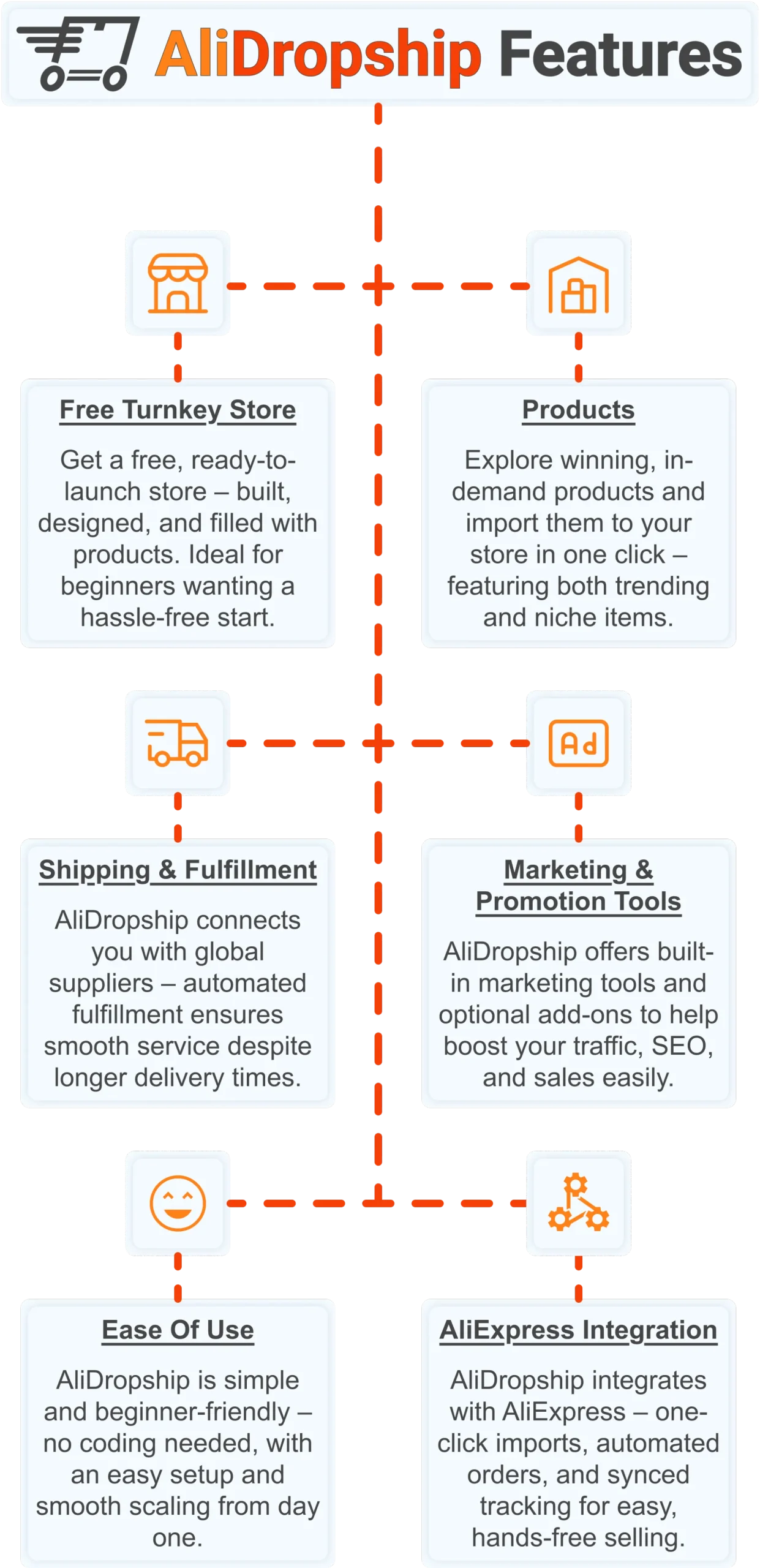
Free turnkey store ️
Get a free turnkey store – built, designed, and filled with products. Ideal for beginners wanting a hassle-free start, the store comes fully optimized to attract customers right away, saving you time on setup. Plus, it includes professional design elements to give your business a polished, trustworthy look from day one. This ready-made foundation makes it easy to move seamlessly into product selection.
Products
Once your store is set up, you can explore winning, in-demand products and import them in one click – featuring both trending and niche items. This wide selection lets you cater to diverse customer interests and test what works best. Regular updates ensure you always have fresh products, keeping your store competitive and relevant. With great products in place, smooth shipping becomes the next essential step.
Shipping & fulfillment
AliDropship connects you with global suppliers, and automated fulfillment ensures seamless order processing despite international delivery times. Customers receive real-time tracking updates, which builds confidence and trust in your store. Once shipping is handled reliably, you can focus on promoting your store and attracting traffic.
Marketing & promotion tools
To maximize sales, AliDropship offers built-in marketing tools and optional add-ons that help boost traffic, SEO, and conversions. From email campaigns and discounts to social media integration, these tools empower you to reach and retain customers without needing prior marketing experience. With promotion strategies in place, managing your business becomes simpler and more efficient.
Ease of use
AliDropship is beginner-friendly – no coding needed, with an intuitive dashboard that guides you through every step. Easy setup and smooth scaling let you expand your store without stress. As your business grows, adding new features, products, and marketing campaigns remains hassle-free, giving you more time to focus on sales.
AliExpress integration
Finally, AliDropship integrates seamlessly with AliExpress, enabling one-click imports, automated orders, and synced tracking. Your inventory stays up-to-date with the latest products and prices, while automated order processing frees you from manual tasks. Combined with the turnkey setup, reliable shipping, and built-in marketing tools, this integration ensures your dropshipping business is fully equipped for growth and success.
Frequently asked questions
What do I need to start a clothing brand in 2026?
To start a clothing brand you need a defined niche, a sourcing method such as dropshipping, print on demand, or private label, an online store, and a consistent marketing strategy. Most beginners can launch within 30 to 60 days on a budget of 200 to 500 dollars. The three main sourcing models differ in upfront cost and risk, with print on demand and dropshipping requiring no inventory. Private label requires more capital, often 1000 to 5000 dollars or more for minimum order quantities, but offers the highest profit ceiling.
How much money can a clothing brand realistically make?
Print on demand typically earns 200 to 1500 dollars per month but carries the tightest margins, often just 3 to 8 dollars profit per item. Clothing dropshipping offers more flexibility and can reach 500 to 5000 dollars or more per month after 60 to 90 days of consistent effort. Private label has the highest ceiling, ranging from 1000 to 15000 dollars or more per month, but requires real upfront investment and inventory risk. These top end figures generally reflect stores that have been operating for 6 to 12 months with active traffic.
What is the difference between dropshipping and print on demand for a clothing brand?
With dropshipping, you list clothing items from suppliers who ship directly to customers, so you never touch inventory and can test around 20 different products in a single week. Print on demand involves creating original designs applied to blank garments by a supplier such as Printful or Printify, producing lower margins but a completely unique product from day one. Dropshipping suits brands prioritizing speed and catalog variety, while print on demand suits brands built around original artwork. Both models let you validate demand before committing to the higher cost of private label manufacturing.
How should I price my clothing brand products for profit?
A practical pricing formula is to add your product cost and shipping cost together to get a base cost, then multiply that number by 2.5 to 3.5 times to set your retail price. Aim for at least a 2x markup on cost price, and ideally 3x or more, when selecting which products to sell. Payment processing fees typically run around 2.9 percent plus 30 cents per transaction on platforms like Stripe or PayPal, so factor those into your margin. Checking similar products on Instagram and competitor stores helps confirm your price stays competitive within your specific niche.
What are the biggest mistakes to avoid when starting a clothing brand?
Trying to serve too broad an audience puts a new brand in direct competition with giants like Zara and SHEIN, which is a fight most beginners lose. Copying a competitors visual identity, such as similar logos or near identical brand names, creates legal exposure and damages customer trust. Ignoring sizing accuracy is a fast way to generate refund requests, so ordering samples and checking measurements against the size chart before listing a product is essential. Launching without any brand story leaves a major conversion lever unused, since customers buy into an identity and not just a garment.
Starting a clothing brand with dropshipping means you can build a real fashion label without the inventory risk, upfront capital, or factory negotiations that used to make fashion entrepreneurship out of reach. Get your free turnkey store today and launch your clothing brand the smart way.
 Previous post
