 ‧ Agnes Kazaryan ‧
March 22, 2026
‧ Agnes Kazaryan ‧
March 22, 2026  602 ‧
602 ‧
 0
0
About 36% of U.S. workers now do at least some remote work. But a growing number of people are taking it further than that. They are not just working from home for an employer. They are building a full business at home and cutting the commute, the boss, and the rigid schedule out of their lives for good. If that is what you are seriously considering, this guide is for you.
This is not a list of 47 side hustles. Instead, this article walks through the most realistic home business models available in 2026 – organized by type, honest about income ranges, and direct about what it actually takes to replace a salary without leaving the house.
Quick answer: A business at home is any income-generating activity you run independently from your own property – no office, no commute, no employer. The most viable models in 2026 fall into three categories: service-based (selling your skills), product-based (selling physical or digital goods), and passive (income that scales beyond your working hours). Realistically, replacing a $3,000–$5,000/month salary takes 6–18 months of consistent effort depending on the model you choose.
The good news is that the barrier to entry has never been lower. Free tools, global marketplaces, and platforms like AliDropship have removed almost every obstacle that used to make starting a home business complicated or expensive. What remains is the part no tool can do for you – choosing the right model and showing up consistently.
What is a business at home?
A business at home is a legitimate, income-generating operation you run from your own property without being employed by someone else. It can be a solo freelance practice, an ecommerce store, a content channel, a coaching service, or a digital product business. The defining feature is that you own it, you set the hours, and you keep the profit.
What separates a home business from a side hustle in 2026 is intent and infrastructure. A side hustle is something you do occasionally to earn extra cash. A home business is something you build deliberately to replace or exceed your current income – with systems, branding, and a growth plan behind it.
The concept has moved from fringe to mainstream. According to U.S. Census Bureau data, over 15 million Americans now report running a home-based business as their primary occupation. That number has grown steadily since 2020 and continues to climb as remote-friendly tools and global ecommerce platforms make it possible to operate professionally without a commercial address.
Why this works in 2026: The combination of global logistics infrastructure, AI-assisted content creation, and plug-and-play ecommerce tools means a single person working from home can now operate at a scale that previously required an entire team.
How much can you realistically earn from a home business?
Income from a home business varies enormously by model, time invested, and how quickly you build an audience or customer base. The table below gives an honest overview of realistic earning ranges across the three main categories.
Service businesses generate income fastest – sometimes within the first week – but they cap out at your available hours. Product-based businesses take longer to build but can scale well beyond your time. Passive models take the longest to produce meaningful revenue but require the least ongoing effort once they are established.
One note on the top figures: The $15,000/month ecommerce figure is real but not typical for year one. Most home ecommerce stores earn $500–$2,500/month in their first six months, with growth accelerating as marketing compounds. Full-time effort – meaning 30–40 hours per week on store operations and promotion – is what separates stores that plateau from those that grow past $5,000/month.
The honest benchmark for replacing a job: most home business owners who successfully replace a $40,000–$60,000 annual salary do it within 12–24 months, with ecommerce and freelancing being the two most common paths. Communities like r/Entrepreneur and r/dropship on Reddit are full of real documented journeys if you want to see what that trajectory actually looks like.
Service-based home businesses
If you want income fast and you already have a marketable skill, service-based businesses are the quickest path to replacing your first paycheck. You are selling your expertise directly to clients – no inventory, no shipping, and minimal startup cost. The tradeoff is that your income is tied to your hours, which creates a ceiling you will eventually want to break through.
Freelancing
Writing and content creation
Content writing, copywriting, and SEO writing are among the most accessible home business options available. Businesses of every size need content constantly – blog posts, product descriptions, email sequences, and social media copy – and demand has not slowed down.
Platforms like Upwork and Fiverr give you immediate access to clients while you build a portfolio. Rates range from $0.05/word for entry-level work to $0.30–$0.50/word for experienced SEO writers, with many full-time freelance writers reaching $3,000–$6,000/month within their first year.
Earning potential: $1,500–$6,000/month depending on niche and client base.
Graphic design and video editing
Visual skills are in constant demand across social media, branding, and digital marketing. If you can use tools like Adobe Creative Suite, Canva Pro, or CapCut at a professional level, there is a steady market for you on platforms like 99designs and DesignCrowd, or through direct outreach on LinkedIn.
Video editing has become particularly well-paid as YouTube and short-form content have made video production an ongoing operational cost for most content-driven businesses. Experienced editors typically charge $50–$150/hour, and retainer arrangements with regular clients are common once you establish trust.
Earning potential: $2,000–$8,000/month for designers and editors with solid portfolios.
Virtual assistance and admin support
Virtual assistants handle tasks like inbox management, scheduling, research, data entry, and customer support for busy entrepreneurs and small business owners. It is one of the most accessible entry points for people who do not yet have a specialized skill set.
Rates typically start at $15–$25/hour for generalist VAs and rise to $40–$75/hour for those specializing in areas like social media management, bookkeeping, or project coordination. Platforms like Belay, Time Etc, and Zirtual actively connect VAs with clients who are hiring.
Earning potential: $1,500–$4,500/month full-time.
Consulting and coaching
Business and marketing consulting
If you have worked professionally in marketing, finance, HR, operations, or any other business function, you can package that experience as consulting services. Businesses – particularly small and mid-sized ones – regularly hire independent consultants for projects they cannot justify a full-time hire for.
Rates for business consultants range from $75–$300/hour depending on niche and credentials. Building a presence on LinkedIn and publishing regular case studies or insights are the most effective client acquisition strategies for this model.
Earning potential: $3,000–$12,000/month for consultants with demonstrable track records.
Online coaching and tutoring
Coaching – whether for fitness, career development, language learning, or personal productivity – has grown into a multi-billion dollar industry, most of it delivered entirely over Zoom from home offices. Platforms like Coach.me and Teachable help coaches find clients and structure programs.
One-on-one coaching rates range from $50–$300/session; group programs can generate $500–$5,000 per cohort. Academic tutoring through platforms like Wyzant or Tutor.com provides steady part-time income, and subject specialists with test prep expertise can earn $80–$150/hour.
Earning potential: $2,000–$10,000/month for coaches with an established niche and client pipeline.
Product-based home businesses
Product-based businesses are where the ceiling lifts. Instead of trading time for money, you build a system – a store, a supply chain, a marketing funnel – that generates revenue independently of how many hours you personally work on any given day. The tradeoff is that they take longer to get off the ground and require more upfront learning. But the scalability is what makes them appealing for anyone whose real goal is replacing a full-time salary.
Ecommerce and dropshipping
Dropshipping from home
Dropshipping is one of the most popular home business models because it removes the biggest traditional barrier to selling products: inventory. You set up an online store, list products from suppliers, and when a customer places an order, the supplier ships directly to them. You never touch the stock. Your job is running the store and driving traffic to it.
The model is particularly well-suited to people leaving full-time employment because operational overhead is low and the whole thing can be managed from a laptop. AliDropship users on Trustpilot frequently describe exactly this kind of transition – starting a store while still employed and scaling to full-time income over 6–12 months. Profit margins on dropshipping typically run 15–40% depending on product category and pricing strategy.
Earning potential: $500–$10,000+/month depending on niche, ad spend, and marketing consistency.
Print-on-demand
Print-on-demand works on a similar principle to dropshipping – you sell products online without holding inventory, and a third party fulfills the order. The difference is that the products carry your custom designs: t-shirts, mugs, phone cases, wall art, and similar items.
Platforms like Printful and Printify integrate directly with Shopify and Etsy. Margins are lower than traditional ecommerce (typically 20–30%), and success depends heavily on design quality and niche targeting. It is a solid option for creatives who want a product business without deep ecommerce knowledge.
Earning potential: $300–$3,000/month for most stores; higher for shops with strong design followings.
Handmade and craft selling
If you make physical products – jewelry, candles, ceramics, woodwork, skincare – Etsy remains the dominant marketplace with over 95 million active buyers. The platform handles discoverability, payments, and a portion of the marketing.
The limitation is production capacity: as a one-person home operation, your output caps your revenue unless you hire help or move to wholesale. Etsy shop owners in established niches report earning $1,000–$5,000/month once their listings rank and reviews accumulate. Shipping and material costs eat into margins, so pricing correctly from the start matters a lot.
Earning potential: $800–$4,000/month for well-reviewed shops in competitive niches.
Digital products
Ebooks, templates, and downloadable resources
Selling digital products – ebooks, Notion templates, Canva templates, spreadsheet tools, guides, or printables – is a genuinely low-overhead home business model. You create the product once and sell it indefinitely. Gumroad, Payhip, and Etsy are the most common platforms for digital product sellers.
The challenge is discoverability: without an existing audience or strong SEO, sales are slow. Creators who pair digital products with content marketing – a blog, YouTube channel, or Pinterest presence – see significantly better results. Successful sellers in popular niches like personal finance or productivity routinely report $1,000–$4,000/month in passive revenue after 12–18 months of building.
Earning potential: $200–$4,000/month depending on audience size and niche demand.
Online courses and memberships
Packaging your knowledge into a structured online course is one of the highest-leverage home business models in 2026. Platforms like Teachable, Podia, and Kajabi handle the technical side – hosting, payment processing, student management – so you can focus on the content itself.
Course prices typically range from $97 for entry-level mini-courses to $997+ for comprehensive programs. A course with 100 students at $297 each generates nearly $30,000, and once built, the core content only needs minor updates over time.
The honest caveat: building an audience that trusts you enough to buy takes time. Most successful course creators spent 12–24 months building credibility before their first major launch.
Earning potential: $1,000–$20,000+ per launch for creators with established audiences.
Passive home businesses
Passive income from home is real – but it is almost never truly passive from day one. Every model in this category requires significant upfront effort before income becomes consistent and predictable. The payoff is that once they hit scale, these businesses continue generating revenue when you are not actively working, which is what makes them genuinely life-changing over the long run.
Content and affiliate marketing
Blogging and SEO content sites
A content website that ranks in Google and earns through display advertising and affiliate commissions is one of the oldest and most proven passive home business models. The economics are straightforward: you produce articles targeting search queries, those articles attract organic traffic, and that traffic converts into ad revenue and affiliate clicks. A site earning $3,000–$5,000/month in display ad revenue typically needs 100,000–200,000 monthly pageviews, which generally takes 18–36 months of consistent publishing to achieve. Income compounds as content ages and domain authority builds – sites that break through regularly earn $10,000–$50,000/month at full maturity.
Earning potential: $500–$10,000+/month for established sites; expect a slow ramp of 18–36 months.
YouTube and video content
YouTube channels monetize through ad revenue, sponsorships, and affiliate links. The YouTube Partner Program requires 1,000 subscribers and 4,000 watch hours before monetization activates – a milestone most new channels reach within 6–18 months of consistent uploads. Revenue per 1,000 views ranges from $2–$15 depending on niche; finance, business, and tech content command the highest rates. Channels that combine AdSense with affiliate marketing and a product or course offering can earn significantly more than ad revenue alone suggests. Many home business owners on Reddit’s r/NewTubers document their growth publicly if you want realistic benchmarks.
Earning potential: $500–$8,000+/month for channels with 50,000–200,000 subscribers.
Affiliate marketing
Affiliate marketing – promoting other companies’ products and earning a commission on each sale – works best as a complement to a content business. Standalone affiliate marketing without an existing platform is harder to scale, but paired with a blog, YouTube channel, or email list it becomes a reliable income stream. Amazon Associates, ShareASale, and individual brand affiliate programs are the most accessible entry points. Commission rates range from 1–4% for physical products to 20–50% for digital products and SaaS tools, many of which pay recurring monthly commissions. Established affiliate marketers with strong organic traffic regularly earn $2,000–$8,000/month.
Earning potential: $500–$8,000/month for content creators with established traffic or audiences.
Investing and asset-based income
Dividend investing and index funds
Dividend investing and index fund portfolios generate passive income through regular payouts. While not a business in the traditional sense, many home-based entrepreneurs build investment portfolios alongside their primary business as a secondary income stream. A $100,000 portfolio invested in dividend ETFs like SCHD or VYM generates roughly $3,500–$4,500/year at current yields – meaningful supplemental income, but not a salary replacement on its own. The honest framing: investing works best as a long-term wealth-building layer rather than a primary strategy for replacing a job in the near term.
Earning potential: $200–$1,500/month depending on portfolio size; a $50,000+ portfolio is needed for meaningful monthly income.
Rental income and short-term hosting
Renting out a spare room, basement apartment, or secondary property through Airbnb or Vrbo is a legitimate home-based income stream. Average Airbnb hosts in mid-tier U.S. cities earn $900–$2,500/month per listing, though income varies significantly by location, occupancy rate, and property quality. Managing a rental is not entirely passive – cleaning, guest communication, and maintenance are real time commitments – but systems like automated messaging and professional cleaning services reduce the workload considerably. This model requires owning or controlling a rentable space, which limits its accessibility compared to purely digital business models.
Earning potential: $800–$3,000/month per listing depending on location and property type.
Legal and practical considerations for a home business
Running a legitimate business at home means treating it like a real business from a legal and financial standpoint. This is the section most guides gloss over – and it is the part that separates sustainable operations from those that hit a wall once they start to grow.
Business structure and registration
Most home businesses should register as a sole proprietorship or LLC (Limited Liability Company). A sole proprietorship requires no formal registration in most U.S. states but offers no personal liability protection. An LLC provides separation between your personal finances and business liabilities – important once you are earning meaningful revenue. Formation fees vary by state, typically $50–$500. LegalZoom and Northwest Registered Agent are two commonly used services for affordable LLC setup. Always consult a local accountant or attorney for advice specific to your state and business type.
Taxes and home office deductions
Home-based business owners in the U.S. can deduct a portion of home expenses – rent or mortgage interest, utilities, internet – as business expenses through the home office deduction. The IRS requires the space to be used regularly and exclusively for business. Self-employed individuals also pay self-employment tax (15.3% on net earnings), so setting aside 25–30% of revenue for taxes from the start is standard practice. Tracking income and expenses from day one – even with a simple spreadsheet – saves significant stress at tax time.
What to avoid
Key principle: Any home business model that promises income without effort, charges significant upfront fees to unlock earning potential, or relies on recruiting other participants is not a legitimate business – it is an MLM, pyramid structure, or outright scam.
Specifically: avoid multi-level marketing schemes dressed up as home businesses, any platform that requires a large starter kit purchase before you can earn, get-rich-quick trading systems, and any opportunity that cannot clearly explain how customer revenue is generated. The FTC and Better Business Bureau both maintain searchable databases of reported scams if you want to check a specific opportunity before committing.
Which home business is right for you?
The right model depends on your current situation – your available time, existing skills, financial runway, and income goals. Here is an honest breakdown by reader profile.
Complete beginner: If you have never run a business before and are not sure what skills you have to offer, product-based businesses – particularly dropshipping – are the most forgiving entry point. You do not need a specialized background. You need to learn one platform, one marketing channel, and one product niche. AliDropship gives beginners a fully built store with products already loaded, which removes most of the technical barrier. Plan for a 60–90 day learning curve and your first sales within weeks of launching.
Intermediate / part-time: If you are still working full-time and building toward an exit, the most practical approach is to start a home business that fits around your current schedule. Ecommerce stores – especially dropshipping with automation – are well-suited to this because they do not require you to be available during client hours. You can manage orders, run ads, and handle customer service in evenings and weekends. Many store owners reach $1,000–$2,000/month in their first 3–6 months while still employed, at which point the transition becomes financially viable.
Advanced / full-time goal: If your goal is to fully replace a $50,000–$80,000 annual salary from home within 12–18 months, the most proven paths are service businesses (high income, fast start, hour-limited) and ecommerce (slower start, unlimited ceiling). The most effective strategy is to combine both – launch a service business to generate immediate income, and build an ecommerce store simultaneously to create a parallel income stream that scales past your hourly limit. By month 12–18, the store typically contributes enough to reduce or eliminate the need for client work entirely.
AliDropship: Your complete all-in-one solution for starting dropshipping in 2026
If you want the simplest possible way to start dropshipping – especially if you’re brand new – AliDropship remains one of the most beginner-friendly tools available in 2026. It brings together store creation, product imports, automation, and marketing into a single streamlined system designed to help you launch quickly and grow confidently.
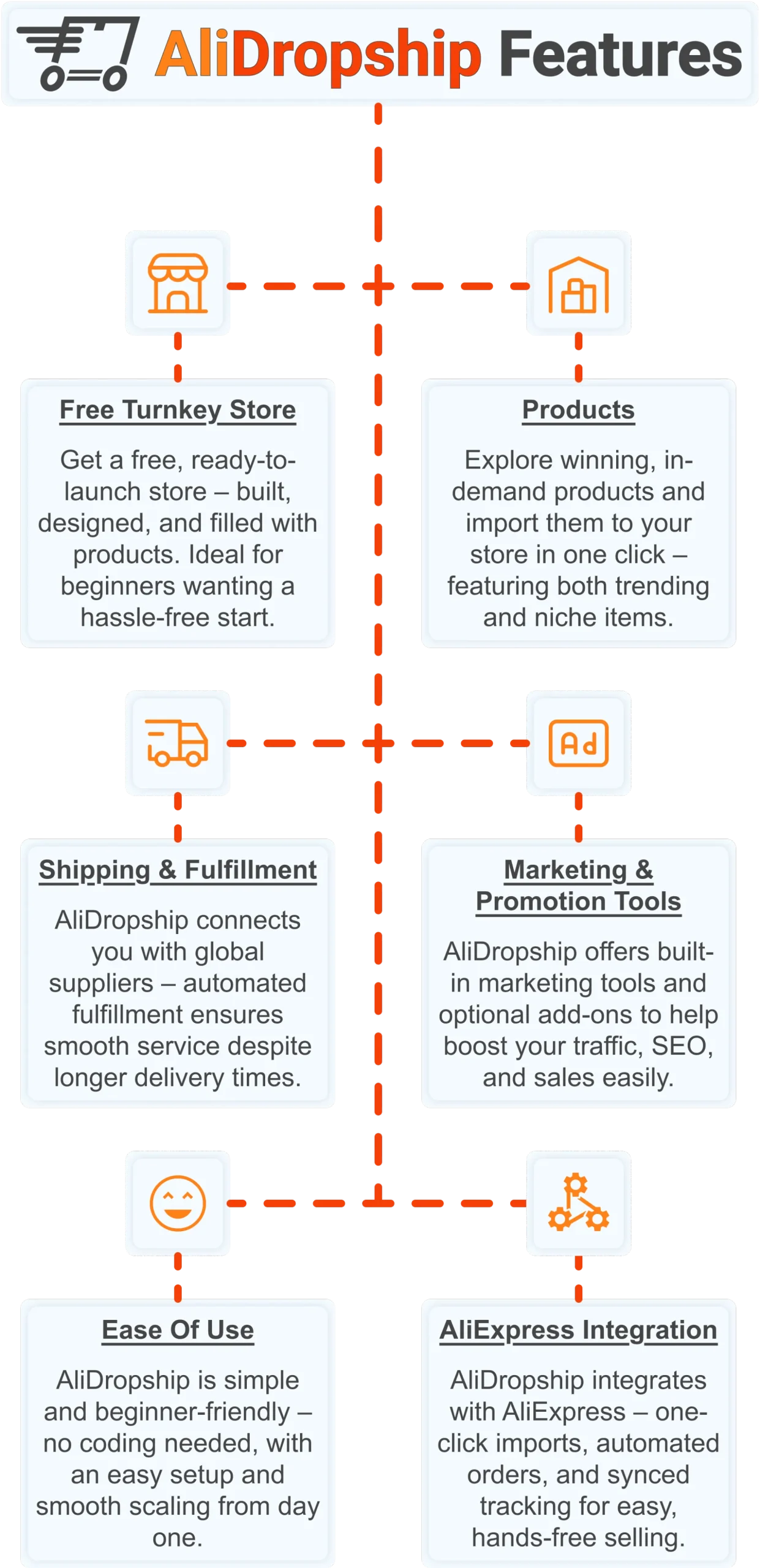
Free turnkey store ️
Get a free turnkey store – built, designed, and filled with products. Ideal for beginners wanting a hassle-free start, the store comes fully optimized to attract customers right away, saving you time on setup. Plus, it includes professional design elements to give your business a polished, trustworthy look from day one. This ready-made foundation makes it easy to move seamlessly into product selection.
Products
Once your store is set up, you can explore winning, in-demand products and import them in one click – featuring both trending and niche items. This wide selection lets you cater to diverse customer interests and test what works best. Regular updates ensure you always have fresh products, keeping your store competitive and relevant. With great products in place, smooth shipping becomes the next essential step.
Shipping & fulfillment
AliDropship connects you with global suppliers, and automated fulfillment ensures seamless order processing despite international delivery times. Customers receive real-time tracking updates, which builds confidence and trust in your store. Once shipping is handled reliably, you can focus on promoting your store and attracting traffic.
Marketing & promotion tools
To maximize sales, AliDropship offers built-in marketing tools and optional add-ons that help boost traffic, SEO, and conversions. From email campaigns and discounts to social media integration, these tools empower you to reach and retain customers without needing prior marketing experience. With promotion strategies in place, managing your business becomes simpler and more efficient.
Ease of use
AliDropship is beginner-friendly – no coding needed, with an intuitive dashboard that guides you through every step. Easy setup and smooth scaling let you expand your store without stress. As your business grows, adding new features, products, and marketing campaigns remains hassle-free, giving you more time to focus on sales.
AliExpress integration
Finally, AliDropship integrates seamlessly with AliExpress, enabling one-click imports, automated orders, and synced tracking. Your inventory stays up-to-date with the latest products and prices, while automated order processing frees you from manual tasks. Combined with the turnkey setup, reliable shipping, and built-in marketing tools, this integration ensures your dropshipping business is fully equipped for growth and success.
Frequently Asked Questions
What is a business at home?
A business at home is an income generating operation run independently from your own property, with no office, no commute, and no employer. It falls into three main categories: service-based work such as freelancing, product-based work such as ecommerce, and passive models such as content or affiliate marketing. According to U.S. Census Bureau data, over 15 million Americans now report running a home-based business as their primary occupation. About 36 percent of U.S. workers currently do at least some remote work, and a growing share are turning that into a full home business.
How much can you realistically earn from a home business?
Service-based home businesses such as freelancing and consulting typically earn between 1,500 and 8,000 dollars or more per month, since income is tied directly to hours worked. Product-based businesses such as ecommerce and dropshipping range from 500 to 15,000 dollars or more per month, though most home ecommerce stores earn between 500 and 2,500 dollars per month in their first six months. Passive models such as content sites and digital products range from 200 to 5,000 dollars or more per month, but usually take the longest to become consistent. Most home business owners who replace a 40,000 to 60,000 dollar annual salary do so within 12 to 24 months.
How much does dropshipping from home typically earn?
Dropshipping from home typically earns between 500 and 10,000 dollars or more per month, depending on niche, ad spend, and marketing consistency. Profit margins on dropshipping generally run between 15 and 40 percent depending on the product category and pricing strategy. Many store owners start a dropshipping business while still employed and scale it to full-time income over 6 to 12 months. Operational overhead is low since the business can be managed from a laptop without holding any inventory.
Should a home business register as an LLC?
Most home businesses register as either a sole proprietorship or an LLC, which stands for Limited Liability Company. A sole proprietorship requires no formal registration in most U.S. states, but it offers no personal liability protection. An LLC separates personal finances from business liabilities, which becomes important once meaningful revenue is coming in, and formation fees typically range from 50 to 500 dollars depending on the state. Self-employed individuals also pay a self-employment tax rate of 15.3 percent on net earnings, so setting aside 25 to 30 percent of revenue for taxes is standard practice.
Can a home business generate passive income?
Passive income from a home business is real, but it is almost never truly passive from day one and requires significant upfront effort. A content website earning 3,000 to 5,000 dollars per month in display ad revenue typically needs 100,000 to 200,000 monthly pageviews, which generally takes 18 to 36 months of consistent publishing to reach. YouTube channels need 1,000 subscribers and 4,000 watch hours before monetization activates, a milestone most channels reach within 6 to 18 months. Affiliate marketing commission rates range from 1 to 4 percent for physical products and 20 to 50 percent for digital products, with established affiliate marketers earning 2,000 to 8,000 dollars per month.
Running a business at home becomes far more achievable when you have the right infrastructure behind you – and AliDropship gives you exactly that from day one. Get your free turnkey store and start building a home business that works on your terms.
 Previous post
