 ‧ Agnes Kazaryan ‧
March 22, 2026
‧ Agnes Kazaryan ‧
March 22, 2026  714 ‧
714 ‧
 0
0
Over 2.77 billion people shop online today. The tools to build a real business from your spare bedroom have never been more accessible – and the barrier to entry has never been lower. If you have been wondering how to start an online business from home but keep getting stuck in research mode, this guide is going to cut through all of it.
You will find a straight comparison of every major home business model, what each one actually earns, and a step-by-step launch plan that works whether you have $0 or $500 to start with.
Quick answer: To start an online business from home, pick one proven model – dropshipping, digital products, or freelancing are the top three for 2026 – set up your platform, build a simple traffic plan, and launch within two weeks. Most people who stay consistent see their first sales within 30–60 days.
What does starting an online business from home actually mean?
An online business from home is any venture where you generate income through the internet without a physical storefront, warehouse, or office. You handle everything from your laptop – marketing, sales, customer service, and often fulfillment too. You can run it from your kitchen table, your spare room, or anywhere with a decent connection.
In 2026, home-based online businesses cover a wide spectrum. On one end, solo freelancers earning a few hundred dollars a month on the side. On the other, full-time ecommerce entrepreneurs running six-figure stores with largely automated operations. What all of them share is a genuinely low barrier to entry compared to traditional brick-and-mortar businesses – no commercial lease, no staff from day one, no massive upfront capital.
The most popular models right now are ecommerce (selling physical products through an online store), dropshipping (selling without holding inventory), digital products (guides, templates, courses), and service-based work like freelancing or consulting. Each has its own risk level, earning ceiling, and time to first profit. Understanding those differences is the most important first step you can take.
Why this works in 2026: Consumer trust in online shopping is at an all-time high, and tools like AliDropship, Shopify, and Gumroad have compressed what used to take months of development into a matter of days. The technical barrier is essentially gone – your competitive edge now lives in product selection and marketing.
How much can you realistically earn?
This is the question everyone wants answered – and the honest answer is that it depends heavily on the model you choose and how consistently you work it. Here is a realistic breakdown of the most common home-based online business models in 2026.
Dropshipping and digital products consistently rank as the highest-leverage starting points for beginners – reasonable startup costs, real path to four-figure monthly income, and genuine scalability over time. Freelancing can pay well but does not scale the same way since your income stays directly tied to your working hours.
One note on these figures: The upper end of any range assumes consistent full-time effort, solid product-market fit, and at least 60–90 days of active operation. If you are starting part-time at 10–15 hours a week, plan for 90–120 days before reliable income appears. Anyone promising faster results than that is overselling.
The best home business models in 2026 – and how they actually work
Here is a practical look at the most proven models for starting an online business from home. These are organized from most beginner-friendly to most demanding, based on startup cost, time to first sale, and long-term earning potential.
Ecommerce and dropshipping
Dropshipping
Dropshipping is the most beginner-friendly ecommerce model available in 2026. You build an online store, list products, and when a customer buys, your supplier ships the order directly to them. You never touch the inventory, never rent warehouse space, and never place bulk orders upfront. Your job is the store, the marketing, and the customer experience.
The model works especially well for people learning how to start an online business from home because the financial risk is low. You only pay for products after your customer has already paid you. Margins typically land between 20–40% depending on your niche, and a well-run dropshipping store can reach $1,000–$3,000 per month within the first 90 days with consistent effort.
The main challenge is traffic. Getting eyes on your store is where the real work is. Most successful dropshippers focus on one paid channel (Meta Ads or TikTok) or one organic channel (SEO or Pinterest) in the early months, rather than spreading thin across everything at once.
Earning potential: $500–$5,000+ per month depending on niche, ad spend, and store optimization.
Print-on-demand
Print-on-demand (POD) works similarly to dropshipping – a third-party handles production and fulfillment – but instead of reselling existing products, you sell custom-designed items: t-shirts, mugs, phone cases, wall art. Platforms like Printful and Printify integrate directly with ecommerce stores and marketplaces like Etsy.
POD suits creative people who want to build a brand without managing suppliers or stock. The trade-off is thinner margins – typically 15–25% – and high competition on Etsy. Stores that build their own traffic through social media consistently outperform those relying entirely on marketplace organic reach.
Earning potential: $200–$2,000 per month for part-time sellers; higher with a strong brand and consistent content output.
Wholesale and private label products
If you want more control over margins and brand identity, sourcing wholesale products or building a private label line is the logical step up from dropshipping. You buy products in bulk from suppliers like Alibaba, brand them as your own, and sell through your store or Amazon FBA. Startup costs are higher – typically $500–$2,000 for your first order – but margins are significantly better, often 40–60%.
This model suits people who have done niche research, have some startup capital, and want to build something with long-term brand equity. It is not the fastest route to a first sale, but it often delivers the most sustainable income over time.
Earning potential: $1,000–$8,000+ per month once product-market fit is established, typically after 90–180 days.
Digital products and content
Selling digital products
Digital products – ebooks, templates, Notion dashboards, Lightroom presets, Canva kits, online courses – are one of the highest-margin ways to run a home-based online business. You create the product once and sell it indefinitely. No shipping, no inventory, no fulfillment cost. The challenge is that building a product people actually want requires real knowledge or skill, and you need a traffic source to reach buyers.
Platforms like Gumroad, Payhip, and Etsy Digital make it simple to list and sell. Many successful digital product sellers start by building a following on Pinterest, Instagram, or YouTube, then monetizing with products once they have an engaged audience. Income can be inconsistent early on but compounds well once you have multiple products in a catalog.
Earning potential: $300–$3,000 per month, with the upper end requiring an established audience and a catalog of 5–10+ products.
Online courses and coaching
If you have genuine expertise – marketing, fitness, coding, language learning, photography – packaging that knowledge into a course or coaching program is one of the highest-earning digital models. Platforms like Teachable and Kajabi handle the technical side. You focus on curriculum and marketing.
The income ceiling here is high. Experienced course creators regularly earn $5,000–$20,000 per month. But it takes time to build the credibility and audience needed to sustain those numbers. Most people start with a low-ticket offer ($47–$97) to validate demand before building a full program.
Earning potential: $500–$10,000+ per month, with significant variance based on audience size and pricing.
Affiliate marketing
Affiliate marketing means promoting other people’s products and earning a commission on each sale you drive. You do not create anything, handle customer service, or deal with fulfillment. Your job is content – blog posts, YouTube videos, TikToks, or email newsletters that recommend products to an audience that trusts you.
Amazon Associates is the most well-known program, but commission rates are low at 1–5%. Higher-value programs – SaaS tools, financial products, online education platforms – often pay 20–50% recurring commissions. Realistic income for a beginner in the first 6 months is $100–$500 per month. After a year of consistent content, $1,000–$2,500 per month is achievable for focused creators.
Earning potential: $100–$2,500 per month for part-time creators; higher for established blogs or YouTube channels with 50,000+ monthly readers or viewers.
Service-based businesses
Freelancing
Freelancing is the fastest way to start earning money online from home – often within the first week of creating a profile on Upwork or Fiverr. If you have a marketable skill (writing, design, web development, video editing, SEO, translation, social media management), you can start offering services immediately. No inventory, no product creation, no waiting period.
The trade-off is scalability. Freelancing income is linear – more work equals more money, but there is a ceiling based on your hours and rate. Most experienced freelancers plateau at $3,000–$6,000 per month working full-time hours unless they move into agency work or productized services.
Earning potential: $1,000–$6,000 per month for skilled freelancers working 30–40 hours per week.
Virtual assistant services
Virtual assistants handle tasks for businesses and entrepreneurs remotely – email management, scheduling, data entry, customer support, bookkeeping. It is one of the most accessible home business models because it requires no specialized technical skills to start, and demand has grown significantly as more businesses operate fully remote. Generalist VA rates typically run $15–$35 per hour; specialists in bookkeeping, project management, or executive support earn $40–$75 per hour.
Earning potential: $800–$3,500 per month depending on specialization and number of clients.
How to start an online business from home: Step by step
Regardless of which model you choose, the launch process follows a similar path. Here is a practical step-by-step breakdown that applies whether you are starting a dropshipping store, selling digital products, or offering freelance services.
Step 1 – Pick your model and niche
Choose one model and one niche before you do anything else. The single biggest mistake beginners make is trying to cover everything at once – a general store with 500 products across 20 categories, or a freelance profile listing 15 different services. Narrow focus wins in 2026. Algorithms reward specialists, and buyers trust them too.
For ecommerce and dropshipping, use tools like Google Trends, TikTok’s Creative Center, and Amazon Bestsellers to find niches with growing demand and manageable competition. Avoid obviously saturated markets and look instead for specific sub-niches: outdoor pet gear, ergonomic home office accessories, eco-friendly kitchen tools.
Step 2 – Set up your platform
For ecommerce, you need a store. Options include Shopify (hosted, beginner-friendly, $29/month), WooCommerce (self-hosted, more flexibility), and AliDropship (purpose-built for dropshipping with WordPress). For absolute beginners who want the fastest possible start, a turnkey store from AliDropship removes most of the technical setup entirely.
For digital products, platforms like Gumroad or Payhip let you start for free. For freelancing, Upwork and Fiverr are free to join. For affiliate marketing, most programs cost nothing – you just need a content platform (a blog, YouTube channel, or social account).
Step 3 – Source or create your products
For dropshipping, connect your store to AliExpress or CJdropshipping. Import products with strong review counts, consistent fulfillment histories, and fast shipping options. Avoid suppliers with ratings below 4.5 stars or very few completed orders.
For digital products, your expertise is the product. Start with something you can create in a weekend – a checklist, a template pack, a short guide. You can expand your catalog later. For freelancing, document your skills clearly and put together a simple portfolio, even if it is just a PDF with examples.
Step 4 – Build your traffic strategy
No traffic means no sales. This is the part most beginners underestimate. You need a clear plan for how people will find you before you launch – not after. Pick one primary traffic channel and commit to it for at least 60 days before you evaluate results.
The highest-ROI free traffic channels for home-based online businesses in 2026 are SEO (blog content targeting buyer-intent keywords), Pinterest (long content lifespan, strong for ecommerce and digital products), and TikTok organic (powerful for product discovery). Paid channels like Meta Ads and Google Shopping work well but require a small test budget of $5–$20 per day and some tolerance for early losses while you learn.
Step 5 – Launch, test, and optimize
Most first launches are imperfect – and that is fine. The goal at launch is not perfection; it is data. Which products get clicks? Which pages have high bounce rates? Which traffic source drives actual conversions? Use free tools like Google Analytics 4 and Hotjar to track behavior on your site and let the data guide your next moves.
Plan to spend at least three months on your first home-based online business before drawing conclusions. Consistency over that window – 10–15 hours per week minimum – is what separates people who see real results from people who quit too early. Most successful ecommerce entrepreneurs name the 60–90 day mark as when things started to click.
Tips to grow your home-based online business faster
Once you are live, the work shifts from setup to growth. These are the habits that consistently separate businesses plateauing at $200–$300 per month from those reaching $2,000–$5,000 per month and beyond.
Focus on one channel before adding more
Every successful home-based online business story you will find on Reddit or Trustpilot has one thing in common during its early phase: channel focus. The entrepreneur who spent 90 days mastering Pinterest SEO or TikTok organic before touching paid ads almost always outperforms the one who dabbled across six channels simultaneously. Depth beats breadth when you are working solo.
Build an email list from day one
Your email list is the only marketing channel you actually own. Social media algorithms change, ad costs rise, and SEO rankings shift – but a list of people who opted in to hear from you is a durable asset. Set up a simple welcome sequence and a lead magnet (a discount code, a free guide, or a free sample) from the moment your store or website goes live. Even 200–300 engaged subscribers can meaningfully move your monthly revenue.
Reinvest early profits strategically
The temptation when you earn your first $500 online is to spend it. Resist that. The most effective early-stage move is to reinvest 70–80% of initial profits back into the business – whether that means testing paid ads, improving product photos, upgrading your store design, or buying a course to sharpen a specific skill. Compounding early gains is how small home businesses become full-time income.
Study what is already working
You do not need to invent a new approach. Look at what successful stores and creators in your niche are already doing. What products are they pushing? What ad creatives have been running long enough to be profitable? Tools like Minea, AdSpy, and the TikTok Creative Center show which ads have run consistently – and consistency is the signal that something converts. Model what works, then differentiate on positioning or audience targeting.
Do not underestimate customer service
Repeat customers cost a fraction of what it takes to acquire new ones. A single well-handled complaint that ends with a refund or a genuine apology email can turn a one-time buyer into a loyal customer who refers others. Tools like Gorgias and Tidio make it easy to manage messages even when you are running a solo operation. Aim for a response time under 24 hours on all queries, even just to acknowledge receipt.
Legal and practical considerations for home-based online businesses
The legal side of starting an online business from home is often ignored by beginners – usually until something goes wrong. Getting the basics right from the start protects you and makes the business easier to scale.
In most countries, you will eventually need to register your business as a legal entity to open a business bank account, collect payments legitimately, and handle taxes properly. In the US, a single-member LLC costs $50–$500 to form depending on your state and gives you liability protection that a sole proprietorship does not. Services like ZenBusiness or Northwest Registered Agent can walk you through the process affordably.
Important: Keep business income and personal finances separate from day one. Open a dedicated business bank account and use it exclusively for business transactions. This makes tax filing significantly simpler and helps you track actual profitability.
For ecommerce specifically, make sure your store has a clear refund policy, a privacy policy (required by GDPR in Europe and various US state laws), and accurate product descriptions. Do not use fake reviews, inflated before-prices, or misleading claims about shipping times. Beyond being dishonest, these practices generate chargebacks and PayPal disputes that can get your payment processor account suspended.
Key principle: Build your online business on honest positioning. Customers who buy based on accurate expectations become repeat buyers. Customers who feel misled become chargebacks and negative reviews.
Which model is right for you?
There is no single best way to start an online business from home – but there is a best starting point for your specific situation. Here is a breakdown by reader profile.
Complete beginner with no budget
If you have zero to start with, freelancing or affiliate marketing are your entry points. Fiverr and Upwork let you list services for free. Affiliate marketing costs nothing beyond a website or social account. These models will not build a passive income business overnight, but they can generate your first $200–$500 online while you learn the fundamentals – and that income funds the next stage.
Beginner with a small budget ($200–$500)
This is the sweet spot for dropshipping. With $200–$500 you can cover domain and hosting costs, set up a store, run initial traffic experiments, and gather real data. AliDropship’s free turnkey store offer is particularly strong here – it removes the store setup cost entirely and includes a $100 voucher toward your first orders, so actual out-of-pocket investment to get started is minimal.
Intermediate – part-time with some experience
If you have already generated some income online and want to scale, digital products and ecommerce offer the best path forward. You understand marketing basics, you have some traffic skills, and you are ready to build something with compounding returns. At this stage the move is to systematize what is working – better product research processes, a content calendar, automated email sequences – and reinvest profits consistently.
Advanced – full-time income goal within 12 months
If your goal is to replace a full-time salary within a year, ecommerce – specifically a focused dropshipping or private label store with a dedicated paid traffic budget – is the most direct route. Plan for $500–$1,500 in ad spend over the first 60–90 days as a testing budget, accept that some of it is learning cost, and double down on whatever your data tells you is converting. Full-time ecommerce income of $3,000–$6,000+ per month is realistic within 9–12 months for people who treat this as a real business from day one.
AliDropship: Your complete all-in-one solution for starting dropshipping in 2026
If you want the simplest possible way to start dropshipping – especially if you’re brand new – AliDropship remains one of the most beginner-friendly tools available in 2026. It brings together store creation, product imports, automation, and marketing into a single streamlined system designed to help you launch quickly and grow confidently.
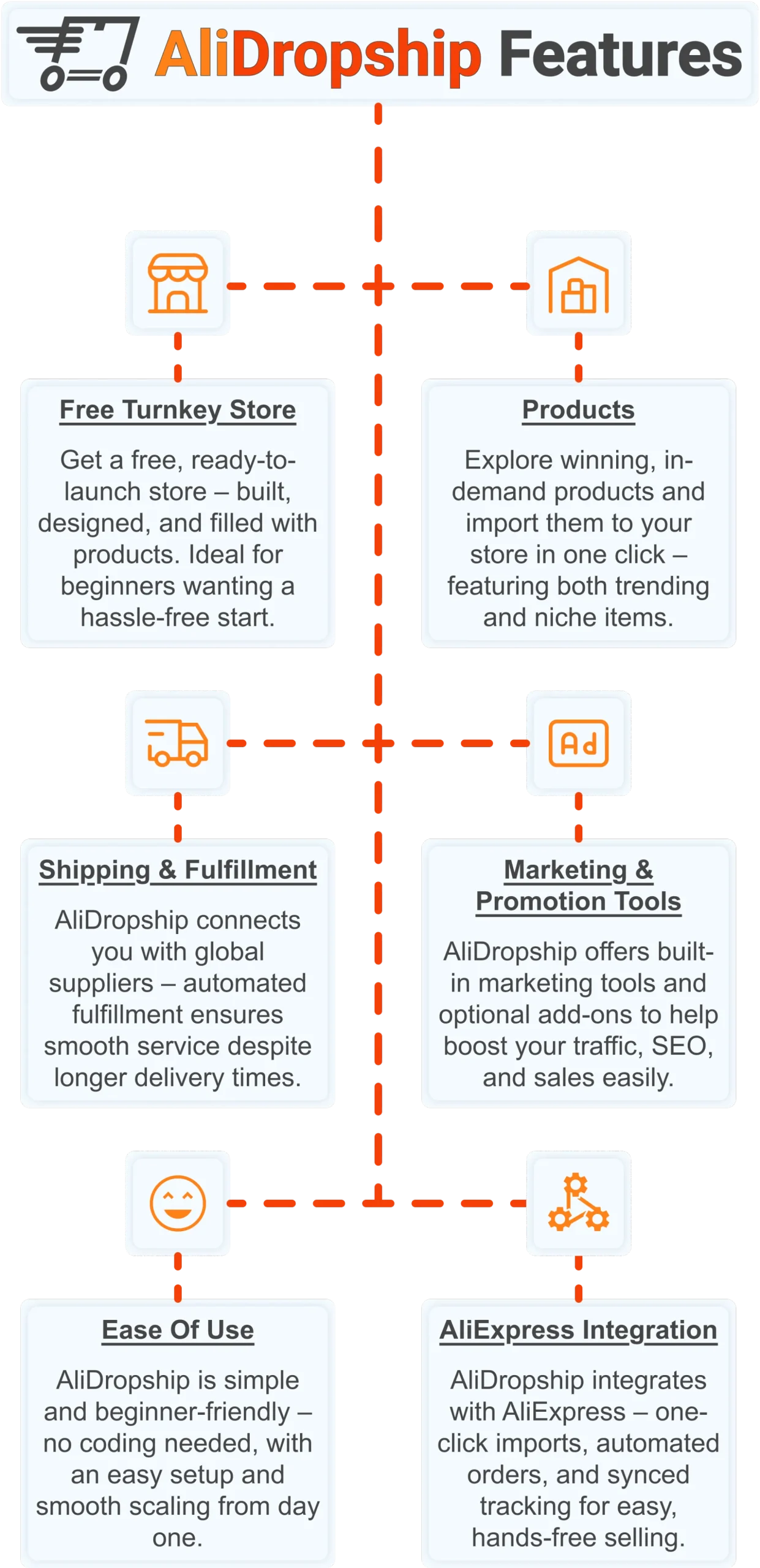
Free turnkey store ️
Get a free turnkey store – built, designed, and filled with products. Ideal for beginners wanting a hassle-free start, the store comes fully optimized to attract customers right away, saving you time on setup. Plus, it includes professional design elements to give your business a polished, trustworthy look from day one. This ready-made foundation makes it easy to move seamlessly into product selection.
Products
Once your store is set up, you can explore winning, in-demand products and import them in one click – featuring both trending and niche items. This wide selection lets you cater to diverse customer interests and test what works best. Regular updates ensure you always have fresh products, keeping your store competitive and relevant. With great products in place, smooth shipping becomes the next essential step.
Shipping & fulfillment
AliDropship connects you with global suppliers, and automated fulfillment ensures seamless order processing despite international delivery times. Customers receive real-time tracking updates, which builds confidence and trust in your store. Once shipping is handled reliably, you can focus on promoting your store and attracting traffic.
Marketing & promotion tools
To maximize sales, AliDropship offers built-in marketing tools and optional add-ons that help boost traffic, SEO, and conversions. From email campaigns and discounts to social media integration, these tools empower you to reach and retain customers without needing prior marketing experience. With promotion strategies in place, managing your business becomes simpler and more efficient.
Ease of use
AliDropship is beginner-friendly – no coding needed, with an intuitive dashboard that guides you through every step. Easy setup and smooth scaling let you expand your store without stress. As your business grows, adding new features, products, and marketing campaigns remains hassle-free, giving you more time to focus on sales.
AliExpress integration
Finally, AliDropship integrates seamlessly with AliExpress, enabling one-click imports, automated orders, and synced tracking. Your inventory stays up-to-date with the latest products and prices, while automated order processing frees you from manual tasks. Combined with the turnkey setup, reliable shipping, and built-in marketing tools, this integration ensures your dropshipping business is fully equipped for growth and success.
Frequently Asked Questions
How do you start an online business from home?
To start an online business from home, pick one proven model such as dropshipping, digital products, or freelancing, set up your platform, build a simple traffic plan, and aim to launch within two weeks. Most people who stay consistent see their first sales within 30 to 60 days. Over 2.77 billion people shop online today, which means the potential customer base is already in place before a store even launches. The technical barrier is now low, since tools like AliDropship, Shopify, and Gumroad have compressed setup time that once took months into a matter of days.
How much can a dropshipping store from home earn?
A dropshipping store from home typically earns between 500 and 5,000 dollars or more per month, depending on niche, ad spend, and store optimization. Profit margins usually land between 20 and 40 percent depending on the niche chosen. A well-run store can reach between 1,000 and 3,000 dollars per month within the first 90 days of consistent effort. Most successful dropshippers focus on one paid channel, such as Meta Ads or TikTok, or one organic channel, such as SEO or Pinterest, rather than spreading across many channels at once.
How much can digital products earn as a home business?
Selling digital products such as ebooks, templates, or Notion dashboards can generate between 300 and 3,000 dollars per month, with the upper end requiring an established audience and a catalog of 5 to 10 or more products. Online courses and coaching have a higher ceiling, with experienced creators regularly earning between 5,000 and 20,000 dollars per month. Most people validate demand with a low-ticket offer priced between 47 and 97 dollars before building a full program. Since there is no shipping, inventory, or fulfillment cost involved, digital products carry some of the highest margins of any home-based online business model.
How fast can freelancing generate income from home?
Freelancing is one of the fastest ways to start earning money online from home, often within the first week of creating a profile on Upwork or Fiverr. Skilled freelancers working 30 to 40 hours per week typically earn between 1,000 and 6,000 dollars per month. Most experienced freelancers plateau at 3,000 to 6,000 dollars per month working full time hours unless they move into agency work or productized services. Virtual assistant rates typically run 15 to 35 dollars per hour for generalists, rising to 40 to 75 dollars per hour for specialists in areas like bookkeeping or project management.
How much does it cost to legally set up an online business from home?
In the United States, forming a single-member LLC typically costs between 50 and 500 dollars depending on the state, and it provides liability protection that a sole proprietorship does not offer. Services such as ZenBusiness or Northwest Registered Agent can walk a new business owner through the formation process affordably. Beyond formation, a dedicated business bank account is recommended from day one to keep personal and business finances separate and simplify tax filing. For ecommerce specifically, a clear refund policy and a privacy policy are also required, since GDPR in Europe and various U.S. state laws mandate them.
Learning how to start an online business from home is the easy part – actually starting is where most people get stuck. Claim your free turnkey store today and take the first real step toward building income on your own terms.
 Previous post
