 ‧ Agnes Kazaryan ‧
March 22, 2026
‧ Agnes Kazaryan ‧
March 22, 2026  571 ‧
571 ‧
 0
0
So you want to know how to create your own online store – but you are not sure where to start, which platform to pick, or whether it can actually earn you money. Those are fair questions. The good news is that launching an ecommerce business in 2026 is more accessible than it has ever been, and you do not need a technical background or a big budget to pull it off.
Quick Answer: To create your own online store, choose a business model (dropshipping is the easiest starting point), pick a platform, add products, set up payments, and launch. With the right setup, you can be live within a day – and earning real income within 60–90 days.
Global ecommerce revenue is expected to exceed $6 trillion in 2026, and a growing share of it is going to independent stores – not just Amazon and Walmart. Consumers are increasingly comfortable buying from smaller brands they find through search and social media. The window is open. This guide covers every decision you need to make, in the right order, so you can build something that actually earns.
What is an online store and why start one in 2026?
An online store is a website where you sell products or services directly to customers – no physical shopfront, no lease, no fixed hours. A customer browses your catalog, adds something to their cart, pays, and receives the order either by mail or digitally. You manage the selling side; a supplier, manufacturer, or fulfillment platform handles the stock.
What has changed most dramatically in recent years is the barrier to entry. You no longer need to code a site from scratch, rent warehouse space, or negotiate minimum orders with factories. Business models like dropshipping let you sell products that are sourced, packed, and shipped entirely by a third-party supplier. Your role is to market the store and handle customer relationships.
The combination of low startup costs, scalable tools, and a growing consumer base willing to buy from independent brands makes 2026 one of the best moments to start. Platforms have matured, supplier networks have expanded, and ready-made store solutions have compressed the time between “thinking about it” and “actually live” to a matter of days.
How much can you realistically earn from your own online store?
This is probably the most important question to answer honestly, because the gap between what gets promoted online and what most people actually experience is wide. Income from an online store depends on your business model, your niche, how much time you invest in marketing, and how quickly you learn from early results.
Here is a realistic breakdown of what different store types tend to generate:
These are realistic ranges based on consistent effort over several months – not best-case scenarios pulled from highlight reels. Most new store owners see their first meaningful sales within 60–90 days. Breaking into daily profitability typically takes 4–8 months of focused work on product selection, traffic, and conversion rate.
One note on the higher figures: The $500+/day ceiling for own-product stores reflects established businesses with repeat customers and strong brand equity – not a typical first-year result. Start your expectations at the lower end of each range and treat anything above that as a bonus you work toward.
How to create your own online store: Step by step
There is no single right path to building an online store – but there is a logical order of decisions that prevents costly mistakes later. Here is the sequence that works for most beginners in 2026.
Choose your business model
Before you pick a platform or design a logo, decide how your store will actually operate. Your business model determines your startup costs, your profit margins, your daily workload, and your long-term growth ceiling.
Dropshipping
Dropshipping is the most popular model for first-time store owners. You list products, a customer buys one, and your supplier ships it directly to them – you never touch the inventory. Your profit is the margin between your selling price and the supplier’s cost. Startup costs are low (typically under $100), and you can test multiple niches without committing to bulk stock.
Earning potential: $30–$150/day with consistent marketing and a focused niche after 3–6 months.
Print-on-demand
Print-on-demand (POD) works similarly to dropshipping but centers on custom-designed products – t-shirts, mugs, phone cases, posters. You create the designs, upload them to a platform like Printful or Printify, and they handle printing and shipping per order. Margins are slimmer, but it requires almost no upfront investment and suits creative types well.
Earning potential: $10–$60/day with strong design work and targeted traffic.
Selling your own products
If you make something – handmade goods, specialty items, local produce – selling through your own store gives you full control over pricing, branding, and the customer relationship. Margins are higher than dropshipping, but you take on inventory risk and fulfillment responsibility. This model works well for makers and artisans looking to move beyond Etsy listings.
Earning potential: $20–$500+/day depending on your product and production capacity.
Digital products
Ebooks, courses, templates, guides, and software tools have zero inventory and instant delivery, making them one of the most scalable ecommerce models. The challenge is creating something genuinely valuable in a competitive market. Once a digital product exists, you can sell it unlimited times with no additional production cost.
Why this works in 2026: Consumer demand for self-improvement content, business tools, and online education continues to grow – and buyers are increasingly comfortable purchasing from independent creators.
Pick your niche
A niche is the specific segment of the market you will serve. “Everything for everyone” is not a viable strategy for a new store – the margins are too thin and the competition from Amazon and Walmart is too strong. The best niches have passionate buyers, repeat purchase potential, and products that are hard to find in local shops.
Strong-performing niches in 2026 for independent stores include: pet accessories and supplements, home organization products, eco-friendly goods, hobby and craft supplies, fitness equipment for specific sports, and niche beauty products serving underserved demographics. The common thread is specificity – “dog toys for small breeds” outperforms “pet products” every time.
Important: Do not choose a niche purely because it looks profitable on paper. If you have no genuine interest in the category, staying consistent long enough to see results becomes significantly harder.
Choose your ecommerce platform
Your platform is the software that powers your store – the checkout, the product catalog, payment processing, and customer accounts. This is one of the most consequential decisions you will make, because switching platforms later is disruptive and time-consuming.
Shopify
Shopify is the most widely used hosted ecommerce platform. It is reliable, well-supported, and has a vast ecosystem of apps and integrations. Plans start at around $39/month, which adds up over time – but the ease of setup is hard to beat. Best suited for stores that plan to scale quickly and want access to advanced marketing and analytics tools from day one.
WooCommerce
WooCommerce is a free, open-source plugin for WordPress. It offers far more control and flexibility than Shopify, and the base software costs nothing – but you pay for hosting, themes, and premium extensions. It is a strong choice if you already know WordPress or want to avoid monthly platform fees. The technical learning curve is steeper than Shopify.
Ready-made store solutions
A third option – particularly popular with dropshippers – is getting a fully pre-built store from a provider like AliDropship. Instead of setting up hosting, installing plugins, configuring a theme, and importing products one by one, you receive a store that is already built, stocked, and optimized. This compresses the time between deciding to start and being ready to sell into a single day.
Why this works in 2026: Speed to market matters. Every week spent on technical setup is a week not spent on traffic and sales. Ready-made stores remove the most friction-heavy part of launching.
Set up your domain and branding
Your domain name is your store’s address on the internet. Keep it short, easy to spell, and relevant to your niche. Avoid hyphens, numbers, and anything that needs explaining when spoken aloud. A .com extension is still the strongest choice for ecommerce credibility.
For branding, you do not need to invest thousands upfront. Free tools like Canva handle logo creation well enough for a new store. What matters more at launch is consistency – the same color palette, font, and tone of voice across your store, your social profiles, and your emails.
Add products and write compelling listings
Every product listing needs three things: a clear, keyword-rich title; a description that directly addresses the buyer’s main concern; and high-quality images. With dropshipping, supplier images are often provided – but the best-performing stores replace generic photos with lifestyle images that show the product in real-world context.
Pricing strategy matters too. Research what competitors charge and position yourself with a clear reason for your price – not necessarily the cheapest, but the most compelling overall offer. Bundles, free shipping thresholds, and time-limited promotions all help convert browsers into buyers.
Set up payments and shipping
Offer at least two payment options at checkout: card processing and PayPal. Stripe powers card payments on most platforms and is straightforward to set up. PayPal builds buyer confidence, especially for first-time customers who are cautious about entering card details on a store they have not bought from before.
For shipping, clarity beats complexity. Define your shipping zones, set flat rates or free shipping thresholds, and communicate delivery timelines honestly in your FAQ and at checkout. Unexpected shipping costs at checkout are the single biggest driver of cart abandonment – transparency here pays off directly in conversions.
How to drive traffic to your new online store
A store with no visitors is a store with no sales. Traffic generation is where most new store owners underinvest – they spend weeks perfecting product pages and then expect Google to send customers automatically. That is not how it works. You need an active traffic strategy from the moment your store goes live.
SEO for ecommerce stores
Search engine optimization is the most cost-effective long-term traffic channel for online stores. The goal is to rank your product and category pages in Google for searches your ideal customers are already making. On-page SEO – keyword-optimized titles, descriptions, and image alt text – is the baseline. The bigger opportunity is content: a blog covering topics your niche audience searches for can drive consistent organic traffic that compounds over months.
Results from SEO are not immediate – typically 3–6 months before meaningful organic traffic arrives – but the payoff is traffic that does not require ongoing ad spend to maintain.
Paid advertising
Paid ads on Meta (Facebook and Instagram) and Google give you immediate, targetable traffic. The tradeoff is cost – you need a testing budget to identify which products and creatives convert. A reasonable starting point is $10–$30/day per campaign during testing. Once you find winners, you scale. Paid advertising is faster than SEO but requires disciplined budget management and a willingness to accept early losses as the price of data.
Social media and organic content
TikTok, Instagram Reels, and Pinterest are powerful free channels for stores in visually driven niches – home decor, fashion, beauty, fitness, food. Organic content can generate sudden spikes in traffic and sales without any ad spend. The catch is consistency: building an audience requires regular posting over weeks and months, not a handful of sporadic uploads.
Email marketing
Email is the highest-ROI marketing channel in ecommerce, with industry benchmarks pointing to returns of $36–$42 for every $1 spent. The mechanism is simple: capture visitor emails with a discount or lead magnet, then nurture those subscribers with product recommendations, promotions, and useful content. Abandoned cart emails alone – automated messages sent when someone leaves without buying – typically recover 5–15% of lost sales.
Tools like Klaviyo and Mailchimp integrate directly with Shopify and WooCommerce and have free tiers suitable for new stores. Build your list from day one, even before you have a full product range ready.
Legal and ethical considerations for your online store
Getting the legal and compliance side of your store right is not exciting – but skipping it creates real risk, including frozen payment accounts, fines, or forced shutdowns. Here is what to address before you start taking orders.
Business registration and taxes
In most countries, selling online counts as operating a business. Depending on your jurisdiction, you may need to register as a sole trader, LLC, or limited company before accepting payments. Even where registration is technically optional at launch, a registered entity protects your personal assets and makes opening a business bank account significantly easier.
Sales tax and VAT obligations vary by country – and in the US, by state. Most ecommerce platforms now handle automatic tax calculation at checkout, but you remain responsible for filing and remitting what you collect. Speak to a local accountant before you cross significant revenue thresholds.
Key principle: Run a compliant business from the start. Fixing tax or registration issues retroactively once you are generating serious revenue is far more disruptive than setting things up correctly upfront.
What to avoid absolutely
A few practices are unfortunately common in ecommerce – and all of them carry serious consequences.
- Fake reviews: Paying for or fabricating reviews violates the terms of service of every major platform and is subject to FTC enforcement in the US and equivalent action elsewhere. Build your review base organically by following up with genuine customers post-purchase.
- Misleading product descriptions: Exaggerating what a product does – especially in health, fitness, or supplement categories – creates legal exposure and destroys customer trust. Stick to what the product actually delivers.
- Selling counterfeit goods: Dropshipping branded products without authorization, or selling grey-market goods under authentic brand names, is illegal and will get your store and payment accounts shut down. Only work with verified suppliers selling legitimate products.
Privacy policy and terms of service
Your store must have a privacy policy if you collect any customer data – which you do the moment someone visits via Google Analytics, adds something to their cart, or signs up to your email list. GDPR applies if any of your customers are in the EU. CCPA applies if you serve California residents.
Free privacy policy generators cover basic compliance. If you expect significant volume, a solicitor or online legal service can help you draft something more robust.
How to choose the right approach for your situation
After covering the full landscape – models, platforms, traffic, and legal – the honest question is: what is actually right for you? The answer depends almost entirely on your starting point.
Complete beginner
If you have never run an online business before, the most important thing is getting live quickly so you can learn from real data. Choose dropshipping – the low startup cost and zero inventory risk means the cost of experimenting is manageable. Use a ready-made or turnkey store to skip the technical setup phase entirely. Focus your first 90 days on learning one traffic channel and testing 5–10 products before drawing conclusions about what works.
Intermediate / part-time
If you have some digital marketing experience or have tried ecommerce without hitting your stride, you are probably ready to invest more seriously in a focused niche. Build on WooCommerce or use a customisable turnkey solution. Dedicate real time to SEO and email marketing – these compound over months and provide the kind of predictable, sustainable traffic that paid ads alone cannot guarantee. Set a specific revenue target (say, $1,500/month net profit) and work backward from it to understand the sales volume and conversion rate you need to hit it.
Advanced / full-time goal
If you are committed to building ecommerce as your primary income source, treat it like a business from day one. Register properly, track your numbers weekly, and reinvest profits into your best-performing products and traffic channels rather than cashing out too early. Consider layering multiple revenue streams – your own store alongside a marketplace presence on Amazon or eBay – to reduce single-channel risk. At this level, the challenges are less about technology and more about building reliable systems, supplier relationships, and a recognizable brand.
Final thoughts: what kind of store builder are you?
Knowing how to create your own online store is the starting point – but the real question is whether you act on it. The tools in 2026 are genuinely accessible. The market is large. The barrier to entry has never been lower. What separates the stores that earn from the ones that get abandoned after a few weeks is almost always speed of execution and willingness to learn from early results.
If you are a complete beginner, start simple – dropshipping with a ready-made store – and focus on one traffic channel until you see results. If you have experience, go deeper on a niche and invest in SEO and email from month one. If you are playing the long game, build systems and brand equity from day one rather than optimizing purely for short-term revenue.
Ecommerce is one of the few paths available in 2026 that genuinely scales with you – from a $30/day side income to a $500+/day full-time business – without requiring a significant upfront capital base. The first step is simply deciding to start, and then starting fast.
AliDropship: Your complete all-in-one solution for starting dropshipping in 2026
If you want the simplest possible way to start dropshipping – especially if you’re brand new – AliDropship remains one of the most beginner-friendly tools available in 2026. It brings together store creation, product imports, automation, and marketing into a single streamlined system designed to help you launch quickly and grow confidently.
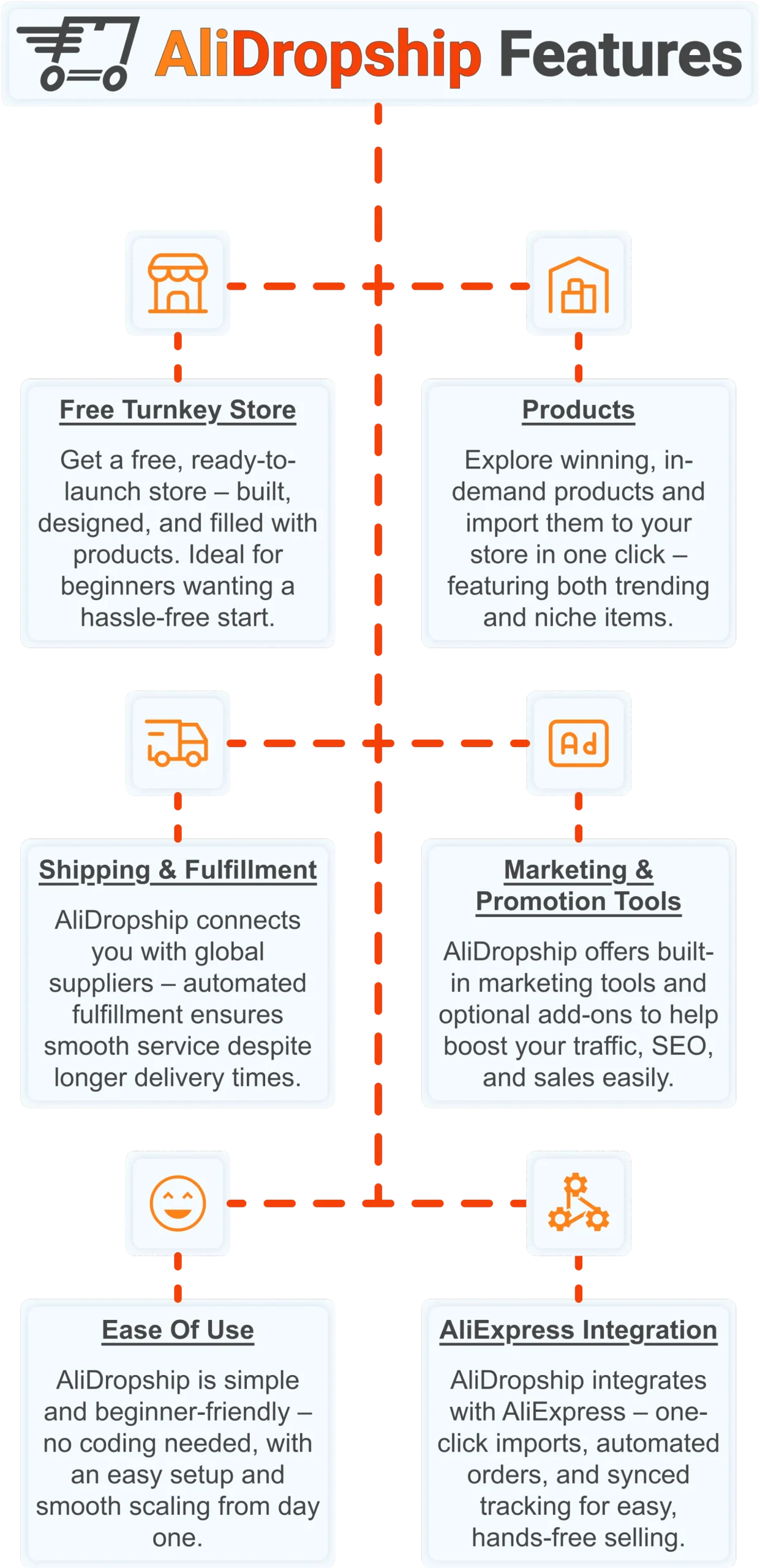
Free turnkey store ️
Get a free turnkey store – built, designed, and filled with products. Ideal for beginners wanting a hassle-free start, the store comes fully optimized to attract customers right away, saving you time on setup. Plus, it includes professional design elements to give your business a polished, trustworthy look from day one. This ready-made foundation makes it easy to move seamlessly into product selection.
Products
Once your store is set up, you can explore winning, in-demand products and import them in one click – featuring both trending and niche items. This wide selection lets you cater to diverse customer interests and test what works best. Regular updates ensure you always have fresh products, keeping your store competitive and relevant. With great products in place, smooth shipping becomes the next essential step.
Shipping & fulfillment
AliDropship connects you with global suppliers, and automated fulfillment ensures seamless order processing despite international delivery times. Customers receive real-time tracking updates, which builds confidence and trust in your store. Once shipping is handled reliably, you can focus on promoting your store and attracting traffic.
Marketing & promotion tools
To maximize sales, AliDropship offers built-in marketing tools and optional add-ons that help boost traffic, SEO, and conversions. From email campaigns and discounts to social media integration, these tools empower you to reach and retain customers without needing prior marketing experience. With promotion strategies in place, managing your business becomes simpler and more efficient.
Ease of use
AliDropship is beginner-friendly – no coding needed, with an intuitive dashboard that guides you through every step. Easy setup and smooth scaling let you expand your store without stress. As your business grows, adding new features, products, and marketing campaigns remains hassle-free, giving you more time to focus on sales.
AliExpress integration
Finally, AliDropship integrates seamlessly with AliExpress, enabling one-click imports, automated orders, and synced tracking. Your inventory stays up-to-date with the latest products and prices, while automated order processing frees you from manual tasks. Combined with the turnkey setup, reliable shipping, and built-in marketing tools, this integration ensures your dropshipping business is fully equipped for growth and success.
Frequently Asked Questions
How much does it cost to create your own online store?
Startup costs depend heavily on the platform and business model you choose. Dropshipping stores typically launch for under 100 dollars since there is no inventory to purchase upfront. Shopify plans start at around 39 per month, while WooCommerce is free to install but requires paying for hosting and premium extensions separately. Ready-made turnkey stores compress setup time into a single day and often bundle hosting and design costs together.
How long does it take to start earning from your own online store?
Most new store owners see their first meaningful sales within 60 to 90 days of launch. Reaching consistent daily profitability typically takes 4 to 8 months of focused work on product selection, traffic generation, and conversion optimization. Dropshipping stores tend to generate 30 to 150 dollars per day after 3 to 6 months of consistent marketing. Results vary based on niche, effort invested, and how quickly you adjust based on early data.
Which ecommerce platform is best for creating your own online store?
The three main options are Shopify, WooCommerce, and ready-made turnkey solutions like AliDropship. Shopify is hosted and beginner-friendly with plans starting around 39 per month, offering a large ecosystem of apps and integrations. WooCommerce is a free WordPress plugin that offers more control but has a steeper technical learning curve and separate hosting costs. Turnkey providers deliver a store that is already built and stocked with products, cutting setup time down to about one day.
What is the easiest business model for a beginner starting their own online store?
Dropshipping is widely considered the easiest entry point because it requires no inventory and typically costs under 100 dollars to start. You list products, and when a customer buys one, your supplier ships it directly without you ever handling stock. This model lets beginners test 5 to 10 products across different niches without committing to bulk purchases. Print on demand is a similar low-risk alternative, generating an estimated 10 to 60 dollars per day with consistent design work.
How do you drive traffic to a newly created online store?
Traffic generation relies on a mix of SEO, paid advertising, social media, and email marketing rather than any single channel. SEO typically takes 3 to 6 months to produce meaningful organic traffic but does not require ongoing ad spend once established. Paid ads on Meta and Google can start producing traffic immediately, with a common testing budget of 10 to 30 dollars per day per campaign. Email marketing delivers the highest return in ecommerce, with industry benchmarks showing 36 to 42 dollars returned for every 1 dollar spent.
Creating your own online store is the most direct path to building real ecommerce income in 2026 – and AliDropship gives you the fastest, most complete way to do it. Get your free turnkey store and start building your business today.
 Previous post
