 ‧ Agnes Kazaryan ‧
March 24, 2026
‧ Agnes Kazaryan ‧
March 24, 2026  650 ‧
650 ‧
 0
0
Amazon has over 310 million active customers and nearly 10 million sellers worldwide. That is a lot of competition – but also a lot of opportunity. The question is whether the platform is the right fit for you, and if so, how to start without losing money in the first 90 days.
This guide covers everything you need to know about how to sell on Amazon: which business model suits your budget, what the fees actually look like once you add them all up, and what realistic income looks like at each level of effort. No fluff, no hype – just the full picture.
Quick answer: To sell on Amazon, you open a Seller Central account, pick a fulfillment model (FBA or FBM), source products, and create optimized listings. Most beginners make their first sale within 30–60 days. Consistent monthly income typically builds over 3–6 months of sustained effort.
What is selling on Amazon?
Selling on Amazon means listing your products on the world’s largest online marketplace and tapping into a customer base that already trusts the platform, has a credit card on file, and expects fast shipping. You do not need to build your own website, set up payments, or earn trust from scratch – Amazon provides all of that infrastructure by default.
Independent third-party sellers now account for more than 60% of all Amazon sales. The average US-based independent seller generated over $290,000 in annual sales in 2024. That is not a guaranteed outcome – it is an average across a very wide range of seller sizes – but it signals the genuine scale of what the platform makes possible.
There are two core fulfillment models to understand before you do anything else.
FBA (Fulfillment by Amazon) means you ship your inventory to Amazon’s warehouses. Amazon then handles picking, packing, shipping, customer service, and returns on your behalf. Your products become Prime-eligible, which dramatically improves conversion rates.
FBM (Fulfilled by Merchant) means you list on Amazon but store and ship products yourself. This gives you more control and lower platform fees, but you handle all the logistics.
The right choice depends on your starting capital, the type of product you want to sell, and how operationally involved you want to be. We will break both down fully below.
How much can you realistically earn selling on Amazon?
Here is an honest breakdown by business model – based on realistic effort and consistent work, not best-case outcomes.
These figures reflect sellers working consistently over 3–6 months. Higher-end numbers require real upfront investment, strong product research, and ongoing optimization – not just listing a few products and waiting.
One note on the upper figures: Private label sellers earning $10,000–$15,000 per month typically started with $3,000–$5,000 in capital, ran paid ads from day one, and spent 60–90 days building reviews before achieving stable sales velocity. If your budget or time is limited, start with a lower-risk model to learn the platform before scaling.
The main business models for selling on Amazon
There are six primary ways to sell on Amazon. Each has different upfront costs, risk levels, and income ceilings. Understanding them before you open a Seller Central account will save you a lot of expensive trial and error.
Private label
Private label is the model most commonly associated with successful FBA sellers. You source a generic or unbranded product from a manufacturer – often through Alibaba – apply your own branding and packaging, and sell it as your own product on Amazon.
This gives you full control over pricing, listing content, and brand identity. The trade-off is that it requires the most upfront capital. Realistic startup costs run $2,500–$5,000 to cover initial inventory, packaging design, and advertising spend.
The key word with private label is differentiation. Selling an identical product at the same price as dozens of existing listings will not work. You need to solve a problem that existing listings miss – better materials, an improved size, a useful bundle, or a smarter design. Get that right and $3,000–$10,000 per month is achievable within 6–12 months.
Earning potential: $2,000–$15,000+ per month with consistent reinvestment and product optimization over 6–12 months.
Wholesale
Wholesale means buying existing branded products in bulk from an authorized distributor and reselling them on Amazon at a markup. You are not creating a brand – you are selling products that already have demand and existing reviews.
The advantage is reduced risk: you know the product sells before you buy it. The disadvantage is competition – other sellers can do exactly the same thing, which keeps margins thin. Wholesale works best for sellers with $2,000–$5,000 to invest in initial stock and a methodical approach to supplier relationships. Direct arrangements with brand owners can protect your margins over time.
Earning potential: $1,000–$5,000 per month with reliable supplier relationships and consistent inventory management.
Retail arbitrage
Retail arbitrage is the most accessible starting point for beginners with limited capital. You buy discounted or clearance products from physical retail stores – Walmart, Target, Home Depot – and resell them on Amazon at a higher price. The Amazon Seller app lets you scan barcodes in-store to see the current Amazon price and estimated profit before you commit to buying anything.
The model requires active, ongoing sourcing effort – you cannot automate it the way you can private label. Margins are lower and inventory is inconsistent. But it is an excellent way to learn how Amazon actually works, understand fee structures, and generate early cash flow with as little as $200–$500 to start.
Earning potential: $300–$1,500 per month part-time, up to $5,000 with full-time sourcing effort.
Online arbitrage
Online arbitrage follows the same logic as retail arbitrage, except all sourcing happens online. You find products on sale at one retailer and resell them on Amazon at a profit. Tools like Tactical Arbitrage automate much of the scanning, making it more scalable than walking retail aisles.
Margins tend to be tighter because more sellers are competing for the same online deals, but once your sourcing systems are set up, the model becomes genuinely efficient.
Earning potential: $500–$2,500 per month with systematic sourcing and repricing tools.
Low-inventory and digital models
Dropshipping on Amazon
Amazon does permit dropshipping – but with one important condition: you must be the seller of record on every transaction. You cannot list products from a retail website and have them shipped directly to your buyer under that retailer’s branding. Amazon suspends accounts for this regularly and without warning.
Legitimate Amazon dropshipping means working with a wholesale supplier who ships directly to customers under your brand name. When done correctly, it is a solid low-inventory model. You validate demand before committing to stock, then transition winning products to FBA once you have real sales data.
Important: Never use a retail store like AliExpress listing pages or eBay as your dropshipping supplier on Amazon. If a customer receives a package branded with a competitor retailer’s name, your account will be flagged.
Earning potential: $500–$3,000 per month with compliant wholesale suppliers and active listing management.
Kindle Direct Publishing (KDP)
KDP lets you self-publish ebooks, paperbacks, and low-content products – planners, logbooks, journals, coloring books – and list them on Amazon with no upfront cost. You earn royalties of up to 70% on ebooks and around 60% on print titles depending on price and region.
The barrier to entry is genuinely low. The challenge is discoverability. Successful KDP sellers focus on narrow, specific niches rather than broad categories. A “meal planner for postpartum recovery” outperforms a generic “meal planner” because it targets a specific searcher intent. Pair strong niche selection with clean formatting and KDP can generate $300–$2,000 per month passively once your catalog grows to 10–30 titles.
Earning potential: $100–$2,000 per month depending on catalog size, niche, and keyword optimization.
Merch on Demand
Merch on Demand lets you upload original artwork to sell on t-shirts, hoodies, tote bags, and other apparel. Amazon handles printing, shipping, and customer service. You earn a royalty per sale with zero inventory risk.
Access is tiered – you start with a limited number of listings and unlock more as you make sales. Patience and volume are required early on, but for designers who want passive income with no logistics overhead, this model is hard to beat.
Earning potential: $100–$1,000 per month for casual designers, up to $3,000–$5,000 for high-volume sellers with large niche-focused catalogs.
Step-by-step: how to start selling on Amazon
Once you have chosen your model, the setup process is fairly straightforward. Here is what it looks like from account creation to your first sale.
Step 1: Choose your selling plan
Amazon offers two account types. The Individual plan charges $0.99 per item sold and suits sellers listing fewer than 40 products per month. The Professional plan costs $39.99 per month flat, removes the per-item fee, unlocks Buy Box eligibility, and gives you access to advertising tools.
For almost any seller with real growth intentions, the Professional plan makes sense from day one – especially since Buy Box eligibility is essential for visibility on mobile searches.
Step 2: Register on Seller Central
Go to sell.amazon.com and click Sign Up. You will need a government-issued ID, a bank account and routing number, a credit card, tax information (SSN or EIN for US sellers), and a phone number for identity verification. Amazon typically verifies identity via video call, so budget 30 minutes and complete registration on a desktop browser.
Once approved, your Seller Central dashboard gives you access to listing tools, inventory management, advertising, and reporting.
Step 3: Research and source your products
Product selection is the most important decision you will make as an Amazon seller. Data beats guesswork every time. Tools like Jungle Scout, Helium 10, and SellerSprite let you analyze search volume, competition, and estimated monthly sales for any product on the platform.
Look for products with consistent demand, manageable competition, and a selling price between $20–$60. This range tends to offer the best balance of margin and conversion. For private label, request samples from at least 3–5 Alibaba suppliers before committing to a bulk order. For retail or online arbitrage, use the Amazon Seller app to check profitability on each item before you buy.
Step 4: Understand Amazon fees before you list
This step catches most beginners off guard. Amazon’s fee structure is layered, and failing to account for all of it can turn a profitable-looking product into a loss. Here is the full fee stack to model before listing:
- Referral fee: 8–15% of the sale price depending on category. Non-negotiable.
- FBA fulfillment fee: $3.22–$6.00+ per unit for standard-size items, based on weight and dimensions.
- Monthly storage fee: approximately $0.78 per cubic foot (Q4 rates are higher).
- Inbound placement fee: charged when you send inventory to Amazon’s fulfillment centers.
- Advertising (PPC): optional but practically essential for new listings. Budget 10–20% of revenue initially.
In total, Amazon typically takes 25–30% of your revenue in fees before advertising. For sellers running PPC, the real number often reaches 35–40%. Use Amazon’s free Revenue Calculator to model your exact unit economics before ordering inventory. Aim for a net margin of 25–35% after all costs – anything below 15% leaves almost no buffer when fees adjust or ad costs rise.
Important note: Amazon confirmed a 3.5% fuel and logistics surcharge on all FBA fulfillment fees effective April 17, 2026. Run your numbers with updated 2026 rates before finalizing pricing.
Step 5: Create optimized product listings
A well-optimized listing is the difference between getting found on Amazon and being invisible. Every listing needs a keyword-rich title leading with your primary keyword, bullet points that directly address customer concerns, a detailed product description, and high-resolution images showing the product from multiple angles.
Amazon’s A10 algorithm rewards listings that convert well, maintain competitive pricing, and accumulate strong reviews. New listings need an initial push to build sales velocity. Many sellers use a launch strategy combining a promotional discount, targeted PPC campaigns, and early review generation through Amazon’s Vine program to accelerate this process.
Why this works in 2026: Getting early reviews and sales velocity signals to Amazon’s algorithm that your listing deserves organic placement – paid ads alone are not enough to sustain ranking long-term.
Legal and ethical considerations when selling on Amazon
Amazon is a rules-heavy platform. Violations can result in listing suppression, account suspension, or a permanent ban. Understanding what to avoid is just as important as knowing what to do.
What to avoid absolutely
Fake or incentivized reviews are the most common cause of serious account action. Amazon’s detection systems are sophisticated and constantly improving. Paying for reviews, swapping reviews with other sellers, or offering refunds in exchange for positive feedback will get your account flagged – often permanently.
The same applies to manipulating pricing data, misrepresenting product condition or authenticity, and using retail sites as dropshipping sources. These are not grey areas. They are clear policy violations with well-documented consequences across Amazon seller communities on Reddit and elsewhere.
Counterfeit products are another absolute line. Listing a product that infringes on a registered trademark – even unknowingly – can result in legal action from brand owners and immediate account suspension. Always verify that the products you source are genuine and that you have the legal right to resell them.
Key principle: If a tactic requires hiding it from Amazon, your supplier, or your customer, it will eventually cost you the account.
What to do instead
Build reviews legitimately by enrolling in Amazon’s Vine program for early feedback, using the “Request a Review” button in Seller Central after each confirmed delivery, and investing in product quality so customers want to leave positive reviews naturally.
For brand protection, register with Amazon Brand Registry once you have an active trademark. This unlocks A+ Content, additional advertising formats, and better counterfeit protection tools.
On the compliance side, keep your account health metrics in good standing: Order Defect Rate below 1%, Late Shipment Rate below 4%, and Pre-Fulfillment Cancellation Rate below 2.5%. Amazon monitors these closely and will suppress your listings before any formal warning arrives if you fall below the thresholds.
Final thoughts: how to choose the right approach for your situation
There is no single right way to sell on Amazon. The best model depends on your starting budget, available time, risk tolerance, and long-term goals. Here is a practical breakdown by reader profile.
Complete beginner (under $500 to start)
Start with retail arbitrage or online arbitrage. These models let you learn the platform with minimal financial risk while generating real sales data. Use the Amazon Seller app to scan products in store and only buy items where the margin after fees is at least $3–$5 per unit. Reinvest your first profits into learning tools and gradually increase sourcing volume. Expect 30–60 days to your first sale and 3–6 months to reach a consistent $500–$1,000 per month.
Intermediate / part-time seller ($500–$2,500 budget)
Wholesale or dropshipping with a compliant supplier are the strongest options at this level. You have enough capital to build a small product catalog and run light PPC campaigns. Focus on one niche, master its demand patterns, and build supplier relationships that improve your pricing over time. A disciplined part-time seller with $1,500–$2,000 in working capital can realistically reach $1,500–$3,000 per month within 4–6 months.
Advanced / full-time goal ($2,500+ budget)
Private label FBA has the highest income ceiling at this level. Allocate at least $2,500–$3,500 for initial inventory, $500–$1,000 for product photography and listing optimization, and a monthly ad budget of $300–$600 minimum to build early sales velocity. With strong product selection and consistent reinvestment, six-figure annual revenues are achievable within 12–18 months. The sellers who get there treat it like a real business from day one – not a passive income experiment.
Amazon remains one of the most powerful distribution channels available to independent sellers in 2026. The platform’s infrastructure, customer base, and fulfillment capabilities are genuinely hard to replicate elsewhere. But with nearly 10 million active sellers globally, success belongs to those who combine rigorous product research, disciplined cost management, and a long-term mindset. The opportunity is real – the shortcut crowd just makes more noise about it than the people actually building sustainable businesses.
AliDropship: Your complete all-in-one solution for starting dropshipping in 2026
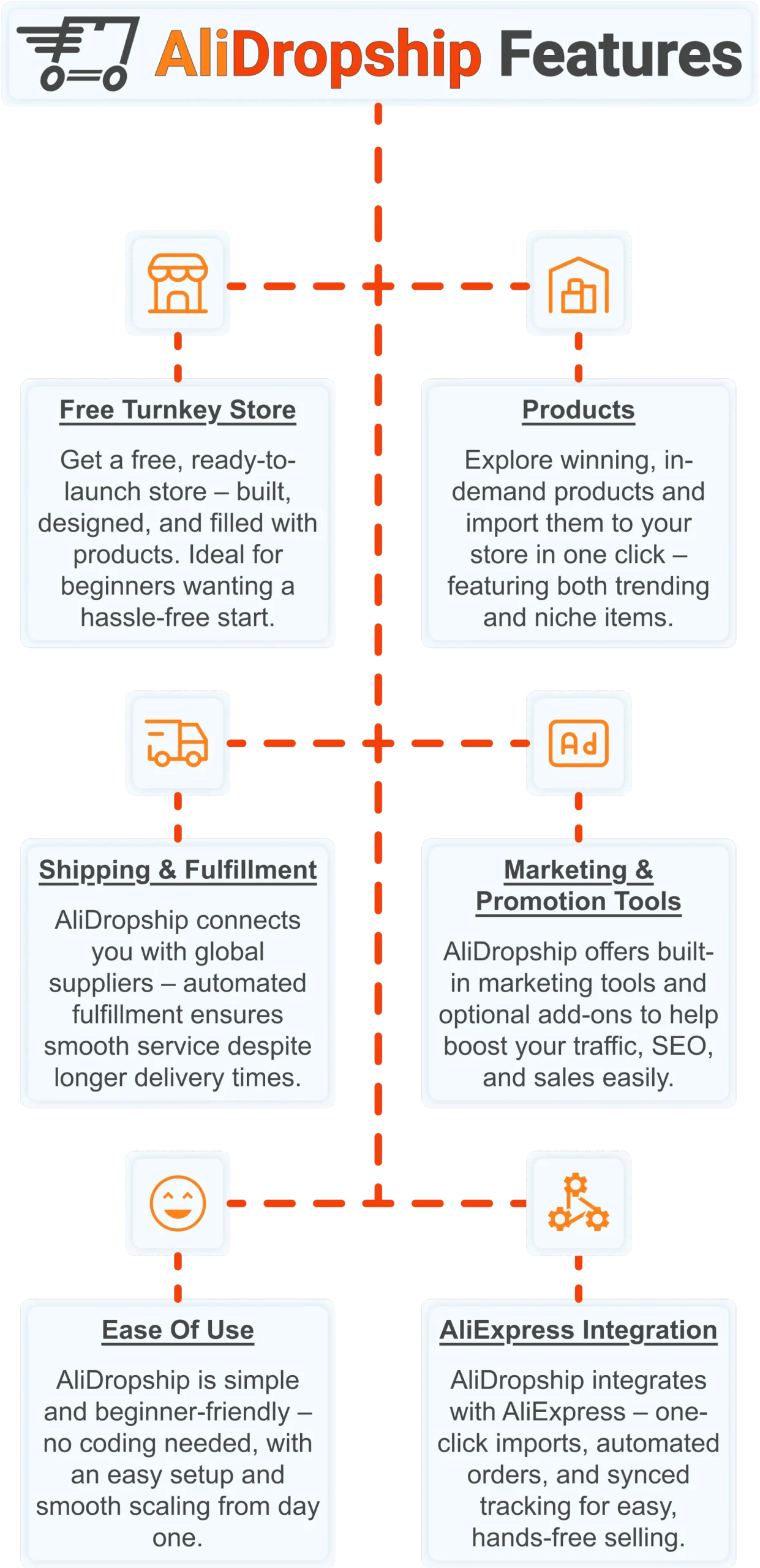
If you want the simplest possible way to start dropshipping – especially if you’re brand new – AliDropship remains one of the most beginner-friendly tools available in 2026. It brings together store creation, product imports, automation, and marketing into a single streamlined system designed to help you launch quickly and grow confidently.
Free turnkey store ️
Get a free turnkey store – built, designed, and filled with products. Ideal for beginners wanting a hassle-free start, the store comes fully optimized to attract customers right away, saving you time on setup. Plus, it includes professional design elements to give your business a polished, trustworthy look from day one. This ready-made foundation makes it easy to move seamlessly into product selection.
Products
Once your store is set up, you can explore winning, in-demand products and import them in one click – featuring both trending and niche items. This wide selection lets you cater to diverse customer interests and test what works best. Regular updates ensure you always have fresh products, keeping your store competitive and relevant. With great products in place, smooth shipping becomes the next essential step.
Shipping & fulfillment
AliDropship connects you with global suppliers, and automated fulfillment ensures seamless order processing despite international delivery times. Customers receive real-time tracking updates, which builds confidence and trust in your store. Once shipping is handled reliably, you can focus on promoting your store and attracting traffic.
Marketing & promotion tools
To maximize sales, AliDropship offers built-in marketing tools and optional add-ons that help boost traffic, SEO, and conversions. From email campaigns and discounts to social media integration, these tools empower you to reach and retain customers without needing prior marketing experience. With promotion strategies in place, managing your business becomes simpler and more efficient.
Ease of use
AliDropship is beginner-friendly – no coding needed, with an intuitive dashboard that guides you through every step. Easy setup and smooth scaling let you expand your store without stress. As your business grows, adding new features, products, and marketing campaigns remains hassle-free, giving you more time to focus on sales.
AliExpress integration
Finally, AliDropship integrates seamlessly with AliExpress, enabling one-click imports, automated orders, and synced tracking. Your inventory stays up-to-date with the latest products and prices, while automated order processing frees you from manual tasks. Combined with the turnkey setup, reliable shipping, and built-in marketing tools, this integration ensures your dropshipping business is fully equipped for growth and success.
If you have learned how to sell on Amazon and want to build something with even fewer platform restrictions and zero fee stacks, your own ecommerce store is the logical next step. Get your free AliDropship store today and start selling on your own terms.
Frequently asked questions
How do you start selling on Amazon as a complete beginner?
To sell on Amazon, you open a Seller Central account, pick a fulfillment model such as FBA or FBM, source products, and create optimized listings. Most beginners make their first sale within 30 to 60 days. Amazon has over 310 million active customers and nearly 10 million sellers worldwide. Consistent monthly income typically builds over 3 to 6 months of sustained effort.
How much can you realistically earn selling on Amazon?
Retail arbitrage typically earns 300 to 1,500 dollars per month, while wholesale can generate 1,000 to 5,000 dollars or more per month with reliable supplier relationships. Private label FBA has the highest ceiling at 2,000 to 15,000 dollars or more per month but requires the most upfront capital and marketing effort. Dropshipping through FBM typically earns 500 to 3,000 dollars per month with compliant wholesale suppliers. Higher end numbers generally require real upfront investment and 60 to 90 days of building reviews before achieving stable sales.
What is the difference between Amazon FBA and FBM?
FBA means you ship inventory to Amazon warehouses, and Amazon handles picking, packing, shipping, customer service, and returns, making your products Prime eligible. FBM means you list on Amazon but store and ship products yourself, giving more control and lower platform fees but requiring you to handle all logistics. Independent third-party sellers now account for more than 60 percent of all Amazon sales. The average US-based independent seller generated over 290,000 dollars in annual sales in 2024.
How much does Amazon actually take in fees from sellers?
Amazon charges a referral fee of 8 to 15 percent of the sale price depending on category, plus an FBA fulfillment fee of 3.22 to 6.00 dollars or more per unit for standard-size items. Monthly storage fees run approximately 0.78 dollars per cubic foot, with higher rates during Q4. In total, Amazon typically takes 25 to 30 percent of revenue in fees before advertising, and sellers running PPC often see that reach 35 to 40 percent. Amazon confirmed a 3.5 percent fuel and logistics surcharge on all FBA fulfillment fees effective April 17, 2026.
Is dropshipping allowed on Amazon, and how does it work?
Yes, Amazon permits dropshipping, but the seller must be the seller of record on every transaction rather than listing products from another retail website. Legitimate Amazon dropshipping means working with a wholesale supplier who ships directly to customers under the seller’s own brand name. Using a retail site like AliExpress or eBay as a direct dropshipping source violates Amazon policy and can get an account flagged. This model typically earns 500 to 3,000 dollars per month with compliant suppliers and active listing management.
 Previous post
