 ‧ Agnes Kazaryan ‧
March 24, 2026
‧ Agnes Kazaryan ‧
March 24, 2026  572 ‧
572 ‧
 0
0
Nearly 70% of online shoppers abandon their cart before completing a purchase. Payment friction is one of the leading causes. If you are setting up an online store, ecommerce payment processing is not a detail you can figure out later – it is the foundation of every sale you will ever make.
Quick Answer: Ecommerce payment processing is the system that moves money from a customer’s card or bank account to your merchant account when they buy something in your store. It involves three core components – a payment gateway, a payment processor, and a merchant account – all communicating in under three seconds.
In this guide, you will learn exactly how the process works step by step, which payment methods matter in 2026, what fees to expect, and how to choose the right setup based on where you are in your ecommerce journey.
What is ecommerce payment processing?
Ecommerce payment processing is the end-to-end system that authorizes, captures, and settles money when a customer pays in your online store. Think of it as the digital equivalent of a card reader in a physical shop – except everything happens online and usually completes in 1–3 seconds.
The system has three main parts. First, a payment gateway – the software layer that encrypts and transmits card data securely between your store and the banking system. Second, a payment processor – the company that moves the money, communicating between the customer’s issuing bank and your acquiring bank to approve or decline the transaction. Third, a merchant account – a special holding account that temporarily stores funds before transferring them to your regular business account.
In 2026, most store owners use an all-in-one provider that bundles all three. Stripe, PayPal, and Square handle the gateway, processing, and merchant account functions under one roof. This means faster setup, simpler billing, and one support team to contact when something goes wrong.
Why this works in 2026: Global ecommerce revenue is expected to exceed $7 trillion this year. Payment infrastructure has matured dramatically – even a brand-new store can access the same processing tools as a major retailer, at flat, predictable rates.
How much does payment processing actually cost?
Processing fees are one of the areas where new store owners get caught off guard. The advertised rate is rarely your true cost once you factor in chargebacks, currency conversion, and any monthly platform charges. Here is a realistic breakdown across the most common setups.
Stripe and PayPal are the most popular starting points because neither charges a monthly fee. On a $50 sale at Stripe’s standard rate, you pay about $1.75 in processing fees – roughly 3.5% of revenue. At $200 per sale, that same rate drops to just over 3% effectively, which is why higher average order values improve your margins. Additional costs to factor in: chargeback fees of $15–$25 per dispute and currency conversion fees of around 1–1.5% on international transactions.
Earning potential: Optimizing your payment setup – reducing chargebacks, enabling wallet payments, and negotiating volume rates – can realistically recover 0.5–1.5% of gross revenue at scale. On $10,000/month, that is $50–$150 back per month.
How ecommerce payment processing works step by step
Understanding the payment flow helps you troubleshoot problems faster, choose the right gateway, and explain things clearly to customers when something goes wrong. Here is exactly what happens in the few seconds between a customer clicking “Pay now” and you receiving an order confirmation.
Step 1 – Customer enters payment details
The customer types their card number, expiry date, and CVV into your checkout form. If your gateway supports it – and every major one does in 2026 – this data is tokenized immediately. That means the actual card number is replaced with a random string of characters before it touches your server. This is a core part of staying PCI DSS compliant without needing to manage card data yourself.
Step 2 – Gateway encrypts and transmits the data
Your payment gateway encrypts the tokenized data using SSL/TLS and sends it to the payment processor. The whole step takes under a second. The customer sees a loading spinner; behind the scenes, a secured data handoff is happening across multiple systems.
Step 3 – Processor requests authorization
The payment processor contacts the customer’s issuing bank – whatever bank issued their card – and asks three things: Is this card valid? Does the customer have sufficient funds? Does anything look fraudulent? The issuing bank runs its own fraud scoring and sends back an approval or decline code.
Step 4 – Authorization response is returned
The response travels back through the processor to your gateway, which relays it to your store. If approved, the customer sees your order confirmation page. If declined, they are prompted to try a different payment method. The full round trip typically takes 1–3 seconds.
Step 5 – Funds are captured and settled
Authorization and capture are two separate steps. Authorization reserves the funds on the customer’s card; capture actually moves them. Most gateways capture immediately on purchase. Settlement – when funds actually arrive in your merchant account – takes 1–3 business days with most processors. Stripe uses a 2-day rolling payout schedule for established accounts.
The main types of ecommerce payment methods
Offering the right mix of payment methods is one of the most underrated conversion levers in ecommerce. Different markets and customer demographics have strong preferences – and missing the preferred option in a given market means leaving sales on the table.
Card payments
Visa and Mastercard remain dominant globally, accounting for roughly 40% of all online transactions. American Express has a smaller but high-spending customer base. Card payments are handled automatically by every major gateway. The main risk is chargebacks – where a customer disputes a transaction with their bank rather than contacting you directly.
Apple Pay, Google Pay, and Samsung Pay have grown significantly and now account for a large share of mobile checkout completions. These wallets use tokenization and biometric authentication, making them faster and more secure than typing card details. If your store gets significant mobile traffic – and in 2026, most stores do – enabling wallet payments is not optional.
Important note: Wallet payment adoption varies by region. Apple Pay dominates in the US and UK; Google Pay performs strongly in Android-heavy markets across Southeast Asia and Latin America.
Alternative payment methods
PayPal has over 400 million active accounts globally and remains one of the most trusted names at checkout. For many customers – especially first-time online buyers or older demographics – seeing PayPal at checkout immediately reduces hesitation. PayPal’s fees run slightly higher than Stripe (3.49% + $0.49 per standard transaction), but the conversion lift often justifies the extra cost.
Buy Now Pay Later (BNPL) options like Klarna, Afterpay, and Affirm have reshaped checkout behavior, particularly for higher-ticket items. BNPL lets customers split payments into interest-free instalments, removing a major purchasing barrier. Merchants pay a higher processing fee – typically 2–8% depending on the provider – but benefit from average order values that are often 30–50% higher than card-only transactions.
Earning potential: Stores that add a BNPL option typically see average order value increases of $30–$80 per transaction for products priced in the $50–$200 range.
If you sell internationally, local payment methods matter enormously. iDEAL is dominant in the Netherlands. Boleto Bancário is widely used in Brazil. Alipay and WeChat Pay are essential for Chinese customers. Stripe and Adyen both support a wide range of local methods, making it easier to serve international markets without managing separate integrations.
Cryptocurrency payments
Crypto payments have matured as a genuine option for niche audiences. Providers like Coinbase Commerce and BitPay make it straightforward to accept Bitcoin, Ethereum, and USDC. The audience is still small – typically under 2% of transactions for mainstream stores – but can be meaningful for tech-forward or privacy-conscious customer bases. Stablecoins like USDC eliminate the volatility risk that made crypto payments impractical in earlier years.
Security, fraud prevention, and PCI compliance
Security is not optional in ecommerce payment processing – it is both a legal requirement and a commercial necessity. Here is what you need to understand without getting lost in technical jargon.
PCI DSS compliance
PCI DSS (Payment Card Industry Data Security Standard) is the set of rules any business handling card data must follow. The good news: if you use a hosted checkout or tokenization through Stripe, PayPal, or a similar provider, you are largely covered. These providers handle card data on their servers, not yours, which keeps your compliance burden minimal. You will still need to complete an annual Self-Assessment Questionnaire – both Stripe and PayPal provide clear guidance on this.
Important: Never store raw card numbers in your own database. The legal and financial liability of a data breach far outweighs any perceived convenience.
Fraud prevention tools
Stripe Radar uses machine learning to score every transaction for fraud risk and can automatically block or flag suspicious orders. PayPal has its own fraud engine built in. If you are on WooCommerce, additional tools like Signifyd or Kount add another layer for higher-volume stores.
Common fraud signals to watch for: mismatched billing and shipping addresses, multiple failed card attempts in quick succession, unusually large first orders, and shipments routed to freight-forwarding addresses. Setting up automated rules for these patterns is straightforward in both Stripe and PayPal dashboards.
3D Secure and strong customer authentication
3D Secure 2 (3DS2) adds an extra verification step for high-risk transactions – typically a biometric prompt or a one-time code sent to the customer’s phone. It is required in the EU under PSD2 Strong Customer Authentication rules and is increasingly common globally. When implemented via your gateway, 3DS2 shifts fraud liability from you to the card issuer – a meaningful protection for merchants. Stripe and Adyen handle 3DS2 automatically when required.
Legal and ethical considerations in payment processing
Payment processing sits at the intersection of financial regulation, consumer protection law, and platform terms of service. Getting any of these wrong can result in account termination, fines, or permanent bans from payment networks.
What to avoid absolutely
Do not use a personal PayPal account for business sales. PayPal’s terms prohibit this, and accounts doing significant volume are regularly suspended without warning. Similarly, do not misrepresent your business category when applying for a merchant account – this is considered fraud and can lead to permanent exclusion from payment networks.
Avoid high-risk product categories unless your account is explicitly approved for them. Most standard processors – Stripe, PayPal, Square – have prohibited or restricted product lists. Selling in grey areas, such as certain supplements, replica goods, or products with unclear legal status, puts your entire merchant account at risk.
Key principle: Operate within your processor’s terms from day one. Account reinstatement after termination is difficult, and switching processors mid-operation disrupts cash flow at exactly the wrong moment.
What to do instead
Choose a product niche that sits clearly within standard processor terms. Stick to accurate product descriptions – inflated claims increase chargebacks and refund rates, both of which trigger processor scrutiny. Make your refund and return policy clearly visible at checkout. Customers who know how to get a refund are far less likely to file a chargeback instead.
If you plan to sell internationally, review payment regulations in your target markets. Some countries have specific requirements around currency display, tax disclosure, or payment method availability.
Important note: Refund rates above 2–3% are a warning sign that processors watch closely. Clear product pages and accurate shipping estimates are your first line of defense against disputes.
How to choose your payment setup based on your situation
The right ecommerce payment processing setup depends on where you are in your journey. Here is a practical breakdown by reader profile.
Complete beginner
Start with Stripe or PayPal – or both. Neither charges a monthly fee, both offer fast onboarding, and their documentation is excellent. If you are launching through AliDropship, payment integration is handled for you as part of the store setup. Your goal at this stage is simply to accept payments reliably and get your first sales. Do not over-engineer it – you can add BNPL, crypto, or international payment methods once you have consistent order volume.
Intermediate – part-time seller
Once you are processing $3,000–$10,000 per month, it is worth revisiting your fee structure. The difference between a 2.9% and a 2.5% rate starts to matter at this volume. Consider negotiating custom rates with your processor (Stripe and Adyen both offer volume discounts), enabling Apple Pay and Google Pay for mobile checkout optimization, and setting up automated fraud rules if you are seeing suspicious orders.
Advanced – full-time goal
At $30,000+ per month, payment optimization becomes a serious revenue lever. Adyen’s interchange-plus pricing model becomes cheaper than flat-rate pricing at high volume. Multi-currency accounts reduce conversion friction for international customers. Dedicated fraud tooling like Signifyd or Kount can pay for itself quickly by reducing false declines – legitimate transactions blocked by overly aggressive fraud filters – which is a hidden cost many stores never quantify.
Pro Tip: Run an A/B test on your checkout page with and without a BNPL option. If your average order value is above $60, the conversion lift almost always outweighs the higher processing fee.
AliDropship: Your complete all-in-one solution for starting dropshipping in 2026
If you want the simplest possible way to start dropshipping – especially if you’re brand new – AliDropship remains one of the most beginner-friendly tools available in 2026. It brings together store creation, product imports, automation, and marketing into a single streamlined system designed to help you launch quickly and grow confidently.
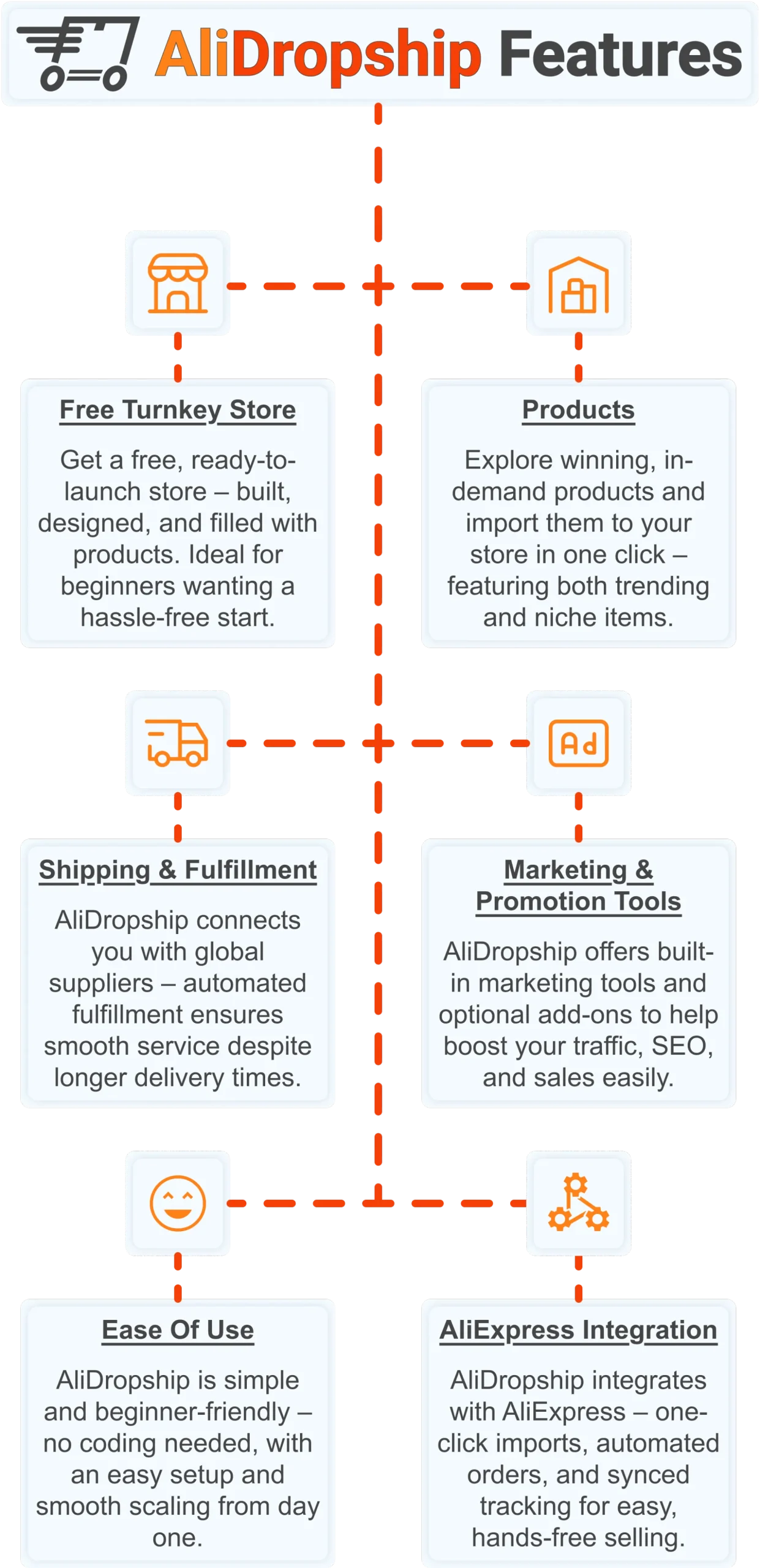
Free turnkey store ️
Get a free turnkey store – built, designed, and filled with products. Ideal for beginners wanting a hassle-free start, the store comes fully optimized to attract customers right away, saving you time on setup. Plus, it includes professional design elements to give your business a polished, trustworthy look from day one. This ready-made foundation makes it easy to move seamlessly into product selection.
Products
Once your store is set up, you can explore winning, in-demand products and import them in one click – featuring both trending and niche items. This wide selection lets you cater to diverse customer interests and test what works best. Regular updates ensure you always have fresh products, keeping your store competitive and relevant. With great products in place, smooth shipping becomes the next essential step.
Shipping & fulfillment
AliDropship connects you with global suppliers, and automated fulfillment ensures seamless order processing despite international delivery times. Customers receive real-time tracking updates, which builds confidence and trust in your store. Once shipping is handled reliably, you can focus on promoting your store and attracting traffic.
Marketing & promotion tools
To maximize sales, AliDropship offers built-in marketing tools and optional add-ons that help boost traffic, SEO, and conversions. From email campaigns and discounts to social media integration, these tools empower you to reach and retain customers without needing prior marketing experience. With promotion strategies in place, managing your business becomes simpler and more efficient.
Ease of use
AliDropship is beginner-friendly – no coding needed, with an intuitive dashboard that guides you through every step. Easy setup and smooth scaling let you expand your store without stress. As your business grows, adding new features, products, and marketing campaigns remains hassle-free, giving you more time to focus on sales.
AliExpress integration
Finally, AliDropship integrates seamlessly with AliExpress, enabling one-click imports, automated orders, and synced tracking. Your inventory stays up-to-date with the latest products and prices, while automated order processing frees you from manual tasks. Combined with the turnkey setup, reliable shipping, and built-in marketing tools, this integration ensures your dropshipping business is fully equipped for growth and success.
Understanding ecommerce payment processing is the first step – but a store that is already built, stocked, and payment-ready is how you start earning. Claim your free turnkey store and $100 voucher today.
Frequently asked questions
What is ecommerce payment processing and how does it work?
Ecommerce payment processing is the system that moves money from a customer card or bank account to a merchant account when they buy something in an online store. It involves three core components, a payment gateway, a payment processor, and a merchant account, all communicating in under three seconds. Nearly 70 percent of online shoppers abandon their cart before completing a purchase, and payment friction is one of the leading causes. Global ecommerce revenue is expected to exceed 7 trillion dollars this year.
How much do payment processing fees actually cost a store?
Stripe charges 2.9 percent plus 30 cents per transaction with no monthly fee, while PayPal charges 3.49 percent plus 49 cents with no monthly fee. On a 50 dollar sale at Stripe standard rate, a store pays about 1.75 dollars in processing fees, roughly 3.5 percent of revenue. Additional costs include chargeback fees of 15 to 25 dollars per dispute and currency conversion fees of around 1 to 1.5 percent on international transactions. Optimizing a payment setup can realistically recover 0.5 to 1.5 percent of gross revenue, which is 50 to 150 dollars back per month on 10,000 dollars in monthly sales.
What payment methods should an online store offer in 2026?
Visa and Mastercard remain dominant globally, accounting for roughly 40 percent of all online transactions, alongside growing use of Apple Pay and Google Pay for mobile checkout. PayPal has over 400 million active accounts globally and reduces hesitation for first-time online buyers. Buy Now Pay Later options like Klarna and Afterpay carry a higher processing fee of typically 2 to 8 percent but can increase average order values by 30 to 50 percent. Cryptocurrency payments through providers like Coinbase Commerce or BitPay remain under 2 percent of transactions for mainstream stores.
How long does it take for payment processing funds to reach a merchant account?
The full authorization process, from a customer clicking pay to receiving order confirmation, typically takes 1 to 3 seconds. Authorization and capture are separate steps, with authorization reserving funds on the card and capture actually moving them, usually done immediately on purchase. Settlement, when funds actually arrive in the merchant account, takes 1 to 3 business days with most processors. Stripe uses a 2-day rolling payout schedule for established accounts.
What security measures protect an ecommerce store from payment fraud?
PCI DSS compliance is largely handled automatically when using a hosted checkout through providers like Stripe or PayPal, since they manage card data on their own servers. Stripe Radar uses machine learning to score every transaction for fraud risk and can automatically block or flag suspicious orders. 3D Secure 2 adds an extra verification step for high-risk transactions and is required in the EU under PSD2 Strong Customer Authentication rules. Refund rates above 2 to 3 percent are a warning sign that processors watch closely, since it can indicate unclear product pages or inaccurate shipping estimates.
 Previous post
