 ‧ Agnes Kazaryan ‧
March 24, 2026
‧ Agnes Kazaryan ‧
March 24, 2026  848 ‧
848 ‧
 0
0
Every day, people are waking up to the idea that you can sell something once and get paid for it repeatedly. Selling digital products is exactly that. No stock to manage, no shipping costs, no warehouse. You create or source a file, put it online, and every sale is almost pure margin. But is it really that clean in practice?
Quick Answer: Yes – selling digital products is one of the most profitable and accessible ways to earn online in 2026. The barriers to entry are low, the margins are high, and the global market keeps growing. The honest caveat is that most beginners take 60–90 days before seeing meaningful revenue, and results vary significantly based on your niche, your product quality, and how consistently you market.
This guide covers everything you need to get started: what digital products actually are, how much you can realistically expect to earn, the best product types and platforms in 2026, strategies to grow your income, and how to avoid the legal and ethical traps that catch a lot of new sellers off guard.
What is selling digital products?
Selling digital products means charging for files, content, or access that customers receive online – no physical delivery involved. A buyer pays, they download or stream what they purchased, and you collect the margin. Once a product is created, it can be sold an unlimited number of times for almost zero additional cost per sale.
Common formats include eBooks, templates, online courses, stock photos, music, fonts, software tools, printables, and membership communities. The category spans everything from $5 Canva templates on Etsy to $2,000 coaching programs on Kajabi. What they all share is the same core advantage: infinite scalability with minimal ongoing operational cost.
Why this works in 2026: Global internet access has put billions of potential buyers within reach of any seller, and payment and delivery platforms now handle the entire transaction automatically – meaning a single creator anywhere in the world can earn while they sleep.
How much can you realistically earn selling digital products?
Most guides at this point throw out a headline figure like “$10,000 a month selling PDFs.” Those numbers are real – but they belong to a small minority of sellers with large audiences, strong SEO, or years of product development behind them. For the majority of people starting out, the early months look very different.
Here is a realistic breakdown of what to expect by product type and effort level:
These ranges reflect sellers who are consistent but not working full-time. Most beginners take 60–90 days to see their first meaningful sales, simply because it takes time for products to get indexed, reviewed, and discovered by buyers.
One note on the ceiling figures: The $5,000–$10,000/month ranges are achievable but require either a substantial existing audience, significant ad spend, or a product distinctive enough to spread organically. Plan for the middle of the range and treat the upper end as a long-term target – not a month-one expectation.
The most consistent earners in this space are not always the most talented creators. They are the most systematic ones. They pick a tight niche, build a small catalog of genuinely useful products, and market those products steadily over months – not days.
The best types of digital products to sell in 2026
Not all digital products are equally accessible for someone starting out. Some take years of skill-building to produce credibly. Others can be created in a single afternoon. Here is a breakdown of the main categories, ordered roughly by how easy they are to get started with.
Downloadable files and templates
Printables
Printables – planners, habit trackers, wall art, worksheets, party packs – are among the most beginner-accessible digital products available. Free tools like Canva put professional-looking design within reach for anyone willing to spend a few hours learning the platform. Etsy has an enormous built-in audience actively searching for exactly these items, and a well-optimized listing in a specific niche can generate consistent passive sales with minimal ongoing work.
Earning potential: $50–$300/month from a focused Etsy shop of 10–20 listings, scaling with volume and reviews.
Spreadsheet and document templates
Business and productivity templates – budget trackers, project trackers, invoice templates, HR onboarding packs – sell consistently on Etsy, Gumroad, and Creative Market. Buyers in this category have a specific problem they need to solve fast, which means conversion rates are typically higher than purely aesthetic products. If you have professional experience in finance, operations, or HR, you can package that knowledge directly into templates that command $15–$50 each.
Earning potential: $100–$600/month for a focused template shop with 10–20 well-built products.
Canva and social media templates
Presentation decks, Instagram templates, brand kits, and pitch deck layouts are in steady demand as small businesses try to look professional online without hiring a designer. Canva templates are particularly appealing to buyers because they require no additional software – just a free Canva account and a few clicks to customize. Etsy and Creative Market are the main platforms for this category.
Earning potential: $80–$400/month with a niche-focused pack that solves a specific visual problem.
Information products
eBooks and guides
eBooks are one of the most flexible digital product formats. You can sell them on your own site, through Amazon KDP, or via platforms like Gumroad and Payhip. The key to success here is specificity. A focused 40-page guide titled something like “How to negotiate your first salary in the tech industry” will consistently outperform a broad 200-page “career success” book, because it matches a precise search intent. Focused guides also rank better in search and attract buyers who are much closer to making a purchase decision.
Earning potential: $100–$800/month for a well-positioned eBook with solid organic discoverability.
Online courses
Courses represent the highest-value segment of the digital product market. Platforms like Teachable, Kajabi, and Thinkific handle delivery and payments, while Udemy provides access to millions of built-in buyers in exchange for lower per-sale margins. A well-structured course on a skill people actively pay to learn – coding, copywriting, photo editing, a language, a business skill – can generate $500–$3,000/month once it has enough reviews and visibility.
The trade-off is production time. A credible course takes weeks to plan, record, and edit properly. Rushing it leads to poor reviews, and a poorly rated course on Udemy is genuinely difficult to recover. Quality over speed is the only path that works here.
Earning potential: $500–$5,000/month for an established course with consistent reviews and ongoing promotion.
Membership sites and communities
Recurring revenue is the holy grail of online income, and membership sites deliver exactly that. Platforms like Patreon, Memberful, and Circle let creators charge monthly or annual fees for ongoing access to content, a community, or live coaching. The catch is that you have to keep producing new value every single month to prevent churn. Managing a membership sustainably requires genuine commitment to the community – it is not a set-and-forget income stream.
Earning potential: $300–$3,000/month from a focused community of 50–300 paying members, depending on your pricing.
Creative and media assets
Stock photography and video
If you are a photographer or videographer, platforms like Shutterstock, Adobe Stock, and Pond5 let you license your work for passive income. The economics require volume – a single photo might earn a few cents per download – but a large portfolio of in-demand content in categories like business, lifestyle, and technology can generate meaningful passive revenue over time. This is a slow-build strategy, but it works for creators already producing content regularly.
Earning potential: $50–$400/month from a portfolio of 500+ high-quality, well-tagged assets.
Music, sound effects, and audio
Audio assets are in growing demand from the creator economy. YouTubers, podcasters, and video editors all need royalty-free music and sound effects, and platforms like AudioJungle, Pond5, and Artlist connect audio creators directly with those buyers. Breaking through requires a distinctive style and strong metadata, but established audio creators with broad libraries earn consistently from passive licensing month after month.
Earning potential: $80–$500/month from an active library of 50–200 assets.
Fonts, icons, and design elements
The design asset market is mature but still active. Fonts command strong prices – a well-crafted, commercially licensed font family can earn $200–$1,000+ in its first month on Creative Market or MyFonts. Icon packs and UI kits attract buyers from the software and web design world. The most effective approach here is niche specificity: a retro serif font or a hand-drawn illustration set will stand out far more than a generic sans-serif in a saturated market.
Earning potential: $100–$1,000/month for a focused design asset catalog with strong niche positioning.
Best platforms for selling digital products in 2026
Choosing the right platform matters as much as the product itself. The best option depends on your product type, your existing audience, and how much platform dependence you are comfortable accepting long-term.
There is no single best platform – and many successful digital product sellers use more than one simultaneously. A common path is starting on a marketplace like Etsy or Udemy to acquire initial buyers and reviews, then gradually moving your best customers to your own storefront where you control margins and customer data long-term.
How to maximize your earnings when selling digital products
Getting your first sale is one milestone. Building a reliable income stream is a different challenge entirely. These are the strategies that separate consistent earners from one-time sellers.
Nail your niche before expanding
Generalist digital product shops rarely perform well. A store selling “all kinds of templates” competes with every other template seller on the platform. A store selling “budget tracking tools for freelance designers” has a clear audience, lower competition, and buyers who immediately recognize it as relevant to their specific situation. Dominate one tight niche before expanding into adjacent ones.
Use SEO from day one
Whether you are on Etsy, your own WordPress site, or Gumroad, search visibility is often the difference between passive income and a product nobody ever discovers. Research what buyers actually type into search – tools like eRank for Etsy, or Google Keyword Planner for your own site – and write your titles, descriptions, and tags around those exact phrases from the start. Retroactive SEO is always harder than getting it right the first time.
Build an email list from your first sale
Every buyer who downloads your product is a potential repeat customer. Offering a small bonus – a complementary template, a checklist, a short follow-up guide – in exchange for an email address lets you build a list you own outright, independent of any platform algorithm. That list becomes your most valuable asset when launching new products, because you are talking directly to people who have already bought from you once.
Price for value, not for volume
Many new sellers underprice out of imposter syndrome or fear that nobody will pay. In practice, a $27 eBook often outsells a $3 version of the same content because buyers associate price with quality. Test higher price points than feel comfortable and adjust based on actual conversion data – not gut instinct or what you would personally spend.
Create bundles and upsells
The average order value from a single product is rarely optimized. Bundling complementary products – three related templates together, a course plus a workbook – increases revenue per transaction without requiring more traffic. Adding an upsell immediately after purchase is one of the simplest revenue lifts available on any platform.
Pro Tip: Set up your upsell or bundle before launch, not after. Adding one retroactively once buyers have already transacted at the base price is significantly harder.
Legal and ethical considerations when selling digital products
The digital product space has its share of grey-area practices that can get your account suspended, expose you to copyright claims, or damage your reputation with buyers. Here is what to watch out for and what to do instead.
Copyright and PLR content
Private Label Rights (PLR) products – pre-written content sold with resale rights – are technically legal to resell but are often low-quality, already saturated across dozens of shops, and sold simultaneously by many other sellers. Passing PLR off as original work is misleading and damages buyer trust. If you use PLR as a foundation, rewrite it substantially and add genuine value before listing it as your own product.
Key principle: Only sell products you have created yourself or have clear, documented commercial rights to sell.
Income claims in your marketing
If your digital product helps others make money – a course, a business template pack, a guide to freelancing – the FTC requires that any income figures you use in marketing are truthful and representative of typical results. Showing your own exceptional results as standard practice is a regulatory violation. Always include a genuine disclaimer and use realistic, qualified figures with a specific timeframe.
Important: This applies to social media posts, sales pages, and email marketing – not just formal advertisements.
Platform policy violations
Each platform has its own rules about what can be sold and how. Etsy periodically removes listings that misrepresent digital content as handmade. Udemy pulls courses containing misleading previews or copyright violations. Gumroad prohibits certain content categories outright. Before listing anything, read the full platform policy – not just the summary.
Important note: Getting banned from a major marketplace means losing all your reviews and organic ranking, which can take years to rebuild on a new account. It is not worth the shortcut.
Final thoughts: how to choose your approach
Not every strategy here is right for every person. Where you should start depends on where you are right now.
Complete beginner
Start with printables or simple templates on Etsy. The platform gives you built-in traffic, the product format is achievable without deep technical skills, and you will learn the fundamentals of listing optimization, pricing, and customer feedback quickly. Aim for 10–20 well-optimized listings before drawing any conclusions about what is working. Consistency over the first 60–90 days matters more than perfection.
Intermediate / part-time seller
If you already have some online income experience, consider building your own audience – a niche blog, a newsletter, or a focused social media channel – alongside your marketplace presence. An email list of even 500 engaged subscribers will consistently outperform any platform algorithm for launching new products. At this stage, think seriously about creating a standalone store where you control the margins and own your customer data.
Advanced / full-time goal
For anyone targeting full-time income from selling digital products, the path runs through owning your distribution: your own website, your own email list, your own community. At $2,000–$5,000/month, platform fees and algorithmic dependence become real constraints on growth. Building on rented land – Etsy, Udemy, Gumroad – is fine for acquiring initial customers, but long-term income security requires owning your audience and your storefront outright.
AliDropship: Your complete all-in-one solution for starting dropshipping in 2026
If you want the simplest possible way to start dropshipping – especially if you’re brand new – AliDropship remains one of the most beginner-friendly tools available in 2026. It brings together store creation, product imports, automation, and marketing into a single streamlined system designed to help you launch quickly and grow confidently.
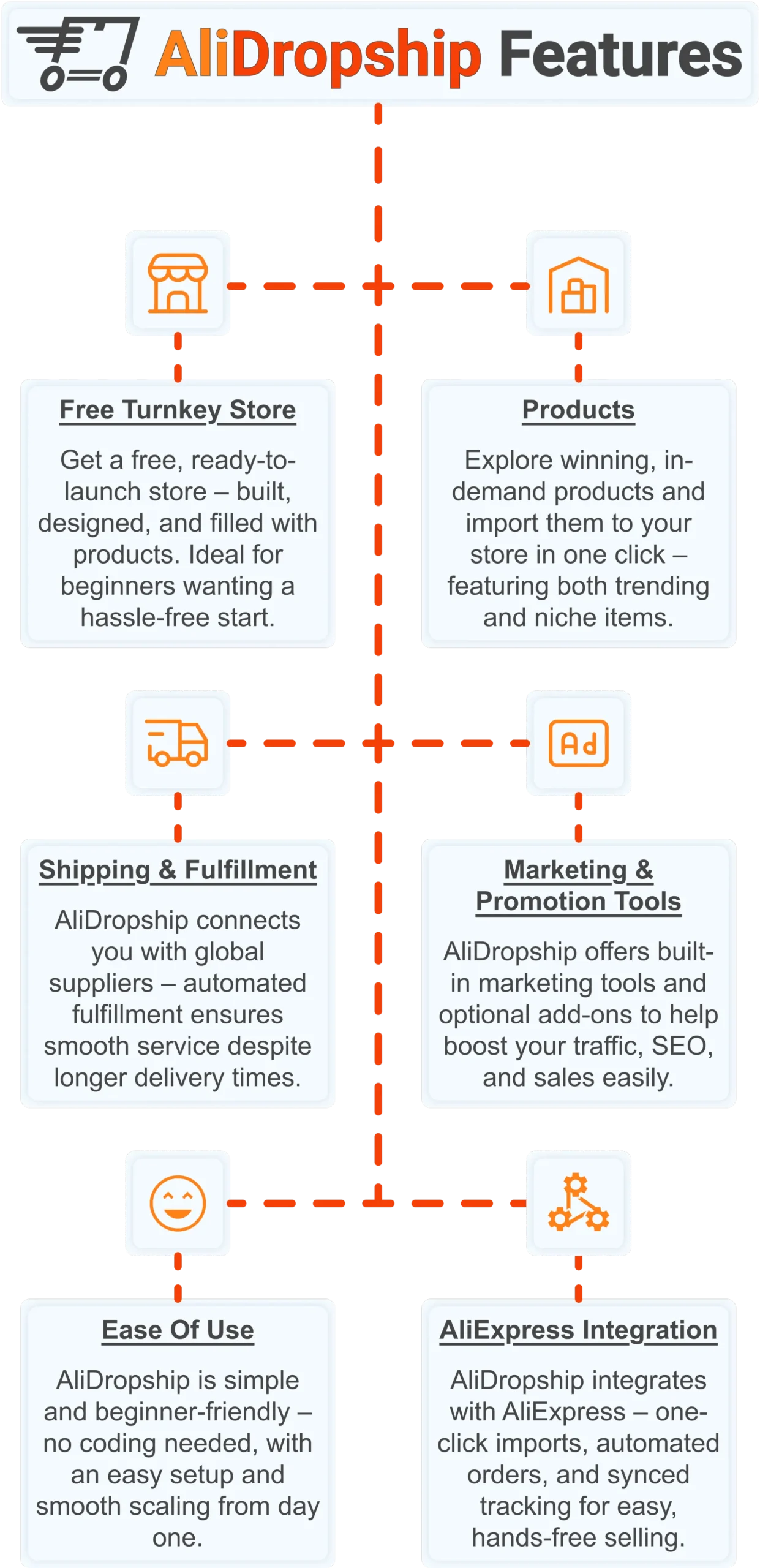
Free turnkey store ️
Get a free turnkey store – built, designed, and filled with products. Ideal for beginners wanting a hassle-free start, the store comes fully optimized to attract customers right away, saving you time on setup. Plus, it includes professional design elements to give your business a polished, trustworthy look from day one. This ready-made foundation makes it easy to move seamlessly into product selection.
Products
Once your store is set up, you can explore winning, in-demand products and import them in one click – featuring both trending and niche items. This wide selection lets you cater to diverse customer interests and test what works best. Regular updates ensure you always have fresh products, keeping your store competitive and relevant. With great products in place, smooth shipping becomes the next essential step.
Shipping & fulfillment
AliDropship connects you with global suppliers, and automated fulfillment ensures seamless order processing despite international delivery times. Customers receive real-time tracking updates, which builds confidence and trust in your store. Once shipping is handled reliably, you can focus on promoting your store and attracting traffic.
Marketing & promotion tools
To maximize sales, AliDropship offers built-in marketing tools and optional add-ons that help boost traffic, SEO, and conversions. From email campaigns and discounts to social media integration, these tools empower you to reach and retain customers without needing prior marketing experience. With promotion strategies in place, managing your business becomes simpler and more efficient.
Ease of use
AliDropship is beginner-friendly – no coding needed, with an intuitive dashboard that guides you through every step. Easy setup and smooth scaling let you expand your store without stress. As your business grows, adding new features, products, and marketing campaigns remains hassle-free, giving you more time to focus on sales.
AliExpress integration
Finally, AliDropship integrates seamlessly with AliExpress, enabling one-click imports, automated orders, and synced tracking. Your inventory stays up-to-date with the latest products and prices, while automated order processing frees you from manual tasks. Combined with the turnkey setup, reliable shipping, and built-in marketing tools, this integration ensures your dropshipping business is fully equipped for growth and success.
If you want to start selling digital products without spending months creating them from scratch, AliDropship gives you everything you need from day one. Claim your free store and $100 gift voucher today.
Frequently Asked Questions
What are the best digital products to sell for beginners?
Printables, spreadsheet templates, and Canva templates are among the most beginner-accessible digital products to sell. A focused Etsy shop of 10 to 20 printable listings can generate 50 to 300 dollars a month, while a template shop of similar size can bring in 100 to 600 dollars a month. Canva and social media templates can earn 80 to 400 dollars a month with a niche-focused pack. These formats require no advanced technical skill and can often be created in a single afternoon.
How much can you realistically earn selling digital products in 2026?
Earnings depend heavily on product type and effort level. Printables and templates typically earn 50 to 500 dollars a month part time, while online courses can reach 500 to 5,000 dollars a month once established. Software and tools represent the highest ceiling, with mature products earning 1,000 to 10,000 dollars a month or more. Most beginners need 60 to 90 days before seeing their first meaningful sales.
Which platforms are best for selling digital products?
Etsy works well for printables, templates, and art thanks to built-in traffic, though competition and fees are high. Gumroad suits eBooks, courses, and any file type with a simple setup, but sellers must bring their own traffic. Udemy offers a massive audience for video courses but often involves aggressive price discounting. Many sellers start on a marketplace to build reviews, then move top customers to their own website for better margins.
How can sellers increase their digital product earnings over time?
Building an email list from the first sale creates a repeat customer base independent of any platform algorithm, and even 500 engaged subscribers can outperform algorithmic reach. Pricing for value rather than volume often works better, since a 27 dollar eBook can outsell a 3 dollar version of the same content. Creating bundles, such as three related templates together, increases revenue per transaction without needing more traffic. Using SEO from day one, rather than retroactively, also improves long-term discoverability.
What legal risks should sellers watch for when selling digital products?
Private Label Rights content is technically legal to resell but should be substantially rewritten before being listed as original work. The FTC requires that any income figures used in marketing digital products be truthful and representative of typical results, not just exceptional outcomes. Each platform enforces its own content rules, such as Etsy removing listings that misrepresent digital content as handmade. Getting banned from a major marketplace can mean losing years of reviews and organic ranking that are difficult to rebuild.
 Previous post
