 ‧ Agnes Kazaryan ‧
April 06, 2026
‧ Agnes Kazaryan ‧
April 06, 2026  668 ‧
668 ‧
 0
0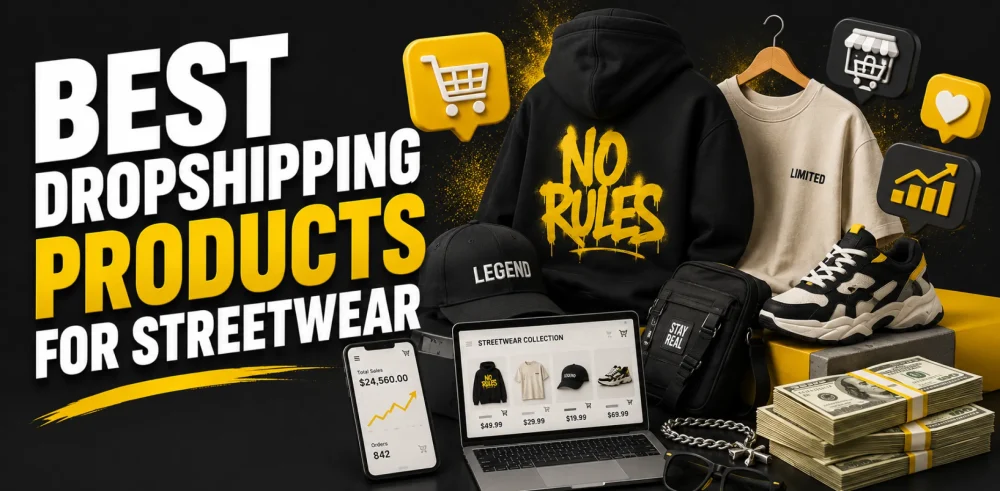
Streetwear is not a passing trend. It is a global market worth well over $185 billion, and it keeps growing every year. If you have been looking for a dropshipping niche with real staying power – one where customers are passionate, order values are high, and organic marketing actually works – the best dropshipping products for streetwear give you all of that in one place. The question is not whether this niche can make money. The question is which products give you the best chance of making it.
Quick Answer: The best dropshipping products for streetwear in 2026 include graphic tees, oversized hoodies, cargo pants, puffer jackets, joggers, snapback caps, crossbody bags, and chunky jewelry. These categories combine consistent demand, strong profit margins, and a digitally native customer base that shops almost entirely online.
This guide covers the top product categories in detail, realistic earning figures, how to identify winning products before you list them, and the legal pitfalls to avoid when building a streetwear dropshipping store from scratch.
What is streetwear dropshipping?
Streetwear dropshipping means selling urban fashion and lifestyle clothing through your own online store without holding any physical inventory. A customer places an order, your supplier ships the item directly to them, and you keep the difference between your retail price and the wholesale cost. No warehouse. No upfront stock. No packing parcels at your kitchen table.
The streetwear segment draws from hip-hop, skateboarding, Japanese street culture, and high fashion simultaneously. That cultural layering is a genuine commercial advantage – streetwear customers identify strongly with what they wear, which means they spend more per order, come back more often, and recommend stores to friends in a way that generic fashion buyers rarely do.
In 2026, the majority of streetwear purchases happen online, and platforms like TikTok, Instagram, and Pinterest function as essentially free advertising channels for anyone selling visually compelling clothing. If your product photos are sharp and your niche positioning is clear, the audience is already there waiting.
How much can you realistically earn from a streetwear dropshipping store?
Earnings vary depending on your niche focus, traffic strategy, and how much time you put in. Here is a realistic breakdown based on effort level:
Most new sellers in the streetwear niche see their first consistent sales within 60–90 days. The middle tier – a focused store with regular social media content – is where most part-time sellers land after three to six months of steady work.
One note on the upper figures: Reaching $200–$500/day requires genuine full-time effort, a tested ad budget, strong product-market fit, and reliable suppliers. These numbers are achievable but they represent the top end, not the typical starting point.
Streetwear customers spend $35–$90 per order on average – meaningfully higher than general fashion. That average order value gives you room to run paid ads profitably once you have identified your winning products. For context, a single organic TikTok video featuring one of your products can generate hundreds of orders in 48 hours. The traffic potential is real, and it does not always require a big budget.
Best dropshipping products for streetwear in 2026: Apparel
Not every streetwear category suits dropshipping equally well. The best products combine fast supplier availability, high visual appeal, and strong organic search demand. Below are the top apparel categories to build your store around.
Graphic tees
Graphic tees are the foundation of every streetwear store. They are low-cost to source ($4–$12 wholesale), easy to photograph, and they sell consistently across every season. The key is picking designs that tap into specific subcultures – anime references, retro sports aesthetics, abstract art, city-specific motifs – rather than generic prints that compete with Amazon on price alone.
AliExpress suppliers refresh their graphic tee catalogs constantly, which means there is always something new to test. With AliDropship, you can import the best-performing designs in a single click and have them live in your store the same day.
Earning potential: $8–$25 profit per tee at a $20–$40 retail price point.
Oversized hoodies and crewnecks
The oversized silhouette has dominated streetwear for several years and shows no sign of fading. Hoodies and crewnecks are high-margin items – a $10–$18 wholesale cost supports a $45–$75 retail price – and they photograph exceptionally well for social media content.
When selecting suppliers, prioritize heavyweight cotton or fleece options. Fabric weight is the most common complaint in this category, and it directly affects your review ratings. Neutral tones (stone, ecru, washed black, sage) alongside bold colorblock styles perform consistently across all demographics.
Why this works in 2026: Oversized hoodies are a wardrobe staple across every streetwear subculture, so your potential audience is not limited to a single age group or gender.
Cargo pants and wide-leg trousers
Cargo pants have made a strong comeback across streetwear, workwear-inspired fashion, and techwear all at once. They are a higher-ticket item ($18–$30 wholesale, $60–$120 retail), which means stronger margins per sale and a higher average order value when bundled with a tee or hoodie.
Wide-leg trousers with a relaxed fit are performing particularly well in the 18–28 age bracket. When choosing suppliers, prioritize those with multiple color options and detailed size charts – fit-related returns are the main pain point in this category, and accurate sizing information upfront cuts your return rate significantly.
Earning potential: $25–$55 profit per unit at mid-range retail pricing.
Puffer jackets and windbreakers
Outerwear drives some of the highest order values in the entire streetwear niche. Puffer jackets and lightweight windbreakers retail at $70–$150, and they generate repeat purchases as seasons rotate. Cropped puffer styles perform especially well in women’s streetwear, while full-length and vest puffer styles lead in men’s.
This category requires careful supplier vetting for fill quality and zipper reliability, but the margins reward that extra diligence. Run these products aggressively in Q3 and Q4 when cold-weather search volume spikes sharply across every major market.
Joggers and sweatpants
Joggers sit at the crossover between streetwear and athleisure, which effectively doubles your addressable audience. Tapered joggers with cuffed ankles and side-stripe detailing are consistent performers across the year. Wholesale costs of $8–$15 against retail prices of $35–$65 give you comfortable margins even when running promotional discounts.
Unlike trend-driven pieces, basic joggers in core colors – black, grey, navy – sell steadily through every season, making them a reliable foundation product that reduces the volatility of your overall catalog.
Earning potential: $15–$35 profit per unit depending on material and finish.
Best dropshipping products for streetwear in 2026: Accessories
Accessories are where your average order value gets a serious lift. They are lightweight to ship, cheap to source, and streetwear customers buy them constantly to complete a look. Adding a strong accessories range to your store is one of the fastest ways to increase revenue without adding significant complexity.
Snapback and dad caps
Caps are among the easiest products to dropship. They are compact, ship quickly, generate almost no returns, and never go out of fashion in the streetwear context. Snapbacks with embroidered logos or text patches are perennial sellers. Wholesale pricing starts at $3–$7, with retail prices of $18–$35 delivering a clean margin on every sale.
Bundle caps with a hoodie or tee in your store to encourage multi-item orders. Streetwear customers almost always buy headwear alongside clothing rather than as a standalone purchase, so a “complete the look” feature can meaningfully increase your cart size.
Beanies and bucket hats
Both categories enjoy strong year-round demand – beanies peak in autumn and winter, bucket hats surge in spring and summer. Ribbed beanies in neutral and earthy tones are especially popular right now, while reversible bucket hats offer added perceived value that supports higher retail pricing.
These are ideal products to feature in your store’s “shop the look” sections. They photograph effortlessly alongside any apparel and require minimal effort to style for content.
Crossbody bags and mini backpacks
Bags have become central to the streetwear aesthetic. Crossbody bags – particularly nylon and canvas styles in neutral or earthy colorways – are selling strongly across gender demographics. Mini backpacks with utilitarian detailing (external pockets, adjustable straps, padded backs) are a natural fit for the streetwear customer who values both function and style.
These are among the highest-margin accessories in the category. Wholesale costs of $12–$22 against retail prices of $45–$80 make bags some of the best-performing items in a well-rounded streetwear catalog.
Earning potential: $20–$45 profit per bag, with strong upsell potential alongside apparel.
Socks and sock sets
Socks have become a genuine streetwear category in their own right, driven largely by the sneaker culture crossover. Crew socks with bold prints, tie-dye patterns, or branded-style ribbing sell extremely well as add-ons at checkout.
At $1–$4 wholesale and $10–$18 retail per pair, they are the perfect low-friction upsell. Many successful streetwear stores bundle three-pack sock sets as a gift item, which increases average order value without meaningfully raising cart abandonment. It is a small addition that consistently pays off.
Streetwear-inspired jewelry and chains
Cuban link chains, chunky rings, and layered necklaces have moved firmly into mainstream streetwear. These items source cheaply ($2–$8 wholesale) and carry high perceived value at retail ($20–$55). They are also ideal for influencer gifting – an accessory that photographs well in a flat lay or worn shot can generate significant organic reach on Instagram and Pinterest at virtually no cost.
Why this works in 2026: Jewelry and chains are genderless in the streetwear context, which means your marketing reach is broader than almost any clothing category you could add to your store.
How to identify winning streetwear products before you list them
Picking the right products is the single biggest factor separating profitable streetwear stores from ones that stall after the first few weeks. You do not need to guess – there are clear signals to follow before you commit to any product.
Use AliExpress order counts as your demand signal
When browsing AliExpress, always sort by orders rather than price or newest listings. A product with 3,000+ orders and a 4.5-star rating has proven demand. You are not trying to be first to market – you are trying to stock what people are already buying. Pay close attention to products with recent reviews (within the last 60 days), as this confirms the demand is current rather than historical.
Cross-reference with TikTok and Instagram
Before listing any product, search for it on TikTok. If you find multiple videos with 100K+ organic views featuring that item, it is already converting somewhere. The streetwear community on TikTok is one of the most powerful product discovery engines available to dropshippers. A trending product today typically has at least 30–60 days of elevated demand ahead of it – enough time to capture meaningful sales if you move quickly.
Check Google Trends for seasonal patterns
Products like puffer jackets and beanies follow predictable seasonal curves. Google Trends shows you exactly when interest peaks so you can time your product additions and ad spend accordingly. For year-round sellers like graphic tees and caps, a steady Trends line indicates reliable ongoing demand rather than a trend-driven spike that can collapse quickly after the buzz fades.
Vet your supplier before scaling
Order samples before running paid ads on any product. In the streetwear niche, fabric quality and sizing accuracy are the two most common customer complaints – both of which show up in your review ratings and return rate. A supplier whose product matches its listing photos and ships within the stated timeframe is worth paying a slightly higher wholesale price for. Read recent buyer reviews carefully, not just the star rating, and look specifically for comments about sizing running small or large.
Legal and ethical considerations for streetwear dropshipping
The streetwear niche has a specific set of legal pitfalls that are worth understanding clearly before you launch. The most important one is trademark and brand infringement.
Important: Never list or sell items featuring logos, wordmarks, or designs belonging to established brands like Supreme, Nike, Off-White, or Stüssy. Even if a supplier is openly selling these items on AliExpress, reselling trademarked designs exposes you to DMCA takedowns, PayPal disputes, and potential legal liability. This applies even when items are described as “inspired by” or use a slightly altered logo.
What to avoid absolutely
Avoid any product that reproduces a recognizable brand logo, even in modified form. Avoid counterfeit goods – items deliberately designed to be mistaken for genuine branded products. Avoid suppliers who describe their products as “replica” or “AAA quality” in relation to a specific brand name. These are not grey areas. They are clear violations of intellectual property law and can result in your store being suspended by your payment processor with very little warning.
Key principle: Sell original designs, generic streetwear aesthetics, and unbranded items – not reproductions of someone else’s intellectual property.
What to do instead
The streetwear aesthetic does not require branded goods. Abstract graphic designs, typography-based prints, cultural references in the public domain, and original illustrated artwork are all legitimate – and often more profitable than trying to compete in the counterfeit space.
Customers in this niche buy into a visual identity, not necessarily a specific logo. Building your own store aesthetic and house style is both legally sound and commercially stronger over time – it creates something no competitor can directly copy. On the practical side, include a clear returns policy, accurate sizing information, and honest product descriptions. Streetwear customers read reviews carefully, and transparent stores consistently outperform those running on thin margins and vague descriptions.
How to choose your approach based on where you are right now
Not every streetwear dropshipping strategy works equally well for every type of seller. Here is a realistic breakdown by experience level so you can match your approach to where you actually are.
Complete beginner
If you are starting from zero, focus on one product category first. Graphic tees or caps are the easiest entry points – low-risk, high-demand, and forgiving on margin if you make early mistakes. Use a pre-built store to skip the technical setup entirely, select 15–25 products from a single niche angle (anime streetwear, skate-inspired graphics, or a city-specific aesthetic work well), and put your energy into content on TikTok and Instagram. Expect your first sale within 2–4 weeks of consistent posting. A profit range of $10–$40/day is a realistic 60-day target.
Intermediate or part-time seller
If you have some ecommerce experience, you are ready to build a more structured streetwear store. Expand to 3–5 product categories, introduce accessories as upsells, and start testing low-budget paid ads ($10–$20/day on Meta or TikTok). Start building an email list from day one – streetwear customers who buy once are highly likely to return if you stay in front of them. At this level, $80–$200/day is achievable within 3–4 months of focused, consistent effort.
Advanced or full-time goal
For sellers aiming to replace a full-time income, the streetwear niche rewards tight specialization. The most profitable stores own a subculture rather than trying to appeal to everyone. Pick a lane – techwear, vintage-inspired streetwear, Japanese street fashion, or a city-specific aesthetic – and build your brand identity firmly around it. Invest in professional product photography, run structured ad campaigns with clear ROAS targets, and treat customer retention as seriously as acquisition. At full-time effort, $300–$600/day is realistic within 6–12 months for a well-executed, focused store.
Whichever profile fits you right now, the long-term trajectory in streetwear ecommerce is positive. The market keeps growing, the customer base is digitally native, and organic discovery tools on social platforms continue to give independent stores a genuine shot at competing with large retailers. Starting now puts you ahead of sellers who are still waiting for the “right time.”
AliDropship: Everything you need to start an online business in 2026 – already done for you
No experience? No problem. If you want the simplest way to start an online business in 2026, AliDropship is one of the most beginner-friendly platforms out there. It brings your store, your products, your fulfillment, and your marketing together in one place, so you can launch fast and grow with confidence. Over 1,500,000 stores have already been built on AliDropship, and the platform has been featured by Forbes, Entrepreneur, Inc., NBC, Business, and Fox News.
Free turnkey store ️
Your store comes fully built, designed, and stocked with products, ready to go the moment you sign up. There is nothing to code and nothing to design from scratch. It looks polished and professional from day one, so you can skip the setup work and get straight to the business.
Products
Once your store is live, you can build your catalog with digital products like guides, courses, and AI-powered toolkits that are delivered instantly and let you keep up to 70 percent margin on every sale, plus a smaller curated lineup of physical items if you want more variety. New products are added regularly, so your store always has something fresh to offer. With your lineup sorted, fulfillment is the next box to check.
Instant fulfillment
Every digital product delivers itself the moment a customer buys – no packing, no shipping, no waiting. Guides, courses, and AI-powered toolkits arrive automatically, so you never touch a single box. If you also carry physical items, AliDropship’s supplier network ships those directly to the buyer too. Either way, fulfillment runs itself, so you are free to focus on bringing in customers.
Marketing & promotion tools
To help you sell, AliDropship’s built-in ad system is its most popular feature – while most platforms expect you to learn and manage your own marketing, this one does it for you, so there is no need to set up Google Ads or Facebook Ads yourself. Choose your daily budget, anywhere from $10 to $50, and the system handles targeting, creatives, and optimization behind the scenes. No marketing background needed: your store can start selling the same day you turn ads on.
Ease of use
AliDropship is built for beginners: no coding, no confusing dashboards, just a simple, guided setup that walks you through every step. The whole platform works right from your phone, and a personal growth manager is available by chat if you ever get stuck. As you grow, adding new products, ads, and features stays just as simple, so scaling never feels overwhelming.
Here is the FAQ section and schema for the streetwear article:
Frequently Asked Questions
What are the best dropshipping products for streetwear in 2026?
The top categories include graphic tees, oversized hoodies, cargo pants, puffer jackets, joggers, snapback caps, crossbody bags, and chunky jewelry. Graphic tees source for 4 to 12 wholesale and earn 8 to 25 profit per unit at a 20 to 40 retail price point. Oversized hoodies support a 45 to 75 retail price on a 10 to 18 wholesale cost. Streetwear customers spend 35 to 90 per order on average, meaningfully higher than general fashion.
How much can you realistically earn from a streetwear dropshipping store?
A beginner store with basic social traffic and about 5 hours a week of effort can earn 10 to 40 per day. A niche-focused store with active social media and about 15 hours a week can reach 50 to 150 per day. An optimized store combining paid ads and SEO with 30 or more hours a week can hit 200 to 500 or more per day, though most new sellers see their first consistent sales within 60 to 90 days.
What margins can you expect from streetwear dropshipping products?
Cargo pants and wide-leg trousers cost 18 to 30 wholesale and retail at 60 to 120, earning 25 to 55 profit per unit at mid-range pricing. Crossbody bags and mini backpacks cost 12 to 22 wholesale against retail prices of 45 to 80, earning 20 to 45 profit per bag. Joggers and sweatpants cost 8 to 15 wholesale and retail at 35 to 65, earning 15 to 35 profit per unit depending on material and finish.
How do you identify winning streetwear products before listing them?
Sort AliExpress listings by orders rather than price or newest, since a product with 3,000 or more orders and a 4.5 star rating has proven demand. Search TikTok before listing a product, and treat multiple videos with 100,000 or more organic views as a signal that it is already converting. Check Google Trends for seasonal patterns, since products like puffer jackets and beanies follow predictable seasonal curves while graphic tees and caps show steady year-round demand.
What legal considerations apply to streetwear dropshipping?
Sellers must never list items featuring logos, wordmarks, or designs belonging to established brands like Supreme, Nike, Off-White, or Stussy, even when described as inspired by or using a slightly altered logo. Counterfeit goods and products described by suppliers as replica or AAA quality in relation to a specific brand name are clear violations of intellectual property law. Building an original store aesthetic and house style is both legally sound and commercially stronger than competing in the counterfeit space over time.
The streetwear niche is growing fast and the best dropshipping products for streetwear are already available to add to your store today. Get your free turnkey store and start selling streetwear with AliDropship right now.
 Previous post
