 ‧ Agnes Kazaryan ‧
March 07, 2026
‧ Agnes Kazaryan ‧
March 07, 2026  29 ‧
29 ‧
 0
0
There are over 8,000 apps in the Shopify App Store right now. That sounds like a lot of options – and it is. But most store owners only need a handful of the right ones to make a real difference. The problem is knowing which ones are actually worth installing and which ones just clutter your dashboard.
Quick Answer: The best Shopify apps in 2026 cover five core areas – marketing and SEO, sales conversion, dropshipping and fulfillment, customer service, and store automation. Pick one or two from each category based on your current priorities, and you’ll have a lean, powerful stack.
Whether you’re just launching your first store or trying to scale past your current ceiling, this guide breaks down the top Shopify apps by category – with honest notes on what each one actually does well.
What are Shopify apps and why do they matter in 2026?
Shopify apps are third-party tools that plug directly into your store to add features the platform doesn’t include by default. Think of them as upgrades – each one handles a specific job so you don’t have to do it manually.
In 2026, the ecommerce space is more competitive than it’s ever been. Margins are tighter, customer expectations are higher, and ad costs keep climbing. The store owners who win are usually the ones who automate the repetitive stuff and focus their energy on what actually drives growth – finding winning products, building trust with buyers, and converting traffic into sales.
That’s exactly what the best Shopify apps are built to help with. A good app stack can save you several hours a week, recover abandoned carts you’d otherwise lose forever, and help your store rank higher on Google without you becoming an SEO expert overnight.
The key is not installing every shiny new tool you come across. Too many apps slow your site down and create conflicting settings. The goal is a focused stack of tools that each do one thing really well.
How much can the right Shopify apps boost your revenue?
It depends on your store’s current stage, but the numbers can be significant. Abandoned cart recovery tools alone typically recover 5–15% of carts that would otherwise be lost. Upsell apps regularly lift average order value by 10–30%. SEO apps can take 60–90 days to show results but often deliver compounding organic traffic that costs nothing per click.
Results vary depending on your niche, traffic volume, and how well you configure each tool. Apps don’t do the selling for you – they create the conditions for better selling. Give any new app at least 30 days before drawing conclusions.
Best Shopify apps for marketing and SEO
Getting traffic is the first challenge every store owner faces. These apps help you attract visitors from Google, email, SMS, and social media – without needing a marketing degree.
SEO tools worth installing
Search engine optimization takes time, but it’s one of the only channels where traffic compounds without ongoing ad spend. Two apps consistently come up in store owner communities as solid starting points.
Plug In SEO
Plug In SEO scans your store for common technical issues – missing meta tags, broken links, slow loading pages, and structured data errors. It gives you a clear list of fixes ranked by priority. Good for beginners who want a starting point without needing to understand every technical detail.
SEO Manager
A step up from Plug In SEO in terms of depth. SEO Manager lets you handle keyword tracking, meta tag templates, and JSON-LD structured data across your whole catalog. Worth the monthly fee once you’re generating consistent traffic and want more control.
Email and SMS marketing apps
Email still delivers the highest ROI of any digital marketing channel – around $36 for every $1 spent according to industry benchmarks. These two apps are the ones most Shopify sellers actually use.
Klaviyo
The go-to choice for data-driven email and SMS marketing. Klaviyo tracks exactly what your customers browse and buy, then lets you build automated flows around that behavior – welcome sequences, abandoned cart reminders, post-purchase upsells. It’s more complex than most beginner tools but the payoff is real.
Omnisend
A strong alternative if you want email, SMS, and push notifications all in one place without Klaviyo’s learning curve. Omnisend’s automation builder is more visual and beginner-friendly, and the free plan covers most small store needs comfortably.
Social selling apps
Facebook and Instagram Shopping
Syncs your Shopify product catalog directly to your Facebook and Instagram shops. Once set up, your inventory stays updated automatically and customers can check out without leaving the app. Essential if social commerce is part of your strategy.
TikTok for Business
Lets you run TikTok ads and tag products in videos so viewers can shop directly. With TikTok’s algorithm still pushing organic content to large audiences, this app is worth having even if you’re not running paid ads yet.
Why this works in 2026: Social commerce is growing faster than traditional ecommerce. Brands that show up where customers already spend time have a measurable edge over stores that only rely on Google and email.
Best Shopify apps to increase sales
Getting visitors to your store is one challenge. Getting them to actually buy – and spend more when they do – is another. These apps work on your conversion rate and average order value, two numbers that directly affect your bottom line.
Upsell and cross-sell tools
ReConvert
Most stores ignore the thank-you page entirely. ReConvert turns it into a revenue opportunity by showing customers targeted upsell offers right after they’ve already completed a purchase. Because buying intent is highest at that moment, conversion rates on these offers tend to be solid – often 5–15% depending on the offer.
Frequently Bought Together
Displays product bundle suggestions on product pages, similar to the Amazon “customers also bought” feature. Simple to install, easy for customers to understand, and consistently effective for stores with complementary products in their catalog.
Review and social proof apps
Loox
Lets customers submit photo and video reviews, which convert better than text-only reviews because they show the product in a real context. Loox also automates review request emails so you’re collecting feedback without any manual effort.
Judge.me
A well-built, mostly free alternative to Loox. Judge.me covers the basics – review collection, star ratings, review widgets – and integrates cleanly with most Shopify themes. A solid choice if budget is tight.
Abandoned cart recovery
Around 70% of online shoppers abandon their cart before completing a purchase. That’s a significant amount of potential revenue that’s already interested in what you’re selling. These apps help bring some of it back.
CartHook
Triggers automated email sequences to cart abandoners and adds post-purchase upsells to the checkout flow. Works well for stores with higher-ticket products where recovering even a small percentage of carts has a noticeable effect on monthly revenue.
SMSBump
Uses text message reminders to follow up with customers who abandoned checkout. SMS open rates are significantly higher than email – often above 90% – which makes this channel effective for time-sensitive recovery messages.
Important note: SMS marketing requires explicit opt-in from customers. Make sure your store’s checkout flow includes a compliant opt-in checkbox before enabling SMS campaigns.
Best Shopify apps for dropshipping and fulfillment
If you’re running a dropshipping store, your fulfillment setup is the backbone of your business. These apps handle product sourcing, order processing, and inventory so you can focus on marketing and customer experience.
Dropshipping solutions
Sellvia
A US-based fulfillment option with a catalog of best-selling products that ship domestically in 1–3 business days. Faster shipping times than most AliExpress suppliers, which matters a lot for customer satisfaction and repeat purchases. Good fit if your primary audience is in North America.
DSers
The official AliExpress dropshipping tool and a strong option for stores sourcing products from AliExpress suppliers. DSers lets you place bulk orders with a few clicks rather than processing each one individually, which becomes a real time-saver at scale. Free plan available.
Print-on-demand services
If you want to sell custom-branded products without holding inventory, print-on-demand apps connect you with manufacturers who produce and ship items only when orders come in.
Printful
One of the most established print-on-demand providers, covering apparel, accessories, home goods, and more. Printful handles production and fulfillment automatically once an order is placed. Quality is consistent and the product range is wide enough to build a focused niche store around.
SPOD
Claims one of the fastest production times in the print-on-demand space – often under 48 hours. A good alternative to Printful if speed is a priority and you’re selling in the US or Europe.
Earning potential: Dropshipping stores in established niches typically generate $30–$150/day in profit within the first 90 days, assuming consistent traffic and reasonable product margins. Results depend heavily on niche selection and marketing execution.
Top Shopify apps for customer service and loyalty
Acquiring a new customer costs five times more than keeping an existing one. The apps in this section help you deliver better support and give customers a reason to come back.
Live chat and support tools
Tidio
Combines live chat with AI-powered chatbots that can handle common questions automatically – shipping times, return policies, product details. Tidio responds instantly to visitors even when you’re not online, which reduces cart abandonment caused by unanswered pre-purchase questions.
Gorgias
Built specifically for ecommerce support teams. Gorgias pulls customer messages from email, live chat, social media, and SMS into a single dashboard, and links each conversation to the customer’s order history in Shopify. Better suited for stores with higher support volumes or small teams managing multiple channels.
Loyalty and rewards programs
Smile.io
One of the most widely used loyalty apps on Shopify. Smile lets you reward customers for purchases, referrals, and social shares – giving them a reason to return rather than buy from a competitor. Free plan available for stores just getting started.
Yotpo Loyalty
More advanced than Smile, with VIP tier structures and gamified rewards. Better suited for stores with a steady stream of repeat customers who are ready to build a more sophisticated loyalty program.
Best Shopify apps for store management and automation
The less time you spend on operational admin, the more time you have to grow. These apps handle inventory tracking, shipping logistics, and financial reporting so things don’t slip through the cracks.
Inventory and order management
Stock Sync
Automatically updates your inventory levels across multiple suppliers and warehouses. If you’re working with more than one supplier, manual stock management becomes a serious risk – Stock Sync keeps everything consistent without daily check-ins.
ShipStation
A multi-carrier shipping platform that connects your Shopify store to UPS, USPS, FedEx, DHL, and more. ShipStation negotiates discounted rates on your behalf and lets you print labels, track shipments, and manage returns from one dashboard.
Accounting and finance tools
QuickBooks Connector
Syncs Shopify sales data directly to QuickBooks, so your accounting stays accurate without manual data entry. Useful for any store generating enough revenue that tax season becomes a real concern.
Xero
A cloud-based accounting alternative to QuickBooks with a clean interface and strong bank reconciliation features. Popular with sellers outside the US who want a bookkeeping tool with good international support.
Things to watch out for when using Shopify apps
Apps can make your store better – but they can also create problems if you’re not careful about which ones you install and how many you run at once.
Key principle: Only install apps you’re actively using. Every inactive app still loads code on your storefront, slowing page speeds and potentially affecting your conversion rate.
A few things worth keeping in mind before you start building your app stack.
First, check the app’s reviews carefully – not just the overall star rating but what people say in the lower-rated reviews. Patterns around poor support, billing issues, or bugs after Shopify updates are worth paying attention to.
Second, test before you commit. Most paid apps offer a 7–14 day free trial. Use it. Run the app under real conditions and measure whether it’s doing what you expected before the first charge hits.
Third, be cautious with apps that require extensive theme code edits. If the app stops being maintained or you switch themes, leftover code can create conflicts that are annoying and sometimes expensive to clean up.
Finally, watch your page speed score in Google PageSpeed Insights before and after installing any new app. A drop of more than 5–10 points is a warning sign.
How to choose the right Shopify apps for your store
There’s no universal best app stack. The right combination depends on where your store is right now and what your biggest constraint is. Here’s a practical starting point by experience level.
Complete beginner: Start with Plug In SEO, Judge.me (free), and Tidio (free plan). Fix the technical basics, collect social proof, and make sure customers can get answers quickly. Add cart recovery once you have consistent traffic.
Intermediate / part-time seller: Add Klaviyo or Omnisend for email automation, ReConvert for post-purchase upsells, and Smile.io to start building a returning customer base. These three alone can meaningfully lift your monthly revenue without much ongoing maintenance.
Advanced / full-time goal: Layer in Gorgias for multi-channel support, Yotpo Loyalty for VIP programs, ShipStation for shipping efficiency, and a proper accounting integration like QuickBooks or Xero. At this stage, the focus shifts from finding customers to keeping them and scaling what already works.
The apps you choose should solve a real problem you’re already experiencing – not a problem you imagine you might have one day. Start lean, measure results, and add tools only when the gap is clear.
AliDropship: Your complete all-in-one solution for starting dropshipping in 2026
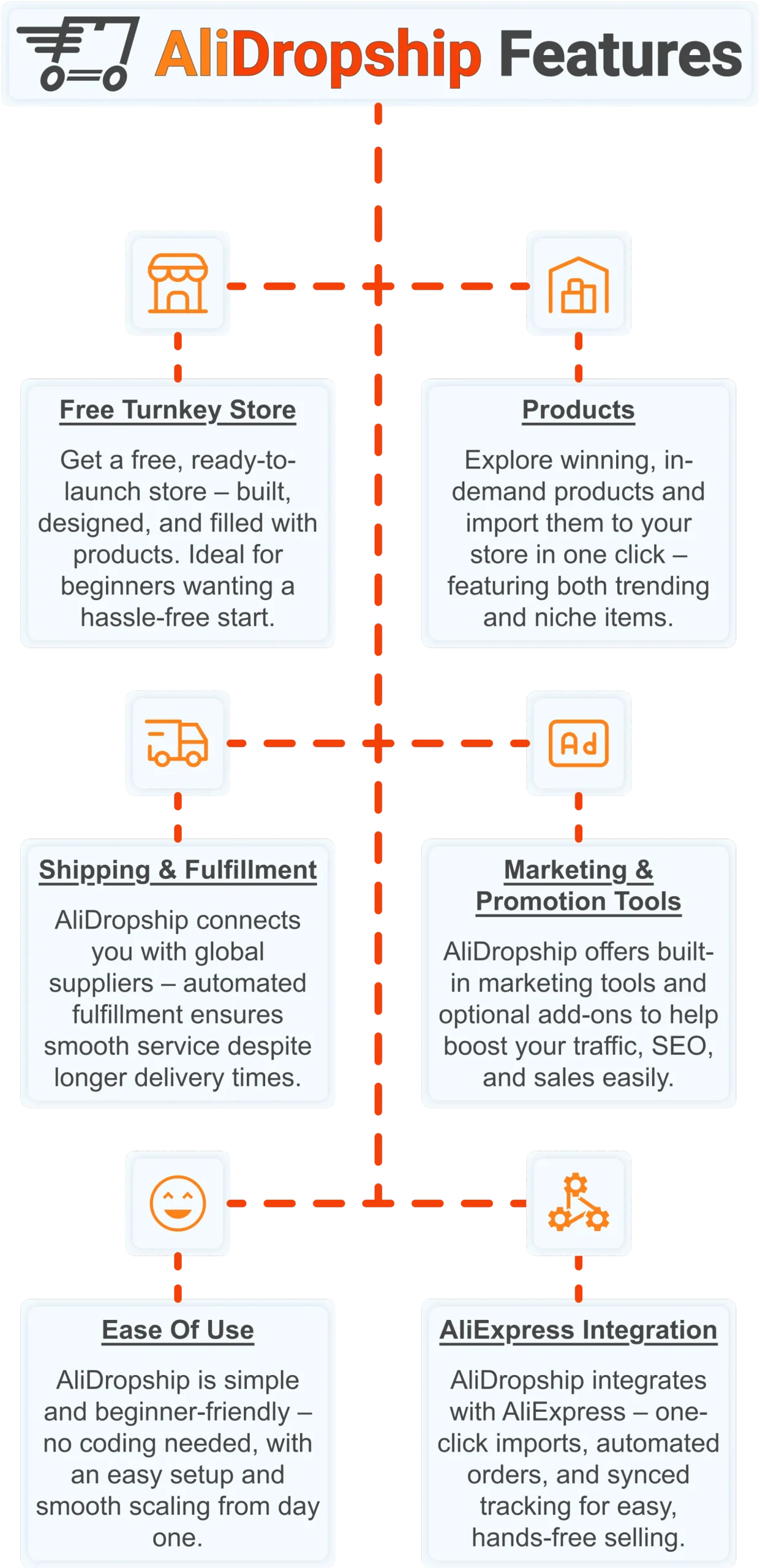
If you want the simplest possible way to start dropshipping – especially if you’re brand new – AliDropship remains one of the most beginner-friendly tools available in 2026. It brings together store creation, product imports, automation, and marketing into a single streamlined system designed to help you launch quickly and grow confidently.
Free turnkey store ️
Get a free turnkey store – built, designed, and filled with products. Ideal for beginners wanting a hassle-free start, the store comes fully optimized to attract customers right away, saving you time on setup. Plus, it includes professional design elements to give your business a polished, trustworthy look from day one. This ready-made foundation makes it easy to move seamlessly into product selection.
Products
Once your store is set up, you can explore winning, in-demand products and import them in one click – featuring both trending and niche items. This wide selection lets you cater to diverse customer interests and test what works best. Regular updates ensure you always have fresh products, keeping your store competitive and relevant. With great products in place, smooth shipping becomes the next essential step.
Shipping & fulfillment
AliDropship connects you with global suppliers, and automated fulfillment ensures seamless order processing despite international delivery times. Customers receive real-time tracking updates, which builds confidence and trust in your store. Once shipping is handled reliably, you can focus on promoting your store and attracting traffic.
Marketing & promotion tools
To maximize sales, AliDropship offers built-in marketing tools and optional add-ons that help boost traffic, SEO, and conversions. From email campaigns and discounts to social media integration, these tools empower you to reach and retain customers without needing prior marketing experience. With promotion strategies in place, managing your business becomes simpler and more efficient.
Ease of use
AliDropship is beginner-friendly – no coding needed, with an intuitive dashboard that guides you through every step. Easy setup and smooth scaling let you expand your store without stress. As your business grows, adding new features, products, and marketing campaigns remains hassle-free, giving you more time to focus on sales.
AliExpress integration
Finally, AliDropship integrates seamlessly with AliExpress, enabling one-click imports, automated orders, and synced tracking. Your inventory stays up-to-date with the latest products and prices, while automated order processing frees you from manual tasks. Combined with the turnkey setup, reliable shipping, and built-in marketing tools, this integration ensures your dropshipping business is fully equipped for growth and success.
If you’ve been searching for the best Shopify apps to run your store more efficiently, AliDropship gives you most of that power in a single platform – without the monthly app fees stacking up. Claim your free store and a $100 voucher to see what’s possible.
 Previous post
