 ‧ Agnes Kazaryan ‧
March 01, 2026
‧ Agnes Kazaryan ‧
March 01, 2026  119 ‧
119 ‧
 0
0
The global digital content market is on track to surpass $1 trillion by 2030 – and you don’t need a warehouse, a shipping team, or a big budget to get a slice of it. Digital products to sell are one of the most accessible online income models available right now. You create something once, and it can keep generating revenue for months or years with minimal ongoing effort.
Quick Answer: The best digital products to sell in 2026 include wellness guides, financial education resources, AI prompt packs, content creation tools, and travel planners. These niches combine strong buyer demand with high profit margins – often between 80 and 95% – and no inventory to manage.
If you’ve been exploring ways to earn online but don’t want to deal with logistics, returns, or stock management, this is a model worth taking seriously. In this guide, you’ll find out exactly what digital products are, which niches are performing best right now, where to list them, and how to actually market them to get consistent sales.
What are digital products – and why do they make sense to sell?
A digital product is anything intangible that gets delivered and consumed online. Think downloadable guides, video courses, templates, software tools, curated collections, and ebooks. There’s no physical stock involved, no shipping costs, and no warehouse. The buyer pays, and they receive a file or access link instantly.
What makes this model so attractive is the combination of low overhead and massive scalability. You create a product once and can sell it to ten people or ten thousand – the production effort doesn’t change. That kind of leverage is almost impossible to replicate with physical goods.
The margins reflect this well. Most digital products operate at 80–95% profit margins, compared to the 30–50% typical in physical product businesses. Add instant global delivery and the potential for truly passive income, and it’s easy to see why so many entrepreneurs are moving in this direction in 2026.
How much can you realistically earn?
Let’s be honest about the numbers, because this space tends to attract both inflated promises and unnecessary skepticism. Here’s a straightforward breakdown of what sellers at different stages typically earn:
These figures depend heavily on niche selection, the size and engagement of your audience, pricing, and how consistently you market your products. Sellers who diversify across complementary categories – pairing a wellness guide with a mindset workbook and a financial template, for example – tend to reach higher earning ceilings faster because they give customers multiple reasons to buy.
Important note: These are realistic ranges, not guarantees. Most people reach the intermediate stage within 60–90 days of consistent effort, but the timeline varies significantly depending on niche competition and how much time you can invest.
How to figure out which digital product niche is right for you
A common mistake first-timers make is chasing the most popular category instead of the one that actually fits their knowledge and audience. The best digital products to sell for you personally sit at the crossroads of genuine market demand and something you can deliver with real value.
Before you create anything, it’s worth asking a few straightforward questions. What do you know well enough to package and sell? Is there proven demand for it, or are you making assumptions? Tools like Google Trends, Etsy’s search bar, and keyword research platforms like SEMrush can help you answer that second question quickly and objectively.
Also think about how you want to get paid. Some digital products work best as one-time purchases. Others suit a subscription or licensing model, which means recurring revenue – and that changes the math on your business quite significantly. Once you’ve worked through these basics, you’re ready to explore the categories where real opportunity exists in 2026.
The best digital products to sell right now
Below is a full breakdown of the strongest-performing digital product niches available to sellers today. Each one represents a scalable, low-overhead opportunity with proven buyer demand.
Wellness and mindset
Wellness products are consistently among the top digital products to sell online, and the reason is simple: people are always looking for practical ways to feel better, think more clearly, and live more intentionally – and they’re willing to pay for it. Meditation guides, stress management workbooks, habit-tracking templates, journaling prompts, and mindset coaching materials all perform well here.
This category attracts highly motivated buyers and works equally well as one-time purchases and subscription content. The audience is loyal, engaged, and values content that creates real, measurable improvements to daily life.
Earning potential: $500–$3,000/month for a focused wellness catalog with consistent SEO and social promotion.
Beauty and personal style
Beauty and personal style tap into two enormous, passion-driven markets. Digital products to sell here include skincare routine guides, makeup tutorials in downloadable or video format, capsule wardrobe planners, personal styling guides, and seasonal lookbook templates.
What makes these niches particularly strong is the audience loyalty. Beauty and fashion buyers come back regularly for fresh content, which makes them excellent candidates for membership-based digital products or regularly updated collections. The overlap between these audiences and visual platforms like Pinterest and Instagram also gives you natural, cost-effective marketing channels.
Earning potential: $300–$2,500/month, with strong repeat purchase rates from loyal niche audiences.
Financial education and wealth
Financial education is one of the most profitable digital products categories because the perceived value is exceptionally high. People invest seriously in content that promises to improve their financial situation – and they’ll pay premium prices for it.
Products here include budgeting templates, investment starter guides, passive income roadmaps, savings challenge workbooks, and financial literacy courses. This is also one of the strongest starting points if you’re thinking about how to sell digital products in high-ticket niches, because there’s active daily demand from people searching for exactly this kind of guidance.
Earning potential: $1,000–$8,000/month for sellers with authority content and a solid email list.
Home styling and organization
This category flies under the radar but performs remarkably well. Buyers here want practical tools – decluttering checklists, room design guides, interior mood boards, moving-day planners, and home management systems. These digital products to sell are ideal for Etsy and Pinterest, where visual appeal drives a significant proportion of purchases.
Pair a well-designed product with strong product photography, and this niche can generate consistent passive income with relatively low ongoing effort. It also has excellent crossover appeal with the wellness and parenting audiences.
Earning potential: $200–$2,000/month, especially strong on visual platforms with good product presentation.
Parenting and pet lifestyle
Parenting and pet lifestyle both attract highly engaged, emotionally motivated buyers. Parents want to do right by their kids, and pet owners are notoriously devoted to their animals – both are prepared to spend on content that genuinely helps.
Digital products to sell here range from child development milestone trackers and educational activity packs to pet care guides, training workbooks, and wellness journals for pet owners. These niches also respond very well to content marketing, since the audiences are constantly consuming information on social media and in community forums.
Earning potential: $400–$3,000/month for sellers who build authority content in a specific sub-niche.
Travel and adventure
Travel content combines aspiration with practicality – a powerful combination when it comes to digital products to sell. Travel-oriented buyers tend to be planners who actively look for tools that help them organise and enhance their experiences.
Digital products in this niche include destination guides, packing list templates, travel budget planners, road trip itineraries, and city-specific travel workbooks. Travel content also performs well on Pinterest and Instagram, giving you natural marketing channels alongside your primary selling platform.
Earning potential: $300–$2,500/month, with seasonal peaks around major travel periods.
Hobbies
The hobbies category is broad – and that’s an advantage when looking for digital products to sell. Whether your audience is into gardening, knitting, photography, cooking, fitness, or DIY projects, hobby-focused buyers are enthusiastic and willing to spend on content that helps them do what they love better.
Pattern downloads, skill-building guides, project planners, and tutorial collections all fit naturally into this space. Because hobby communities tend to be tight-knit and share recommendations freely, word-of-mouth can be a surprisingly effective distribution channel for this type of content.
Earning potential: $200–$2,000/month, with low price sensitivity and strong community-driven sharing.
Electronics, technology, and cars
These niches attract audiences that do their homework before buying – which means high-quality, well-researched digital products to sell are especially valued here. Products can include buyer’s guides for gadgets, tech setup tutorials, car maintenance checklists, used car inspection guides, and purchase comparison frameworks.
Understanding how to sell digital products to these audiences comes down to one thing above all else: authority. These buyers trust content that feels specific, detailed, and well-researched. Surface-level content won’t convert. Depth really does matter in this category.
Earning potential: $500–$4,000/month for sellers who produce genuinely authoritative, research-backed content.
Dating and social confidence
Dating and social confidence is a niche where people feel the problem acutely but often struggle to find content that feels genuine rather than gimmicky. That gap represents a real opportunity for digital products to sell.
Products here include conversation starter guides, confidence-building workbooks, first date planning templates, and social skills coaching materials. This category also tends to convert well because buyers are motivated by a strong personal desire for change – they’re not browsing, they’re ready to act.
Earning potential: $400–$3,000/month, with high conversion rates driven by strong personal motivation.
Online content creation and AI
Content creation tools and AI guides are arguably two of the best digital products to sell in 2026. The creator economy is expanding rapidly, and AI is reshaping how people work, create, and run their businesses – which means there’s enormous appetite for practical guidance in both areas.
Products here include content calendars, platform growth guides, monetisation roadmaps, AI prompt packs, AI workflow templates, and beginner guides to tools like ChatGPT and Midjourney. These are among the most profitable digital products right now because demand is high, the audience is tech-curious, and genuinely useful content in this space is still relatively scarce compared to how fast the market is growing.
Earning potential: $800–$6,000/month, with strong upside as AI adoption continues to accelerate.
Where to sell your digital products
Choosing the right platform is a meaningful decision when it comes to selling digital products successfully. Third-party marketplaces like Etsy, Udemy, and Creative Market come with built-in audiences, which sounds appealing early on – but the trade-off is real. You’re working within their rules, paying their fees, and ultimately building on someone else’s foundation rather than your own.
Having your own independent store changes that equation entirely. You keep full control over your pricing, branding, and margins, and every sale goes toward building a business asset that actually belongs to you. For most people figuring out how to sell digital products for the first time, the idea of running their own store can feel like a steep learning curve. But with the right platform handling the technical side, that barrier is lower than it used to be – and the long-term payoff in profit margins and brand ownership makes it well worth the effort.
Important: If you start on a marketplace, treat it as a testing ground – not a permanent home. Use it to validate demand and build reviews, then migrate to your own store once you’ve confirmed what sells.
How to actually market your digital products and get sales
Having a great product is step one. Getting it in front of the right people is step two – and it’s where many sellers stall. If you’re serious about selling digital products consistently, SEO should be your long-term foundation. Optimising your product listings and supporting blog content for relevant keywords brings in steady, free traffic over time.
Email marketing is another channel that deserves serious attention. It delivers an average ROI of $36 for every $1 spent – which is extraordinary compared to most paid channels. Building your list before your product even launches gives you a ready audience the moment you go live.
Beyond those two foundations, content marketing, social media (Pinterest for visual digital products, TikTok for educational content), and affiliate programmes are all effective depending on your niche. The key is to start with one or two channels, go deep, and expand from there once you’ve built traction.
Pro Tip: If you’re just starting out, pick one social platform where your target audience already spends time and focus all your early promotion energy there. Spreading yourself across five platforms at once is one of the fastest ways to burn out before you’ve gained any momentum.
Common mistakes worth avoiding from the start
Even with strong digital products to sell, these patterns can slow your progress significantly. Skipping product validation is the biggest one – always confirm genuine demand before you build anything. Underpricing is another trap: low prices signal low value, so price your products based on the transformation or utility they deliver, not just the time it took you to create them.
Neglecting your email list from day one, ignoring SEO, and depending on a single product for all your income are habits that consistently limit growth. Relying on one platform for all your traffic is also risky – algorithm changes can cut your sales overnight if you don’t have a backup channel.
Key principle: Treat your digital product business like a real business from day one. The sellers who get there fastest are the ones who show up consistently, track what works, and build multiple income streams over time.
Final thoughts – how to choose your approach
Digital products to sell represent one of the most accessible and scalable ways to build genuine online income in 2026. Low startup costs, high margins, instant global delivery, and real passive income potential – it’s a combination that’s hard to argue with once you’ve seen what consistent sellers are able to build.
Here’s a quick breakdown by where you’re starting from:
- Complete beginner: Start with one niche you genuinely know. Create a simple checklist or short guide, list it on Etsy or Gumroad, gather feedback, and build from there. Don’t overthink the product – launch something imperfect and improve it.
- Intermediate / part-time: Focus on building your email list and one primary marketing channel. Add 2–3 complementary products to your catalog within your first 90 days. Invest time in SEO for long-term traffic.
- Advanced / full-time goal: Move to your own store as soon as you’ve validated demand. Diversify across 3–5 complementary niches, build an affiliate programme, and use automation to handle fulfillment and email sequences while you focus on content and growth.
The best time to launch your first digital product was last year. The second best time is right now.
AliDropship: Your complete all-in-one solution for starting dropshipping in 2026
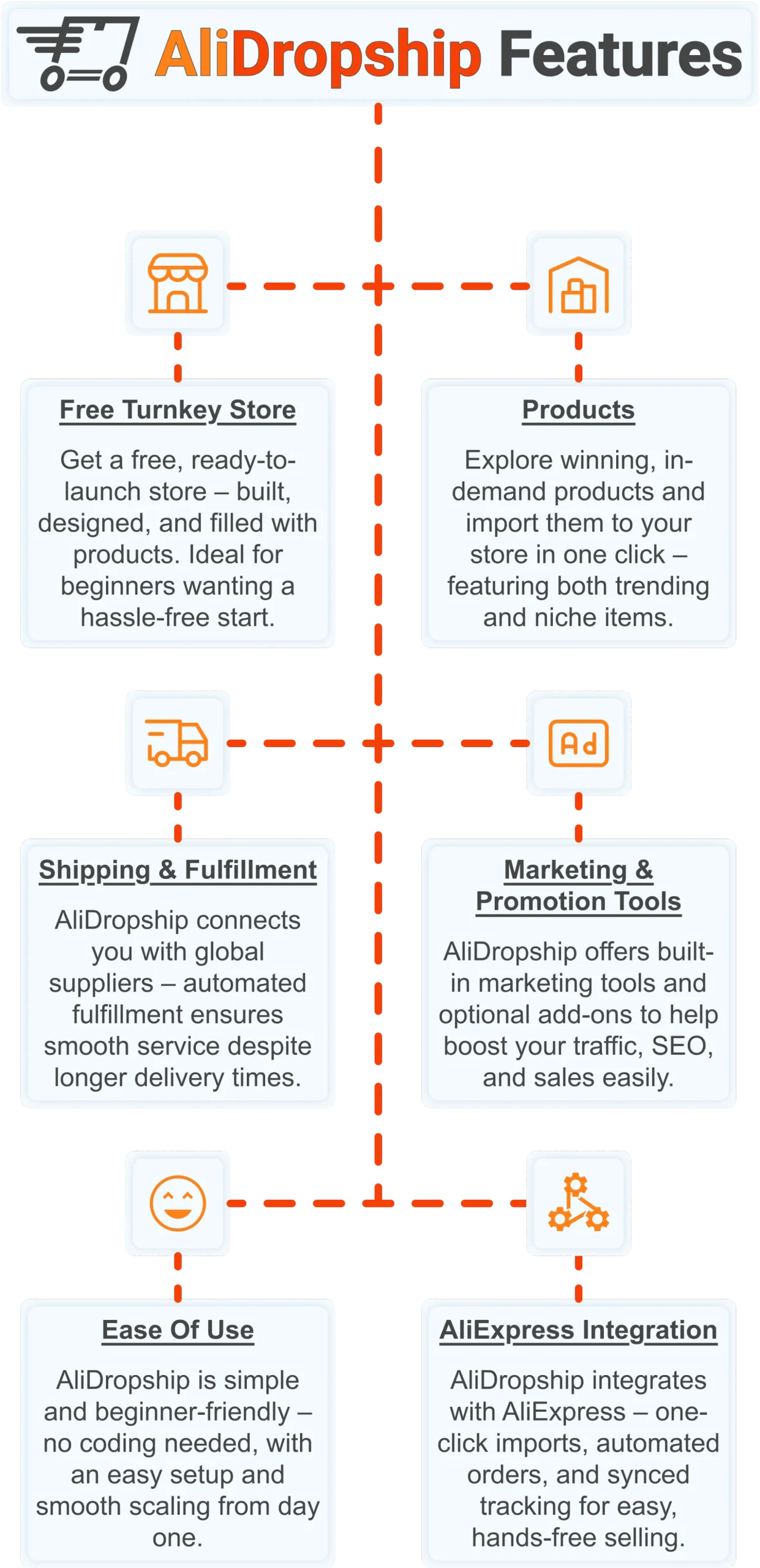
If you want the simplest possible way to start dropshipping – especially if you’re brand new – AliDropship remains one of the most beginner-friendly tools available in 2026. It brings together store creation, product imports, automation, and marketing into a single streamlined system designed to help you launch quickly and grow confidently.
Free turnkey store ️
Get a free turnkey store – built, designed, and filled with products. Ideal for beginners wanting a hassle-free start, the store comes fully optimized to attract customers right away, saving you time on setup. Plus, it includes professional design elements to give your business a polished, trustworthy look from day one. This ready-made foundation makes it easy to move seamlessly into product selection.
Products
Once your store is set up, you can explore winning, in-demand products and import them in one click – featuring both trending and niche items. This wide selection lets you cater to diverse customer interests and test what works best. Regular updates ensure you always have fresh products, keeping your store competitive and relevant. With great products in place, smooth shipping becomes the next essential step.
Shipping & fulfillment
AliDropship connects you with global suppliers, and automated fulfillment ensures seamless order processing despite international delivery times. Customers receive real-time tracking updates, which builds confidence and trust in your store. Once shipping is handled reliably, you can focus on promoting your store and attracting traffic.
Marketing & promotion tools
To maximize sales, AliDropship offers built-in marketing tools and optional add-ons that help boost traffic, SEO, and conversions. From email campaigns and discounts to social media integration, these tools empower you to reach and retain customers without needing prior marketing experience. With promotion strategies in place, managing your business becomes simpler and more efficient.
Ease of use
AliDropship is beginner-friendly – no coding needed, with an intuitive dashboard that guides you through every step. Easy setup and smooth scaling let you expand your store without stress. As your business grows, adding new features, products, and marketing campaigns remains hassle-free, giving you more time to focus on sales.
AliExpress integration
Finally, AliDropship integrates seamlessly with AliExpress, enabling one-click imports, automated orders, and synced tracking. Your inventory stays up-to-date with the latest products and prices, while automated order processing frees you from manual tasks. Combined with the turnkey setup, reliable shipping, and built-in marketing tools, this integration ensures your dropshipping business is fully equipped for growth and success.
If you’re ready to start selling digital products – or expand into a full dropshipping business – AliDropship gives you everything you need in one place. Claim your free store and $100 voucher today and take the first step.
 Previous post
