 ‧ Agnes Kazaryan ‧
March 06, 2026
‧ Agnes Kazaryan ‧
March 06, 2026  11 ‧
11 ‧
 0
0
So, how much does Amazon pay? The short answer: it depends entirely on what role or income stream you choose. A warehouse associate and an FBA seller both earn through Amazon – but they operate in completely different worlds, with very different income ceilings.
Quick answer: Amazon pays anywhere from $2–$10/hour for microtasks on Mechanical Turk, $17–$25/hour for delivery and warehouse roles, up to $50,000+/month for experienced FBA sellers. There is no single figure – your path determines your pay.
This guide breaks down every major way to earn money with Amazon in 2026 – from hourly employment to affiliate commissions to selling products online. You’ll get realistic numbers, honest caveats, and enough context to figure out which path actually fits your situation.
What does “how much does Amazon pay” actually mean?
It’s a simple question with a complicated answer. Amazon isn’t just a single employer – it’s an ecosystem. You can earn a regular paycheck as an employee. You can drive for Amazon Flex as an independent contractor.
You can earn commissions through the Associates program, build income as an influencer, grind through microtasks on Mechanical Turk, or run a full-scale product business through FBA. Each of these is a different arrangement with different rules, different effort levels, and a very different earnings ceiling.
In 2026, Amazon continues to be one of the most accessible earning platforms on the internet – but that access cuts both ways. Entry is easy; meaningful income often takes time, strategy, or both. Understanding what each path actually pays – and what it costs you in time and effort – is the whole point of this article.
How much can you realistically earn with Amazon?
Before diving into each option individually, here’s a honest overview of what the main Amazon income paths typically pay in 2026.
The gap between the lowest and highest earners is enormous. MTurk workers and warehouse associates provide their time for a fixed return. FBA sellers and affiliates are building assets that can compound over time. The path you pick should match your available hours, your tolerance for upfront effort, and how soon you need the income.
One note on these figures: All income ranges above assume consistent effort over at least 60–90 days. New accounts, low traffic, or minimal hours will produce results at the lower end of each range.
How much does Amazon pay its employees?
If you’re asking how much Amazon pays in the traditional employment sense – wages, benefits, hourly rates – the answer varies a lot by role and location. But Amazon has made a point of positioning itself as a competitive employer, particularly for entry-level and warehouse positions.
Warehouse associates in 2026 typically earn between $17 and $19 per hour, with some high-demand locations pushing closer to $20 for experienced workers. The work is physical and fast-paced – fulfillment centers run on tight schedules – but full-time employees do receive benefits including health coverage, paid time off, and in some cases stock options.
It’s a predictable income source with a clear structure, and there are promotion opportunities for those who want to move into lead or management roles.
Remote and office-based roles tell a slightly different story. Customer service representatives typically earn $16–$25/hour depending on experience and the nature of the role. Technical or corporate positions can push significantly higher – into six figures annually for specialized or senior roles – though these positions usually require relevant qualifications or prior industry experience.
What Amazon employment offers that other income paths don’t is reliability. You know exactly what you’re earning each week. You’re not waiting on commissions, delivery blocks, or algorithm changes. For people who need financial stability while building something else on the side, a standard Amazon role can provide a useful foundation.
Important: Pay rates vary by state and city. Roles in higher cost-of-living areas like Seattle or New York typically pay more than the national averages listed here.
How much does Amazon pay for delivery – Flex, DSP, and driver roles
Delivery work is one of the most popular ways people earn with Amazon, and it’s easy to see why. The barrier to entry is low, the hours are flexible, and you can start earning relatively quickly once approved.
Amazon Flex
Amazon Flex lets you deliver packages using your own vehicle. You sign up through the Flex app, pick available delivery blocks – typically two to four hours – and earn a set rate per block. Pay generally works out to $18–$25 per hour, depending on your location, the type of deliveries, and demand at the time you’re working.
The flexibility is real, but so are the costs. Flex drivers are independent contractors, which means fuel, vehicle wear, and self-employment taxes all come out of your pocket. After accounting for expenses, net earnings are noticeably lower than the advertised hourly rate. In high-demand areas during peak seasons, the math can still work out well. In quieter periods, available blocks can be scarce.
Earning potential: $18–$25/hour gross, typically $13–$18/hour net after vehicle expenses and taxes.
Amazon DSP drivers
DSP (Delivery Service Partner) drivers are employed by independent companies contracted to deliver for Amazon. Unlike Flex, this is an actual employment arrangement – you work set hours, receive a more stable schedule, and may get benefits depending on the DSP company. Pay typically ranges from $17 to $22 per hour.
The trade-off is flexibility. DSP roles are closer to a regular job in terms of schedule commitment. But for people who prefer consistency over gig-style work, it can be a better fit. The vehicle and associated costs are usually covered by the company, which means your net earnings are closer to your gross rate.
Why this works in 2026: Amazon’s logistics network keeps expanding, which means ongoing demand for delivery workers in most major cities and suburbs – making this one of the more reliable entry-level income options in the Amazon ecosystem.
How much does Amazon Associates pay – commission rates and affiliate earnings
The Amazon Associates program is Amazon’s affiliate marketing platform. You sign up, get unique tracking links for products, publish them on your website, blog, YouTube channel, or social media, and earn a commission every time someone clicks through and buys.
Commission rates range from 1% to 10% depending on the product category. Luxury beauty and Amazon devices tend to sit at the higher end. Everyday items like groceries or electronics fall closer to the bottom. So a $50 kitchen appliance at a 5% rate earns you $2.50. A $200 camera accessory at 3% earns $6.
That sounds modest – and for beginners, it is. Most new affiliates earn under $100/month in their first few months. But dedicated affiliates with strong content and consistent traffic can earn thousands. The range is genuinely wide: somewhere between $100 and $10,000+/month is realistic depending on your niche, content quality, and audience size.
The biggest factor is traffic. More visitors to your content means more clicks, which means more potential sales. Affiliates who focus on a specific niche – tech gadgets, home improvement, fitness, parenting – tend to see stronger conversion rates than those who promote everything. Targeted audiences buy more reliably.
Important note: Amazon Associates has a 24-hour cookie window. If someone clicks your link but doesn’t buy within 24 hours, you don’t earn a commission on that sale.
How much does the Amazon Influencer Program pay?
The Amazon Influencer Program is similar to Associates but built specifically for social media creators. Instead of a website with affiliate links, you get a personalized Amazon storefront – a curated page of product recommendations you can share with your followers on Instagram, YouTube, TikTok, or other platforms.
Commission rates are comparable to the standard Associates program. But the earnings potential is different because the format is different. A well-produced video review or “shop my page” post can drive a surge of purchases in a short window. A static blog post with affiliate links tends to generate a slower, steadier trickle.
Smaller creators with engaged audiences typically earn a few hundred dollars per month. Established influencers with tens of thousands of active followers can earn several thousand. The very top earners – creators with millions of subscribers who genuinely drive purchasing decisions – can see five-figure monthly income from the program. But that level takes years to build and isn’t guaranteed.
The semi-passive nature of the program is its most appealing quality. Once your storefront is live and your content is posted, it keeps generating potential commissions without ongoing effort. That said, success requires consistent content, genuine audience trust, and smart product selection. Promoting irrelevant or low-quality products will damage both your conversions and your relationship with your audience.
One note on influencer income: Month-to-month earnings can swing significantly. One viral post could generate hundreds of dollars in a day; a quiet month with low engagement might produce almost nothing.
How much does Amazon Mechanical Turk pay?
Amazon Mechanical Turk – usually called MTurk – is a crowdsourcing platform where businesses post small digital tasks (called HITs, or Human Intelligence Tasks) and workers complete them for payment. Tasks include things like image labeling, survey responses, content moderation, data entry, and audio transcription.
Pay varies enormously by task. Simple tasks might pay $0.05. More complex or time-consuming assignments might pay $2–$5. Most workers on MTurk earn between $2 and $10 per hour, depending on how quickly they can identify and complete the higher-paying tasks. Experienced workers often use browser tools to filter tasks by pay rate, which helps – but even then, MTurk income is modest.
The appeal is maximum flexibility with zero barrier to entry. You can work from anywhere, at any time, with no prior experience required. There’s no schedule, no commitment, and no minimum hours. For someone filling dead time – a commute, a lunch break, an evening watching TV – it’s a low-effort way to generate a small amount of extra income.
Be honest with yourself about what MTurk is and isn’t. It’s not a side hustle with growth potential. It’s not scalable. It’s a flexible way to earn a little extra, and that’s the right way to think about it.
Earning potential: $2–$10/hour, typically $50–$200/month for regular but not full-time use.
How much does Amazon pay sellers – FBA vs merchant fulfilled
Selling on Amazon is the most entrepreneurial option on this list, and it has the highest earning ceiling. The question of how much Amazon pays sellers is really a question of how well you run your business – because Amazon itself provides the infrastructure, but your profit depends on what you sell, how you price it, and how you manage your costs.
Fulfillment by Amazon (FBA)
FBA is the most popular option for sellers, especially beginners. You source products, ship them to an Amazon fulfillment center, and Amazon handles storage, packaging, shipping, and customer service. In exchange, Amazon charges fulfillment and storage fees.
After fees and cost of goods, profit margins for FBA sellers typically run between 10% and 30%. So $10,000 in monthly sales could realistically yield $1,000–$3,000 in net profit depending on your product category and supplier pricing. Sellers who optimize their product selection, listings, and advertising can push margins higher. Sellers who don’t pay attention to fees can find their margins erased entirely.
The advantage of FBA is scalability. Once your listings are live and your inventory is stocked, Amazon does the heavy lifting. Adding more products or increasing volume doesn’t require proportionally more of your time, which is why experienced FBA sellers can generate significant income without it consuming their entire week.
Merchant Fulfilled Network (MFN)
With MFN, you list products on Amazon but handle storage and shipping yourself. This gives you more control over the fulfillment process and can slightly improve margins since you’re not paying Amazon’s storage and fulfillment fees. But it also adds time, complexity, and logistical overhead. For most people just starting out, FBA is the simpler path to getting going quickly.
Earning potential: $1,000–$50,000+/month depending on product selection, sales volume, and business maturity. Realistic first-year targets for a focused beginner: $1,000–$3,000/month within 6–12 months.
Things to keep in mind before you start
Amazon offers real earning opportunities across all of these paths – but it’s worth being clear-eyed about the risks and responsibilities that come with each one.
For delivery work, you’re responsible for your own vehicle, fuel costs, and taxes as a Flex contractor. Net earnings are lower than the advertised hourly rate once you factor those in. For MTurk, the income is very limited – treat it as supplemental, not foundational.
For affiliate and influencer income, Amazon can change commission rates with limited notice. Rates have dropped in some categories in past years. Building an audience and content strategy on the assumption that current rates are permanent is a risk. Diversifying your affiliate partnerships over time is smart.
For FBA sellers, the platform has rules – strict ones. Violations around product authenticity, listing manipulation, or review solicitation can result in account suspension. Protect your seller account by reading Amazon’s policies carefully before you list anything. And always track your unit economics closely: a product that looks profitable at surface level can lose money once you factor in returns, advertising spend, and storage fees.
Key principle: Whichever path you choose, build your Amazon income on a solid understanding of the actual numbers – not the headline figures.
Final thoughts – which Amazon income path is right for you?
How much Amazon pays is ultimately a question only you can answer, because the answer depends entirely on what you’re willing to commit to. Here’s a practical summary by experience level.
Complete beginner: Start with something low-barrier. Amazon Flex or an associate/warehouse role gives you immediate income without requiring upfront investment or technical skills. MTurk is an option if you just want to test the waters with zero commitment, but don’t rely on it for meaningful income.
Intermediate / part-time: Amazon Associates or the Influencer Program are strong options if you already have an audience or content platform. The income starts small but can compound over time. If you have a bit of startup capital and patience, FBA is worth exploring – the learning curve is real, but so is the potential.
Advanced / full-time goal: FBA selling is the clearest path to meaningful, scalable income on Amazon. Experienced sellers who understand product research, listing optimization, and unit economics can build a business that generates consistent monthly profit. It takes time – expect 6–12 months before seeing reliable results – but the ceiling is far higher than any of the other options on this list.
Many people combine streams. A DSP driver by day, building an FBA store in the evenings. An affiliate marketer who also runs a small Amazon influencer page. There’s no rule that says you have to pick just one. The key is choosing at least one path to go deep on, rather than spreading yourself too thin across all of them at once.
AliDropship: Your complete all-in-one solution for starting dropshipping in 2026
If you want the simplest possible way to start dropshipping – especially if you’re brand new – AliDropship remains one of the most beginner-friendly tools available in 2026. It brings together store creation, product imports, automation, and marketing into a single streamlined system designed to help you launch quickly and grow confidently.
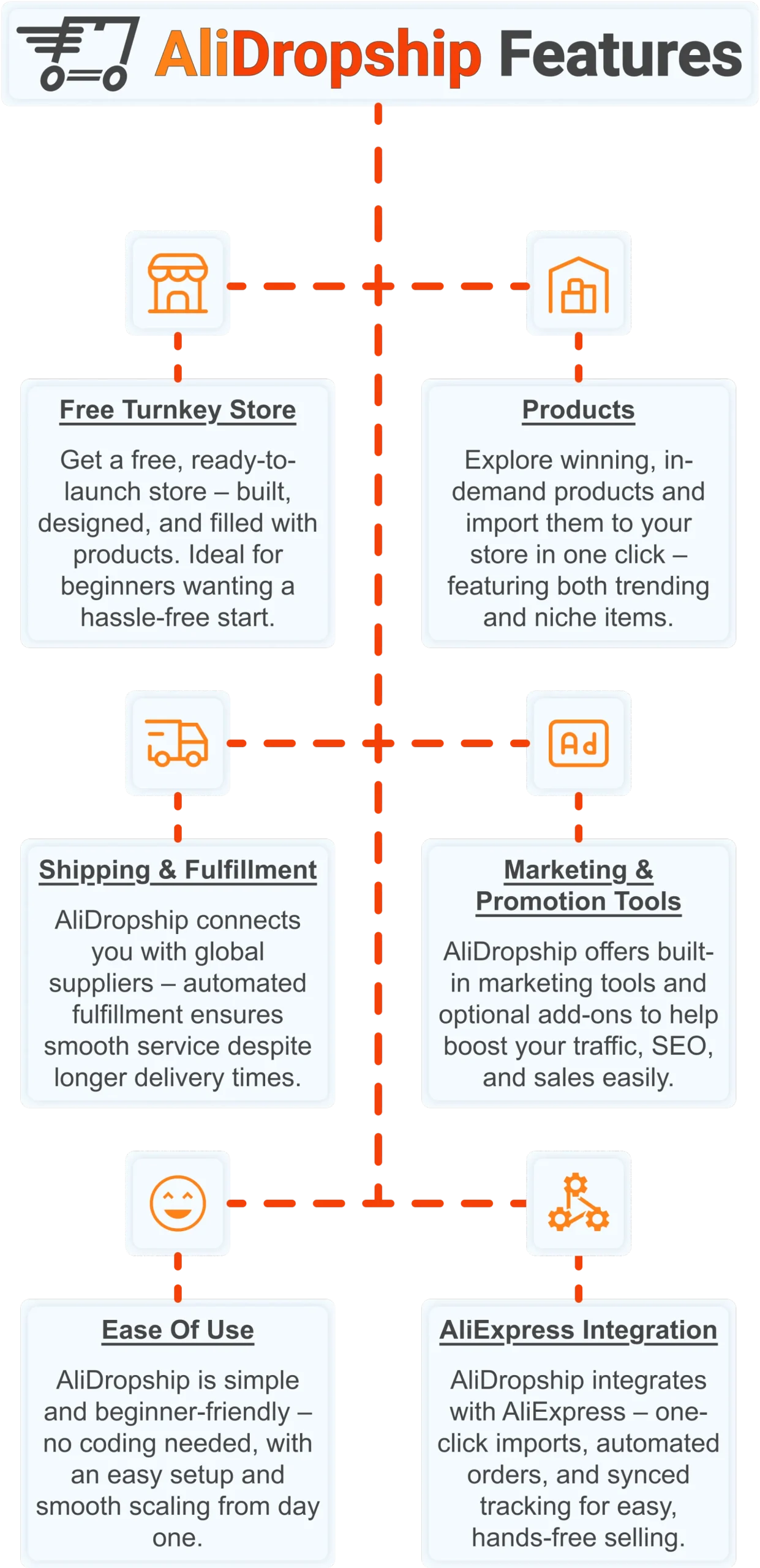
Free turnkey store ️
Get a free turnkey store – built, designed, and filled with products. Ideal for beginners wanting a hassle-free start, the store comes fully optimized to attract customers right away, saving you time on setup. Plus, it includes professional design elements to give your business a polished, trustworthy look from day one. This ready-made foundation makes it easy to move seamlessly into product selection.
Products
Once your store is set up, you can explore winning, in-demand products and import them in one click – featuring both trending and niche items. This wide selection lets you cater to diverse customer interests and test what works best. Regular updates ensure you always have fresh products, keeping your store competitive and relevant. With great products in place, smooth shipping becomes the next essential step.
Shipping & fulfillment
AliDropship connects you with global suppliers, and automated fulfillment ensures seamless order processing despite international delivery times. Customers receive real-time tracking updates, which builds confidence and trust in your store. Once shipping is handled reliably, you can focus on promoting your store and attracting traffic.
Marketing & promotion tools
To maximize sales, AliDropship offers built-in marketing tools and optional add-ons that help boost traffic, SEO, and conversions. From email campaigns and discounts to social media integration, these tools empower you to reach and retain customers without needing prior marketing experience. With promotion strategies in place, managing your business becomes simpler and more efficient.
Ease of use
AliDropship is beginner-friendly – no coding needed, with an intuitive dashboard that guides you through every step. Easy setup and smooth scaling let you expand your store without stress. As your business grows, adding new features, products, and marketing campaigns remains hassle-free, giving you more time to focus on sales.
AliExpress integration
Finally, AliDropship integrates seamlessly with AliExpress, enabling one-click imports, automated orders, and synced tracking. Your inventory stays up-to-date with the latest products and prices, while automated order processing frees you from manual tasks. Combined with the turnkey setup, reliable shipping, and built-in marketing tools, this integration ensures your dropshipping business is fully equipped for growth and success.
If you’re ready to build income beyond a single Amazon role, dropshipping gives you a scalable business you own outright. Claim your free store and $100 voucher to get started today.
 Previous post
