 ‧ julia.nenyukova ‧
March 15, 2026
‧ julia.nenyukova ‧
March 15, 2026  43 ‧
43 ‧
 0
0
Day trading gets more online attention than almost any other money-making strategy – and it is not hard to see why. The idea of sitting at your desk, buying and selling stocks through the morning, then closing your positions by lunch sounds like the dream. Flexibility, independence, and real income all in one place.
But here is what most guides skip: the majority of people who try day trading lose money, at least initially. Not because the strategies are fake – but because the competition is fierce, the learning curve is long, and the emotional discipline required is genuinely difficult to sustain.
Quick answer: You can make money day trading, but it is not fast and it is not passive. Most beginners take 6–12 months of dedicated practice before seeing consistent results. Realistic daily earnings for an intermediate trader sit around $30–$200 per day, depending on capital and strategy. Getting there requires structured education, the right tools, and tight risk management from day one.
This guide breaks down exactly how to approach day trading in 2026 – from picking a strategy and setting up your platform, to the psychological traps that trip up most beginners. If you are considering this seriously, read all of this before placing your first trade.
What is day trading?
Day trading is a style of active trading where you buy and sell financial instruments – most commonly stocks, forex, futures, or cryptocurrency – within the same trading session. All positions are closed before the market closes, which means no overnight exposure to sudden price gaps or after-hours news.
The core premise is simple: financial markets move constantly throughout the day, and those price fluctuations create short windows of opportunity. A stock might open at $50, drop to $48.20 during the first hour, then recover to $51.50 by midday. A day trader tries to capture part of that movement – buying at the low and selling into the recovery, or shorting the stock and profiting on the decline.
In practice, day trading relies heavily on technical analysis. Traders read charts, study price patterns, and use indicators like moving averages, volume signals, and the Relative Strength Index (RSI) to predict short-term price direction. A company’s long-term fundamentals barely factor in when you are working off a one-minute or five-minute chart.
It is completely different from swing trading (holding positions for days or weeks) or long-term investing. Day trading is one of the most demanding and technically intensive ways to participate in financial markets – which is exactly why it attracts so many people and why so many of them struggle early on.
How much can you realistically earn day trading?
Income potential in day trading varies significantly based on your experience, available capital, and which strategy you use. The headline numbers you see on YouTube and social media are almost always outliers. Here is a more grounded picture.
These figures assume a starting capital of $5,000–$10,000 and a trader who has moved past the initial learning phase. For complete beginners, the first 60–90 days should be treated as primarily educational – losses during this period are common and expected.
One note on these figures: They reflect what is achievable with consistent discipline and a tested strategy – not what you will earn in your first week. Overestimating early income is one of the biggest reasons new traders blow up their accounts before they ever find their groove.
How to get started with day trading
Getting started the right way means building your foundation before risking real capital. Here is the approach that gives you the best chance of long-term success.
Start with education
Before anything else, learn the basics thoroughly. You need to understand financial instruments (stocks, ETFs, forex, futures), order types (market, limit, stop-loss), bid-ask spreads, and how different market sessions operate. Technical analysis is non-negotiable – focus on chart patterns, trend lines, support and resistance levels, and key indicators like moving averages and RSI.
Free resources are legitimate starting points. Investopedia, YouTube channels run by professional traders, and communities like Reddit’s r/Daytrading offer real, practical information without the upsell. Paid courses can add value, but be sceptical of anything that leads with income screenshots.
Choose the right brokerage
Your brokerage is your core infrastructure. Look for low commissions (critical when you trade frequently), a stable and fast trading platform, real-time data feeds, and solid customer support. In the US, platforms like Interactive Brokers, thinkorswim, and Webull are widely used by active traders. For forex, MetaTrader 4 and MetaTrader 5 remain the global standard.
Important note: In the US, the Pattern Day Trader (PDT) rule requires a minimum margin account balance of $25,000 to make more than three day trades within any five-business-day period. This is a regulatory requirement, not a broker preference – and it catches many beginners off guard.
Paper trade before going live
Paper trading – simulated trading with virtual money – is one of the most underused tools available to beginners. Most major platforms offer it for free. Spend at least 30–60 days paper trading before committing real capital. If you cannot make consistent simulated profits, you are not ready to trade live.
Build a trading plan
A trading plan defines your goals, your risk tolerance per trade (professional traders typically risk no more than 1–2% of capital on any single position), the strategies you will use, your entry and exit criteria, and how you will review your own performance over time. Without a written plan, you are guessing – and guessing in a market full of professionals is expensive.
Day trading strategies that actually work
There are hundreds of day trading strategies described online. In practice, most profitable traders master one or two and apply them consistently. Here are the three most widely used approaches – each with a different risk and effort profile.
Scalping
Scalping is the highest-frequency approach to day trading. Scalpers execute dozens or hundreds of trades per session, targeting tiny price movements – sometimes just a few cents per share – and compounding those small gains across the day. It requires a broker with tight spreads and low commissions, a fast execution platform, and the ability to make split-second decisions without hesitation.
Scalpers typically work on one-minute or two-minute charts and must stay focused and in front of their screens for the entire session. It is mentally exhausting, which is why many traders who try scalping eventually migrate to less intensive strategies.
Earning potential: $30–$500/day depending on capital and trade volume, though commission costs can erode profits quickly if your win rate or position sizing is not dialled in.
Momentum trading
Momentum traders look for stocks that are moving strongly in one direction – usually triggered by breaking news, earnings surprises, analyst upgrades, or significant events. The strategy is to enter early in the move and exit before the momentum starts to fade.
This requires a reliable real-time news source, the ability to act fast, and a good eye for volume patterns that confirm whether a move has genuine strength behind it. Breakout trades – entering when a stock pushes above a well-established resistance level – are a common and widely-proven momentum technique.
Earning potential: $50–$300/day for a trader who has identified and consistently applied a solid momentum setup.
Technical breakout trading
Breakout trading relies almost entirely on chart reading. Traders identify key support and resistance levels, watch for price to break through those levels on strong volume, and enter in the direction of the breakout. It tends to involve fewer trades per day than scalping but requires more patience and deeper analysis per trade.
Why this works in 2026: Even with algorithmic trading making markets more efficient, breakout patterns still hold up – partly because large institutional players also use technical levels as entry and exit triggers, creating self-reinforcing momentum when those levels are breached.
Tools every day trader needs
You do not need an expensive multi-monitor setup to start day trading – but you do need a few core tools that work reliably. Here is what actually matters.
A live trading platform
Your platform must provide real-time Level 2 quotes (which show the full bid-ask order book across market makers), customizable charts with built-in technical indicators, and fast order execution. A delay of even two or three seconds can turn a winning trade into a losing one. Test your platform on a demo account before going live.
A financial news feed
A significant portion of intraday price movement is news-driven. A real-time financial news feed – Bloomberg Terminal, Benzinga Pro, or a well-curated financial news source – helps you anticipate and react to market-moving events before they are fully priced in by the broader market.
A stock screener
A stock screener filters the entire market in real time based on criteria you define – price change percentage, volume spikes, volatility, float size. This narrows thousands of potential trades down to a manageable shortlist of actionable candidates each morning. Finviz, Trade Ideas, and the built-in screeners inside most major platforms are all widely used and legitimate options.
A trading journal
Overlooked by beginners, used by almost every profitable trader. A journal tracks every trade – entry price, exit price, rationale, result, emotional state – so you can identify patterns in your performance over time. It turns your own trading history into a structured feedback loop. Without it, you repeat the same mistakes without realizing it.
The psychological side of day trading
Technical skill gets you into the game. Psychology determines whether you survive it long-term. The emotional demands of day trading are real and regularly underestimated by people who are just starting out.
The two most destructive psychological patterns are revenge trading – placing impulsive trades to recover a loss before the session ends – and overconfidence after a winning streak, which leads to oversized positions and unnecessary exposure. Both are driven purely by emotion. Neither is part of any serious trading plan.
Discipline means sticking to your rules even when your gut says otherwise. It means walking away from your screen after hitting your daily loss limit. It means accepting that losing days are normal and expected – they do not mean your strategy is broken. Traders who treat losses as information rather than failures tend to improve steadily over time.
Pro tip: Set a hard daily loss limit before every session – for example, no more than 3% of your account balance. If you hit it, shut everything down for the day. This single rule prevents the kind of catastrophic drawdown that wipes out months of steady gains in a single afternoon.
Legal and ethical considerations
Day trading is completely legal, but there are regulatory requirements and tax obligations you need to understand before you start – particularly if you are trading in the US.
The Pattern Day Trader rule
FINRA classifies you as a Pattern Day Trader (PDT) if you execute four or more day trades in a five-business-day window and those trades represent more than 6% of your total trading activity during that period. This classification requires you to maintain a minimum margin account balance of $25,000 at all times. Dropping below that threshold restricts your trading until the balance is restored.
Tax on trading profits
Trading profits are taxable income. In the US, short-term capital gains – profits from positions held for less than one year – are taxed as ordinary income, often at a significantly higher rate than long-term capital gains. Keep meticulous records of every trade. Many active traders work with an accountant who specialises in trader tax status to ensure they are compliant and not overpaying.
Margin and leverage risks
Many brokers offer margin – effectively borrowed capital – which amplifies both gains and losses proportionally. Margin calls can force you to close positions at a loss at exactly the wrong moment. Use leverage cautiously, especially during your first year, and never let your total exposure exceed what you could absorb as a complete loss.
Key principle: Trade within your means, follow all regulatory requirements in your jurisdiction, and never risk capital you cannot afford to lose entirely.
Final thoughts: which approach is right for you?
Day trading is a legitimate income source for people who invest the time to learn it properly – but it is not a shortcut, and it is not a part-time hobby. Your experience level and goals should shape the path you take.
If you are a complete beginner, the best move right now is education and paper trading. Spend 60–90 days learning before putting real capital on the line. Start with technical breakout trading – it requires fewer decisions per day and is more forgiving while you build your skill set.
If you are at an intermediate level – comfortable reading charts and with some live trading experience – define one or two strategies that fit your schedule and personality, then apply them consistently. Journal every trade. Review weekly. Make small, deliberate improvements over time rather than chasing the next hot setup.
If your goal is full-time trading income, be honest about the timeline. Most traders who reach that level took 1–3 years to get there. The capital requirement is real, the tax complexity is real, and the emotional demands never fully disappear. It is achievable – but only if you approach it as a serious, skill-based profession from day one.
If the financial risk and steep learning curve of day trading feel like too much right now, it is worth knowing that there are lower-barrier alternatives for building online income – including ecommerce models that generate revenue without the daily pressure of market exposure.
AliDropship: Your complete all-in-one solution for starting dropshipping in 2026
If you want the simplest possible way to start dropshipping – especially if you’re brand new – AliDropship remains one of the most beginner-friendly tools available in 2026. It brings together store creation, product imports, automation, and marketing into a single streamlined system designed to help you launch quickly and grow confidently.
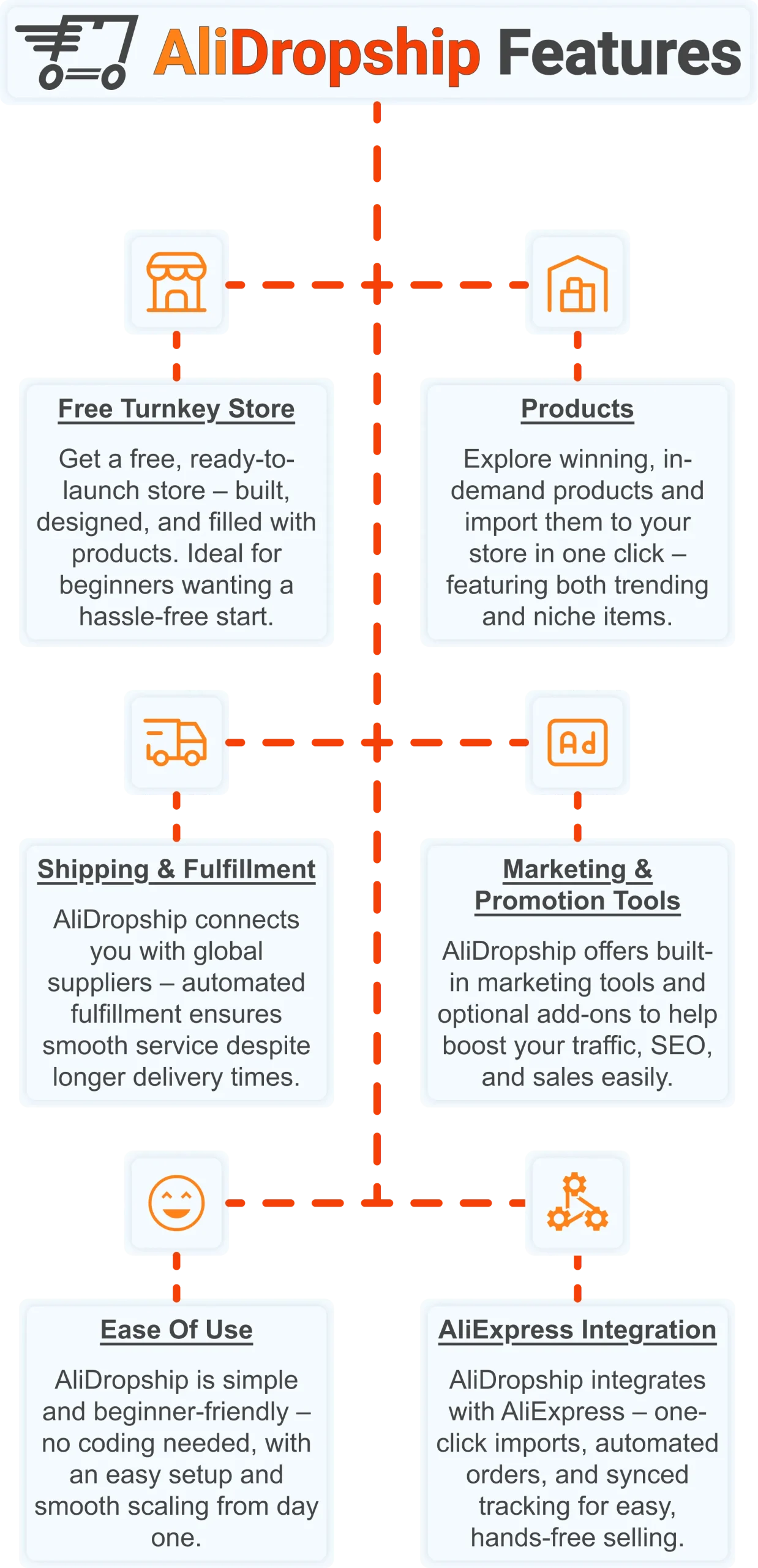
Free turnkey store ️
Get a free turnkey store – built, designed, and filled with products. Ideal for beginners wanting a hassle-free start, the store comes fully optimized to attract customers right away, saving you time on setup. Plus, it includes professional design elements to give your business a polished, trustworthy look from day one. This ready-made foundation makes it easy to move seamlessly into product selection.
Products
Once your store is set up, you can explore winning, in-demand products and import them in one click – featuring both trending and niche items. This wide selection lets you cater to diverse customer interests and test what works best. Regular updates ensure you always have fresh products, keeping your store competitive and relevant. With great products in place, smooth shipping becomes the next essential step.
Shipping & fulfillment
AliDropship connects you with global suppliers, and automated fulfillment ensures seamless order processing despite international delivery times. Customers receive real-time tracking updates, which builds confidence and trust in your store. Once shipping is handled reliably, you can focus on promoting your store and attracting traffic.
Marketing & promotion tools
To maximize sales, AliDropship offers built-in marketing tools and optional add-ons that help boost traffic, SEO, and conversions. From email campaigns and discounts to social media integration, these tools empower you to reach and retain customers without needing prior marketing experience. With promotion strategies in place, managing your business becomes simpler and more efficient.
Ease of use
AliDropship is beginner-friendly – no coding needed, with an intuitive dashboard that guides you through every step. Easy setup and smooth scaling let you expand your store without stress. As your business grows, adding new features, products, and marketing campaigns remains hassle-free, giving you more time to focus on sales.
AliExpress integration
Finally, AliDropship integrates seamlessly with AliExpress, enabling one-click imports, automated orders, and synced tracking. Your inventory stays up-to-date with the latest products and prices, while automated order processing frees you from manual tasks. Combined with the turnkey setup, reliable shipping, and built-in marketing tools, this integration ensures your dropshipping business is fully equipped for growth and success.
If you want to build consistent online income without the daily pressure of market timing or the steep capital requirements of day trading, dropshipping is worth a serious look. Claim your free turnkey store and $100 voucher to get started today.
 Previous post
