 ‧ julia.nenyukova ‧
March 09, 2026
‧ julia.nenyukova ‧
March 09, 2026  17 ‧
17 ‧
 0
0
The global digital products market crossed $500 billion in 2025 – and it is still growing. More people than ever are earning real income from eBooks, templates, printables, and online courses, and the barrier to entry has never been lower. You do not need inventory. You do not need a shipping label. And you do not need a big budget to get started.
Whether you are after a $300–$500 monthly side income or you want to replace your full-time pay, selling digital products gives you one of the most scalable models in e-commerce. Create the product once, sell it endlessly, and let automation handle the rest.
Quick Answer: Selling digital products means creating downloadable files – eBooks, courses, templates, printables – and listing them for sale online. Beginners can realistically earn $200–$800 per month within 60–90 days by choosing the right niche, pricing fairly, and marketing consistently across one or two platforms.
This guide covers everything – the best product types to sell, the right platforms to use, how to price and market your items, and the fastest way to launch if you are starting from scratch in 2026.
What is selling digital products?
Selling digital products means offering downloadable files or online access to content in exchange for payment. The product exists as a digital file – a PDF, a video, an audio track, a spreadsheet, a template – and once a customer pays, they receive it instantly via download link or email.
What makes this model so attractive is the economics. You create the product once and sell it an unlimited number of times. There is no restocking cost, no warehouse, and no shipping. Your margin on a $15 eBook or a $29 Canva template pack can be 95–100% after platform fees.
In 2026, selling digital products online has become even more accessible thanks to AI tools that dramatically speed up content creation, marketplaces that handle delivery automatically, and buyers who are increasingly comfortable purchasing digital downloads. The infrastructure is already built – you just need to add your products to it.
How much can you realistically earn selling digital products?
Earnings vary widely depending on your niche, product quality, and how actively you market. Here is an honest breakdown by product type:
Most beginners hit their first $200–$400/month within 30–60 days of launching, especially on established marketplaces like Etsy. Sellers who build a catalog of 10–20 products and market consistently tend to reach $600–$2,000/month within 90 days.
One note on earning potential: These figures assume active selling with real marketing effort behind it. Passive income takes time to build. Your first 60 days will likely feel like more work than reward – but the compounding effect kicks in once your catalog grows and your listings gain search visibility.
Best types of digital products to sell in 2026
Not all digital products are created equal. Some sell fast on any platform; others need a specific audience and a clearly defined niche. Here are the categories that consistently perform well right now – and why they work.
eBooks and PDF guides
If you have knowledge or expertise in any subject, packaging it as an eBook or practical PDF guide is one of the fastest ways to start selling digital products. Topics like personal finance, fitness, parenting, home organization, cooking, and productivity all sell reliably. Aim for 5,000–15,000 words for a standalone product, or shorter guides sold as part of a bundle at a higher combined price point.
Earning potential: $5–$30 per sale, $100–$600/month with a small catalog and basic listing SEO.
Printables and planners
Printable content – habit trackers, daily planners, budget sheets, journal pages, meal planners, checklists – is one of the top-performing categories on Etsy right now. These products are fast to produce using free tools like Canva, they download instantly, and buyers are impulse-friendly at $3–$10 price points. A well-optimized Etsy shop with 20–30 printable listings can generate steady income with very little ongoing maintenance.
Earning potential: $3–$12 per sale, $200–$900/month with an optimized shop and consistent new listings.
Canva templates and design assets
Social media templates, business card designs, resume templates, presentation decks, and brand kits sell well to small business owners who want professional-looking assets without hiring a designer. Canva templates in particular have seen explosive growth on Etsy and Creative Market in recent years – and demand is still rising as more solo entrepreneurs build their own brands online.
Earning potential: $10–$40 per sale, $300–$1,200/month with strong visuals and good SEO.
Online courses
Online education is one of the fastest-growing industries globally. Platforms like Udemy, Teachable, Kajabi, and Skillshare give you a built-in audience, while selling directly from your own site offers better profit margins. Courses take more time to produce but can earn $30–$200+ per enrollment – making them one of the highest-value options when selling digital products online.
Earning potential: $30–$200 per enrollment, $500–$5,000/month once you have an established audience.
AI content bundles (new 2026 trend)
One of the fastest-growing categories this year is AI-assisted digital products. These include ChatGPT prompt libraries, AI-generated artwork packs, AI-written wellness guides, and automated content bundles. They take little time to create and can be sold as instant downloads. Demand is rising fast – especially from business owners who want ready-to-use content without writing it themselves.
Why this works in 2026: AI tools have cut digital product creation time by 60–80% for many creators, making it easier than ever to build a large catalog in a short amount of time.
How to sell digital products on Etsy
Etsy remains one of the best platforms for selling digital products online – especially printables, templates, and creative guides. Its built-in buyer audience actively searches for downloadable content, and listing fees are low at just $0.20 per listing. If you are new to selling digital products, Etsy is the most beginner-friendly starting point available.
Set up your shop the right way
Before you list anything, spend time on your shop profile. A clear banner, a well-written bio, and a coherent brand identity help buyers trust you faster. Name your shop something memorable and niche-relevant rather than your own name. Fill in your shop policies section – buyers check return policies even for digital products, and having clear terms reduces disputes.
Optimize every listing for Etsy SEO
Etsy search is keyword-driven. Use your primary keyword in your listing title, the first paragraph of your description, and all 13 available tags. Tools like EtsyRank or Marmalead can help you find what buyers are actively searching for in your niche. Your listing photos matter too – even for digital products, strong mockup images dramatically increase click-through rates. Use Canva or Smartmockups to show your product in a real-world context.
Drive free traffic from social media
Pinterest and TikTok are the two highest-ROI platforms for Etsy digital sellers in 2026. Pinterest pins drive long-tail organic traffic for months or even years after you post them. TikTok short tutorials showing your product in use can send a significant traffic spike overnight. Start with one platform, build consistency, and expand later – you do not need to be everywhere at once to see results.
Important note: Etsy charges a 6.5% transaction fee plus a small payment processing fee on every sale. Factor this into your pricing from day one to protect your margins and avoid surprises.
How to sell digital products on Amazon
Amazon is not just for physical goods. For the right product types, it offers access to hundreds of millions of active buyers – making it one of the most powerful channels for selling digital products at scale, particularly for eBooks and software tools.
Self-publish with Amazon KDP
Amazon Kindle Direct Publishing (KDP) lets you upload a manuscript and sell it as a Kindle eBook or a print-on-demand paperback. You keep 35–70% royalties depending on your pricing tier. Non-fiction guides, how-to books, and niche-specific manuals perform especially well. Enrolling in KDP Select gives you access to Kindle Unlimited subscribers, which can add meaningful monthly volume on top of your direct sales.
Sell software, tools, and apps
Developers can list software, browser extensions, cloud tools, and SaaS subscriptions through the Amazon marketplace. This is a more technically demanding route, but the earning potential is significantly higher – especially for niche productivity tools, automation software, or digital subscriptions with recurring billing.
What is new in 2026
Amazon improved its KDP platform this year with AI-assisted formatting tools, faster publishing review times that now average under 12 hours for most submissions, and better analytics dashboards for tracking royalties by title. These updates make getting started with selling digital products on Amazon quicker and less technically demanding than it was two years ago.
Important: Amazon enforces strict content quality policies. Thin, low-value content – or content that reads like AI-generated filler without original insight – risks removal without warning. Focus on genuine depth and usefulness in whatever you publish.
How to sell digital products on your own website
Selling from your own site gives you something no marketplace can offer: full control. You keep more of the margin, own your customer data, set your own rules, and build a brand that exists independently of any platform’s algorithm or policy change.
Platforms to use
The most popular options for running a personal digital products store are WordPress with WooCommerce, Shopify, and Squarespace. Each has plugins or built-in tools that handle digital file delivery automatically after purchase – no manual emails required. WooCommerce with a digital downloads plugin is one of the most flexible setups available, especially if you want to combine digital and physical products in the same store.
Speed things up with a pre-built store
Building a site from scratch takes time you may not want to spend in setup mode. Done-for-you store solutions – like those offered through AliDropship – give you a fully designed, functional online store without the development work. You can be live and selling the same day, with product pages, payment processing, and download delivery all handled out of the box.
This is one of the most practical options for anyone who wants to make money selling digital products online without getting stuck in the technical setup phase.
Why this works in 2026: Owning your store eliminates platform dependency. If Etsy changes its algorithm or Amazon updates its fee structure, your own site and email list continue to drive revenue unaffected.
How to price your digital products
Pricing is one of the most underrated levers in digital product selling. Too low and you undermine your perceived value. Too high without demonstrating quality and buyers walk away. Here is how to approach it with confidence.
Research your market before you set a number
Before you decide on a price, look at what competitors charge for comparable products. On Etsy, filter your category by best-selling listings and note the price range for items with 100+ reviews. On Amazon KDP, use the “Look Inside” feature to assess content depth versus price point. You are not trying to undercut everyone – you are finding where strong products are positioned, and aiming to match or exceed their quality at a similar price.
Use tiered pricing for better conversions
Offer two or three versions of your product – a basic version at $9–$15, a standard version at $19–$29, and a premium bundle at $39–$59. Most buyers choose the middle option. This is why anchoring a higher-priced tier makes your standard version feel accessible – and increases the average order value without requiring more buyers.
Apply smart pricing tactics that actually move product
- Use charm pricing ($9.99 instead of $10, $24.99 instead of $25)
- Bundle related products to justify a higher combined price
- Run limited-time seasonal discounts to create genuine urgency
- Offer a free entry-level product to grow your email list
- Add a relevant upsell on the download confirmation page
High-value products – courses, comprehensive toolkits, multi-guide bundles – justify higher price points as long as you clearly communicate the scope of what buyers receive. Simple, small downloads sell best at $5–$15 and rely on volume rather than margin.
How to market your digital products in 2026
The best product in the world earns nothing without visibility. Marketing is not optional – it is the engine that makes selling digital products actually work. Here is how to build consistent traffic without burning out in the first month.
Start with one social platform and commit to it
You do not need to be everywhere. Pick the one platform where your target audience spends the most time and commit to it for 60–90 days. For visual products like printables and templates, Pinterest and Instagram deliver the most reliable traffic. For educational products like courses and guides, TikTok and YouTube Shorts generate fast growth. For B2B and professional templates, LinkedIn works well. Start focused – expand once you have traction.
Use SEO for long-term passive traffic
Whether you are on Etsy, Amazon, or your own website, keyword-driven SEO is the most sustainable traffic source available. Write product descriptions that include the phrases buyers actually search for. If you have a blog, publish content targeting long-tail queries related to your niche. A single well-ranked article or product listing can send traffic to your store for years without any ongoing effort.
Build an email list as early as possible
Email marketing consistently delivers the highest return of any marketing channel – often $36–$42 for every dollar spent, according to industry benchmarks. Offer a free product or short guide to encourage sign-ups, then use your list to announce new products, share limited-time discounts, and turn one-time buyers into repeat customers. Your email list is an asset that no algorithm can take away from you.
Collaborate with creators and micro-influencers
Offer your product for free to content creators in your niche in exchange for an honest review or a mention in their content. Micro-influencers with 5,000–50,000 followers often deliver better engagement and conversion rates than large accounts – and they are far more accessible to new sellers who do not yet have a big marketing budget.
Pro Tip: One focused hour of marketing per day – replying to comments, posting one piece of content, optimizing one listing – compounds faster over time than sporadic bursts of effort with long gaps in between.
Final thoughts – which approach is right for you?
Selling digital products works at every level of experience. The key is matching your starting point to the right strategy and platform – and then staying consistent long enough to see results.
If you are a complete beginner, start with printables or short PDF guides on Etsy. Low production time, accessible price points, and a built-in buyer audience make it the easiest entry point. Aim for 5–10 listings in your first month and focus on SEO before paid promotion.
If you are intermediate or part-time, consider expanding to Canva template packs or your own WooCommerce or Shopify store. At this stage, building an email list and committing 30–60 minutes per day to social media marketing will noticeably accelerate your growth.
If you have a full-time income goal, the highest-leverage move is creating an online course or a high-value digital toolkit priced at $50–$200. Combined with your own website, an SEO-driven blog, and email automation, this is the path to $2,000–$5,000+ per month – but it typically takes 6–12 months of consistent effort to reach that level sustainably.
In every case, the fundamentals are the same: choose a niche you understand, create something genuinely useful, price it fairly, and market it consistently. The infrastructure for selling digital products in 2026 has never been more beginner-friendly. The only thing missing is your first product.
AliDropship: Your complete all-in-one solution for starting dropshipping in 2026
If you want the simplest possible way to start dropshipping – especially if you’re brand new – AliDropship remains one of the most beginner-friendly tools available in 2026. It brings together store creation, product imports, automation, and marketing into a single streamlined system designed to help you launch quickly and grow confidently.
Free turnkey store ️
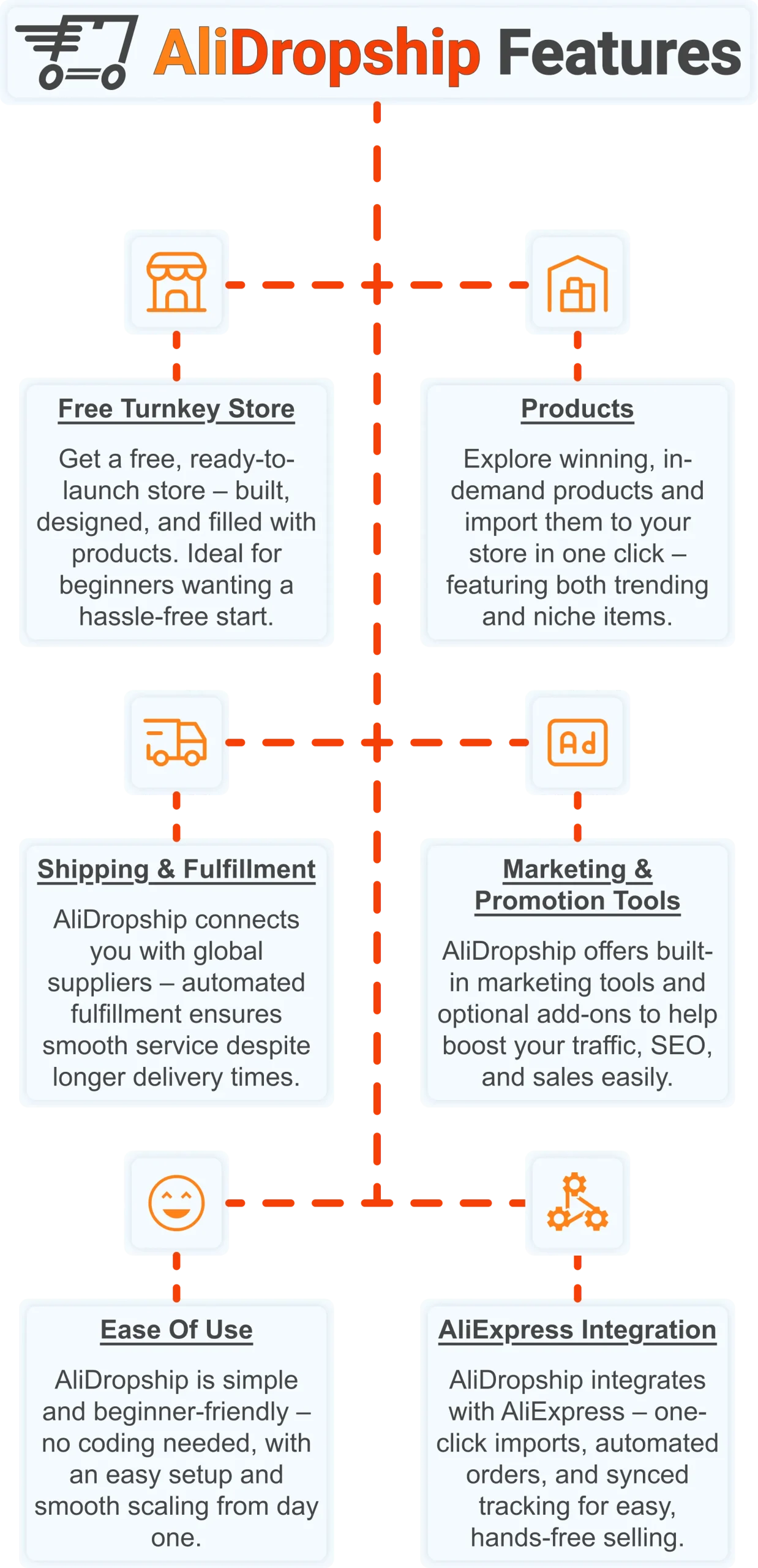
Get a free turnkey store – built, designed, and filled with products. Ideal for beginners wanting a hassle-free start, the store comes fully optimized to attract customers right away, saving you time on setup. Plus, it includes professional design elements to give your business a polished, trustworthy look from day one. This ready-made foundation makes it easy to move seamlessly into product selection.
Products
Once your store is set up, you can explore winning, in-demand products and import them in one click – featuring both trending and niche items. This wide selection lets you cater to diverse customer interests and test what works best. Regular updates ensure you always have fresh products, keeping your store competitive and relevant. With great products in place, smooth shipping becomes the next essential step.
Shipping & fulfillment
AliDropship connects you with global suppliers, and automated fulfillment ensures seamless order processing despite international delivery times. Customers receive real-time tracking updates, which builds confidence and trust in your store. Once shipping is handled reliably, you can focus on promoting your store and attracting traffic.
Marketing & promotion tools
To maximize sales, AliDropship offers built-in marketing tools and optional add-ons that help boost traffic, SEO, and conversions. From email campaigns and discounts to social media integration, these tools empower you to reach and retain customers without needing prior marketing experience. With promotion strategies in place, managing your business becomes simpler and more efficient.
Ease of use
AliDropship is beginner-friendly – no coding needed, with an intuitive dashboard that guides you through every step. Easy setup and smooth scaling let you expand your store without stress. As your business grows, adding new features, products, and marketing campaigns remains hassle-free, giving you more time to focus on sales.
AliExpress integration
Finally, AliDropship integrates seamlessly with AliExpress, enabling one-click imports, automated orders, and synced tracking. Your inventory stays up-to-date with the latest products and prices, while automated order processing frees you from manual tasks. Combined with the turnkey setup, reliable shipping, and built-in marketing tools, this integration ensures your dropshipping business is fully equipped for growth and success.
If you are serious about turning digital products into a consistent income stream, AliDropship gives you the store, the tools, and the product catalog to start today. Get your free store and a $100 gift voucher to start selling digital products right now.
 Previous post
