 ‧ julia.nenyukova ‧
March 16, 2026
‧ julia.nenyukova ‧
March 16, 2026  37 ‧
37 ‧
 0
0
Bitcoin crossed $100,000 for the first time in late 2024. If you had bought just $500 worth back in 2020, that investment would be worth several thousand dollars today. That kind of growth gets people asking the same question: how do you actually make money with bitcoin?
Quick Answer: You can make money with bitcoin through buying and holding, short-term trading, mining, earning interest on holdings, accepting it as payment, or running crypto affiliate marketing. Each method carries different risk levels and requires different amounts of time and starting capital.
The honest reality is that some of these methods are genuinely accessible to beginners, while others demand significant experience or upfront investment. This guide breaks down each approach clearly – with realistic earning expectations and the risks you need to understand before you start.
What does “making money with bitcoin” actually mean?
Bitcoin is a decentralized digital currency – not controlled by any government, bank, or single authority. Its value is driven entirely by supply and demand on the open market, which is why the price can swing dramatically in short periods.
When people talk about how to make money with bitcoin, they usually mean one of two things: profiting from price appreciation, or using bitcoin as a tool to generate ongoing income. Some methods do both.
What makes bitcoin particularly interesting in 2026 is that institutional adoption has matured significantly. Major companies now hold bitcoin on their balance sheets. Spot ETFs are live in multiple markets. That does not make it risk-free – but it does mean the infrastructure around it is more stable than it was five years ago.
Important note: Bitcoin is still a highly volatile asset. Any strategy you choose should account for the possibility that the value can drop sharply and quickly – sometimes by 50–70% within a single bear cycle.
How much can you realistically earn with bitcoin?
There is no single answer to this – earnings depend heavily on the method, the amount of capital you start with, and prevailing market conditions. The table below gives you a grounded overview of what to expect from each approach.
These figures are realistic estimates based on publicly available data and community reports. Bitcoin’s price volatility means actual returns can be much higher or much lower in any given period – never treat these as guaranteed outcomes.
Buy and hold: the simplest long-term bitcoin strategy
HODLing is exactly what it sounds like. You buy bitcoin, store it securely, and wait. The term itself originated from a typo-filled post on a Bitcoin forum in 2013 – someone spelled “holding” as “hodling” – and it stuck. Today it describes one of the most straightforward approaches to how to make money with bitcoin over the long term.
The logic is rooted in bitcoin’s fixed supply. There will only ever be 21 million coins in existence. As demand grows over time, many long-term investors believe the price will continue rising on a long enough horizon. People who bought and held through previous bear markets did well in the long run – but they also had to endure drawdowns of 50–80% along the way. That is not a small thing to stomach.
How to get started
You will need an account on a reputable exchange – Coinbase, Kraken, and Binance are among the most established. Once you have purchased bitcoin, the safest place to store it long-term is a hardware (cold) wallet, not on the exchange itself.
Important: Exchanges have been hacked before. If you are holding a significant amount, move it to cold storage. Devices like a Ledger or Trezor keep your private keys completely offline.
Dollar-cost averaging (DCA) is worth considering here too. Instead of trying to time the market with a single large buy, DCA means investing a fixed amount at regular intervals – say, $50 or $100 every week regardless of price. Over time, this smooths out your average purchase cost and removes a lot of the emotional pressure.
Earning potential: Entirely dependent on entry price and market cycle. Long-term holders who stayed in through 2020–2024 saw returns of 300–1,000%+ on their original investment – but past performance does not predict future results.
Trading bitcoin for short-term gains
If HODLing is a marathon, trading is a sprint – and it comes with a significantly higher chance of getting hurt if you are not prepared. Short-term trading means buying and selling bitcoin based on price movements, usually over hours or days rather than months or years.
Platforms like Binance, Kraken, and Bitfinex all support bitcoin trading pairs. Many traders use TradingView to analyse price charts, identify patterns, and plan entry and exit points before placing orders.
What you actually need to succeed at trading
Trading requires a working understanding of basic technical analysis – concepts like support and resistance levels, moving averages, RSI (Relative Strength Index), and MACD (Moving Average Convergence Divergence). None of this is impossible to learn, but it genuinely takes time and practice before it becomes useful.
Important: Studies consistently show that the majority of retail traders lose money, particularly in the first year. Start with very small amounts – amounts you are genuinely comfortable losing entirely – while you are still learning.
Stop-loss orders are non-negotiable. These automatically close your position if the price drops to a level you set in advance, limiting how much you can lose on any single trade. No experienced trader enters a position without one.
Earning potential: Experienced traders report $50–$500/day on modest capital in strong market conditions. However, flat or bear markets can eliminate gains quickly, and most beginners lose money in their first 60–90 days of trading.
Bitcoin mining: still viable in 2026?
Mining is the process that keeps the Bitcoin network running. Miners use powerful computers to validate transactions and add them to the blockchain – and in return, they earn newly created bitcoin as a reward. In the early days of Bitcoin, you could mine on a regular laptop. In 2026, that is no longer even close to possible.
Today, profitable mining requires ASIC (Application-Specific Integrated Circuit) rigs – hardware built specifically for Bitcoin mining that costs anywhere from $2,000 to $15,000+ per unit. On top of the hardware investment, electricity consumption is a major ongoing cost that can make or break the economics.
Mining pool vs. solo mining
Solo mining is effectively off the table for individual users at this point. The probability of a single machine successfully mining a block alone is astronomically low. Most independent miners join a mining pool, where participants combine computing power and split rewards proportionally based on their contribution.
The economics of mining in 2026 depend heavily on your electricity cost per kilowatt-hour. If you have access to cheap or renewable energy – under $0.05/kWh – mining can still generate a meaningful return. In areas with higher electricity rates, the numbers often do not work out after costs.
Earning potential: $10–$50/day per ASIC unit in favourable conditions after electricity costs. Profitability calculators like WhatToMine can give you a precise estimate based on your specific hardware and local electricity rate.
Earning interest on your bitcoin holdings
One of the lower-effort ways to generate returns from bitcoin you already own is to lend it out via a platform that pays you interest. Think of it as putting your bitcoin in a high-yield savings account – except with meaningfully different risk characteristics.
These platforms connect bitcoin holders with borrowers, typically institutional traders who need liquidity. You deposit your bitcoin, the platform lends it out, and you earn a yield – usually between 2% and 8% APY, depending on market conditions and the platform in question.
Risks you need to know about
This method is not without danger. Several major lending platforms collapsed in 2022 – Celsius and BlockFi among them – leaving hundreds of thousands of users unable to access their funds. It was a stark reminder that these platforms carry real counterparty risk and are not covered by deposit protection schemes like the FDIC.
If you go this route in 2026, prioritise platforms with transparent proof-of-reserves audits and a clear public explanation of how they use customer funds. Never deposit more than you are prepared to lose entirely.
Earning potential: 2–8% APY on your bitcoin holdings. On $10,000 worth of bitcoin, that translates to roughly $200–$800 per year in interest income – not exciting on its own, but useful as a passive layer on top of a long-term hold position.
Accepting bitcoin as payment and affiliate marketing
These two methods work best for people who already have something to sell – a product, a service, or an online audience. They are less about speculating on price and more about integrating bitcoin into an existing income stream.
Accepting bitcoin as payment
If you run a business – even a small freelance operation – you can start accepting bitcoin alongside traditional payment methods. Payment processors like BitPay and CoinGate make the integration straightforward for websites, WooCommerce stores, and direct client invoicing.
The upside is that you receive bitcoin, which may appreciate over time. The downside is volatility – if the price drops significantly after you receive a payment, your effective earnings drop too. Many merchants who accept bitcoin convert it to local currency immediately to avoid this exposure entirely.
Crypto affiliate marketing
If you have a blog, YouTube channel, or social following focused on finance, technology, or investing, crypto affiliate programmes can be genuinely lucrative. Exchanges like Coinbase and Binance, as well as hardware wallet brands like Ledger, all run affiliate schemes with competitive commission structures.
Why this works in 2026: Crypto onboarding is still a growth market globally. New users signing up to exchanges represent real commission events, and referral payouts in this space tend to be higher than in most other affiliate niches.
Earning potential: $100–$1,500/month for affiliate marketers with an engaged audience of 5,000–20,000 followers in a relevant niche. More established creators report significantly higher figures, particularly during bull market cycles when interest in bitcoin spikes.
Legal and ethical considerations
Making money with bitcoin is legal in most countries – but how you report it, and what you do with it, matters enormously. Treating crypto as a legal grey area is a mistake that has cost people significant amounts in back taxes and penalties.
Tax obligations
In most jurisdictions, bitcoin is treated as a capital asset. Selling it, trading it for another cryptocurrency, or using it to purchase goods and services can all trigger a taxable event. In the US, the IRS requires you to report bitcoin gains on your annual tax return. Similar obligations exist in the UK, EU, Canada, and Australia.
Keeping clear records of every transaction – the date, amount, and the price in your local currency at the time – is not optional. Tools like Koinly and CoinTracker can automate the bulk of this process and generate tax-ready reports.
Key principle: Never assume that crypto gains are invisible to tax authorities. Blockchain transactions are public and permanent – and exchanges are increasingly required by law to report user activity to government agencies.
What to avoid absolutely
- Pump-and-dump schemes – artificially inflating a token’s price before selling. This is market manipulation and is illegal in most jurisdictions.
- Unregistered exchanges – some platforms operating in grey areas have simply disappeared with user funds. Stick to regulated, well-audited exchanges.
- Guaranteed return promises – any platform promising fixed, guaranteed returns on bitcoin is almost certainly a scam. Legitimate investments do not guarantee returns.
- Undisclosed affiliate promotion – if you promote crypto products to an audience, disclosure is both a legal requirement and a basic ethical standard in most markets.
Final thoughts: choosing the right bitcoin strategy for you
There is no single answer to how to make money with bitcoin that works for everyone. The right method depends on your starting capital, your risk tolerance, how much time you can invest, and the skills you already have.
Here is a quick breakdown by reader profile.
Complete beginner: Start with dollar-cost averaging into a buy-and-hold position. Use a reputable exchange, move your bitcoin to a hardware wallet, and leave it alone for at least 12–24 months. Only invest what you are genuinely comfortable losing entirely.
Intermediate / part-time: Consider adding an interest-earning layer on a portion of your holdings while maintaining a core HODL position. If you are already creating content online, layering in crypto affiliate marketing is a natural and low-friction extension of what you already do.
Advanced / full-time goal: Active trading and mining are more realistic at this level – but only after you have spent serious time learning the tools, studying price behaviour, and testing with small amounts. Mining in particular requires a rigorous cost-of-electricity analysis before committing any capital to hardware.
One note on earning figures: Every number in this article is a realistic estimate based on community data from sources like Reddit and publicly available platform disclosures. Bitcoin’s volatility means actual results can vary dramatically in either direction. Approach every method as a long-term commitment, not a shortcut to fast money.
AliDropship: Your complete all-in-one solution for starting dropshipping in 2026
If you want the simplest possible way to start dropshipping – especially if you’re brand new – AliDropship remains one of the most beginner-friendly tools available in 2026. It brings together store creation, product imports, automation, and marketing into a single streamlined system designed to help you launch quickly and grow confidently.
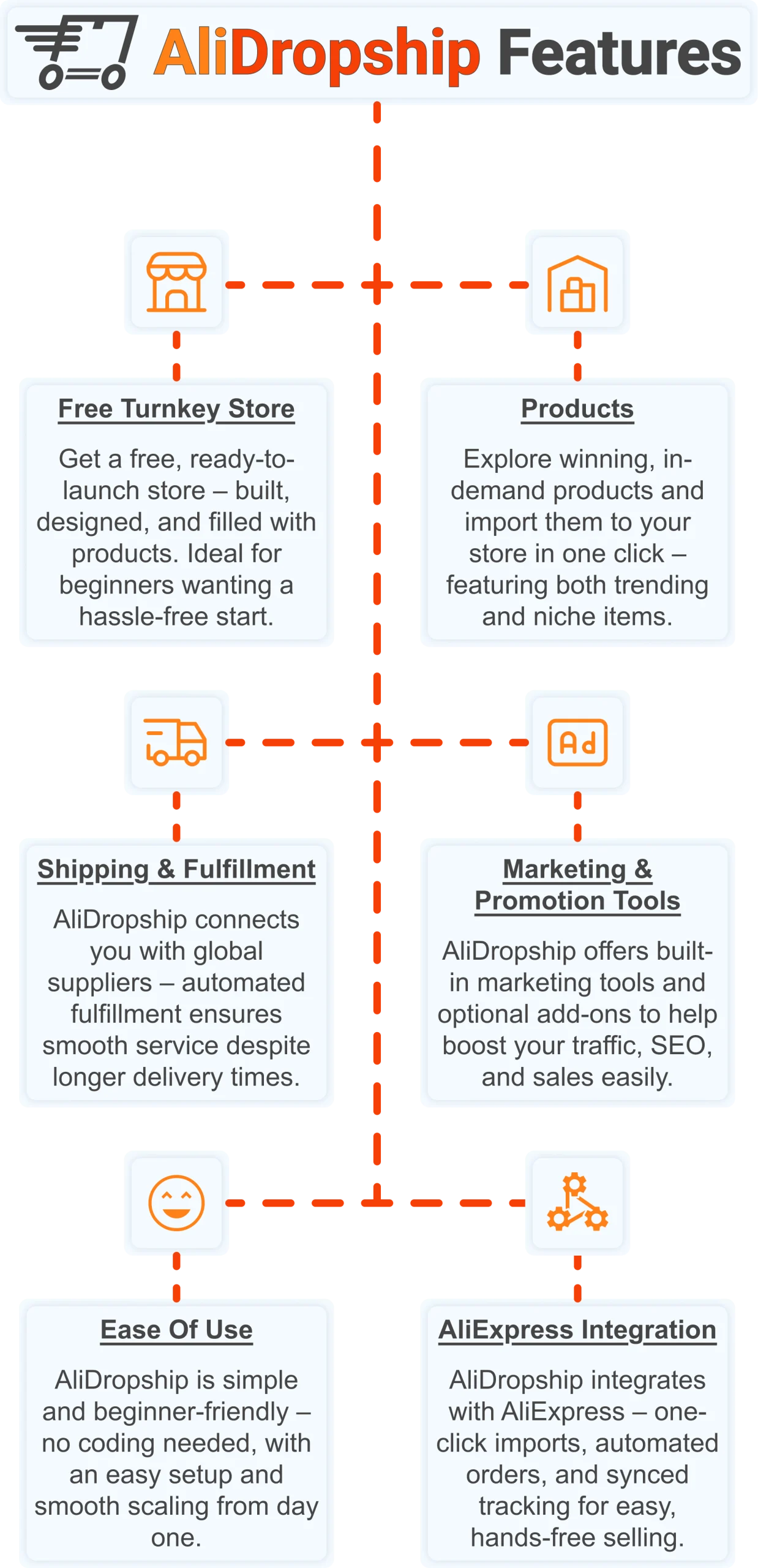
Free turnkey store ️
Get a free turnkey store – built, designed, and filled with products. Ideal for beginners wanting a hassle-free start, the store comes fully optimized to attract customers right away, saving you time on setup. Plus, it includes professional design elements to give your business a polished, trustworthy look from day one. This ready-made foundation makes it easy to move seamlessly into product selection.
Products
Once your store is set up, you can explore winning, in-demand products and import them in one click – featuring both trending and niche items. This wide selection lets you cater to diverse customer interests and test what works best. Regular updates ensure you always have fresh products, keeping your store competitive and relevant. With great products in place, smooth shipping becomes the next essential step.
Shipping & fulfillment
AliDropship connects you with global suppliers, and automated fulfillment ensures seamless order processing despite international delivery times. Customers receive real-time tracking updates, which builds confidence and trust in your store. Once shipping is handled reliably, you can focus on promoting your store and attracting traffic.
Marketing & promotion tools
To maximize sales, AliDropship offers built-in marketing tools and optional add-ons that help boost traffic, SEO, and conversions. From email campaigns and discounts to social media integration, these tools empower you to reach and retain customers without needing prior marketing experience. With promotion strategies in place, managing your business becomes simpler and more efficient.
Ease of use
AliDropship is beginner-friendly – no coding needed, with an intuitive dashboard that guides you through every step. Easy setup and smooth scaling let you expand your store without stress. As your business grows, adding new features, products, and marketing campaigns remains hassle-free, giving you more time to focus on sales.
AliExpress integration
Finally, AliDropship integrates seamlessly with AliExpress, enabling one-click imports, automated orders, and synced tracking. Your inventory stays up-to-date with the latest products and prices, while automated order processing frees you from manual tasks. Combined with the turnkey setup, reliable shipping, and built-in marketing tools, this integration ensures your dropshipping business is fully equipped for growth and success.
If bitcoin feels too volatile for your goals right now, dropshipping with AliDropship gives you a lower-risk way to build real online income with physical products and real customers. Claim your free store and a $100 voucher to get started today.
 Previous post
