 ‧ Agnes Kazaryan ‧
March 07, 2026
‧ Agnes Kazaryan ‧
March 07, 2026  57 ‧
57 ‧
 0
0
Thinking about using Printify to launch a print-on-demand business in 2026? You’re not alone. The platform has grown steadily over the past few years, and it remains one of the most talked-about options for anyone who wants to sell custom products online without holding any inventory.
But “talked about” doesn’t always mean “right for you.” This Printify review cuts through the noise and gives you a clear, honest look at how the platform actually works – what it does well, where it falls short, and whether it’s the best fit for your goals this year.
Quick answer: Printify is a solid print-on-demand platform with a free plan, a catalog of 900+ products, and integrations with all the major ecommerce platforms. It’s a good starting point for creative sellers, but product quality varies by provider and scalability has real limits compared to full dropshipping.
What is Printify?
Printify is a print-on-demand platform that connects online sellers with a global network of print providers. You upload a design, apply it to a product from the catalog – think t-shirts, mugs, hoodies, tote bags – and when a customer places an order, the provider prints and ships it directly to them. You never touch the stock.
It launched in 2015 and has since grown into one of the largest POD marketplaces, with providers operating across the US, Europe, Australia, and beyond. By 2026, the platform supports over 900 products and has added AI-assisted mockup tools, expanded integrations, and improved fulfillment tracking.
The core appeal is simple: low barrier to entry, no upfront inventory costs, and the ability to start selling creative products almost immediately.
How much can you realistically earn with Printify?
Earnings on Printify depend heavily on your niche, your designs, your marketing effort, and the margins you build into your pricing. It’s not a passive income machine out of the box – but with consistent effort, it can generate real money.
These figures assume solid niche selection, quality designs, and active marketing. Most beginners take 60–90 days to see consistent sales.
Important note: Printify margins are tighter than they look at first glance. Once you factor in production costs, shipping, platform fees, and any ad spend, realistic net profit per order is often $5–$15. Volume is key.
How Printify works
The workflow is refreshingly straightforward, which is a big part of why so many beginners gravitate toward it. Here’s what the process looks like in 2026:
- Create a free account – no upfront costs or credit card required.
- Browse the product catalog – now over 900 items across apparel, accessories, home decor, and more.
- Upload your designs and use the mockup generator – AI-powered previews make this faster than ever.
- Connect your store – integrations are available for Shopify, Etsy, WooCommerce, Wix, Squarespace, BigCommerce, and TikTok Shop.
- Publish and sell – orders route automatically to the print provider, who handles production and shipping.
There’s no inventory to buy, no warehouse to rent, and no fulfillment to manage manually. That’s the core promise of print on demand – and Printify delivers on it reliably.
Why this works in 2026: Social commerce is growing fast. The addition of TikTok Shop as a direct integration means creators can now move from viral content to checkout without ever leaving the app.
Printify pricing: What does it actually cost?
One of Printify’s strongest selling points is its pricing structure. Getting started costs nothing, and you only pay when you make a sale. Here’s how the plans break down.
Free plan
The free plan lets you create unlimited products and connect up to five stores. You pay the base production and shipping cost per order, and keep whatever margin you mark up on top. For testing the platform or running a side hustle, this is more than enough.
Premium plan – $29/month
The Premium plan unlocks up to 20% discounts on all products and support for up to 10 stores. At scale, that discount has a real impact on margins. If you’re selling 50+ units a month, the plan pays for itself quickly.
Enterprise plan
For high-volume sellers, Printify offers custom enterprise pricing with dedicated support and additional features. This is worth exploring once you’re consistently moving hundreds of orders per month.
Earning potential: On the free plan, expect margins of $5–$12 per item. With Premium, margins improve to $8–$18 per item depending on the product and provider.
Product quality: The honest picture
This is where Printify gets more complicated than competitors like Printful. Because Printify works with a network of third-party providers rather than operating its own facilities, quality isn’t uniform across the board.
Some providers deliver excellent print clarity, durable fabrics, and neat packaging. Others fall short – inconsistent color reproduction, thinner-than-expected materials, or slower turnaround times. The difference between two providers listing the same t-shirt can be significant.
The good news? Printify has improved provider transparency considerably. In 2026, you can filter providers by rating, read customer feedback, and compare production times directly in the dashboard. Before committing to a product at scale, ordering samples is still the smartest move.
Important: Never skip samples if you’re planning to scale. A quality issue discovered after 200 orders is far more damaging than one caught before launch.
Printify shipping: speeds, costs, and reliability
Shipping performance has improved noticeably over the past two years, largely because Printify has pushed more providers to establish regional fulfillment hubs. For US and European orders, most deliveries now arrive within 5–10 business days from the production date.
International orders are less predictable. Delivery times vary depending on the provider’s location, the destination country, and local customs. Printify does provide integrated tracking across most providers, so customers aren’t left wondering where their order is.
Flat-rate shipping is available on many products, which makes pricing calculations simpler. That said, shipping costs can eat into margins quickly – especially on lower-priced items like phone cases or accessories.
One note on shipping: Printify doesn’t control fulfillment directly. If a provider has a bad week, your customers feel it. Always check provider ratings and recent reviews before adding new products to your store.
Platform integrations
Printify connects with all the major ecommerce platforms, which is one of the main reasons it stays competitive. Products, orders, and inventory sync automatically once you link your store, removing the need for manual updates.
Supported integrations in 2026 include Shopify, Etsy, WooCommerce, Wix, Squarespace, BigCommerce, eBay (still in beta), and TikTok Shop. For most sellers, Shopify and Etsy are the go-to combinations – Etsy for organic discovery and Shopify for building a branded storefront.
The TikTok Shop integration is worth paying attention to. Social commerce is growing fast, and being able to connect your Printify catalog to a TikTok store gives creators a direct path from content to conversion.
Printify pros and cons
What works well
- Free to start with no upfront investment required
- Catalog of 900+ customizable products across multiple categories
- Integrates with all major ecommerce and social commerce platforms
- Multiple providers per product – you can switch if quality drops
- Automated order fulfillment once your store is connected
- AI mockup tools make the design process faster and more intuitive
Where it falls short
- Product quality varies significantly between providers
- Limited branding and custom packaging options
- Shipping times depend on the provider’s location and workload
- Margins are tight, especially on the free plan with lower-priced products
- Scaling has natural limits compared to broader dropshipping models
Printify vs other POD platforms in 2026
Printify isn’t the only print-on-demand option out there. Here’s a quick, honest comparison with the main alternatives.
Printify vs Printful
Printful is Printify’s closest competitor and the most common comparison. Printful operates its own production facilities, which means more consistent quality and better branding options – custom labels, packaging inserts, and branded packaging. The tradeoff is higher base prices, which squeeze margins, especially for lower-volume sellers. If brand experience is your top priority and you’re willing to charge more, Printful is worth considering. If you want flexibility and a wider product range at lower cost, Printify wins.
Printify vs Gelato
Gelato has built a strong reputation for fast international shipping, thanks to its network of local print partners in over 30 countries. For sellers targeting global audiences, this can mean noticeably shorter delivery times. The downside is a smaller product catalog, which limits how much you can diversify your store.
Printify vs SPOD
SPOD (Spreadshirt Print-On-Demand) is known for extremely fast production – often shipping within 48 hours. Its product range is solid and pricing is competitive. Where it lags behind Printify is in platform integrations and advanced features like AI design tools. For sellers who prioritize speed above all else, SPOD is worth a look.
Printify vs Spring (Teespring)
Spring is built for creators who sell directly to their social media audience. It’s simple to set up and integrates well with YouTube, Instagram, and TikTok. The catalog is narrower, and product quality outside of core apparel is inconsistent. Spring makes sense for influencers with an existing audience – less so for building a standalone store.
Overall, Printify’s combination of a large catalog, competitive pricing, flexible provider selection, and broad integrations keeps it near the top of the POD market in 2026. It’s not perfect, but for most sellers starting out, it’s a strong and practical choice.
Print on demand vs dropshipping: What’s the real difference?
From the outside, POD and dropshipping look like the same thing – sell products without holding inventory, let someone else handle fulfillment. But in practice, the two models are quite different, and the difference matters when you’re thinking about growth.
Print on demand is a creative model. You design products, build a niche around your aesthetic, and sell to customers who connect with that identity. Every item is made to order, which keeps risk low but limits how fast you can scale. You’re also tied to a POD catalog – you can only sell what the provider can print.
Dropshipping operates on a different scale. Instead of a catalog of a few hundred customizable items, you have access to millions of ready-to-ship products from global suppliers. You can test niches, chase trends, and enter new categories without any design work. Automation tools handle product imports, pricing rules, and order processing so the business can grow without adding proportional workload.
Branding freedom is another key difference. With POD, you’re often constrained by provider packaging and labeling policies. With dropshipping – especially when you own your store – you control the entire brand experience, from the domain name to the checkout design.
Neither model is wrong. POD is a great entry point for designers and creators. But if your goal is to build a scalable, long-term ecommerce business, dropshipping offers more room to grow.
Legal and ethical considerations
Print on demand sits in a legally complex space that’s worth understanding before you launch.
The most common issue is intellectual property. Uploading someone else’s design, logo, character, or slogan – even a modified version – without a license is copyright infringement. This applies to sports teams, musicians, movie franchises, and brand logos. Etsy and other platforms are increasingly active at removing infringing listings, and repeat violations can result in account suspension.
Key principle: Only sell designs you created or hold a valid commercial license for. If you’re using a freelancer or a design tool, check the licensing terms before listing the product.
On the consumer side, be honest about production and shipping times. Customers comparing your store to Amazon will have expectations. Clearly communicating that items are made to order – and giving realistic delivery windows – reduces refund requests and negative reviews.
One area to avoid completely: “inspired by” or “fan art” listings that walk the line on licensed IP. Even if similar listings exist on Etsy, that doesn’t mean they’re legal. It means they haven’t been caught yet.
Final thoughts: Who is Printify actually right for?
Printify is a well-built, genuinely useful platform – but it’s not the right tool for everyone. Here’s a quick breakdown by seller profile.
Complete beginner
If you’re brand new to ecommerce and want to test whether selling online suits you, Printify is a low-risk way to start. The free plan costs nothing, setup is intuitive, and you don’t need any technical knowledge. Expect your first 60–90 days to be mostly learning and experimenting. Income in this phase will be modest – think $100–$300/month if you’re consistent.
Intermediate / part-time seller
If you already have some experience with online selling and want to add a POD channel, Printify integrates cleanly into existing Shopify or WooCommerce setups. The Premium plan’s product discounts become meaningful at 30–50+ orders per month. Focus on niche specificity and design quality to stand out from the crowd.
Advanced / full-time goal
If you’re aiming for $3,000–$5,000+/month and want a business you can scale aggressively, Printify alone will likely feel limiting. The margin constraints, provider variability, and inability to sell outside the POD catalog are real ceilings. At this level, it’s worth looking at broader dropshipping models that give you more product freedom, better margins, and full store ownership.
AliDropship: Your complete all-in-one solution for starting dropshipping in 2026
If you want the simplest possible way to start dropshipping – especially if you’re brand new – AliDropship remains one of the most beginner-friendly tools available in 2026. It brings together store creation, product imports, automation, and marketing into a single streamlined system designed to help you launch quickly and grow confidently.
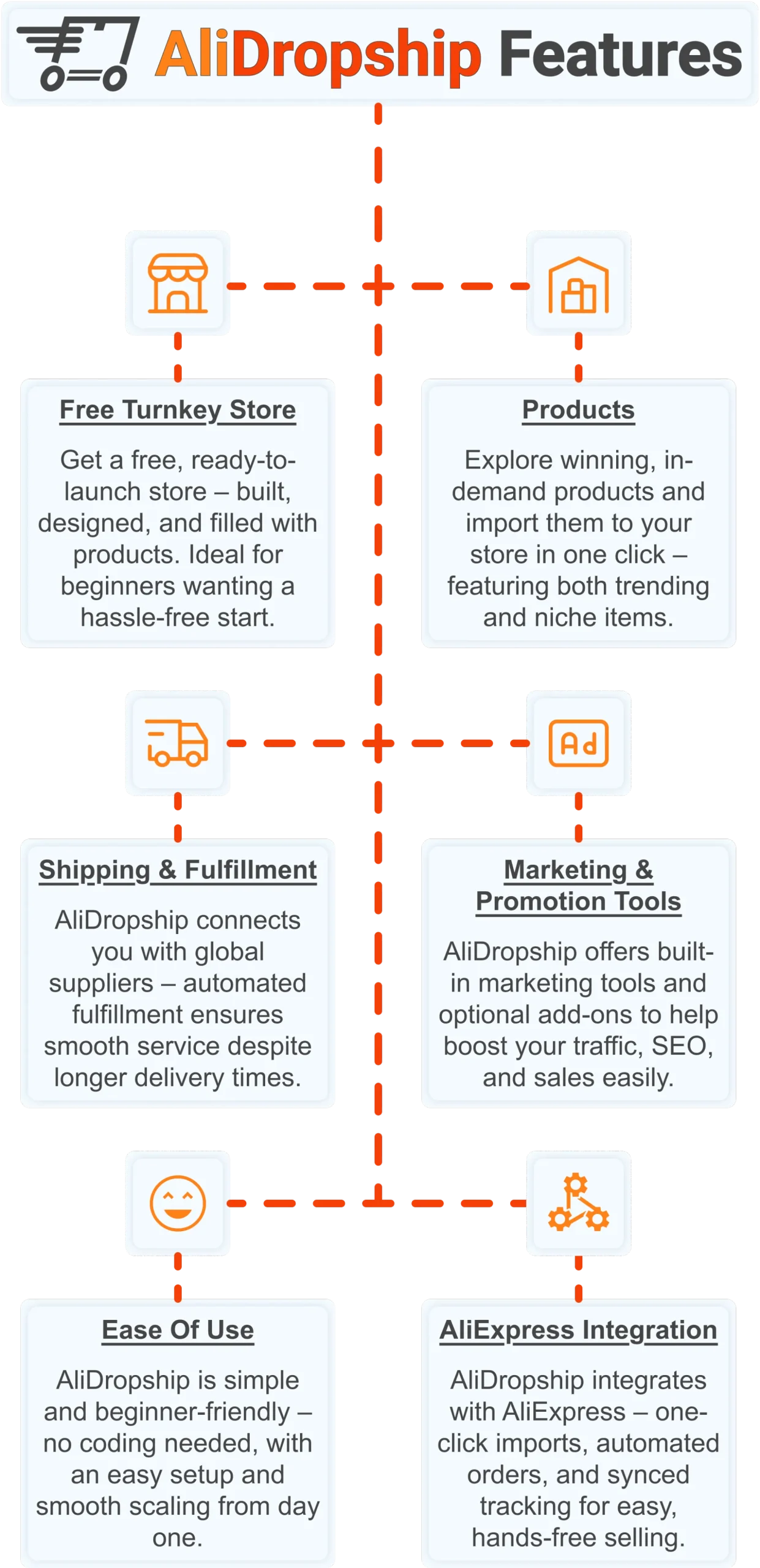
Free turnkey store ️
Get a free turnkey store – built, designed, and filled with products. Ideal for beginners wanting a hassle-free start, the store comes fully optimized to attract customers right away, saving you time on setup. Plus, it includes professional design elements to give your business a polished, trustworthy look from day one. This ready-made foundation makes it easy to move seamlessly into product selection.
Products
Once your store is set up, you can explore winning, in-demand products and import them in one click – featuring both trending and niche items. This wide selection lets you cater to diverse customer interests and test what works best. Regular updates ensure you always have fresh products, keeping your store competitive and relevant. With great products in place, smooth shipping becomes the next essential step.
Shipping & fulfillment
AliDropship connects you with global suppliers, and automated fulfillment ensures seamless order processing despite international delivery times. Customers receive real-time tracking updates, which builds confidence and trust in your store. Once shipping is handled reliably, you can focus on promoting your store and attracting traffic.
Marketing & promotion tools
To maximize sales, AliDropship offers built-in marketing tools and optional add-ons that help boost traffic, SEO, and conversions. From email campaigns and discounts to social media integration, these tools empower you to reach and retain customers without needing prior marketing experience. With promotion strategies in place, managing your business becomes simpler and more efficient.
Ease of use
AliDropship is beginner-friendly – no coding needed, with an intuitive dashboard that guides you through every step. Easy setup and smooth scaling let you expand your store without stress. As your business grows, adding new features, products, and marketing campaigns remains hassle-free, giving you more time to focus on sales.
AliExpress integration
Finally, AliDropship integrates seamlessly with AliExpress, enabling one-click imports, automated orders, and synced tracking. Your inventory stays up-to-date with the latest products and prices, while automated order processing frees you from manual tasks. Combined with the turnkey setup, reliable shipping, and built-in marketing tools, this integration ensures your dropshipping business is fully equipped for growth and success.
If this Printify review has you thinking about what a more scalable ecommerce model could look like, AliDropship gives you everything you need to build a full store on your own terms. Claim your free store and $100 voucher today and see the difference for yourself.
 Previous post
