 ‧ Agnes Kazaryan ‧
March 13, 2026
‧ Agnes Kazaryan ‧
March 13, 2026  494 ‧
494 ‧
 0
0
If your Shopify store is not pulling in consistent organic traffic, the problem is rarely your products. More often, it is visibility. The vast majority of shoppers never scroll past the first page of Google – which means the right Shopify SEO tools can be the difference between a store that earns steadily and one that sits invisible.
Quick Answer: The best Shopify SEO tools in 2026 include Plug In SEO, SEO Manager, Google Search Console, Ahrefs, and Semrush. Free tools cover the essentials for new stores; paid platforms become worthwhile once your store generates consistent revenue. Start free, scale up as traffic grows.
The good news is you do not need a technical background to use these tools effectively. Whether you are launching your first store or pushing an established one past a plateau, there are Shopify SEO tools built for every experience level and budget. And in 2026, organic search matters more than ever – paid ads are increasingly expensive and unpredictable, while a solid SEO strategy can deliver thousands of qualified visitors every month without paying per click.
What are Shopify SEO tools?
Shopify SEO tools are apps, software platforms, and analytics services that help your store rank higher in search engine results. They cover a wide range of functions: auditing your store for technical problems, researching the keywords your customers are actually typing into Google, tracking your ranking positions over time, improving your product page copy, and building the backlinks that signal authority to search engines.
Some tools install directly from the Shopify App Store and work natively inside your store dashboard. Others – like Ahrefs or Semrush – are broader platforms that work with any website, including Shopify. For most store owners, the most effective approach is to combine both: a Shopify-native app for on-page fixes and a broader platform for keyword research and competitor intelligence.
Why this works in 2026: Google now weighs expertise, content depth, and user experience more heavily than ever before. Shopify SEO tools give you structured data and actionable recommendations to improve on all three – without having to guess what Google actually wants from your store.
How much can better SEO realistically improve your Shopify revenue?
The revenue impact of Shopify SEO optimization depends heavily on your niche, competition level, and how consistently you apply improvements. A brand-new store targeting competitive keywords can take 60–90 days to see meaningful organic traffic. An established store with existing domain authority may see ranking gains within 2–4 weeks of fixing core on-page issues.
Here is a realistic look at what different SEO approaches typically produce for Shopify stores:
On-page fixes and technical improvements are the fastest wins for most stores – they require the least ongoing effort once implemented. Blogging and link building take longer but produce compounding returns over time.
One note on these revenue figures: These ranges reflect what stores achieve with consistent, competent SEO work over several months – not overnight results. The upper figures assume moderate niche competition, a domain with some existing authority, and regular content updates. For brand-new stores in saturated categories, set expectations at the lower end.
The best Shopify SEO tools for on-page optimization
On-page SEO covers everything structured and visible on your product pages, collections, and blog posts: titles, meta descriptions, headings, image alt text, and URL structure. These Shopify-native apps work directly inside your store dashboard to help you optimize all of it – no coding required.
Plug In SEO
Plug In SEO is one of the most widely installed Shopify SEO apps, with a solid free tier that covers the basics for new stores. It scans your store and flags issues like missing meta titles, broken links, duplicate content, and slow load times. The paid plan adds automated on-page improvements and JSON-LD structured data support, which helps your products appear in Google rich results – the star ratings and price snippets that significantly lift click-through rates. For any store owner new to Shopify SEO optimization, it is a reliable starting point.
Earning potential: Stores that act on Plug In SEO’s flagged issues typically report a 10–25% improvement in organic click-through rates within 60 days.
SEO Manager
SEO Manager gives you granular control over every on-page SEO element in your store. You can edit meta tags in bulk, manage 301 redirects, add JSON-LD schema for products and reviews, and track keyword rankings directly from the dashboard. A built-in Google Search Console integration pulls your ranking data without switching between tabs. For intermediate sellers who want more precision than Plug In SEO provides, SEO Manager is worth the monthly cost.
Earning potential: The keyword tracking and structured data features help stores move from page 2 to page 1 rankings – which typically doubles or triples organic traffic for targeted terms.
Smart SEO
Smart SEO targets the repetitive parts of Shopify SEO that scale poorly when managed manually: meta tags for large catalogs, alt text for product images, and structured data for collections and blog posts. If your store has hundreds or thousands of products, writing a unique meta description for every SKU is simply not practical. Smart SEO generates these from templates you configure, keeping your store consistently optimized without constant manual effort.
Earning potential: Automating alt text and meta tags across large catalogs can surface long-tail keyword traffic previously invisible to Google, adding $100–$500/month for high-SKU stores.
Technical SEO and analytics tools for Shopify stores
Technical SEO tools look at the structural health of your store – how Google crawls it, how fast pages load, whether your sitemap is correct, and whether redirects are handled cleanly. These are not Shopify-specific, but they surface data that no on-page app can replicate.
Google Search Console
Google Search Console is free and should be the first tool connected to any new Shopify store. It shows you which search queries your pages appear for, which pages Google has indexed, what crawl errors exist, and how your click-through rates compare across different keywords. It also flags mobile usability issues and Core Web Vitals problems that affect rankings. No paid tool replaces what Search Console provides – it is direct insight from Google itself.
Important: Submit your Shopify sitemap to Search Console immediately after launching your store. This single step significantly speeds up indexing for new stores.
Screaming Frog SEO Spider
Screaming Frog crawls your Shopify store the same way Googlebot does and surfaces issues that are invisible from inside the Shopify dashboard: duplicate page titles, missing H1 tags, redirect chains, broken internal links, and pages accidentally blocked from indexing. The free version handles up to 500 URLs, which covers most small-to-medium Shopify stores. For larger catalogs, the paid version costs around £259 per year. Running a full crawl at least once per quarter catches technical problems before they compound.
Earning potential: Fixing crawl errors and redirect chains typically produces 5–15% ranking improvements within 30–45 days of implementation.
Ahrefs
Ahrefs is one of the most powerful ecommerce SEO tools on the market, used by professional marketers and large Shopify brands. Its strengths are keyword research, backlink analysis, and competitor intelligence. You can identify exactly which keywords competitors rank for, which pages generate the most organic traffic, and which backlinks are building their domain authority. The Site Audit feature is particularly valuable for Shopify stores – it crawls your store on a schedule and alerts you to new technical issues automatically. Pricing starts at around $129/month, making it best suited to stores already generating reliable revenue.
Why this works in 2026: Ahrefs’ keyword database is updated frequently, making it reliable for spotting emerging search trends in your niche before competitors act on them.
Semrush
Semrush is a close competitor to Ahrefs with different strengths: it is more capable on content marketing, local SEO, and paid search data overlap. For Shopify stores that publish blog content as part of their SEO strategy, Semrush’s content tools – topic clustering, SEO writing assistant, and content gap analysis – are genuinely useful. The free tier allows a basic site audit and a limited number of keyword searches per day. Paid plans start at around $139/month.
Earning potential: Shopify stores using content gap analysis to target unaddressed keywords report adding 2,000–8,000 organic monthly visitors within 90–180 days of consistent publishing.
Free SEO tools worth using for any Shopify store
Not every useful Shopify SEO tool costs money. These free options give you solid, actionable data without any subscription fee – which makes them the right starting point for most new store owners before committing to paid platforms.
Google Keyword Planner
Google Keyword Planner was built for Google Ads, but the underlying data is equally useful for organic SEO research. Enter a product category or a competitor’s URL and it returns monthly search volume estimates, keyword ideas, and competition levels. It is less detailed than Ahrefs or Semrush, but at zero cost it provides a reliable foundation for understanding what your potential customers actually type into Google when they are ready to buy.
Important note: Keyword Planner rounds search volumes into ranges rather than exact figures. Pair it with Google Search Console data for a more accurate keyword picture.
Ubersuggest
Ubersuggest offers a free tier covering keyword research, domain overviews, and basic backlink data. It is less powerful than Ahrefs or Semrush but meaningfully more accessible for beginners just starting to learn ecommerce SEO tools. The site audit feature surfaces straightforward, actionable shopify store seo tips without overwhelming you with data. It is a solid first audit tool before you decide whether to invest in a paid platform.
Earning potential: Targeting 10–15 low-competition long-tail keywords identified through Ubersuggest gives new Shopify stores a realistic path to 500–2,000 monthly organic visitors within 60–90 days.
Shopify SEO tools compared: A quick reference
Here is a side-by-side comparison of the main Shopify SEO tools covered in this guide to help you decide where to start:
Free tools like Google Search Console and Keyword Planner are non-negotiable starting points for every store. Shopify-native apps like Plug In SEO or SEO Manager handle on-page fixes efficiently. Broader platforms like Ahrefs or Semrush make more sense once you have the revenue to justify the monthly cost and a content strategy to support them.
Tips to get more from your Shopify SEO tools
Having the right tools is only half the equation. Here is how to use them effectively to produce real, compounding SEO results for your store.
Start with a full site audit
Before researching keywords or publishing blog content, run a complete audit of your existing store. Use Screaming Frog, Plug In SEO, or Google Search Console to identify what is already broken or misconfigured. Fixing existing issues almost always produces faster ranking improvements than creating new content on a technically flawed foundation. Audit first, content second – that is the correct order of operations for Shopify SEO optimization.
Go after long-tail keywords before competitive ones
New Shopify stores will not outrank established brands for high-volume terms in the near term. The smarter strategy is to target long-tail variations – specific, lower-competition phrases like “minimalist running shoes for wide feet” or “non-slip cork yoga mat” – that reflect actual buying intent. These keywords convert better and are realistically achievable for stores under 12 months old. Use Ubersuggest, Google Keyword Planner, or Ahrefs to find them systematically.
Optimize product page title tags first
Your product page title tags are the single most important on-page element for ranking in Google. They should include the primary keyword for each product – ideally near the front – and be written to describe what the product actually is rather than just its brand name. Keep them under 60 characters to avoid truncation in search results. Tools like SEO Manager let you edit all title tags in bulk from a single dashboard, which saves significant time for large catalogs.
Fix image alt text across your entire catalog
Most Shopify stores have hundreds of product images with either blank or auto-generated alt text that provides no useful signal to Google. Alt text helps Google understand what your images show and also serves accessibility purposes for screen reader users – both matter for rankings and user experience. Smart SEO can automate this across your entire product catalog in minutes, making it one of the quickest SEO wins available to any Shopify store owner.
Build internal links consistently
Internal linking – connecting your product pages, collection pages, and blog posts to each other – helps Google understand the structure of your store and distributes page authority across your site. A product page linked from five blog posts will generally rank better than one that only appears in navigation. As you publish content, always link back to relevant product or collection pages using descriptive anchor text. It costs nothing to implement and is one of the most underused free seo tools for shopify available to any store owner.
Legal and ethical SEO considerations for Shopify stores
Most Shopify SEO optimization is completely legitimate, but there are grey-area tactics worth understanding – both to avoid them and to recognize why they consistently backfire.
What to avoid absolutely
Keyword stuffing – forcing your primary keyword into every sentence, heading, and meta tag at an unnatural density – used to produce ranking gains in early Google. It no longer does, and it actively harms rankings today. Google’s spam policies specifically penalize pages stuffed with keywords unnaturally, and recovery from a manual penalty is slow and uncertain.
Buying backlinks from link farms or paid directories is another common mistake. Google’s link spam algorithm is sophisticated enough to detect patterns of paid links at scale, and a manual action for unnatural links can drop a store off the first page entirely.
Key principle: Every SEO decision you make for your Shopify store should produce a better experience for real users – not just a signal optimization for a search crawler.
What to do instead
Focus on creating genuinely useful product descriptions, clear collection pages, and blog content that answers questions your customers are already searching for. Submit to relevant industry directories where your store legitimately belongs. Pursue press coverage and product reviews through honest outreach. These approaches take longer but compound over time and carry no risk of algorithmic or manual penalties that can undo months of work.
How to choose the right Shopify SEO tools for your situation
The best Shopify SEO toolkit depends entirely on where you are in your ecommerce journey. Here is a practical breakdown by store stage and goal.
Complete beginner
If you are just launching your Shopify store, start with Google Search Console and Plug In SEO. Both are free or low-cost and cover the most critical SEO foundations: indexing, meta tags, broken links, and site speed. Spend the first 30 days fixing every issue these tools surface before investing in anything more advanced. Add Google Keyword Planner to build your initial keyword list for product pages and blog content.
Intermediate / part-time seller
If your store has some organic traffic but has plateaued, the next step is deeper competitor and keyword analysis. Consider upgrading to SEO Manager for better on-page control and adding Ubersuggest or the free tier of Semrush for keyword gap analysis. Run a Screaming Frog crawl to identify any technical issues suppressing your rankings. At this stage, a content strategy targeting long-tail keywords through blog posts is the most reliable path to consistent traffic growth.
Advanced / full-time goal
If SEO is a core revenue pillar for your ecommerce business, invest in Ahrefs or Semrush at the paid tier. These platforms give you the competitor intelligence, backlink tracking, and content planning tools needed to compete seriously in any niche. Combine them with Smart SEO for catalog-scale automation and a regular Screaming Frog audit schedule. At this level, SEO should be treated as a dedicated channel with real budget – not an afterthought bolted onto ad spend.
AliDropship: Your complete all-in-one solution for starting dropshipping in 2026
If you want the simplest possible way to start dropshipping – especially if you’re brand new – AliDropship remains one of the most beginner-friendly tools available in 2026. It brings together store creation, product imports, automation, and marketing into a single streamlined system designed to help you launch quickly and grow confidently.
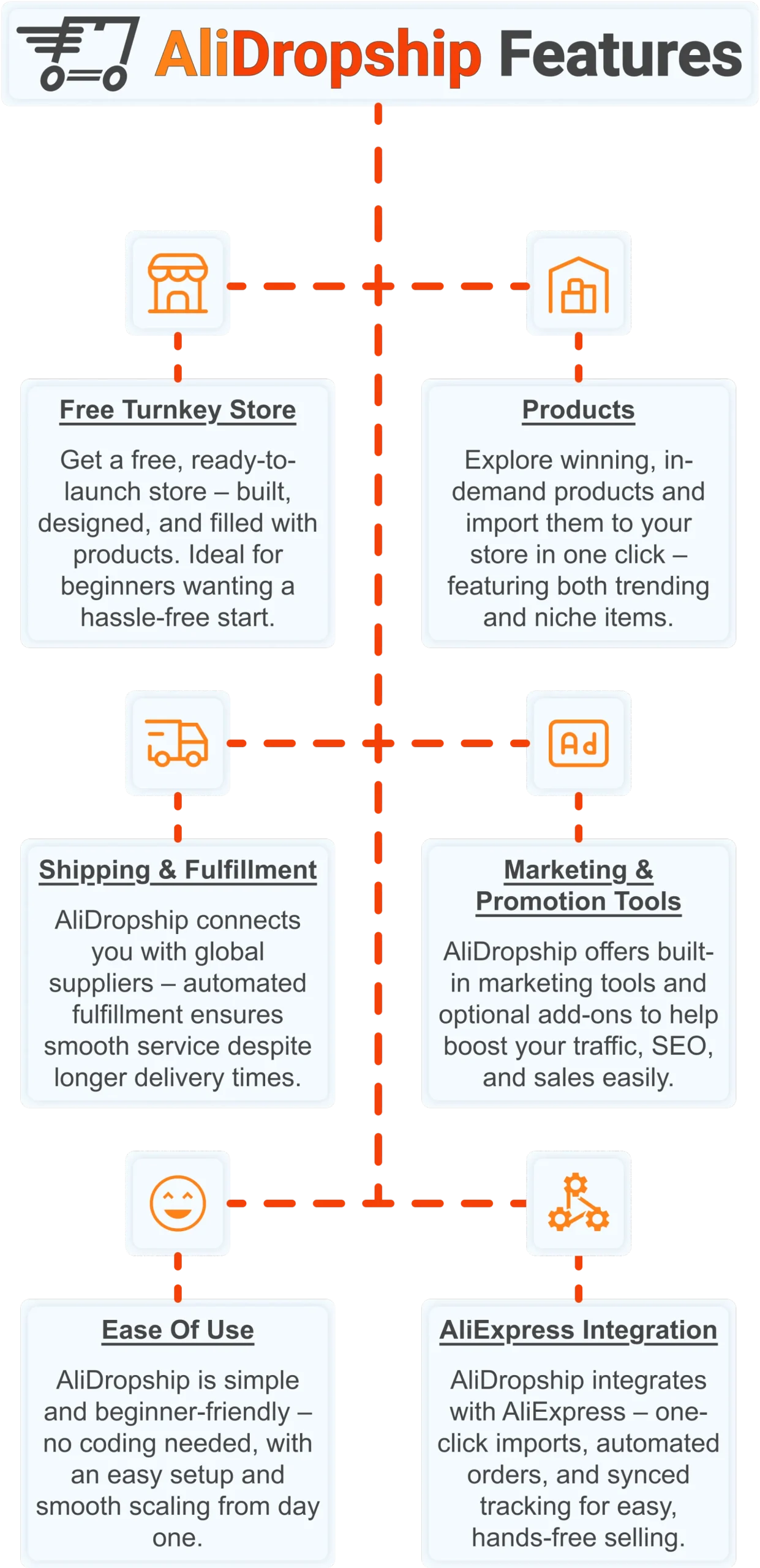
Free turnkey store ️
Get a free turnkey store – built, designed, and filled with products. Ideal for beginners wanting a hassle-free start, the store comes fully optimized to attract customers right away, saving you time on setup. Plus, it includes professional design elements to give your business a polished, trustworthy look from day one. This ready-made foundation makes it easy to move seamlessly into product selection.
Products
Once your store is set up, you can explore winning, in-demand products and import them in one click – featuring both trending and niche items. This wide selection lets you cater to diverse customer interests and test what works best. Regular updates ensure you always have fresh products, keeping your store competitive and relevant. With great products in place, smooth shipping becomes the next essential step.
Shipping & fulfillment
AliDropship connects you with global suppliers, and automated fulfillment ensures seamless order processing despite international delivery times. Customers receive real-time tracking updates, which builds confidence and trust in your store. Once shipping is handled reliably, you can focus on promoting your store and attracting traffic.
Marketing & promotion tools
To maximize sales, AliDropship offers built-in marketing tools and optional add-ons that help boost traffic, SEO, and conversions. From email campaigns and discounts to social media integration, these tools empower you to reach and retain customers without needing prior marketing experience. With promotion strategies in place, managing your business becomes simpler and more efficient.
Ease of use
AliDropship is beginner-friendly – no coding needed, with an intuitive dashboard that guides you through every step. Easy setup and smooth scaling let you expand your store without stress. As your business grows, adding new features, products, and marketing campaigns remains hassle-free, giving you more time to focus on sales.
AliExpress integration
Finally, AliDropship integrates seamlessly with AliExpress, enabling one-click imports, automated orders, and synced tracking. Your inventory stays up-to-date with the latest products and prices, while automated order processing frees you from manual tasks. Combined with the turnkey setup, reliable shipping, and built-in marketing tools, this integration ensures your dropshipping business is fully equipped for growth and success.
Frequently Asked Questions
What are the best free Shopify SEO tools for beginners?
Google Search Console is free and should be the first tool connected to any new Shopify store, showing indexing status and crawl errors. Plug In SEO offers a solid free tier that scans for missing meta titles, broken links, and duplicate content. Google Keyword Planner provides monthly search volume estimates and keyword ideas at zero cost. Ubersuggest offers a free tier covering keyword research, domain overviews, and basic backlink data for beginners.
How much does SEO Manager cost and what does it offer for Shopify stores?
SEO Manager starts at 20 per month and gives granular control over every on page SEO element in a store. It supports bulk meta tag editing, 301 redirect management, and JSON-LD schema for products and reviews. A built in Google Search Console integration pulls ranking data directly into the dashboard. The keyword tracking and structured data features can help stores move from page 2 to page 1 rankings, often doubling or tripling organic traffic for targeted terms.
How much do Ahrefs and Semrush cost for Shopify SEO research?
Ahrefs pricing starts at around 129 per month and is best suited to stores already generating reliable revenue. Semrush paid plans start at around 139 per month, with a free tier allowing a basic site audit and limited daily keyword searches. Shopify stores using Semrush content gap analysis report adding 2000 to 8000 organic monthly visitors within 90 to 180 days. Both platforms are considered advanced tools rather than starting points for brand new stores.
How long does it take to see results from Shopify SEO tools?
A brand new store targeting competitive keywords can take 60 to 90 days to see meaningful organic traffic. An established store with existing domain authority may see ranking gains within 2 to 4 weeks of fixing core on page issues. Fixing crawl errors and redirect chains typically produces 5 to 15 percent ranking improvements within 30 to 45 days. Stores acting on Plug In SEO flagged issues typically report a 10 to 25 percent improvement in organic click through rates within 60 days.
What technical SEO issues does Screaming Frog SEO Spider detect on Shopify stores?
Screaming Frog crawls a Shopify store the same way Googlebot does and surfaces duplicate page titles, missing H1 tags, and redirect chains. It also detects broken internal links and pages accidentally blocked from indexing. The free version handles up to 500 URLs, covering most small to medium Shopify stores. For larger catalogs, the paid version costs around 259 British pounds per year.
The right Shopify SEO tools can drive serious organic traffic – but you need a store built to convert it. Get your free turnkey store from AliDropship and start with a foundation ready to rank and earn.
 Previous post
