 ‧ Agnes Kazaryan ‧
March 13, 2026
‧ Agnes Kazaryan ‧
March 13, 2026  792 ‧
792 ‧
 0
0
Around 27% of online retailers now use dropshipping as their primary fulfillment model – and a large share of them started exactly where you are now: trying to figure out how dropshipping Shopify actually works.
Shopify has become the default starting point for new dropshippers because it combines a beginner-friendly store builder with a deep app ecosystem built specifically for selling products without holding inventory. Whether you want a few hundred dollars a month on the side or a full-time ecommerce income, this guide covers everything you need to make an informed start.
Quick Answer: Dropshipping on Shopify means you build an online store, list products from third-party suppliers, and when a customer orders, the supplier ships directly to them – you never touch the stock. Beginners can realistically earn $30–$100 per day within 60–90 days with consistent effort and smart product testing.
Before diving in, it is worth knowing that Shopify dropshipping is one of the most documented online business models in 2026 – which means there is a lot of noise alongside the genuinely useful guidance. This article cuts straight to what works, what to avoid, and how to match your approach to your actual goals.
What is dropshipping on Shopify?
Dropshipping is a retail fulfillment method where your store sells products you do not stock yourself. When a customer places an order, you forward it to a third-party supplier who ships the item directly to the buyer. Your profit is the margin between the retail price you set and the wholesale cost you pay the supplier. Shopify is the platform that hosts your storefront, processes payments, and connects with apps that automate the supplier side of the operation.
The combination works because Shopify was built with ecommerce entrepreneurs in mind. It handles the technical heavy lifting – hosting, checkout, payment processing, and order management – while apps like DSers or AutoDS connect your store to supplier catalogues on AliExpress and other sourcing platforms. You focus on choosing products, setting prices, and driving traffic. The supplier handles storage, packaging, and shipping.
In 2026, this model is still highly viable. The global dropshipping market continues to grow year on year, and Shopify’s ecosystem has matured significantly – setup is faster and more reliable than it has ever been. You do not need coding knowledge, a large upfront budget, or any logistics background to get a Shopify dropshipping store off the ground.
Why this works in 2026: Supplier networks on AliExpress and through fulfillment partners like CJDropshipping have expanded considerably, addressing faster delivery times – historically one of the biggest drawbacks of the model.
How much can you realistically earn with Shopify dropshipping?
Earnings vary widely depending on your niche, marketing budget, and the hours you put in. The table below gives an honest breakdown across different commitment levels.
These figures reflect reported earnings from Shopify merchant communities on Reddit and documented dropshipping case studies. Most beginners land in the first bracket during their first 60–90 days, then move upward as they identify winning products and tighten their ad performance.
One note on the upper figures: The $20,000+ per month range is real but uncommon. It typically requires paid advertising budgets of $2,000–$5,000 per month, strong product-market fit, and 6–12 months of consistent iteration. Do not treat it as a starting expectation – use it as a ceiling to work toward over time.
How to start dropshipping on Shopify: A step-by-step overview
Starting a Shopify dropshipping business does not require a large budget or any technical expertise. The process breaks down into five core stages that most beginners can work through over a focused weekend.
Step 1: Choose your niche
Your niche determines everything downstream – your supplier options, your ad targeting, and your customers’ willingness to pay. A solid dropshipping Shopify niche in 2026 has consistent demand, manageable competition, and products that support a healthy margin (aim for 30–50% profit after ad costs). Strong-performing categories right now include home improvement gadgets, pet accessories, compact fitness equipment, and personal care devices.
Use Google Trends, AliExpress bestseller lists, and communities like r/dropship on Reddit to validate demand before committing. A niche with 10,000–50,000 monthly searches and no dominant single-brand player is generally a solid starting point for a new Shopify dropshipping store.
Step 2: Set up your Shopify store
Shopify offers a free trial so you can build before spending anything. Paid plans start at around $25–$32 per month depending on your region. During setup you pick a theme, configure your domain, connect a payment gateway, and install the apps you need. Keep your initial store focused: one niche, a clean theme, and a clear homepage that communicates your value immediately.
Trying to sell everything to everyone from day one is one of the most consistent mistakes beginners make with dropshipping Shopify – it reliably leads to poor conversion rates and unfocused ad spend. Narrow your focus early, then expand once you have real traction.
Step 3: Find products and suppliers
Your supplier relationship is the backbone of the whole operation. For AliExpress dropshipping Shopify, the DSers app – Shopify’s official AliExpress partner – makes it easy to browse millions of products, check supplier ratings, and import listings directly to your store. Look for suppliers with 4.8-star ratings or higher, at least 500 completed orders on the specific product, and ePacket or AliExpress Standard Shipping availability to your target market.
Platforms like Spocket and Zendrop offer pre-vetted US and EU-based suppliers, which cuts delivery times significantly – an important factor if your customers are in North America or Europe and shipping speed is part of your proposition.
Step 4: Import products and optimize listings
Once you select products, import them to your Shopify store and rewrite the product descriptions. Supplier copy is almost always generic – custom descriptions improve SEO, build trust, and increase conversions. Add your own images where possible, or compress supplier photos for faster page load times. Pages that load in under 2 seconds convert at measurably higher rates than slower ones.
For pricing, a standard dropshipping Shopify formula is: supplier cost multiplied by 2.5 to 3.5, then adjusted against competitor pricing. Check what similar items sell for on Amazon and comparable Shopify stores before you finalize your price points.
Step 5: Drive traffic and make sales
No traffic means no sales. The two primary channels for a new Shopify dropshipping business are paid social advertising (Meta Ads and TikTok Ads) and organic content marketing (SEO blog content, TikTok product videos, and Pinterest). Most beginners start with a small paid budget of $10–$20 per day on Meta to test products quickly before scaling what works.
Organic traffic takes longer – typically 3–6 months to build meaningful SEO traction – but carries no ongoing cost once established. Combining both gives you short-term data from paid ads while building long-term traffic through content. The how-to-make-money-dropshipping equation almost always comes down to how well you manage this traffic balance over time.
Best dropshipping apps for Shopify in 2026
The app you use to connect your Shopify dropshipping store to suppliers affects your automation level, supplier quality, and how much manual work you handle daily. Here are the five most widely used and reviewed options available right now.
DSers
DSers is Shopify’s recommended app for AliExpress dropshipping and replaced Oberlo as the default solution. It supports bulk order processing, automatic supplier switching when a product goes out of stock, and one-click AliExpress imports. The free plan covers up to 3 stores and 3,000 products – more than enough for anyone launching their first Shopify dropshipping store.
Earning potential: $500–$3,000/month once a winning product is identified and ad performance stabilizes.
AutoDS
AutoDS is a more advanced automation platform that supports multiple supplier marketplaces beyond AliExpress, including Amazon, Walmart, and CJDropshipping. It handles automatic price and stock monitoring, order fulfillment, and includes an AI-powered product research tool. Pricing starts at around $26/month, making it one of the more affordable all-in-one options for a growing dropshipping business in 2026.
Earning potential: $1,500–$8,000/month for intermediate users running multiple stores with strong product-market fit.
Spocket
Spocket focuses on US and EU-based suppliers, with delivery times of 3–7 business days to North American and European customers – a meaningful advantage over standard AliExpress shipping windows. Products are generally higher quality and support premium pricing. Plans start at $39.99/month, which is worth it if faster shipping is a core part of your positioning.
Earning potential: $1,000–$5,000/month with premium product positioning and strong store branding.
Zendrop
Zendrop is built specifically for Shopify and offers a curated product catalogue, branded packaging options, and a dedicated US fulfillment center. Its free plan allows unlimited product imports, and the Pro plan at $49/month adds auto-fulfillment and custom branding. It is particularly popular among TikTok-focused dropshippers targeting US customers who expect fast shipping and a branded unboxing experience.
Earning potential: $800–$4,000/month once TikTok or Meta ad campaigns reach steady performance.
CJDropshipping
CJDropshipping is both a sourcing agent and a fulfillment platform. It handles product sourcing on request, maintains warehouses in multiple countries, and offers competitive wholesale pricing. The platform itself is free to use – you pay per order – which makes it a low-risk entry point for beginners who want to test new products without committing to a monthly subscription.
Earning potential: $600–$5,000/month for sellers with established traffic who use CJ’s pricing advantage to protect margins.
Each of these apps has trade-offs. The best choice depends on your target market, your budget, and how much hands-on management you want to handle day to day.
Tips to maximize your Shopify dropshipping earnings
Choosing a platform and finding products is only the beginning. What separates profitable Shopify dropshipping stores from abandoned ones is consistent optimization across a small number of high-impact areas.
Test multiple products before committing
Most experienced dropshippers recommend testing 5–10 products simultaneously with small daily budgets of $5–$10 per product before scaling anything. A product is worth scaling when it hits a ROAS (return on ad spend) of 2.0 or higher within the first 7 days of a Meta or TikTok campaign. Cut products that do not reach that threshold and reallocate budget to those that do. This iterative approach is how most successful Shopify dropshipping stores find their winning products.
Optimize your product pages for conversions
Your product page is your salesperson. High-converting pages share a few consistent traits: a clear benefit-focused title, 4–8 high-quality images, a short description that leads with benefits rather than specs, customer reviews above the fold, and a visible call to action without scrolling. Apps like Loox or Judge.me automate review collection from verified buyers and consistently lift conversion rates once installed.
Use abandoned cart recovery
Shopify’s built-in abandoned cart email feature recovers 5–15% of lost checkouts on average. Set up at least two follow-up emails: one sent 1 hour after abandonment and a second with a small discount (5–10%) sent 24 hours later. This single automation can add $200–$800/month to an active store at zero additional ad cost – arguably the highest-ROI optimization available to any Shopify dropshipping business.
Build an email list from day one
Email marketing delivers one of the best returns of any ecommerce channel – industry averages sit around $36 returned for every $1 spent. Use a pop-up offer (10% off the first order) to start capturing emails immediately. Klaviyo integrates directly with Shopify and supports automated flows for welcome sequences, post-purchase upsells, and win-back campaigns – all of which compound your revenue over time without extra ad spend.
Review supplier reliability regularly
Supplier stockouts and shipping delays are the most common causes of negative reviews in Shopify dropshipping. Check your active suppliers weekly, monitor tracking data for delivery time consistency, and always have a backup supplier identified for your top-selling products. Proactive fulfillment management is what allows stores to maintain strong Trustpilot ratings – which drives repeat purchases and word-of-mouth.
Legal and ethical considerations for Shopify dropshipping
Running a legitimate dropshipping Shopify business means staying within consumer protection laws, platform policies, and supplier agreements. These are not optional extras – they are the foundation of a store that lasts.
What to avoid absolutely
Important: Selling branded or trademarked products (Nike, Apple, Supreme, and similar) without authorization is trademark infringement – not just a policy violation. Shopify can permanently close your store and you may face legal liability. Only source products from suppliers who confirm the goods are unbranded or carry legitimate licensing documentation.
Fake reviews are another serious risk. Shopify’s policies explicitly prohibit review manipulation, and platforms like Trustpilot actively investigate and remove fabricated testimonials. Beyond platform risk, fake reviews damage customer trust when discovered – and they get discovered more often than sellers expect.
Misleading delivery time claims are among the most common sources of chargebacks in dropshipping Shopify stores. If a customer orders expecting 5-day delivery and receives their package in 25 days, disputes follow. Always display honest estimated delivery windows on product pages – customers who know what to expect are far more tolerant than those who feel misled.
What to do instead
Source only unbranded or white-label products, or work exclusively with suppliers who provide proof of brand authorization. Display accurate shipping estimates prominently on product pages and in your order confirmation emails. Respond to customer service inquiries within 24 hours – this single habit prevents most disputes from escalating to chargebacks or platform complaints.
Key principle: A dropshipping business built on honest product representation and reliable fulfillment outperforms any grey-area shortcut within 6 months – and it builds equity instead of risk.
How to choose your approach: Final thoughts by reader profile
Not everyone comes to Shopify dropshipping with the same goals or starting resources. Here is a practical breakdown of where to focus based on where you are right now.
Complete beginner: Start simple – one niche, one supplier platform (DSers and AliExpress), and a Shopify free trial. Spend your first 30 days on product research and store setup before running any paid ads. Once your store is live, test with $5–$10 per day on Meta to gather data. Do not expect profitability before day 45–60. The goal in the first two months is learning the system – treat every dollar spent as tuition with data as the return.
Intermediate / part-time: If you have some ecommerce experience, your priority is scaling what already works. Identify your top 2–3 performing products, increase ad spend to $30–$50 per day on those winners, and introduce email automation through Klaviyo. Consider switching to Spocket or Zendrop if your current supplier shipping times are hurting conversions. A realistic target for this stage is $1,000–$2,500 per month within 90 days of focused effort.
Advanced / full-time goal: If your aim is a full-time Shopify dropshipping income, treat it like a business from day one. That means a dedicated monthly ad budget of $1,500–$3,000, a virtual assistant handling customer service, and a data-driven product testing system with clear cut-off rules. Once you hit consistent monthly revenue, consider white-labeling your top products to protect margins and build a brand that is genuinely harder to copy.
The dropshipping Shopify landscape in 2026 is competitive but far from saturated in well-selected niches. Suppliers are faster, Shopify’s tools are more powerful, and the data available to new sellers – through TikTok trends, Google Trends, and Reddit communities – makes informed product decisions more accessible than ever before.
AliDropship: Your complete all-in-one solution for starting dropshipping in 2026
If you want the simplest possible way to start dropshipping – especially if you’re brand new – AliDropship remains one of the most beginner-friendly tools available in 2026. It brings together store creation, product imports, automation, and marketing into a single streamlined system designed to help you launch quickly and grow confidently.
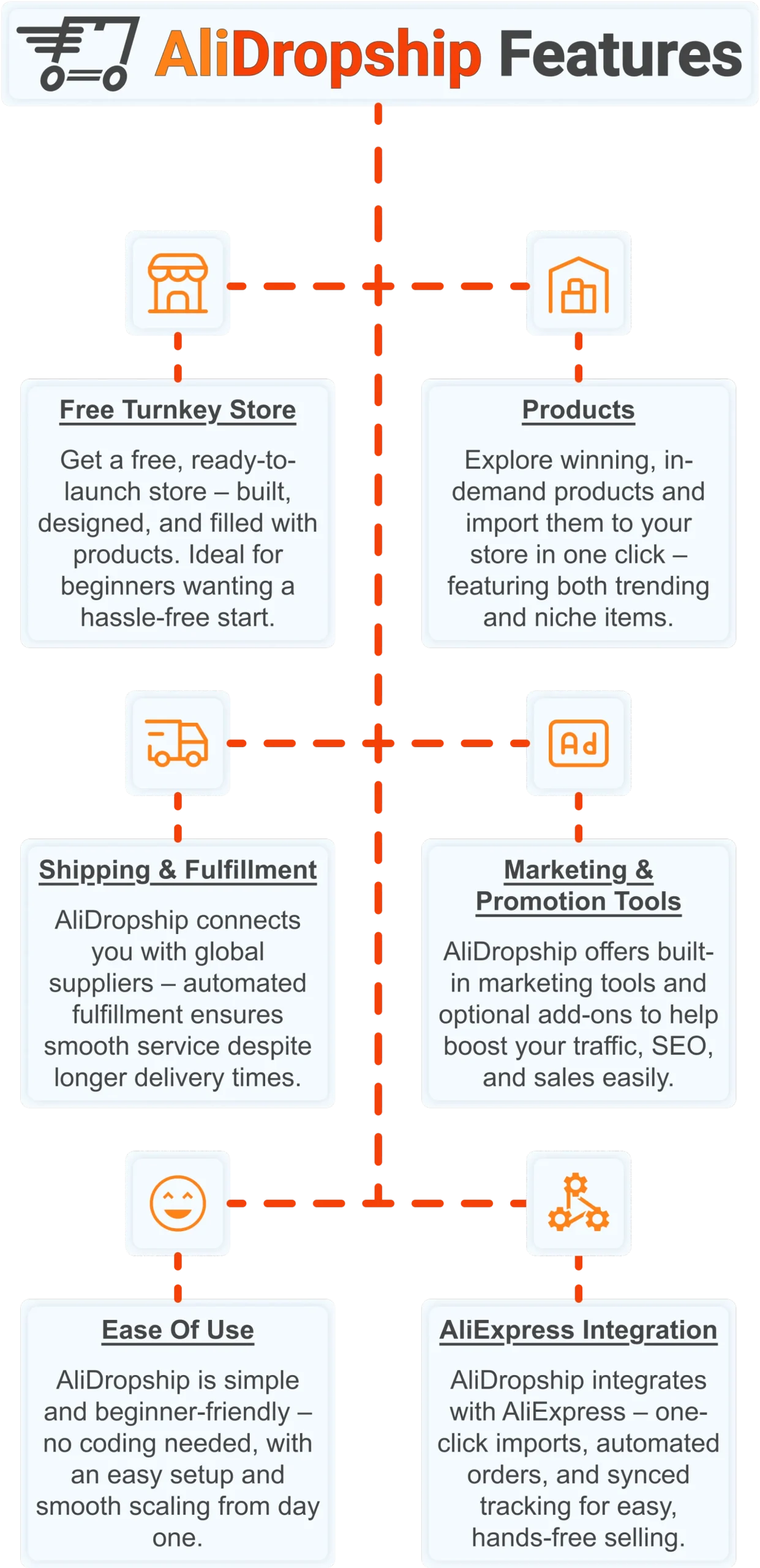
Free turnkey store ️
Get a free turnkey store – built, designed, and filled with products. Ideal for beginners wanting a hassle-free start, the store comes fully optimized to attract customers right away, saving you time on setup. Plus, it includes professional design elements to give your business a polished, trustworthy look from day one. This ready-made foundation makes it easy to move seamlessly into product selection.
Products
Once your store is set up, you can explore winning, in-demand products and import them in one click – featuring both trending and niche items. This wide selection lets you cater to diverse customer interests and test what works best. Regular updates ensure you always have fresh products, keeping your store competitive and relevant. With great products in place, smooth shipping becomes the next essential step.
Shipping & fulfillment
AliDropship connects you with global suppliers, and automated fulfillment ensures seamless order processing despite international delivery times. Customers receive real-time tracking updates, which builds confidence and trust in your store. Once shipping is handled reliably, you can focus on promoting your store and attracting traffic.
Marketing & promotion tools
To maximize sales, AliDropship offers built-in marketing tools and optional add-ons that help boost traffic, SEO, and conversions. From email campaigns and discounts to social media integration, these tools empower you to reach and retain customers without needing prior marketing experience. With promotion strategies in place, managing your business becomes simpler and more efficient.
Ease of use
AliDropship is beginner-friendly – no coding needed, with an intuitive dashboard that guides you through every step. Easy setup and smooth scaling let you expand your store without stress. As your business grows, adding new features, products, and marketing campaigns remains hassle-free, giving you more time to focus on sales.
AliExpress integration
Finally, AliDropship integrates seamlessly with AliExpress, enabling one-click imports, automated orders, and synced tracking. Your inventory stays up-to-date with the latest products and prices, while automated order processing frees you from manual tasks. Combined with the turnkey setup, reliable shipping, and built-in marketing tools, this integration ensures your dropshipping business is fully equipped for growth and success.
Frequently Asked Questions
How much does a Shopify subscription cost compared to Etsy listing fees?
Shopify plans start at 39 per month for the Basic plan, covering unlimited products and a custom domain connection. Etsy charges 0.20 per listing, renewing every four months, with no monthly subscription fee required. At 500 per month or less in sales, Etsy can be cheaper since there is no subscription fee to cover. Once a seller crosses 1000 per month in sales, the Shopify fixed cost model becomes considerably more efficient.
What percentage of each sale does Etsy take in fees?
Etsy takes a 6.5 percent transaction fee on every sale, applied to both the item price and shipping cost charged. Payment processing adds approximately 3 percent plus 0.25 per transaction on top of that fee. On a 50 sale, Etsy takes roughly 3.25 in transaction fees plus 1.75 in processing, about 10 percent of revenue before advertising spend. At 1000 per month in Etsy revenue, expect 65 to 100 in platform fees before any ad spend.
Is Shopify or Etsy better suited for a dropshipping business?
Shopify is the clear choice for dropshipping since it integrates with tools like AliDropship, DSers, and AutoDS for automated order fulfillment. Etsy prohibits the resale of mass produced goods unless production partners are fully disclosed, and standard dropshipping typically violates its handmade and original goods policy. There are no restrictions on product type or supplier origin on Shopify. Building a scalable dropshipping business on Etsy is not considered a viable long term path.
How much traffic does Etsy bring compared to a new Shopify store?
Etsy attracts roughly 90 million active buyers to the platform, giving new listings a chance to surface without any ad spend. Shopify gives sellers zero built in traffic, meaning visibility depends entirely on the sellers own marketing through SEO, social media, or paid ads. Popular Etsy categories are heavily saturated, so reaching page one visibility typically requires strong keyword optimization and sales momentum. Most sellers on either platform reach consistent monthly income after 60 to 90 days of active effort.
How much can a seller realistically earn on Shopify versus Etsy per month?
Etsy handmade or niche sellers typically earn 200 to 800 per month with medium effort. Shopify dropshipping sellers typically earn 1000 to 5000 per month with medium to high effort. Etsy print on demand sellers tend to earn less, around 100 to 400 per month. For most new sellers on either platform, a realistic first target is 30 to 80 per day in gross sales during the first 30 to 60 days.
If you are ready to turn everything in this guide into a real dropshipping Shopify business, AliDropship gives you the fastest path to your first sale. Claim your free store and start building your ecommerce income today.
 Previous post
