 ‧ Agnes Kazaryan ‧
March 15, 2026
‧ Agnes Kazaryan ‧
March 15, 2026  527 ‧
527 ‧
 0
0
The e-learning market is on track to reach $764 billion by 2030 – and in 2026, it is already one of the most accessible ways to earn income online. Thousands of people are turning their expertise into courses every month. So if you have been wondering how to create an online course, you are asking the right question at exactly the right time.
Quick answer: To create an online course, you need to pick a profitable topic, validate demand, build a curriculum, record your content, choose a hosting platform, and market it consistently. Most first-time creators go from idea to launch in 4–8 weeks.
But here is the honest part: not everyone who starts ends up making real money. The process takes more time, effort, and audience-building than most tutorials admit. This guide walks you through every step clearly – and also shows you a faster alternative if building a course from scratch sounds like too much work right now.
What is an online course and why does it matter in 2026?
An online course is a structured digital learning experience – usually a series of video lessons, written modules, quizzes, or a combination – designed to take a student from point A to point B on a specific topic. Unlike a blog post or a YouTube video, a course delivers a defined transformation with a beginning, middle, and end. You pay for the outcome, not just the information.
In 2026, online courses matter for one clear reason: the creator economy is mature. Students are used to paying for quality learning online. Platforms like Udemy, Thinkific, Kajabi, and Teachable have normalized buying a course the same way you would buy a book. The barrier to publishing has dropped dramatically – you do not need a studio, a publisher, or a teaching degree to get started.
What you do need is a clear topic, genuine experience or expertise, and the willingness to market your work consistently. If you have all three, course creation is genuinely within reach. If any one of those three is missing, the results will be much harder to predict.
How much can you realistically earn from an online course?
The range is enormous, and that is the honest truth. Some creators earn nothing in their first year. Others clear six figures in twelve months. The difference usually comes down to niche, audience size, pricing, and how aggressively they market.
Most successful course creators settle into the $1,000–$10,000/month range once they find their rhythm. Getting there typically takes 6–18 months of consistent audience-building, content updates, and marketing investment.
One note on the ceiling figures: The seven-figure stories you see online almost always involve creators who already had large email lists, YouTube channels, or social followings before they launched. Starting from zero adds 6–12 months of audience-building to your timeline before course revenue becomes meaningful. Full-time effort means 30–40 hours per week across content creation, marketing, community management, and course updates.
How to create an online course: Step by step
Here is the full process, broken into the stages every successful course creator goes through – from idea validation all the way to your first paying students.
Step 1 – Choose a profitable topic
Your course topic needs to solve a specific, painful problem for a defined group of people. “Marketing” is too broad. “How to run Facebook ads for local restaurants” is the right level of specificity. The narrower you go, the easier it is to find your audience, write sales copy, and price your course with confidence.
To validate demand before you invest weeks of work, check three signals. First, search your topic on Udemy and Coursera – if similar courses exist with high ratings and thousands of students, demand is already proven. Second, look at Reddit communities and Facebook groups in your niche and notice which questions get asked repeatedly. Third, use free tools like Google Trends or the Google Keyword Planner to confirm that people are actively searching for solutions in your space.
Why this works in 2026: The creator economy has matured to the point where a niche audience with a real problem is more valuable than a broad audience with casual interest. Specificity converts.
Step 2 – Define your learning outcome
Before you outline a single lesson, write down the exact transformation your student will experience. “By the end of this course, you will be able to [specific outcome].” That one sentence becomes your sales hook, your marketing copy, and your curriculum compass.
A course without a clear outcome is just content. Students pay for transformation, not information. If you cannot articulate what they will be able to do after completing your course, you have not narrowed your topic enough yet.
Step 3 – Outline your curriculum
Structure your course as 4–6 modules, each covering one major concept that builds on the previous one. Within each module, plan 3–6 lessons of roughly 8–12 minutes each. This keeps students moving forward without overwhelming them.
Map the learner journey from problem to solution in a straight line. Each lesson should advance that journey by exactly one step. Avoid side trips into tangentially related topics – save those for bonus content or a follow-up course. The cleaner your throughline, the better your completion rate. And completion rate directly drives reviews and word-of-mouth referrals.
Step 4 – Record and produce your content
You do not need a professional studio to create an online course that sells. A quiet room, a decent USB microphone, a ring light, and screen recording software is enough for most topics. Audio quality matters more than video quality – students will tolerate average visuals, but they will abandon a course immediately if the audio is hard to follow.
Keep lessons short and focused. Research consistently shows that lesson completion drops sharply when individual videos exceed 12–15 minutes. Record in batches to maintain consistent energy, and edit out long pauses rather than obsessing over perfect takes. For screen-based courses on software, design, or coding, free tools like Loom, Camtasia, or OBS Studio let you record your screen and camera simultaneously. For talking-head lessons, a ring light in front of a clean wall or bookshelf is all you need.
Step 5 – Choose the right course platform
Where you host your course shapes your revenue model, your student relationships, and how much of each sale you keep. There are three broad categories worth knowing.
Course marketplaces (Udemy, Skillshare)
These platforms bring built-in traffic, which is their biggest advantage. On Udemy, you can launch and immediately reach millions of potential students searching for your topic. The trade-off: Udemy takes up to 63% of revenue from marketplace sales, and pricing is largely controlled by the platform’s frequent discount events, which drive down perceived value over time. These platforms work best as a starting point to collect reviews and validate demand – not as a long-term revenue strategy.
Standalone course platforms (Thinkific, Teachable, Kajabi)
These give you full control over pricing, branding, and student relationships. You keep the majority of revenue – typically 97% or more after payment processing fees. The trade-off is that you are entirely responsible for driving your own traffic. Thinkific and Teachable are solid starting points for most creators. Kajabi adds more robust email marketing and community features at a higher monthly price, starting around $69–$149/month.
Self-hosted (WordPress + LearnDash)
Maximum flexibility and no platform fees, but requires more technical setup. Best suited for creators who already have a WordPress site and want to keep everything under one roof for the long term.
Step 6 – Price your course strategically
Most new creators underprice. The instinct is to start low to attract students, but low pricing signals low value and attracts less committed buyers – who also tend to have higher refund rates and lower completion rates.
A better approach: price based on the transformation you deliver, not the hours of content you include. A 2-hour course that helps someone land a $60,000 job is worth $500. A 10-hour course teaching hobby photography has a much lower ceiling. Effective price points for self-hosted courses in 2026 are $97–$297 for introductory courses and $497–$1,997 for flagship or advanced programs.
Earning potential: $1,000–$10,000/month with a validated audience, consistent marketing, and a course priced at $197 or above.
Step 7 – Build your audience before you launch
This is the step most new course creators skip – and it is the main reason first launches underperform. A course without an audience is a product without a store. The content exists, but no one finds it.
Start building your audience at least 60–90 days before your planned launch date. The most reliable channels in 2026 are an email list (still the highest-converting channel for digital products), a YouTube channel or podcast for organic discovery, and a focused presence on whichever social platform your target audience uses most. An email list of even 500 engaged subscribers can generate a meaningful first launch. A warm list of 2,000–5,000 subscribers gives you a serious shot at a $10,000–$30,000 launch in a well-priced niche.
Step 8 – Launch and market consistently
A launch is not a one-time event. Treat it as the first cycle of an ongoing marketing rhythm. A basic launch sequence includes a pre-launch phase (email warm-up, social content teasing the topic, a free lead magnet or webinar), an open-cart phase (3–7 days with urgency-based messaging), and a post-launch phase (follow-up emails to non-buyers and testimonial collection from early students).
After the initial launch, set your course to evergreen – meaning it stays open for enrollment year-round, supported by automated email sequences and consistent content marketing. The most successful course creators treat their course as a living product: they update it regularly, respond to student questions, and run a fresh launch every quarter to bring in new students.
Comparing the main course platforms
Choosing your platform early locks in your technical workflow, so think about where you want to be in 12–24 months – not just where it is easiest to start today. Switching platforms later means migrating students, rebuilding course pages, and updating all your marketing links.
Tips for selling more courses
Validate before you build
Run a presale or a live cohort before you record a single video. If people pay in advance, demand is confirmed. If they do not, you have saved weeks of production time. Presales at 50–70% of your full price are a standard validation tactic used by experienced course creators across all niches.
Use testimonials strategically
Social proof drives course sales more than almost any other factor. Invite your first 10–20 students to join at a steep discount in exchange for honest testimonials and case study interviews. Video testimonials convert especially well on sales pages. Place the most specific, results-driven testimonials near your pricing section, where purchase intent is highest.
Build an email list from day one
Email marketing consistently outperforms social media for course sales, with conversion rates typically 3–5 times higher than cold social traffic. Offer a free resource directly related to your course topic – a checklist, a mini video, a PDF guide – in exchange for sign-ups. Every email address you collect before your launch is worth significantly more than a social media follower.
Price anchor with tiers
Offering two or three pricing tiers – for example, self-paced access, self-paced plus workbooks, and self-paced plus live Q&A sessions – increases average order value dramatically. Most buyers gravitate toward the middle option when three tiers are presented. This is a well-documented principle in pricing psychology and it works consistently in the online course market.
Update your course regularly
Courses updated in the past six months earn significantly more on average than outdated ones. Even small updates – a new lesson, a refreshed module with current examples, a new intro video – signal to both the platform algorithm and prospective students that the course is actively maintained. Schedule a quarterly content review from day one and stick to it.
Legal and ethical considerations when creating an online course
Course creation comes with responsibilities that do not always get discussed in how-to guides. Here is what to take seriously before you launch.
Key principle: Only teach what you can genuinely deliver – misrepresenting your credentials or overpromising results is both ethically wrong and legally risky.
Income disclaimers are non-negotiable for any course that touches on earning money. If your course teaches business, investing, freelancing, or any income-related skill, include a clear disclaimer on your sales page stating that results vary and that past earnings shown are not typical. Failing to do so exposes you to consumer protection complaints and, in some jurisdictions, regulatory scrutiny.
Copyright is a real issue for course creators. Never use music, images, or video clips without a proper license. Free resources like Unsplash (images), Pixabay (video), and Epidemic Sound (music) exist specifically for this purpose. Using copyrighted material in a paid product – even a short clip – creates liability that is not worth the risk.
Refund policies protect both you and your students. Most successful platforms recommend a 14–30 day satisfaction guarantee. It reduces buyer hesitation, increases sales, and – done right – actually lowers refund rates because students who feel secure are more likely to engage with the content rather than abandon it early.
Finally, if you collect student data – emails, payment information, usage data – you are subject to data protection laws in your students’ jurisdictions. GDPR (EU) and CCPA (California) require a privacy policy, secure data handling, and clear student rights over their information. Platforms like Thinkific and Kajabi handle much of the technical compliance, but the legal responsibility remains yours.
Which approach is right for you?
The honest answer depends entirely on where you are right now and what you are optimizing for.
Complete beginner
If you have no existing audience, no email list, and no experience with digital products, profitably selling an online course is a 12–18 month project at minimum. The work is real and rewarding if you are passionate about your topic – but do not expect fast income. A better short-term move may be to build your audience first through free content, then launch a course once you have at least 500–1,000 engaged followers behind you.
Intermediate creator (some audience, some experience)
If you already have an email list, a social following, or an existing client base, an online course is a logical next step. You have the audience validation that most beginners lack. Focus on pricing confidently, building a tight sales funnel, and investing in good audio for your recordings. A first launch with a warm audience of 1,000 subscribers at a $297 price point can realistically generate $3,000–$10,000.
Advanced / full-time goal
If you want course creation to be your primary income source, treat it as a business from day one. That means a content marketing strategy, a professional sales page, an automated email funnel, a community component (Discord, Slack, or a private forum), and a reinvestment plan for paid advertising as your revenue grows. Creators who reach $10,000+/month consistently combine great content with systematic marketing – not one or the other.
People who want digital income without creating a course
Creating a course requires expertise, equipment, recording time, editing, platform fees, marketing, and constant updates. If you want to sell digital products and earn online without building a course from scratch, there is a more direct path. AliDropship gives you a ready-made library of digital products to sell under your own brand – no recording, no curriculum design, no ongoing platform subscriptions. It is a different model, but it delivers digital product income with a fraction of the setup time.
AliDropship: Your complete all-in-one solution for starting dropshipping in 2026
If you want the simplest possible way to start dropshipping – especially if you’re brand new – AliDropship remains one of the most beginner-friendly tools available in 2026. It brings together store creation, product imports, automation, and marketing into a single streamlined system designed to help you launch quickly and grow confidently.
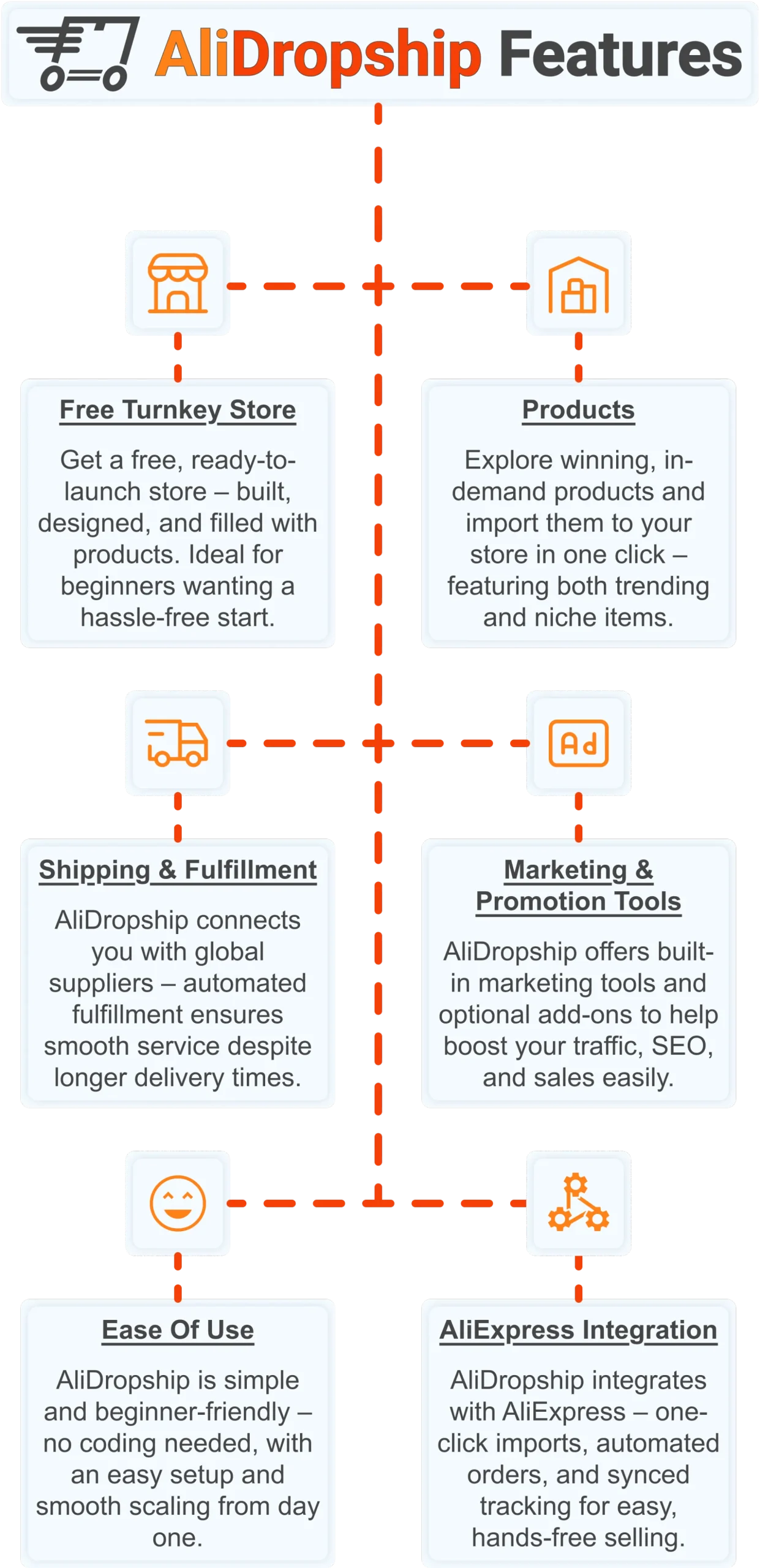
Free turnkey store ️
Get a free turnkey store – built, designed, and filled with products. Ideal for beginners wanting a hassle-free start, the store comes fully optimized to attract customers right away, saving you time on setup. Plus, it includes professional design elements to give your business a polished, trustworthy look from day one. This ready-made foundation makes it easy to move seamlessly into product selection.
Products
Once your store is set up, you can explore winning, in-demand products and import them in one click – featuring both trending and niche items. This wide selection lets you cater to diverse customer interests and test what works best. Regular updates ensure you always have fresh products, keeping your store competitive and relevant. With great products in place, smooth shipping becomes the next essential step.
Shipping & fulfillment
AliDropship connects you with global suppliers, and automated fulfillment ensures seamless order processing despite international delivery times. Customers receive real-time tracking updates, which builds confidence and trust in your store. Once shipping is handled reliably, you can focus on promoting your store and attracting traffic.
Marketing & promotion tools
To maximize sales, AliDropship offers built-in marketing tools and optional add-ons that help boost traffic, SEO, and conversions. From email campaigns and discounts to social media integration, these tools empower you to reach and retain customers without needing prior marketing experience. With promotion strategies in place, managing your business becomes simpler and more efficient.
Ease of use
AliDropship is beginner-friendly – no coding needed, with an intuitive dashboard that guides you through every step. Easy setup and smooth scaling let you expand your store without stress. As your business grows, adding new features, products, and marketing campaigns remains hassle-free, giving you more time to focus on sales.
AliExpress integration
Finally, AliDropship integrates seamlessly with AliExpress, enabling one-click imports, automated orders, and synced tracking. Your inventory stays up-to-date with the latest products and prices, while automated order processing frees you from manual tasks. Combined with the turnkey setup, reliable shipping, and built-in marketing tools, this integration ensures your dropshipping business is fully equipped for growth and success.
If learning how to create an online course made you realize you want digital income without months of content production, AliDropship is built exactly for that. Get your free store and a $100 gift voucher to start selling today.
Frequently Asked Questions
How long does it take to create an online course and launch it?
Most first time creators go from idea to launch in 4 to 8 weeks when following a structured process. This includes choosing a topic, outlining a curriculum of 4 to 6 modules, recording content, and selecting a hosting platform. Building an audience beforehand is recommended to start at least 60 to 90 days before the planned launch date. Skipping audience building is the main reason many first launches underperform despite good course content.
How much money can you make creating an online course?
Earnings vary enormously depending on niche, audience size, and pricing strategy. New creators with no existing audience typically earn 0 to 500 per month in their first few months, while mid-level creators with a small audience can reach 1,000 to 5,000 per month. Established creators with a large following can generate 10,000 to 50,000 or more per month once trust and reach are already built. Most successful creators eventually settle into the 1,000 to 10,000 per month range after 6 to 18 months of consistent effort.
Which platform should you use to host an online course?
Course marketplaces like Udemy offer built in traffic but take up to 63 percent of revenue from marketplace sales. Standalone platforms such as Thinkific, Teachable, and Kajabi let creators keep around 97 percent of revenue after payment processing fees. Kajabi adds more advanced email marketing and community features starting around 69 to 149 per month. Self hosted setups using WordPress and LearnDash offer close to 99 percent revenue retention but require more technical setup.
How should you price an online course?
Pricing should reflect the transformation delivered rather than simply the number of hours of content included. Effective price points for self hosted introductory courses in 2026 range from 97 to 297, while flagship or advanced programs often sell for 497 to 1,997. A course priced at 197 or above paired with a validated audience and consistent marketing can generate 1,000 to 10,000 per month. Offering two or three pricing tiers also increases average order value, since most buyers gravitate toward the middle option.
What legal considerations apply when creating and selling an online course?
Courses that touch on earning money must include a clear income disclaimer stating that results vary and past earnings are not typical. Using copyrighted music, images, or video clips without a proper license creates real legal liability, even for short clips in a paid product. Refund policies of 14 to 30 days are recommended by most successful platforms, since they reduce buyer hesitation and can actually lower refund rates. Collecting student data also triggers obligations under GDPR in the European Union and CCPA in California, including a privacy policy and secure data handling.
 Previous post
