 ‧ Agnes Kazaryan ‧
March 17, 2026
‧ Agnes Kazaryan ‧
March 17, 2026  974 ‧
974 ‧
 0
0
The phrase “AI business” is everywhere right now. But most of the content out there is either vague hype or a list of side hustles that top out at pocket money. If you want to know which AI business models actually generate meaningful income in 2026 – and what it realistically takes to get there – this guide gives you a straight answer.
Quick Answer: An AI business is any model that uses artificial intelligence tools to automate operations, create products, or deliver services for paying customers. In 2026, the most accessible AI business ideas include AI-powered dropshipping, digital product creation, content services, and prompt engineering – most of which can be started with little to no upfront cost.
Whether you are starting from zero or adding a new income stream, the models below are ranked by realistic accessibility and earning potential – not by what sounds impressive on a YouTube thumbnail.
What is an AI business?
An AI business is any business that uses artificial intelligence as a core part of how it runs, creates value, or delivers its product. That can mean using ChatGPT to write product descriptions at scale, using Midjourney to create digital assets, using AI chatbots to handle customer service, or using an AI-powered platform to automate an entire ecommerce operation.
What makes 2026 different is accessibility. Three years ago, running an AI-powered business required at least some technical background. Today, tools like ChatGPT, Claude, and purpose-built platforms like AliDropship have made it possible for non-technical people to launch, automate, and scale businesses that previously needed a full team.
The most important shift is this: AI is no longer infrastructure for tech companies. It is practical business leverage for freelancers, solopreneurs, and small ecommerce operators. If you can direct AI tools effectively and pair them with a solid monetization strategy, you have a real business on your hands – not just a side project.
How much can you realistically earn from an AI business?
Earning potential varies a lot depending on the model, your effort level, and how fast you learn. Here is an honest breakdown of the most common AI business types and what real operators report earning.
These figures reflect what independent operators are reporting in communities like Reddit’s r/dropshipping and r/Entrepreneur as of 2026. The lower end is realistic for someone in their first 60–90 days with part-time effort. The upper end typically requires at least 6 months of consistent work, product-market fit, and reinvestment.
One note on the ceiling figures: The $5,000+ monthly numbers for AI ecommerce are achievable but not typical for beginners in their first quarter. Most new operators land in the $300–$800/month range before scaling. Full-time focus, smart product selection, and reinvesting early profits are what move the needle.
The best AI business ideas to start in 2026
Not all AI business ideas are equal. Some require technical skills most people do not have. Others have low earning ceilings. The models below combine genuine income potential with a realistic launch path for someone starting today.
AI-powered ecommerce and dropshipping
AI-powered ecommerce is the most scalable AI business model available in 2026 for people without a technical background. The core idea is simple: use AI tools to automate product research, listing copy, SEO descriptions, customer emails, and ad creative – then run all of that through a dropshipping store that processes orders automatically.
How AI changes the ecommerce game
Traditional dropshipping required hours of manual product research and writing descriptions from scratch. AI eliminates most of that friction. ChatGPT can generate dozens of product descriptions in minutes. AI research tools surface winning products based on trend data and sales velocity. Platforms like AliDropship embed automation at every level – from one-click product imports to automated order fulfillment.
The result is that a single operator can manage a store that, in 2020, would have needed a small team. That is a genuine structural advantage for anyone launching an AI business today.
How to get started with AI ecommerce
Start by choosing a niche with consistent demand – health, home improvement, pets, and outdoor gear are perennial performers. Use AI tools to validate product ideas against search trends before committing. Then set up your store on a platform that automates the operational side, so your time goes toward marketing and scaling rather than manual admin.
Earning potential: $500–$5,000+ per month after 60–90 days of consistent effort, depending on niche and marketing investment.
What AI tools to use
For product copy, ChatGPT and Claude handle descriptions, email sequences, and ad copy well. For visuals, Midjourney and Adobe Firefly can enhance supplier images or generate lifestyle shots. For SEO, tools like Surfer SEO help you optimize listings and blog content to drive organic traffic over time.
AI content creation services
Businesses across every industry need more content than they can produce in-house – blog posts, social media copy, email newsletters, product descriptions, video scripts. AI has made it possible for one person to produce that volume at a quality level clients will pay for.
What this looks like in practice
You position yourself as an AI-assisted content strategist or copywriter. You use tools like ChatGPT, Jasper, or Claude to produce first drafts quickly, then apply your own editing and strategic judgment to deliver work that feels human, on-brand, and conversion-focused. Clients pay for your output and expertise – not for the fact that you used AI to produce it faster.
How to find clients
Start with Upwork, Contra, and LinkedIn. Build a portfolio of 5–10 sample pieces in different formats: a blog post, a product description set, an email sequence, a landing page. Specialize early – content for SaaS companies, ecommerce brands, or local service businesses generates more consistent work than pitching everyone.
Earning potential: $300–$2,000/month for part-time operators; $3,000–$6,000 for those running it as a full-time client business with retainers.
Selling AI-generated digital products
Digital products are one of the most attractive AI business models because of the economics: create once, sell infinitely, with zero fulfillment cost. AI makes the creation process dramatically faster and cheaper than it used to be.
What sells well
AI-generated digital products with consistent buyer demand include prompt packs for popular AI tools, editable Canva and Notion templates, niche-specific ebooks and guides, AI-designed printables like planners and wall art, and business document templates. Platforms like Etsy, Gumroad, and Creative Market are proven distribution channels for these products.
How to get started
Identify a specific audience – teachers, fitness coaches, real estate agents, small business owners – and create a set of 10–20 digital products tailored to their workflow or goals. Use AI to generate the content, Canva for design and formatting, and Gumroad or Etsy to handle payments and delivery automatically.
Earning potential: $100–$1,500/month for a focused digital product shop with consistent new listings; scalable beyond that with advertising and SEO.
One thing to watch out for
Platform policies on AI-generated content change frequently. Etsy, for example, requires sellers to disclose AI use in listings. Always check current marketplace rules before listing, and focus on adding genuine value through curation, customization, or specialized knowledge – rather than bulk-generating generic products.
AI prompt engineering and consulting
Prompt engineering has become a genuine service category. Businesses that have adopted AI tools often struggle to get consistently useful outputs from them. A skilled prompt engineer solves that by building prompt libraries, workflow documentation, and AI integration strategies tailored to a specific business.
Who buys this service
Marketing teams that want reliable AI-generated copy. Customer service departments building chatbot scripts. HR teams using AI to draft job descriptions and onboarding materials. Any company that has deployed an AI tool and is not getting the results they expected is a potential client.
How to position yourself
Specialize by industry rather than by AI tool. An AI consultant for real estate agencies or for ecommerce brands is far easier to market than a general “AI consultant.” Build case studies – even from your own projects or pro bono work – that show measurable improvements in output quality or time savings.
Earning potential: $500–$3,000/month for part-time consulting; project rates of $500–$2,000 per engagement for prompt library builds and AI workflow audits.
AI chatbot development for small businesses
Small businesses – restaurants, salons, real estate agencies, dental practices – increasingly want AI chatbots to handle appointment booking, FAQs, and lead capture without paying for a full-time receptionist. Platforms like ManyChat, Tidio, and Botpress have made building these chatbots accessible without needing to write code.
How to get started without coding
Learn one no-code chatbot platform thoroughly. Build a few demo chatbots for common small business use cases – appointment booking, lead qualification, FAQ handling. Offer your first 2–3 clients a discounted rate in exchange for a testimonial and case study. Then package your service as a fixed-price offer: a complete chatbot setup plus 30 days of support for a flat fee.
Earning potential: $1,000–$8,000/month for operators with 5–10 active clients on monthly maintenance retainers, once a client base is established.
Comparing AI business models: which is right for you?
Every model has trade-offs. Here is a direct comparison to help you identify the best fit based on your starting point and goals.
For true scalability with the least ongoing time commitment, AI ecommerce and digital products lead the pack. Service models like content creation and chatbot development offer faster first income but require continued client work to sustain revenue. The smartest long-term play is often to start with a service model to generate early cash flow, then reinvest that into building a scalable product or store.
Tips for making your AI business actually work
The tools available in 2026 make starting an AI business easier than ever. Making it sustainable takes a different set of habits. Here are the principles that separate operators who scale from those who stall.
Pick one model and go deep before branching out
The biggest mistake new AI business owners make is trying to run an ecommerce store, a content agency, and a digital product shop at the same time. Each model has its own learning curve, customer base, and growth mechanics. Pick the one that fits your schedule and skills, commit for 90 days, and only expand once you have consistent revenue coming in.
Build on owned infrastructure, not just platforms
Etsy, Upwork, and social media platforms change their algorithms and policies regularly. Always build toward an owned asset – your own store, your own email list, your own website. Platforms are great for early traction, but dependency on a single platform is a real fragility risk for any serious AI business.
Use AI for leverage, not as a replacement for judgment
AI tools are exceptionally good at generating volume – more content, more product variations, more ad copy options. They are not good at replacing business judgment: choosing the right niche, identifying what customers actually want, or knowing when to pivot. Your role is to direct the tools with clear strategic intent, not to let the tools make your decisions.
Track your numbers from day one
Revenue, conversion rate, customer acquisition cost, average order value – these numbers tell you what is working and what to fix. Many new AI business owners focus entirely on output (more content, more products, more listings) without measuring what converts. Set up basic tracking before you launch, even if it is just a spreadsheet, and review it weekly.
Reinvest early profits into paid traffic or SEO
Organic growth is real but slow. The fastest way to accelerate an AI business is to put a portion of early revenue back into paid ads on Meta, Google, or TikTok – or into SEO content that compounds over time. Even $10–$20/day in paid traffic can tell you within 2–3 weeks whether your offer converts before you invest months of organic effort.
Why this works in 2026: AI-generated ad creative has dramatically lowered the cost of testing multiple ad angles, making paid traffic more accessible for solo operators than it was even two years ago.
Legal and ethical considerations for AI businesses
Running an AI business in 2026 comes with responsibilities that are still evolving. Getting these right from the start protects your business and your reputation.
Transparency and disclosure
Many platforms now require disclosure of AI-generated content. Etsy requires sellers to disclose AI-generated digital products. The FTC has issued guidance on AI-generated content in advertising. Some clients explicitly require disclosure of AI use in deliverables. When in doubt, disclose – it protects you legally and builds trust with your audience.
Key principle: Transparency about AI use is increasingly a baseline expectation, not a competitive disadvantage.
Copyright and intellectual property
AI-generated images and text sit in a complex legal space. In most jurisdictions, AI-generated content cannot be copyrighted by the operator as of 2026, though the legal landscape is shifting. Avoid using AI tools to produce derivative works that closely mimic specific artists or authors. Use platforms with clear commercial licensing terms for their outputs.
What to avoid absolutely
- Fake AI-generated reviews posted as genuine customer feedback
- Using AI to impersonate real people or fabricate quotes
- Misrepresenting AI-generated products as human-made when clients have specifically requested non-AI work
- Bulk-generating low-quality content purely for SEO with no genuine value for readers
- Scraping and republishing copyrighted material through AI paraphrasing tools
What to do instead
Use AI as a productivity multiplier for genuinely original work. Let it research, draft, and iterate faster – then apply your own expertise, voice, and editorial judgment to the final output. Businesses built on real value outlast those built on shortcuts, regardless of what tools they use to deliver it.
How to choose the right AI business model for your situation
There is no single best AI business idea – there is the best fit for your skills, schedule, and goals. Here is how to think about it based on where you are starting from.
Complete beginner
If you are new to online business, start with AI-powered ecommerce or a digital product shop. Both have low technical barriers, clear monetization mechanics, and platforms designed to support beginners. The learning curve is about marketing and product selection, not technology. A turnkey ecommerce store with built-in automation removes most of the setup complexity and lets you focus on learning the fundamentals.
Intermediate / part-time
If you already have some online income or professional skills you can leverage, AI content services or prompt engineering can add $500–$2,000/month in 60–90 days. Position AI as a productivity multiplier for work you already know how to do – writing, strategy, research – and charge for the results, not the time.
Advanced / full-time goal
If your goal is full-time income within 12 months, the fastest path is usually a combination: a service model for immediate cash flow, and an ecommerce store or digital product business built in parallel for long-term passive income. The service income funds the growth of the passive asset. Within 6–9 months, many operators in this position are earning $3,000–$8,000/month across both streams.
Final thoughts: the AI business landscape in 2026
The operators who do well in AI business are not the ones who chased every new tool or trend. They are the ones who picked a model, built systematically, and treated AI as infrastructure rather than a novelty.
The tools will keep improving. The opportunity compounds for those who start now and stay consistent. If you are still deciding which model fits your situation, go back to the comparison table and the reader profiles above – and pick the one that matches where you actually are, not where you hope to be in a year.
A scalable AI business does not require genius or technical skill. It requires a clear model, consistent execution, and the patience to let things compound. All three are within reach starting today.
AliDropship: Your complete all-in-one solution for starting dropshipping in 2026
If you want the simplest possible way to start dropshipping – especially if you’re brand new – AliDropship remains one of the most beginner-friendly tools available in 2026. It brings together store creation, product imports, automation, and marketing into a single streamlined system designed to help you launch quickly and grow confidently.
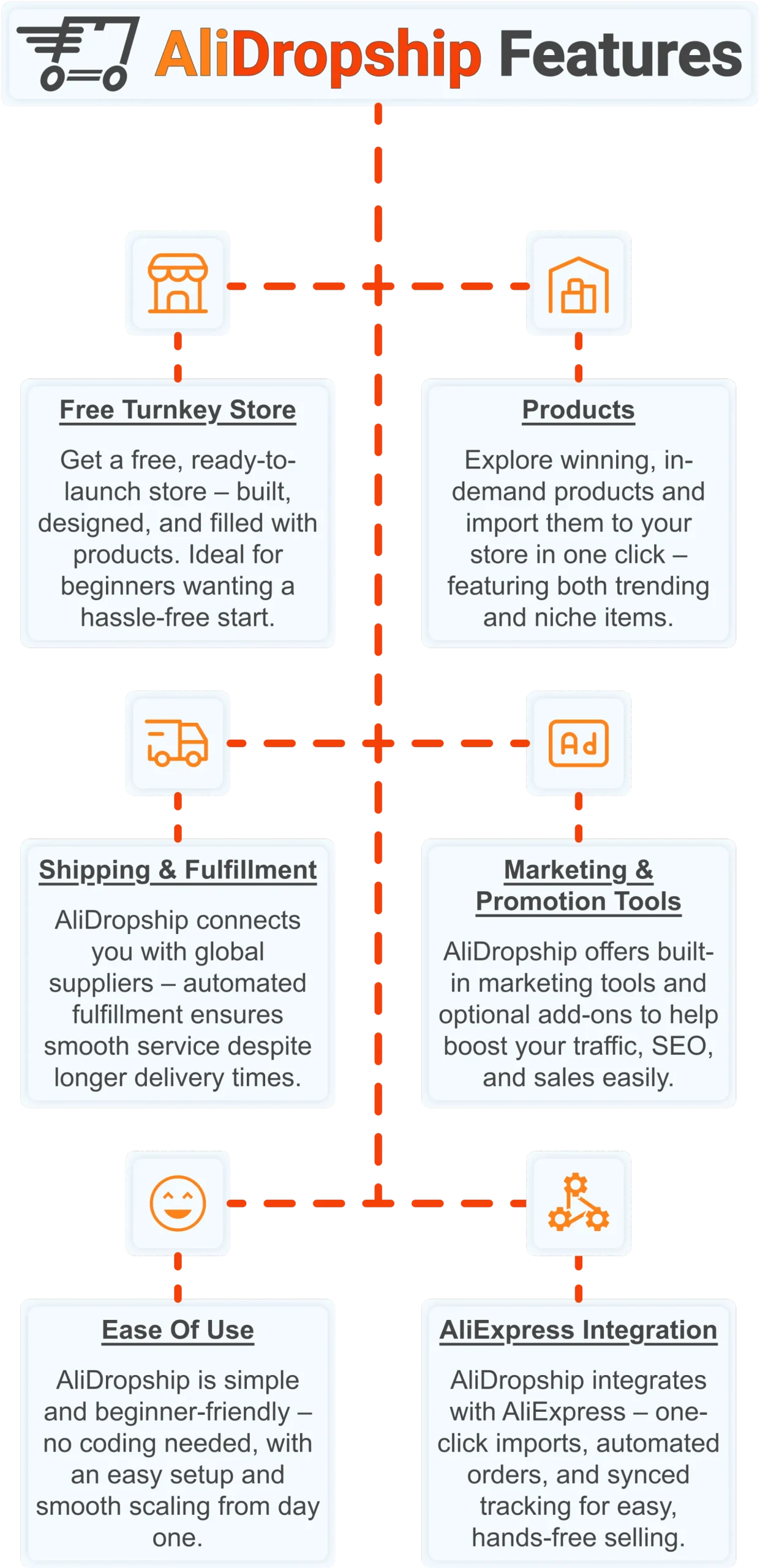
Free turnkey store ️
Get a free turnkey store – built, designed, and filled with products. Ideal for beginners wanting a hassle-free start, the store comes fully optimized to attract customers right away, saving you time on setup. Plus, it includes professional design elements to give your business a polished, trustworthy look from day one. This ready-made foundation makes it easy to move seamlessly into product selection.
Products
Once your store is set up, you can explore winning, in-demand products and import them in one click – featuring both trending and niche items. This wide selection lets you cater to diverse customer interests and test what works best. Regular updates ensure you always have fresh products, keeping your store competitive and relevant. With great products in place, smooth shipping becomes the next essential step.
Shipping & fulfillment
AliDropship connects you with global suppliers, and automated fulfillment ensures seamless order processing despite international delivery times. Customers receive real-time tracking updates, which builds confidence and trust in your store. Once shipping is handled reliably, you can focus on promoting your store and attracting traffic.
Marketing & promotion tools
To maximize sales, AliDropship offers built-in marketing tools and optional add-ons that help boost traffic, SEO, and conversions. From email campaigns and discounts to social media integration, these tools empower you to reach and retain customers without needing prior marketing experience. With promotion strategies in place, managing your business becomes simpler and more efficient.
Ease of use
AliDropship is beginner-friendly – no coding needed, with an intuitive dashboard that guides you through every step. Easy setup and smooth scaling let you expand your store without stress. As your business grows, adding new features, products, and marketing campaigns remains hassle-free, giving you more time to focus on sales.
AliExpress integration
Finally, AliDropship integrates seamlessly with AliExpress, enabling one-click imports, automated orders, and synced tracking. Your inventory stays up-to-date with the latest products and prices, while automated order processing frees you from manual tasks. Combined with the turnkey setup, reliable shipping, and built-in marketing tools, this integration ensures your dropshipping business is fully equipped for growth and success.
Starting an AI business is about finding the model that works for your life – and ecommerce automation is one of the most powerful options available in 2026. Get your free turnkey store and launch your AI-powered ecommerce business today.
Frequently asked questions
What is an AI business and how does it work?
An AI business is any model that uses artificial intelligence tools to automate operations, create products, or deliver services for paying customers. The most accessible options in 2026 include AI-powered dropshipping, digital product creation, content services, and prompt engineering. Most of these models can be started with little to no upfront cost. Platforms like AliDropship now embed automation at every level, from one-click product imports to automated order fulfillment.
How much can you realistically earn from an AI business?
AI ecommerce and dropshipping can generate 500 to 5000 dollars or more monthly, while AI chatbot development can reach 1000 to 8000 dollars monthly for operators with 5 to 10 active clients. AI content creation typically earns 300 to 2000 dollars monthly for part time work. Most new operators land in the 300 to 800 dollar a month range in their first quarter before scaling further. The higher figures generally require at least 6 months of consistent work and reinvestment.
What are the best AI business ideas to start in 2026?
AI powered ecommerce and dropshipping is considered the most scalable model for people without a technical background. AI content creation services let one person produce blog posts, social copy, and email newsletters at a volume clients will pay for. Selling AI generated digital products, such as prompt packs and Canva templates, offers a create once and sell repeatedly structure. AI chatbot development for small businesses like restaurants and dental practices can generate 1000 to 8000 dollars a month once a client base of 5 to 10 is established.
How long does it take to start earning from an AI business?
Time to first revenue varies by model, with AI content services generating income in 1 to 3 weeks and AI digital products taking 2 to 4 weeks. AI ecommerce and dropshipping typically reaches first revenue in 2 to 6 weeks, while chatbot development can take 4 to 10 weeks due to the client acquisition process. A common strategy is starting with a service model for early cash flow, then reinvesting into a scalable store or digital product line. Even 10 to 20 dollars a day in paid traffic can indicate within 2 to 3 weeks whether an offer converts.
What legal and ethical rules apply to running an AI business?
Many platforms now require disclosure of AI generated content, and Etsy specifically requires sellers to disclose AI generated digital products. The FTC has issued guidance on AI generated content in advertising within the United States. In most jurisdictions, AI generated content cannot be copyrighted by the operator as of 2026, though this legal landscape continues to shift. Operators should avoid fake AI generated reviews and bulk generating low quality content purely for SEO purposes.
 Previous post
