 ‧ Agnes Kazaryan ‧
March 21, 2026
‧ Agnes Kazaryan ‧
March 21, 2026  578 ‧
578 ‧
 0
0
More than 26% of the global population now shops online – and millions of those transactions happen through stores that didn’t exist two years ago. Starting an online store has never been more accessible, but the gap between wanting to sell online and actually making consistent money can feel wide if you go in without a plan.
The good news is that the tools available in 2026 make launching faster, cheaper, and more beginner-friendly than at any previous point in ecommerce history. You do not need a warehouse, a developer, or a big budget to get started.
Quick Answer: Starting an online store in 2026 means choosing a business model (dropshipping is the most beginner-friendly), picking a niche, setting up your store, and driving traffic to it. Most people can launch within a week, and realistic earnings range from $30–$80/day within 60–90 days with consistent effort.
This guide covers everything you need to know – what to expect, which methods actually work, how much you can realistically earn, and how to avoid the mistakes that catch most first-time store owners off guard.
What starting an online store actually means in 2026
Starting an online store means building a website where you list products, accept payments, and fulfill orders – all without the overhead of a physical location. In 2026, global ecommerce revenue is on track to surpass $6.3 trillion, and a significant slice of that growth is still driven by independent sellers launching their first store.
The three most common models for beginners are dropshipping (a supplier ships products directly to your customer), print-on-demand (custom items made only when ordered), and selling your own physical or digital products. Each has different upfront costs, margins, and time requirements.
Dropshipping remains the most popular starting point because it requires no inventory investment – you only pay for a product after a customer has already bought it. That dramatically lowers the risk of starting out.
Why this works in 2026: Consumer trust in independent online stores has grown steadily, and platforms like TikTok and Instagram give small sellers direct access to large, buying-intent audiences without requiring big ad budgets on day one.
How much can you realistically earn from an online store?
One of the most searched questions around starting an online store is how much money you can actually make. The honest answer depends on your model, your effort, and your timeline – but the table below gives a grounded baseline based on what real sellers at different stages tend to achieve.
Dropshipping is the clearest path for beginners because startup costs are low and you can test products within days. The highest-earning rows reflect sellers who are 12–24 months in, running paid ads, and treating their store as a full-time business.
One note on the ceiling figures: The high-end numbers above are real but not typical for beginners. Most people starting part-time should plan for $30–$100/day as a realistic 90-day target – sustainable, real income, but not an overnight transformation.
The most important variable is consistency. Sellers who test 10–20 products in their first two months and commit to learning one traffic channel – organic social, SEO, or a small paid ads budget – consistently outperform those who set up a store and wait for sales to arrive.
The main ways to start selling online in 2026
There is no single right way to start an online store. The best method depends on how much time and money you can invest upfront, whether you want to handle physical products, and how quickly you need to see a return. Below are the most popular and proven paths.
Dropshipping
Dropshipping is the model where you list products in your store, collect payment from the customer, and then your supplier ships the item directly to them. You never hold inventory. Your profit is the difference between what the customer pays you and what you pay the supplier.
How dropshipping works
You set up a store, import products from a supplier catalog (AliExpress is the most widely used source), set your own retail price, and start driving traffic. When a sale comes in, your platform places the order with the supplier automatically and sends tracking to your customer. The entire fulfillment loop runs without you touching the product.
Earning potential: $30–$150/day within 60–90 days for active beginners testing multiple products.
Choosing your niche
Niche selection is where most beginners get stuck. The safest approach is picking a category with consistent year-round demand – home organization, pet accessories, fitness gear – rather than chasing seasonal or viral trends early on. Use Google Trends and AliExpress bestseller lists to validate demand before committing to a direction.
Important note: A well-chosen niche does not need to be unique – it needs to have buyers. “Dog accessories” has millions of them. You do not need to out-niche every competitor; you need to out-market them in one specific channel.
Finding reliable suppliers
Supplier reliability is the backbone of a solid dropshipping operation. For AliExpress-based dropshipping, filter by order count (10,000+ is a solid baseline), seller rating (4.7 stars or above), and shipping options. For faster delivery, look for suppliers based in the US or EU – times can drop from 20+ days to under 10.
Print-on-demand
Print-on-demand lets you sell custom-designed products – t-shirts, mugs, phone cases, posters – without holding any stock. A third-party service prints and ships each item only when a customer orders it. Your margin per item is lower than dropshipping, but your risk is near zero.
Getting started with print-on-demand
The most popular platforms are Printful, Printify, and Gelato. You upload your designs, connect the platform to your store, and set your prices. Most successful POD sellers are also content creators who drive traffic through social media. If design is not your strength, tools like Canva make basic mockup creation accessible even for non-designers.
Earning potential: $10–$50/day once you have 20–50 products live and a consistent traffic source running.
Selling your own products
If you make handmade goods, source wholesale products, or create digital items – templates, guides, presets – you can sell them directly through your own store. This is the highest-margin model and also the most effort-intensive. You are responsible for inventory, quality, and fulfillment.
Physical products
Starting with a small batch of 20–50 units lets you test demand before committing to a large order. Platforms like Alibaba let you source private-label products at low minimum order quantities. Many successful stores start as hybrids – their own branded products alongside dropshipped items to fill out the catalog.
Digital products
Digital products – eBooks, Notion templates, Lightroom presets, online courses – have a near-100% margin after creation. The main challenge is discoverability. Most successful digital product sellers build an audience first (on Pinterest, TikTok, or a blog) before launching their store, so they have warm traffic from day one.
Earning potential: $20–$300/day once a content funnel is driving consistent, warm traffic to the store.
Your own store vs selling on marketplaces
Many beginners start on Etsy, Amazon, or eBay because there is built-in traffic. The trade-off is steep: platform fees of 8–15% per sale, almost no control over branding, and constant exposure to algorithm changes that can tank your visibility overnight.
Your own store costs more to drive traffic to initially, but it compounds. SEO, email lists, and returning customers belong to you – not to the platform.
Important: Running a marketplace account alongside your own store is a viable hybrid strategy. Use the marketplace for discovery, then convert buyers to your store for repeat purchases where your margins are higher.
How to drive traffic to your new online store
A store with no traffic earns nothing. Traffic strategy is where most beginners underinvest – not in money, but in time and consistency. The four channels below deliver the most reliable results for new store owners in 2026.
Short-form video is the fastest route to free traffic for product stores in 2026. A single TikTok showing a product solving a real problem can generate hundreds of store visits in 24 hours. Pinterest is slower but durable – pins continue driving traffic for months after posting.
Organic social media for product stores
The most effective organic content for ecommerce is not promotional – it is educational or entertaining. Show the product being used. Show the problem it solves. Show the unboxing. Show the before and after. Posts that start with the customer’s problem and arrive at your product as the natural solution consistently outperform direct “buy this” content.
Running paid ads on a small budget
You do not need a large budget to test paid ads. Many dropshipping beginners start with $10–$20/day on Meta or TikTok Ads, running broad interest targeting on a single product. The goal in the first two weeks is not profit – it is data. Which product gets clicks? Which creative gets watched past three seconds?
Once you have winning signals, scale the budget on what works and cut everything else.
Pro Tip: Start with one platform, master it, and only add a second after you are profitable on the first. Splitting attention between Meta and TikTok Ads simultaneously almost always leads to wasted spend and muddled learning.
SEO for your online store
SEO is the long game, but it pays the highest dividends. For a new store, the fastest SEO win is writing product descriptions that actually answer search queries – not just listing features, but addressing what the customer wants to know. For a blog attached to your store, targeting long-tail buying-intent keywords puts you in front of people who are ready to purchase.
Email marketing from day one
Email is the highest-ROI channel for established stores, but most beginners ignore it at the start. Installing a simple pop-up offering a 10% discount in exchange for an email address from your first week means you are building an owned audience in parallel with your traffic efforts. By the time you have 500 subscribers, a single email blast can generate $500–$2,000 in revenue depending on your product price.
Legal and ethical considerations when starting an online store
Most beginners focus entirely on product selection and traffic and then get caught off guard by the operational and legal side of running a store. Here is what you actually need to know before you start earning consistently.
Business registration and taxes
In most countries, you are legally required to register your business once you start earning regularly – even as a sole trader. In the US, forming an LLC costs $50–$300 depending on the state and provides basic liability protection. You will also need to understand sales tax rules: most US states require you to collect sales tax once you cross a revenue threshold, often $100,000/year or 200 transactions.
Important: Even if your store is small and not yet profitable, keeping a separate business bank account from day one makes tax time dramatically simpler and protects your personal finances.
What to avoid absolutely
Some shortcuts in ecommerce seem tempting early on but carry serious consequences:
- Fake reviews – Soliciting or manufacturing fake product reviews violates the terms of every major platform and FTC guidelines in the US. Penalties include account bans and fines.
- Counterfeit or trademarked products – Selling knock-off branded goods is illegal and will result in store takedown, payment processor termination, and potential legal action.
- Misleading shipping times – If your supplier ships from China with a 20-day window, advertising “ships within 2 business days” will generate chargebacks and kill a new store quickly.
- No refund policy – A clear, honest returns policy is a legal requirement in most countries and dramatically reduces payment disputes.
Key principle: Operate your store the way you would want to be treated as a customer – transparent pricing, honest product descriptions, and a real path to resolution if something goes wrong.
What to do instead
Build trust actively from the start. Add a real contact email. Show product photos that accurately represent what the customer receives. Write honest descriptions that mention limitations alongside benefits. Respond to customer messages within 24 hours. These habits cost nothing but time, and they compound – a store with a genuine reputation for service converts better, earns repeat customers, and generates organic word-of-mouth that no ad budget can replicate.
How to choose your approach: Recommendations by reader profile
Not every path works for every person. Here is a straightforward breakdown based on where you are starting from.
Complete beginner with limited budget
If you are new to ecommerce and working with under $200 to start, dropshipping through AliDropship is the most practical path. You can get a fully built, product-filled store without needing to know how to code, design, or source suppliers yourself. Focus your first 30 days entirely on learning one traffic channel – organic TikTok or Instagram is free and can generate sales without any ad spend.
Intermediate seller with part-time commitment
If you have tried selling online before or you are willing to invest 10–15 hours per week, the next step is adding paid traffic to a product that is already converting organically. A small Meta Ads budget ($15–$20/day) on a proven product can accelerate what is already working without requiring you to go full-time. At this stage, start building your email list and investing in product photography – these two things consistently increase conversion rates by 15–30%.
Advanced seller with a full-time goal
If you are targeting $200–$500/day as a sustained income, your focus shifts from “what product should I sell?” to “what system lets me scale?” This means automating order fulfillment, building a brand identity, running multi-channel paid ads, and systematically growing your email list. Most sellers at this level are also exploring private-label products – working directly with a manufacturer to put their own brand on a proven-selling product, which dramatically increases margins.
Why this works in 2026: The ecommerce market is maturing. Generic “sell everything” stores are giving way to focused, branded niche stores that own a specific customer relationship. Starting now with a niche focus positions you ahead of where most beginners will be in 18 months.
AliDropship: Your complete all-in-one solution for starting dropshipping in 2026
If you want the simplest possible way to start dropshipping – especially if you’re brand new – AliDropship remains one of the most beginner-friendly tools available in 2026. It brings together store creation, product imports, automation, and marketing into a single streamlined system designed to help you launch quickly and grow confidently.
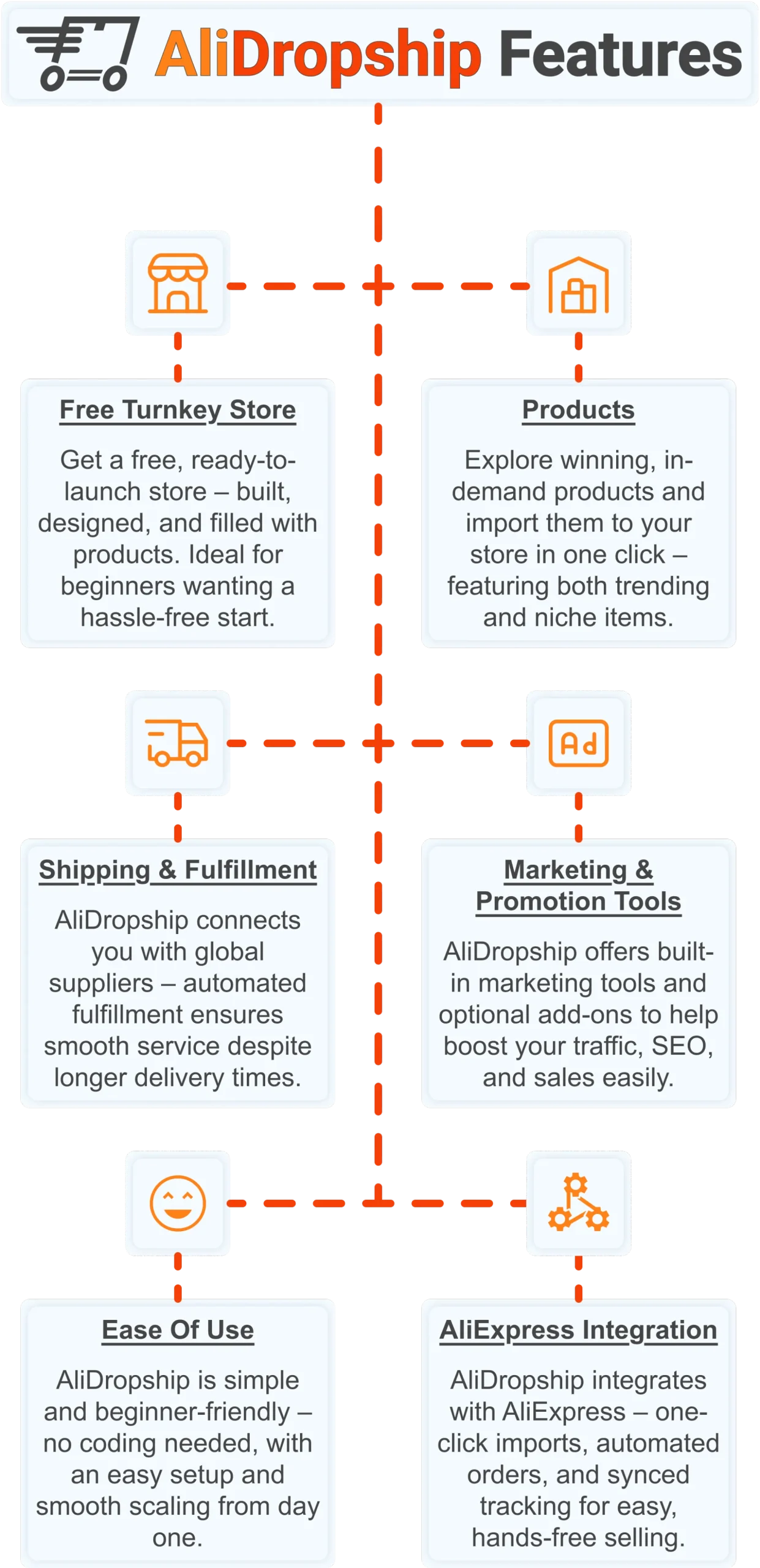
Free turnkey store ️
Get a free turnkey store – built, designed, and filled with products. Ideal for beginners wanting a hassle-free start, the store comes fully optimized to attract customers right away, saving you time on setup. Plus, it includes professional design elements to give your business a polished, trustworthy look from day one. This ready-made foundation makes it easy to move seamlessly into product selection.
Products
Once your store is set up, you can explore winning, in-demand products and import them in one click – featuring both trending and niche items. This wide selection lets you cater to diverse customer interests and test what works best. Regular updates ensure you always have fresh products, keeping your store competitive and relevant. With great products in place, smooth shipping becomes the next essential step.
Shipping & fulfillment
AliDropship connects you with global suppliers, and automated fulfillment ensures seamless order processing despite international delivery times. Customers receive real-time tracking updates, which builds confidence and trust in your store. Once shipping is handled reliably, you can focus on promoting your store and attracting traffic.
Marketing & promotion tools
To maximize sales, AliDropship offers built-in marketing tools and optional add-ons that help boost traffic, SEO, and conversions. From email campaigns and discounts to social media integration, these tools empower you to reach and retain customers without needing prior marketing experience. With promotion strategies in place, managing your business becomes simpler and more efficient.
Ease of use
AliDropship is beginner-friendly – no coding needed, with an intuitive dashboard that guides you through every step. Easy setup and smooth scaling let you expand your store without stress. As your business grows, adding new features, products, and marketing campaigns remains hassle-free, giving you more time to focus on sales.
AliExpress integration
Finally, AliDropship integrates seamlessly with AliExpress, enabling one-click imports, automated orders, and synced tracking. Your inventory stays up-to-date with the latest products and prices, while automated order processing frees you from manual tasks. Combined with the turnkey setup, reliable shipping, and built-in marketing tools, this integration ensures your dropshipping business is fully equipped for growth and success.
Frequently Asked Questions
What does starting an online store actually involve in 2026?
Starting an online store in 2026 means choosing a business model, picking a niche, setting up your store, and driving traffic to it, with dropshipping being the most beginner-friendly option. Most people can launch within a week, and realistic earnings range from 30 to 80 dollars per day within 60 to 90 days with consistent effort. More than 26 percent of the global population now shops online, showing the scale of ongoing opportunity. Global ecommerce revenue is on track to surpass 6.3 trillion dollars, with a significant share still driven by independent sellers.
How much can a new online store realistically earn?
A beginner dropshipping store typically earns 30 to 80 dollars per day within 60 to 90 days of launch, while a scaling dropshipping store can reach 200 to 800 dollars per day. Print-on-demand stores tend to earn less, around 10 to 50 dollars per day, but require lower effort. Selling your own products has the highest ceiling at 100 to 1000 dollars or more per day, though it also requires the most effort. Most beginners working part-time should plan for 30 to 100 dollars per day as a realistic 90-day target rather than expecting an overnight transformation.
What is the fastest way to drive traffic to a new online store?
Short-form video on TikTok and Instagram Reels is the fastest route to free traffic for a new product store, with a single video capable of generating hundreds of store visits within 24 hours. Paid ads on Meta or TikTok can produce immediate results, and many beginners start with 10 to 20 dollars per day in ad spend to gather early data. SEO takes 3 to 6 months to show results but pays the highest long-term dividends through free, compounding traffic. Pinterest sits in between, typically taking 2 to 8 weeks to build momentum, but pins continue driving traffic for months afterward.
How does dropshipping compare to selling on marketplaces like Etsy or Amazon?
Marketplaces like Etsy, Amazon, and eBay offer built-in traffic but charge platform fees of 8 to 15 percent per sale and give sellers little control over branding. Running your own store costs more to drive traffic to at first, but the SEO, email lists, and returning customers it builds belong to you rather than the platform. A hybrid strategy is often effective, using a marketplace for initial discovery and then converting buyers to your own store for repeat purchases at higher margins. This approach reduces dependence on any single platform’s algorithm changes.
What legal steps are required before starting an online store?
In most countries, business registration becomes legally required once you start earning regularly, even as a sole trader, and forming a US LLC typically costs 50 to 300 dollars depending on the state. Most US states require sales tax collection once you cross a revenue threshold, often 100000 dollars per year or 200 transactions. Soliciting or manufacturing fake product reviews violates the terms of every major platform and FTC guidelines, with penalties including account bans and fines. Advertising misleading shipping times, such as claiming 2-day shipping when a supplier actually ships in 20 days, generates chargebacks and can quickly damage a new store’s reputation.
Starting an online store in 2026 is genuinely within reach for anyone willing to put in consistent effort – and AliDropship gives you every tool you need to go from zero to your first sale without the technical headaches. Claim your free turnkey store and start building your online business today.
 Previous post
