 ‧ Agnes Kazaryan ‧
March 21, 2026
‧ Agnes Kazaryan ‧
March 21, 2026  541 ‧
541 ‧
 0
0
Millions of people are asking the same question right now: WooCommerce vs Shopify – which one should I actually use? Both platforms run serious ecommerce businesses. Both have proven track records. But they are built on completely different foundations, and choosing the wrong one for your situation can cost you months of wasted effort and real money.
Quick Answer: Shopify is faster and lower-maintenance – the right choice if you want to get selling quickly with minimal technical involvement. WooCommerce gives you more flexibility and lower long-term costs if you are comfortable managing a self-hosted website. Neither is universally better. The right answer depends on your goals, your budget, and your technical confidence.
This guide breaks down every major difference between WooCommerce and Shopify in 2026 – pricing, ease of use, SEO, dropshipping, customization, and scalability – so you can make a confident, informed decision and move forward.
What is WooCommerce vs Shopify?
Before going feature by feature, it helps to understand what each platform actually is at its core – because they are built on fundamentally different architectures, and that difference shapes everything else.
Shopify is a fully hosted, all-in-one ecommerce platform. You pay a monthly subscription and Shopify handles hosting, security, software updates, and server infrastructure on your behalf. You log in, build your store through a clean visual dashboard, and focus on selling. There is nothing to install, no servers to manage, and no technical background required. Shopify currently powers more than 9 million stores across 175+ countries.
WooCommerce is a free, open-source ecommerce plugin built for WordPress. It transforms any WordPress website into a fully functional online store. Because it runs on WordPress, you are responsible for your own hosting, security, plugin updates, and keeping everything compatible. The plugin itself is free – but operating it is not.
This core difference – hosted versus self-hosted – drives almost every practical distinction between the two platforms. One hands the responsibility to the platform. The other hands it to you. That is not a criticism of either approach. It is just the starting point for every decision that follows.
How much can you realistically earn with either platform?
Before picking a platform, it helps to understand what realistic earning potential looks like – because the platform itself is just infrastructure. What you earn depends on your niche, your products, your marketing, and your consistency.
Most beginners see their first meaningful revenue within 3–6 months of consistent effort. The platform matters less than the work you put into product selection and marketing.
Important: These figures represent realistic outcomes with active effort – not passive income. Stores that go quiet after launch do not generate revenue on either platform.
WooCommerce vs Shopify: Pricing breakdown
Pricing is where this comparison gets genuinely complicated. Both platforms have costs that are easy to underestimate until you are already committed.
Shopify pricing in 2026
Shopify runs on a tiered subscription model. The Basic plan starts at $29/month billed annually, or $39/month on a rolling basis. The mid-tier Shopify plan runs $105/month and the Advanced plan costs $399/month. Shopify Plus – aimed at enterprise merchants – starts around $2,300/month.
On top of the base subscription, Shopify charges transaction fees if you do not use Shopify Payments as your gateway: 2% on Basic, 1% on Shopify, and 0.5% on Advanced. At any meaningful sales volume, that adds up quickly. Premium themes cost $150–$350, and the apps you realistically need add another $20–$100/month each. A mid-level Shopify store often runs $300–$600/month before a single dollar goes to marketing.
WooCommerce pricing in 2026
WooCommerce the plugin is free. What you actually pay for is everything around it. Managed WordPress hosting from providers like Kinsta, WP Engine, or Cloudways typically costs $30–$80/month. A quality theme adds another $50–$150 as a one-time purchase. Premium plugins for SEO, page builders, and security add $10–$50/month each. WooCommerce charges no platform transaction fees – you only pay standard payment gateway rates, typically 1.4%–2.9% plus a small fixed fee per transaction.
One note on WooCommerce’s “free” label: The plugin costs nothing, but total operational costs – hosting, maintenance, developer time, and plugins – can easily match or exceed a comparable Shopify plan, especially if you need outside help managing updates and security patches.
WooCommerce vs Shopify: Pricing at a glance
High-volume stores with a technically capable team tend to save money with WooCommerce over time. For newer stores and solo operators, Shopify’s all-inclusive pricing removes financial surprises – including the risk of an unexpected developer bill when a WordPress update breaks something mid-sale.
Ease of use: Getting your store live
This is where WooCommerce and Shopify diverge most sharply. Your honest assessment of your own technical skills matters more here than any feature comparison.
Shopify setup experience
Shopify is built for non-technical business owners from the ground up. The onboarding process is guided and intuitive – most people can have a working store with products, payments, and shipping configured within 2–4 hours. The admin dashboard is clean, consistent, and logical. Adding products, editing your storefront, setting up discounts, and reviewing analytics all happen in the same visual interface without any code required.
In 2026, Shopify has expanded its native AI features significantly. Shopify Magic now generates product descriptions, email copy, blog content, and customer segmentation suggestions – all without third-party tools. For store owners who want to focus entirely on products and marketing, Shopify removes the friction.
WooCommerce setup experience
WooCommerce requires meaningfully more technical involvement. Before you even open WooCommerce, you need a domain, a WordPress hosting account, a WordPress installation, a compatible theme, and several core plugins for security, SEO, and performance. Someone with WordPress experience can typically get a basic store live in 2–5 days. A complete beginner should budget 1–3 weeks and will likely encounter configuration issues that require research or outside help.
Ongoing maintenance is a recurring commitment. WordPress core updates, WooCommerce plugin updates, theme compatibility checks, and security monitoring typically consume 2–4 hours per month for a well-maintained store. Skip those updates and you risk plugin conflicts, broken functionality, or a security vulnerability.
Important: WooCommerce discontinued its own point-of-sale system in February 2026. Merchants who need in-person selling now need a third-party POS app like Lightspeed, which costs around $249/year separately.
SEO and content marketing: Which platform ranks better?
Both platforms can rank well in Google, but they approach SEO differently – and for content-driven ecommerce, the difference is meaningful.
WooCommerce SEO strengths
WooCommerce runs on WordPress, which is the world’s most widely used content management system. That gives it a natural advantage for content-driven SEO strategies. You have complete technical control: custom URL structures, full robots.txt access, advanced schema markup, and deep integration with powerful SEO plugins like Yoast SEO and Rank Math. If you plan to build traffic through blog content, guides, or long-form articles, WooCommerce on WordPress is hard to beat.
Why this works in 2026: Optimizing for AI-generated search results – sometimes called GEO, or Generative Engine Optimization – has become as important as traditional Google SEO. WooCommerce’s open architecture makes it easier to implement the structured data and content strategies that AI-driven answer engines prioritize.
Shopify SEO strengths and limitations
Shopify includes solid built-in SEO features: automatic sitemaps, editable meta titles and descriptions, clean canonical tags, and a fast CDN-backed infrastructure that delivers strong Core Web Vitals by default. For most stores, these fundamentals are more than enough to compete.
Where Shopify falls short is technical SEO control. You cannot fully customize URL structures – the mandatory “/products/” prefix in product URLs cannot be removed. Robots.txt customization is limited, and advanced permalink modifications require workarounds. For stores that rely heavily on programmatic SEO or highly customized content architectures, these constraints become real bottlenecks.
Customization and flexibility
Both platforms offer extensive customization, but the ceiling – and the floor – look very different depending on your technical capacity.
WooCommerce customization
WooCommerce’s open-source architecture gives you complete access to the codebase. You can modify checkout flows, build custom user roles, implement role-based pricing, integrate enterprise ERP systems, and create specialized functionality that does not exist as an off-the-shelf plugin. The broader WordPress ecosystem offers more than 60,000 plugins and extensions – there is almost no feature you cannot build or install.
The tradeoff is what developers call “plugin bloat.” Every additional plugin adds database calls, scripts, and potential security vulnerabilities. Over time, a heavily extended WooCommerce store can become difficult to update safely, and conflicts between plugins are a genuine operational risk – particularly when a WordPress core update drops and multiple plugins need simultaneous attention.
Shopify customization
Shopify’s theme editor and Liquid templating language give non-technical users solid control over layout, fonts, colors, and content. The Shopify App Store offers more than 8,000 vetted integrations – apps are reviewed for performance and security before listing, which means far fewer conflicts compared to the open WordPress ecosystem.
For more advanced customizations around checkout behavior, Shopify restricts some features to its Shopify Plus tier (from $2,300/month). If you need to deeply modify the checkout experience at scale, that restriction is a meaningful cost consideration.
Important note: Shopify’s closed architecture means that if no app exists for a specific custom need, you must build a private app using the Shopify API – which is doable, but typically more expensive than a WooCommerce plugin equivalent.
WooCommerce vs Shopify for dropshipping
Dropshipping is one of the most popular use cases for both platforms, and this comparison is particularly relevant if you are considering launching a dropshipping store in 2026.
Shopify for dropshipping
Shopify has become one of the dominant platforms for dropshipping, primarily because of how fast it is to launch and how clean the product management experience is. Apps like DSers and AutoDS integrate directly with AliExpress suppliers, allowing one-click product imports and automated order forwarding. The checkout process is polished out of the box, which reduces friction for customers and tends to support higher conversion rates.
The main limitation is cost accumulation. Between the monthly subscription, the apps needed to run a proper dropshipping operation, and transaction fees on non-Shopify Payments gateways, your overheads can quickly exceed $150–$200/month before you have made a single sale. For a beginner testing their first niche, that is a real financial pressure.
WooCommerce for dropshipping
WooCommerce paired with AliDropship is a particularly strong combination for dropshipping. WooCommerce handles the store infrastructure while AliDropship provides dedicated dropshipping automation – product imports, order fulfillment, pricing rules, and supplier sync – all in one purpose-built plugin. Because WooCommerce charges no platform transaction fees, more of each sale stays in your pocket as you scale.
The tradeoff, again, is setup complexity. Getting a WooCommerce dropshipping store properly configured – with the right hosting, a quality theme, the AliDropship plugin, and all the supporting pieces – takes longer than spinning up a Shopify store. For someone with no WordPress experience, the first few weeks involve a real learning curve.
Earning potential: $30–$80/day within the first 60–90 days with consistent product research and marketing effort on either platform. Most beginners see meaningful results within 3–6 months of focused work.
Security, performance, and scalability
As your store grows, platform stability becomes critical. A slow checkout or a security breach can destroy months of brand-building overnight.
Shopify security and performance
Shopify manages all hosting infrastructure on your behalf: server uptime, PCI compliance, SSL certificates, and security patching. Its globally distributed CDN delivers consistent performance – every store benefits from the same enterprise-grade infrastructure regardless of plan tier. Shopify reports 99.99% uptime. For store owners who do not want to think about any of this, that reliability is genuinely valuable.
One underappreciated benefit of Shopify’s managed infrastructure is the elimination of “emergency spend” – the unexpected $500–$5,000 developer bill that arrives when a WordPress update breaks a checkout flow in the middle of a high-traffic sale period.
WooCommerce security and performance
WooCommerce performance depends entirely on your hosting choice and your optimization discipline. A WooCommerce store on premium managed hosting – Kinsta, WP Engine, or Cloudways – can match or exceed Shopify’s speed. A WooCommerce store on budget shared hosting will be noticeably slower and far more vulnerable to traffic spikes.
Security is where self-hosting demands the most ongoing attention. You are responsible for WordPress core updates, WooCommerce plugin updates, theme compatibility, backup schedules, and firewall configuration. A missed update is a potential attack surface. Most serious WooCommerce operators either develop strong personal maintenance habits or hire a developer on retainer to manage it.
Legal and ethical considerations when choosing an ecommerce platform
Choosing between WooCommerce and Shopify has real implications around data ownership, privacy compliance, and long-term business risk – worth considering before you commit.
WooCommerce, being self-hosted, gives you complete ownership of all customer data. Your database sits on your server, under your control. This is particularly relevant for businesses operating under strict data protection regulations – GDPR compliance in Europe is more straightforward to manage when data does not pass through a third-party US-based platform.
Shopify, as a hosted platform, stores your store data on its servers. If Shopify were to change its terms, increase pricing significantly, or discontinue a feature, your ability to respond quickly is more limited than on a self-hosted solution. Platform risk is a genuine long-term consideration – though Shopify’s scale and track record make a sudden shutdown highly unlikely.
Key principle: Understand what you are agreeing to before you build on any platform – read the data handling terms, know where your customer data lives, and make sure the platform’s policies align with your market’s legal requirements.
What to avoid on either platform: grey-area tactics like selling counterfeit branded goods, misrepresenting shipping times, or using deceptive plugins that display fake stock counts. These practices violate platform terms and consumer protection laws in most markets – and they generate chargebacks that will get your merchant account suspended.
WooCommerce vs Shopify: Which platform is right for you?
There is no single correct answer in 2026. Both platforms run multi-million dollar businesses. The right choice depends entirely on your situation, your goals, and your honest self-assessment.
Complete beginner
If you have never built a website before, have no WordPress experience, and want to start selling as quickly as possible, Shopify is the safer starting point. The guided setup, managed infrastructure, and clean dashboard let you focus your energy on product selection and marketing – where it belongs in the early months of a new store. You can be live and accepting orders within hours, not days.
Intermediate / part-time seller
If you already have some WordPress experience, are comfortable managing a hosting account, and want a store you own and control completely, WooCommerce is worth the extra effort. The long-term cost advantages are real at volume, the SEO flexibility is genuinely superior for content-led growth, and the absence of platform transaction fees compounds meaningfully as sales increase.
Advanced / full-time ecommerce goal
For technically experienced operators building toward a full-time income, the choice depends more on your business model than on platform features. If you are building a content-first, SEO-driven brand with complex product logic or custom integrations, WooCommerce gives you the most room to grow on your own terms. If you want the fastest path to a scalable, low-maintenance operation with predictable costs and enterprise-grade infrastructure, Shopify – particularly at higher plan tiers – is the more operationally efficient choice.
AliDropship: Your complete all-in-one solution for starting dropshipping in 2026
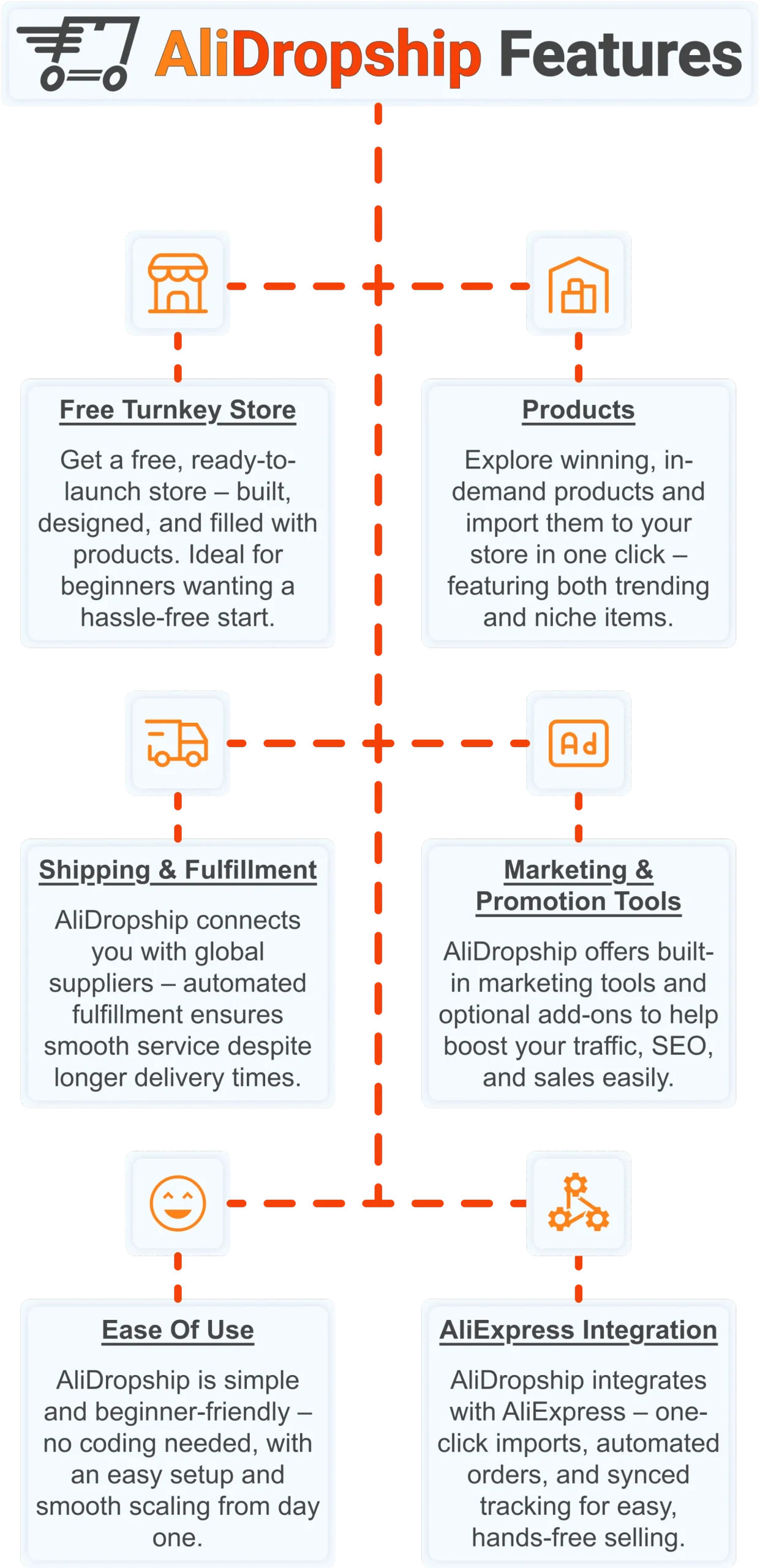
If you want the simplest possible way to start dropshipping – especially if you’re brand new – AliDropship remains one of the most beginner-friendly tools available in 2026. It brings together store creation, product imports, automation, and marketing into a single streamlined system designed to help you launch quickly and grow confidently.
Free turnkey store ️
Get a free turnkey store – built, designed, and filled with products. Ideal for beginners wanting a hassle-free start, the store comes fully optimized to attract customers right away, saving you time on setup. Plus, it includes professional design elements to give your business a polished, trustworthy look from day one. This ready-made foundation makes it easy to move seamlessly into product selection.
Products
Once your store is set up, you can explore winning, in-demand products and import them in one click – featuring both trending and niche items. This wide selection lets you cater to diverse customer interests and test what works best. Regular updates ensure you always have fresh products, keeping your store competitive and relevant. With great products in place, smooth shipping becomes the next essential step.
Shipping & fulfillment
AliDropship connects you with global suppliers, and automated fulfillment ensures seamless order processing despite international delivery times. Customers receive real-time tracking updates, which builds confidence and trust in your store. Once shipping is handled reliably, you can focus on promoting your store and attracting traffic.
Marketing & promotion tools
To maximize sales, AliDropship offers built-in marketing tools and optional add-ons that help boost traffic, SEO, and conversions. From email campaigns and discounts to social media integration, these tools empower you to reach and retain customers without needing prior marketing experience. With promotion strategies in place, managing your business becomes simpler and more efficient.
Ease of use
AliDropship is beginner-friendly – no coding needed, with an intuitive dashboard that guides you through every step. Easy setup and smooth scaling let you expand your store without stress. As your business grows, adding new features, products, and marketing campaigns remains hassle-free, giving you more time to focus on sales.
AliExpress integration
Finally, AliDropship integrates seamlessly with AliExpress, enabling one-click imports, automated orders, and synced tracking. Your inventory stays up-to-date with the latest products and prices, while automated order processing frees you from manual tasks. Combined with the turnkey setup, reliable shipping, and built-in marketing tools, this integration ensures your dropshipping business is fully equipped for growth and success.
Frequently Asked Questions
What is the main difference between WooCommerce and Shopify?
Shopify is a fully hosted, all-in-one ecommerce platform where the company manages hosting, security, and software updates for you. WooCommerce is a free, open-source plugin for WordPress that turns any WordPress site into a store, leaving hosting and maintenance in your hands. Shopify currently powers more than 9 million stores across 175 plus countries, showing its scale as a managed solution. This hosted versus self-hosted distinction drives nearly every practical difference between the two platforms.
How much does WooCommerce cost compared to Shopify in 2026?
Shopify Basic starts at 29 dollars per month billed annually, while the mid-tier Shopify plan runs 105 dollars monthly and Advanced costs 399 dollars monthly. A mid-level Shopify store often totals 300 to 600 dollars per month once apps and themes are included. WooCommerce itself is free, but managed WordPress hosting typically costs 30 to 80 dollars monthly, bringing a realistic WooCommerce total to 80 to 250 dollars per month. WooCommerce also charges no platform transaction fees, unlike Shopify, which charges 0 to 2 percent depending on plan and payment gateway.
Which platform is easier to set up for beginners?
Shopify is built for non-technical business owners, and most people can have a working store with products, payments, and shipping configured within 2 to 4 hours. WooCommerce requires a domain, hosting account, WordPress installation, a theme, and several core plugins before the store can go live. Someone with WordPress experience can typically launch a basic WooCommerce store in 2 to 5 days, while a complete beginner should budget 1 to 3 weeks. Ongoing WooCommerce maintenance, including updates and security monitoring, typically takes 2 to 4 hours per month.
Which platform is better for dropshipping, WooCommerce or Shopify?
Shopify integrates with apps like DSers and AutoDS for one-click AliExpress imports, but combined subscription costs, apps, and transaction fees can exceed 150 to 200 dollars per month before any sales are made. WooCommerce paired with AliDropship provides dedicated dropshipping automation, including product imports and supplier sync, with no platform transaction fees taken from each sale. Both platforms show similar earning potential of 30 to 80 dollars per day within the first 60 to 90 days of consistent effort. WooCommerce requires more setup time upfront, while Shopify offers a faster initial launch for dropshipping beginners.
How do WooCommerce and Shopify compare on SEO for content marketing?
WooCommerce runs on WordPress, giving it complete technical control over custom URL structures, robots.txt access, and advanced schema markup through plugins like Yoast SEO and Rank Math. Shopify includes solid built-in SEO features such as automatic sitemaps and clean canonical tags, but it cannot remove the mandatory forward slash products forward slash prefix in product URLs. For stores relying heavily on long-form content or programmatic SEO, WooatCommerce open architecture is generally considered stronger. Shopify’s SEO fundamentals remain more than sufficient for most standard ecommerce stores that are not content-driven.
Whether you land on WooCommerce or Shopify, AliDropship removes the hardest part of getting started by giving you a complete, ready-to-earn store from day one. Claim your free turnkey dropshipping store and skip straight to selling.
 Previous post
