 ‧ Agnes Kazaryan ‧
March 23, 2026
‧ Agnes Kazaryan ‧
March 23, 2026  599 ‧
599 ‧
 0
0
So you want to know how to open an online store. You have probably heard the stories – people building ecommerce businesses from their kitchen table, earning money while they sleep, shipping products worldwide without ever touching a single item. Some of those stories are completely real. But knowing where to actually start? That is where most people get stuck.
This guide cuts through the noise. Whether you have never sold anything online or you have dabbled and want a clearer roadmap, you will find a practical breakdown of everything you need to launch a working online store in 2026 – from picking your niche to processing your first order.
Quick Answer: To open an online store, you need to choose a niche, select an ecommerce platform, source your products, set up your storefront, configure payments and shipping, and drive traffic. The whole process can take as little as a few days when you use the right tools.
The good news is that starting an online store has never been more accessible. You do not need coding skills, a warehouse, or a massive upfront budget. The tools available today handle most of the heavy lifting – so your job is to make the right decisions at each step and stay consistent once you launch.
What does opening an online store actually mean in 2026?
An online store is a website where customers browse products, add them to a cart, and complete a purchase – all without visiting a physical location. That sounds simple, but there are several business models behind it, and the one you choose shapes everything from your startup costs to your daily workload.
The three most common models for new store owners are:
- Dropshipping – You sell products without holding inventory. When a customer orders, a supplier ships directly to them. You earn the margin between the supplier price and your retail price.
- Print-on-demand – Similar to dropshipping, but products like t-shirts, mugs, and posters are custom-printed per order. Lower margins, but zero upfront stock costs.
- Own inventory – You buy stock in advance and ship it yourself or through a fulfillment center. More control, but a higher upfront investment.
For most beginners opening their first online store, dropshipping is the lowest-risk entry point. There is no inventory to buy, no warehouse to rent, and no products sitting unsold in your spare room. You only pay for a product after a customer has already paid you for it.
Why this works in 2026: Global ecommerce revenue is on track to surpass $6.8 trillion by 2028, and mobile shopping, social media discovery, and faster cross-border shipping are all lowering the barriers for new independent sellers.
How much can you realistically earn from an online store?
Before we get into the steps, let us talk numbers. Income from an online store depends heavily on your niche, your traffic strategy, and how much consistent effort you put in during the early months.
These ranges are realistic for dropshipping stores with consistent marketing effort. A new store with no ad spend and no SEO strategy will sit at the lower end. A store with a proven winning product and even a modest daily ad budget can move through those stages faster.
One note on the ceiling figures: Stores earning $10,000+ per month typically have 6–18 months of data behind them, a refined product selection, and either solid paid ad experience or a steady organic content strategy. Getting there from zero takes real, consistent effort over at least 60–90 days.
How to open an online store step by step
Here is the exact sequence to follow. Each step builds on the last, so resist the urge to skip ahead – getting the foundation right saves a lot of rework later.
Step 1 – Choose your niche
Your niche is the category of products your store focuses on. This is one of the most important decisions you will make because it affects your target audience, your marketing angle, and your long-term profitability.
A strong niche has three qualities: there is real demand for it, the competition is not completely locked up by giant retailers, and you can reach the audience affordably. Pet accessories, home fitness gear, kitchen gadgets, and hobby supplies all tick those boxes. Ultra-generic categories like “clothing” or “electronics” are too broad – you need a tighter focus.
Some practical ways to validate a niche before committing:
- Check Google Trends – is search interest stable or growing?
- Browse AliExpress bestseller lists for products with thousands of orders
- Look at what competing stores are selling using tools like SimilarWeb or the Facebook Ad Library
- Join relevant Reddit communities and see what products people are actually asking about
Important: Avoid niches with fragile supply chains, seasonal demand only, or heavy legal restrictions – like supplements or electronics requiring certifications – until you have more experience under your belt.
Step 2 – Pick your ecommerce platform
Your ecommerce platform is the engine that runs your store. It handles product listings, the checkout process, payment processing, and order management. The right choice depends on your technical comfort level and how you plan to source products.
WooCommerce
WooCommerce is a free plugin for WordPress and gives you full ownership of your store. It is the preferred platform for dropshipping with AliDropship because the plugin integrates directly with AliExpress, automating product imports, pricing, and order fulfillment. There is a learning curve, but the flexibility and long-term control make it worth it for serious sellers.
Shopify
Shopify is a hosted platform with a clean interface and a large app marketplace. Monthly fees start at $39, and you will pay additional transaction fees unless you use Shopify Payments. It is beginner-friendly but can get expensive as you add apps for features that WooCommerce handles out of the box.
Wix ecommerce
Wix is the easiest to set up but the most limited in terms of scalability and dropshipping integrations. It works well for small product ranges but is not the best fit if you plan to grow beyond a handful of products.
Step 3 – Source your products
For dropshipping, AliExpress is the most accessible starting point. It gives you access to millions of products across every category, with suppliers who ship internationally and provide real-time inventory updates. You can filter by order volume, supplier rating, and shipping time to find reliable sources.
When evaluating products to sell in your online store, look for:
- 4.5+ star ratings with at least 200 reviews
- Suppliers with a 95%+ positive feedback score
- ePacket or AliExpress Standard Shipping for faster international delivery
- Products priced low enough that you can apply a 2–3x markup and still be competitive
Start with 10–20 products rather than trying to fill your store with hundreds at launch. A smaller, curated selection is easier to market and lets you identify winning products much faster.
Step 4 – Set up your storefront
This is where your store starts to look like a real business. Your storefront includes your domain name, theme, logo, homepage layout, and product pages. Each element either builds or undermines visitor trust – and trust is what converts browsers into buyers.
Domain name
Pick a name that is short, memorable, and relevant to your niche without being so specific it traps you later. Register it through Namecheap or GoDaddy – expect to pay around $10–$15 per year for a .com domain.
Theme and design
Use a clean, mobile-optimized theme. Most ecommerce platforms offer free themes that are professional enough to start with. Prioritize fast load times – a one-second delay in page load can reduce conversions by up to 7%, according to Google’s Core Web Vitals research.
Product pages
Do not just copy supplier descriptions. Rewrite them in your own brand voice, highlight the customer benefit rather than just the feature, and include multiple high-quality images. Add a clear call to action and a shipping and return policy summary directly on the product page.
Trust signals
New stores struggle with trust. Close the gap by including a real About page, displaying security badges at checkout, adding a live chat widget, and collecting reviews as early as possible. Even 5–10 genuine reviews significantly lift conversion rates on a brand-new store.
Step 5 – Configure payments and shipping
A store that cannot take payments is just a catalog. Setting up your payment gateway correctly is a critical step before you go live.
PayPal and Stripe are the two most trusted options globally. Both integrate with WooCommerce and Shopify with minimal setup. PayPal is preferred by buyers in many markets because of its built-in buyer protection. Stripe gives you more control over the checkout experience. Offer both where possible.
For dropshipping, your supplier handles the physical shipping. But you still need to set accurate delivery estimates in your store settings. Be honest about timelines – most AliExpress suppliers dispatch within 1–3 business days, with delivery typically taking 7–20 days depending on the destination. Setting clear expectations upfront significantly reduces refund requests and negative reviews.
Consider building free shipping into your product price. “Free shipping” consistently outperforms “low flat rate” in conversion tests across most ecommerce product categories.
Step 6 – Drive traffic to your store
Opening an online store is one thing. Getting people to actually visit it is a completely different challenge – and it is where most new store owners underinvest their time and energy.
There are two main traffic strategies: paid and organic. Most successful store owners use a combination of both.
Paid advertising
Facebook and Instagram ads are the most popular starting point for new dropshipping stores. You can reach highly targeted audiences based on interests, demographics, and behaviors. Start with a small daily budget of $10–$20 and test multiple ad creatives before scaling anything. TikTok Ads is a lower-cost alternative with strong reach among younger demographics.
Organic SEO
Search engine optimization builds free, compounding traffic over time. Target long-tail keywords relevant to your niche in product descriptions and blog content. It takes 60–120 days to see meaningful results, but a well-optimized store can generate consistent traffic without any ongoing ad spend.
Social media and content
Create a TikTok or Instagram account around your niche and post product content consistently. Organic social is less predictable than paid ads, but viral posts can drive thousands of visitors at zero cost. Unboxing videos, problem-solution posts, and behind-the-scenes content all perform well in ecommerce niches.
Things to get right before you hit publish
Before you go live and start sending traffic, run through this list. Missing any of these items is one of the most common reasons new stores fail to convert their first visitors into actual sales.
- Test the full checkout flow yourself – from adding a product to completing a test purchase
- Verify your payment gateway is live and accepting real transactions
- Check that all product images load correctly on mobile
- Confirm your shipping policy, returns policy, and contact page are all accessible from the footer
- Set up Google Analytics 4 and the Meta Pixel before sending any paid traffic
- Create a professional business email address – not a free Gmail account
- Add an SSL certificate – most hosting providers include this free, and it is essential for both trust and SEO
Pro Tip: Place a real test order through your store using a small, inexpensive product from your supplier. This confirms the entire fulfillment loop works correctly before a real customer has to experience it.
Legal and practical considerations when starting an online store
Most first-time store owners focus entirely on the product side and leave the legal and operational basics until something goes wrong. A bit of prep work here saves a significant amount of stress later.
Business registration
In most countries, you will need to register your business once you start generating income. In the US, an LLC gives you liability protection and is straightforward to set up through your state’s secretary of state website. Costs range from $50–$500 depending on the state. Consult a local accountant or legal advisor if you are unsure what structure suits your situation best.
Tax obligations
Sales tax rules vary significantly by country and state. In the US, online sellers may need to collect and remit sales tax in states where they exceed certain sales thresholds. Use a tool like TaxJar or Avalara to automate this process once your store starts generating consistent revenue.
Consumer protection compliance
Your store needs a clear privacy policy – required under GDPR if you sell to EU customers – along with a terms of service page and an honest returns and refund policy. These are not just legal requirements; they are trust signals that directly affect your conversion rate.
Key principle: If your store would not hold up to scrutiny from a consumer protection body, fix it before you scale traffic. The short-term cost of compliance is far lower than the long-term cost of chargebacks, refunds, or account bans.
A few practices that seem tempting but create serious problems:
- Selling counterfeit or trademarked products – AliExpress has them; avoid any branded items you have not licensed
- Faking reviews – platforms and regulators are cracking down hard on this in 2026
- Misleading shipping times – nothing kills a store’s reputation faster than customers who waited six weeks for a product promised in two
- Using copyrighted images from supplier pages without permission – always secure proper rights or use your own photos
How to choose your approach based on where you are right now
Not everyone looking to open an online store is starting from the same position. Here is an honest breakdown of what makes sense depending on your situation.
Complete beginner
If you have never run an online store before, the priority is reducing friction. Pick one niche, one platform, and one traffic channel. Do not try to learn everything at once. Dropshipping with WooCommerce and AliDropship is the most beginner-friendly combination because it handles fulfillment automatically and gives you a pre-built foundation to work from. Focus your first 60 days on understanding how your customers find you and what convinces them to buy.
Intermediate – you have tried before
If you have had a store that did not perform, the problem is almost always one of three things: wrong niche, weak product pages, or no consistent traffic strategy. Before opening a new store, audit what did not work. Use your existing platform knowledge and direct your energy at the one area that held you back. This time, commit to a 90-day traffic experiment before drawing any conclusions.
Ready to go full-time
If your goal is to replace your income with ecommerce revenue, treat your store like a business from day one. That means tracking your metrics – conversion rate, average order value, cost per acquisition – reinvesting profit into advertising, and building systems that let the store run without your constant involvement. At this level, dropshipping works well as the operational model while you focus on brand-building and scaling.
AliDropship: Your complete all-in-one solution for starting dropshipping in 2026
If you want the simplest possible way to start dropshipping – especially if you’re brand new – AliDropship remains one of the most beginner-friendly tools available in 2026. It brings together store creation, product imports, automation, and marketing into a single streamlined system designed to help you launch quickly and grow confidently.
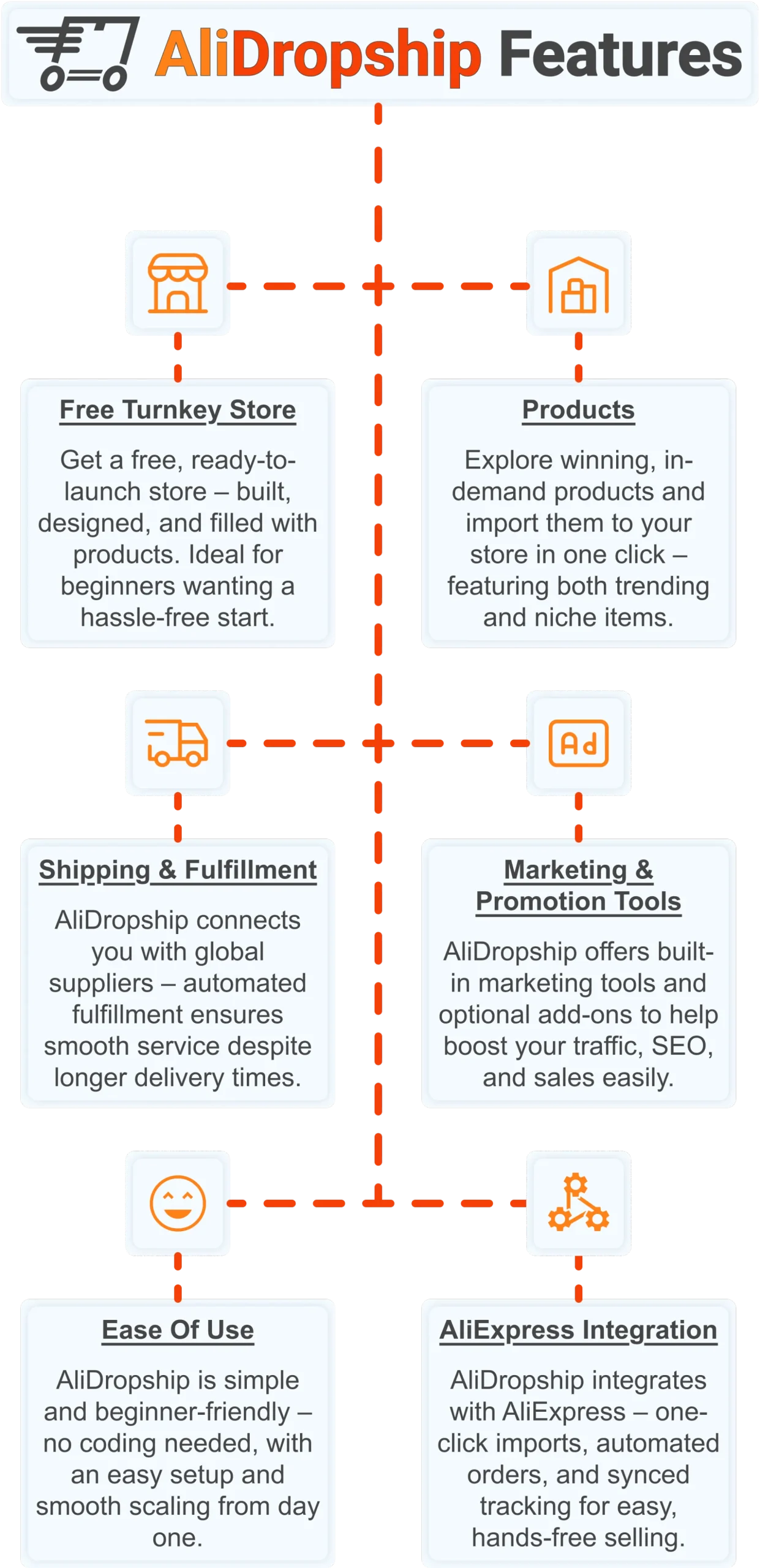
Free turnkey store ️
Get a free turnkey store – built, designed, and filled with products. Ideal for beginners wanting a hassle-free start, the store comes fully optimized to attract customers right away, saving you time on setup. Plus, it includes professional design elements to give your business a polished, trustworthy look from day one. This ready-made foundation makes it easy to move seamlessly into product selection.
Products
Once your store is set up, you can explore winning, in-demand products and import them in one click – featuring both trending and niche items. This wide selection lets you cater to diverse customer interests and test what works best. Regular updates ensure you always have fresh products, keeping your store competitive and relevant. With great products in place, smooth shipping becomes the next essential step.
Shipping & fulfillment
AliDropship connects you with global suppliers, and automated fulfillment ensures seamless order processing despite international delivery times. Customers receive real-time tracking updates, which builds confidence and trust in your store. Once shipping is handled reliably, you can focus on promoting your store and attracting traffic.
Marketing & promotion tools
To maximize sales, AliDropship offers built-in marketing tools and optional add-ons that help boost traffic, SEO, and conversions. From email campaigns and discounts to social media integration, these tools empower you to reach and retain customers without needing prior marketing experience. With promotion strategies in place, managing your business becomes simpler and more efficient.
Ease of use
AliDropship is beginner-friendly – no coding needed, with an intuitive dashboard that guides you through every step. Easy setup and smooth scaling let you expand your store without stress. As your business grows, adding new features, products, and marketing campaigns remains hassle-free, giving you more time to focus on sales.
AliExpress integration
Finally, AliDropship integrates seamlessly with AliExpress, enabling one-click imports, automated orders, and synced tracking. Your inventory stays up-to-date with the latest products and prices, while automated order processing frees you from manual tasks. Combined with the turnkey setup, reliable shipping, and built-in marketing tools, this integration ensures your dropshipping business is fully equipped for growth and success.
Opening an online store is the first step – AliDropship makes it the easiest one you will take. Get your free turnkey store and start selling in 2026.
Frequently asked questions
How much does it cost to open an online store?
A domain name typically costs 10 to 15 dollars per year through a registrar such as Namecheap or GoDaddy. Shopify plans start at 39 dollars per month, while WooCommerce itself is a free WordPress plugin with only hosting costs to consider. Business registration such as an LLC in the United States can range from 50 to 500 dollars depending on the state. Most beginners can launch a basic store within a few days once a niche, platform, and starting product selection are in place.
How much can a new online store realistically earn?
A brand new store in its first 60 days typically earns between 0 and 500 dollars per month while the owner tests products and traffic sources. A growing store between 60 and 180 days can reach 500 to 3,000 dollars per month as marketing gets optimized. Established stores with 6 or more months of data often reach 3,000 to 10,000 dollars per month or higher. Reaching the higher end usually takes 6 to 18 months of consistent product testing and traffic building.
What is the best platform to open an online store on?
WooCommerce is a free WordPress plugin that integrates directly with AliExpress, making it the preferred choice for dropshipping stores that want full ownership and long term control. Shopify is a hosted platform with plans starting at 39 dollars per month plus additional transaction fees unless a store uses Shopify Payments. Wix is the easiest platform to set up but the most limited for scaling beyond a handful of products. The right choice depends mainly on technical comfort level and how a store plans to source its products.
How do you choose products when opening an online store?
AliExpress remains the most accessible sourcing option, giving access to millions of products with real time inventory updates from suppliers. Strong candidates typically carry a rating of 4.5 stars or higher with at least 200 reviews and a supplier feedback score of 95 percent or better. Starting with 10 to 20 curated products is easier to market than filling a store with hundreds of items at launch. A markup of 2 to 3 times the supplier price is a common starting point for staying competitive while maintaining margin.
How long does it take to drive traffic to a new online store?
Organic search engine optimization typically takes 60 to 120 days to produce meaningful, compounding traffic without ongoing ad spend. Paid advertising on Facebook or Instagram can generate visitors immediately, with many new stores starting at a daily budget of 10 to 20 dollars while testing creatives. TikTok Ads offers a lower cost alternative with strong reach among younger audiences. Most successful stores combine paid and organic traffic rather than relying on a single channel.
 Previous post
