 ‧ Agnes Kazaryan ‧
September 22, 2026
‧ Agnes Kazaryan ‧
September 22, 2026  34 ‧
34 ‧
 0
0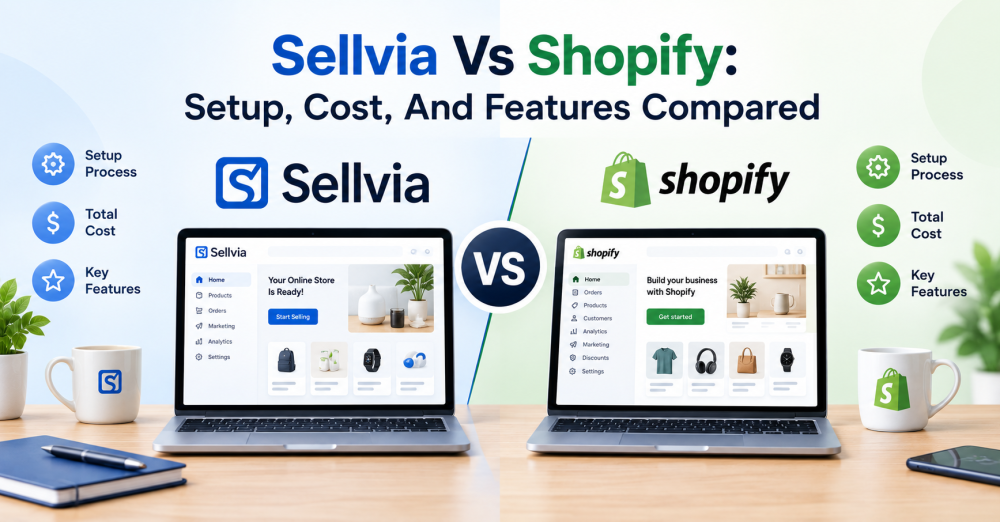
Quick Answer: Sellvia gives you a store pre-loaded with digital products and built-in ads so you can start selling almost immediately, while Shopify gives you a blank storefront with far more design and app flexibility that you have to populate and market yourself – Sellvia suits a faster, simpler start, and Shopify suits someone who wants long-term control over their brand.
Sellvia and Shopify solve the same basic problem – starting an online store – in almost opposite ways. One hands you a finished store and a catalog on day one; the other hands you a blank canvas and lets you build exactly what you want. Both are legitimate, widely used platforms, so the better choice comes down to how much setup work you want to do and how much control you want over the result.
This article compares the two head to head across setup time, cost, product sourcing, advertising, and support, so you can see where each one actually wins rather than relying on a marketing pitch from either side.
What is the core difference between Sellvia and Shopify?
Sellvia is a done-for-you online business platform: your store arrives already built and loaded with a curated catalog of digital products – guides, courses, checklists, and similar tools – plus a one-click advertising system to bring in buyers. Shopify is a store-building platform: it gives you the storefront software, hosting, and checkout, but you choose your own theme, source your own products through separate apps, and set up your own marketing.
Neither approach is inherently better – they are built for different starting points. Sellvia removes the setup work in exchange for a curated, done-for-you catalog. Shopify hands you the tools to build something fully custom, in exchange for more time and decisions on your end.
How much can you realistically earn with each platform?
These figures are illustrative ranges tied to effort level, not typical or guaranteed results on either platform – actual outcomes depend on your product choices, ad budget, and how much time you put into running the store.
Important note: It is possible to see a sale within your first week on either platform. It is not accurate to say most sellers do on either one, since neither company publishes data on what a typical store owner earns.
Setup and time to launch
Sellvia
Your store arrives already built, with products from Sellvia’s catalog already loaded and priced. There is no theme to choose, no product page to write, and no supplier to connect – your first task is picking which products to feature and turning on ads.
Shopify
You start with an empty store and work through a setup checklist: pick a theme, connect a payment method, add products (usually through a separate supplier app), and configure shipping and tax settings. Shopify’s setup process is well documented and reasonably fast for someone comfortable with basic web tools, but it is still meaningfully more work than a pre-built store.
What you can sell
Sellvia
Sellvia’s catalog is digital only – guides, courses, checklists, and similar tools created by Sellvia rather than by you. You choose which of these to feature; you are not sourcing or creating products yourself, and there is no shipping, warehouse, or inventory to manage.
Shopify
Shopify does not include a product catalog at all – it is a blank storefront. Most sellers connect a separate supplier app to source physical products, though you can also sell your own physical goods, your own digital downloads, or services directly. This makes Shopify far more flexible in what you can sell, at the cost of having to choose and set up that sourcing yourself.
Cost comparison
Sellvia
Sellvia’s monthly plan costs $39, or about $1.30 a day, after a 14-day free trial that includes a $40 ad credit. During the trial the store itself is free to use; order fees only apply once a sale actually happens. You keep 50 to 70% of each sale as your share, before ad spend, your monthly plan, and order fees.
Shopify
Shopify’s entry-level Basic plan runs $39 a month billed monthly, or roughly $29 a month on annual billing – the same headline price as Sellvia’s plan, though what it includes is different. Basic covers the storefront, hosting, and checkout, but does not include products, a supplier app, or an advertising system, so those come as separate costs on top. Online transactions through Shopify’s own payment processing typically carry a fee of around 2.9% plus 30 cents per sale on the Basic plan, with higher tiers (Grow, Advanced) lowering that rate in exchange for a higher monthly price.
Important: The $39/month sticker price looks identical on both platforms, but Sellvia’s plan already includes the product catalog and ad system, while Shopify’s plan is just the storefront – budget for a supplier app and your own ad spend separately if you choose Shopify.
Marketing and advertising
Sellvia
Sellvia includes one-click ads built into the platform. You choose a daily budget of $10 to $50, and the system handles targeting, creatives, and optimization for you – a $40 ad credit is included free during the trial so you can test it before spending your own money.
Shopify
Shopify does not include a built-in advertising system. You set up and manage your own campaigns through Facebook Ads, Google Ads, or a marketing app, which gives you more control over targeting and creative choices but requires learning those platforms yourself or hiring someone who already knows them.
Support and who each is built for
Why this works in 2026: The done-for-you versus build-it-yourself split has become the main way sellers choose between platforms like these – beginners increasingly value speed to launch, while more experienced sellers still gravitate toward the control a platform like Shopify offers.
Sellvia includes a personal growth manager to help you through setup and early questions, and the whole platform is designed to work from a phone with no coding or design background required. Shopify has extensive public documentation, a large app ecosystem, and a big community of freelancers and agencies who build Shopify stores professionally – support that assumes more baseline comfort with running a website yourself.
Legal and ethical considerations
Key principle: Whichever platform you choose, describe your products and expected results accurately to your own customers – neither platform’s flexibility or simplicity changes your responsibility to avoid misleading claims about what you are selling or what a buyer should expect.
What to avoid: assuming either platform guarantees a specific income because of how easy or flexible it is. What to do instead: treat your first 30 to 60 days on either platform as a test, track your actual numbers, and make decisions based on your own data rather than a general reputation either platform has.
Final thoughts: Sellvia or Shopify?
Neither platform is universally better – they are built for different starting points and different reader profiles.
- Complete beginner: Sellvia’s pre-built store and included ad system remove the most setup steps, which makes it a faster way to test whether running an online store is something you want to keep doing.
- Intermediate or part-time seller: Shopify paired with a supplier app gives you more control over your branding and product selection once you have some experience with the basics of running a store.
- Advanced or full-time goal: Shopify’s higher tiers, larger app ecosystem, and eventual Plus plan give the most room to scale a custom store as revenue grows, at the cost of managing more moving parts yourself.
Sellvia: Your complete all-in-one solution for starting an online business in 2026
If you want the simplest possible way to start an online business – especially if you’re brand new – Sellvia remains one of the most beginner-friendly platforms available in 2026. It gives you a fully built online store pre-loaded with digital products you can sell right away, plus one-click ads to help bring in buyers, so there is no design, coding, or product sourcing required to get started.
Prebuilt store, ready to sell
Sign up and your store arrives already built and pre-loaded with digital products you can sell immediately – no design, coding, or product sourcing required on your end. You choose which products to feature from the Sellvia catalog rather than creating your own. The store works from your phone or computer, so there is no separate software to install. With the store itself handled, running ads is the next step.
One-click ads built in
Instead of learning Facebook or Google Ads yourself, Sellvia’s built-in advertising system handles targeting, creatives, and optimization for you. You choose a daily budget of $10 to $50, and your store can start selling the same day you turn on ads. A $40 ad credit is included free during your trial, so you can test the system before spending your own money. Turning ads on gets your store in front of buyers – how much you sell from there still depends on your products and how you run things.
Digital products, no logistics headaches
Every product in the Sellvia catalog is digital – guides, courses, checklists, and similar tools created by Sellvia, not by you. There is no inventory, no shipping, and no warehouse involved, since each purchase is delivered to the buyer instantly. You keep 50 to 70% of each sale as your share, before ad spend, your monthly plan, and order fees. This removes the operational side that slows down most physical-product businesses.
Built for zero experience, zero tech skills
Every part of Sellvia is designed for someone who has never done this before – the dashboard works from a phone, the language stays simple, and a personal growth manager is available to answer questions as you go. There is no coding, design, or marketing background required to get your store live. This is one of the clearest differences between Sellvia and store-builder platforms like Shopify or Wix, which expect you to build, source, and market on your own. Once your store and ads are running, understanding the real costs is worth doing upfront.
A low monthly plan, costs shown upfront
Sellvia’s monthly plan costs $39, or about $1.30 a day, after a 14-day free trial that includes a $40 ad credit. During the trial the store itself is free to use; order fees only apply once a sale actually happens. After the trial ends, the $39 monthly plan continues automatically – you can cancel anytime before then with no charge. Beyond the base plan, ad spend, product packs, and other upgrades are separate costs worth budgeting for as you grow.
Backed by real recognition
Sellvia is a member of the Forbes Communications Council and the Entrepreneur Leadership Network, and it ranked 1,818th on the 2022 Inc. 5000 list of fastest-growing private companies. The platform has also picked up industry awards from TITAN, Hermes Creative Awards, MarCom, and dotCOMM. More than 1,500,000 stores have launched on Sellvia, and store owners have earned $1.5B+ in total. These are the kinds of independent, checkable signals worth looking for before trusting any online business platform.
If reading through this comparison left you leaning toward the simpler setup, it costs nothing to see it for yourself. Start your free Sellvia trial and compare it side by side.
Free for 14 days with a $40 ad credit. $39/month after the trial. Cancel anytime before then – no charge.
Frequently asked questions
Is Sellvia better than Shopify?
Better depends on what you are optimizing for. Sellvia gives you a pre-built store with digital products and ads already set up, which suits a faster, simpler start. Shopify gives you a blank storefront with more design and app flexibility, which suits someone who wants full control over their brand. Neither is objectively better across every situation.
Is Sellvia cheaper than Shopify?
The headline price is similar. Sellvia and the Shopify Basic plan both cost 39 dollars a month, but Sellvia includes the product catalog and advertising system in that price, while Shopify charges for those separately through supplier apps and your own ad spend. Total cost depends heavily on which apps and ad budget you add to a Shopify store.
Do I need technical skills to use Shopify instead of Sellvia?
Some, though Shopify is designed to be usable without coding knowledge. You will need to choose a theme, connect a payment method, and set up a supplier app and your own marketing, which takes more setup time and decisions than a pre-built Sellvia store. Sellvia is built specifically for people with no technical background at all.
Can I sell digital products on Shopify like I can on Sellvia?
Yes, Shopify supports digital products through its own settings or additional apps, but it does not come with a built-in digital product catalog the way Sellvia does. On Shopify you would need to create or source the digital products yourself, while Sellvia provides a ready-made catalog of guides, courses, and checklists from the start.
Which is better for a complete beginner, Sellvia or Shopify?
Sellvia generally requires fewer setup decisions for someone who has never run a store before, since the store, products, and ad system all come pre-built. Shopify can still work for a beginner, but expect more time spent choosing a theme, a supplier app, and learning basic marketing before your store is ready to sell.
 Previous post