 ‧ Agnes Kazaryan ‧
September 23, 2026
‧ Agnes Kazaryan ‧
September 23, 2026  411 ‧
411 ‧
 0
0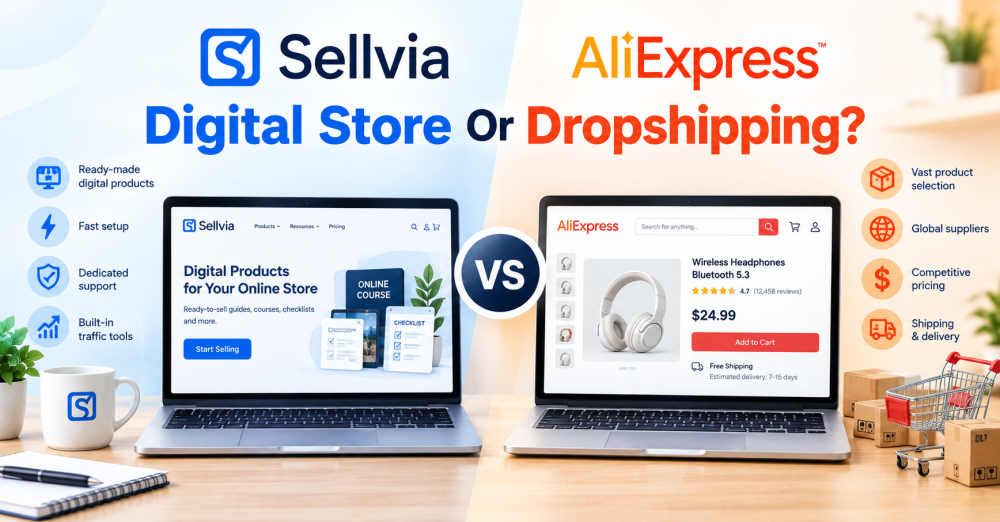
Quick Answer: Sellvia gives you a pre-built store loaded with digital products that deliver instantly, while AliExpress is a supplier marketplace you source physical products from yourself, then ship to customers through a separate store platform – Sellvia suits someone who wants speed and no shipping to manage, and AliExpress suits someone who wants physical products and is willing to handle sourcing, shipping times, and a separate store setup.
“Sellvia vs AliExpress” is a slightly unusual comparison, since the two are not quite the same type of thing – Sellvia is a complete store platform, while AliExpress is a supplier marketplace that you would typically pair with a separate store like Shopify or WooCommerce. Even so, people comparing them are usually asking the same underlying question: should I sell digital products through a done-for-you store, or source physical products myself and handle shipping?
This article walks through both models side by side, so you can see what each one actually involves before you commit time or money to either.
What is the core difference between Sellvia and AliExpress?
Sellvia is a done-for-you online business platform: you get a pre-built store already loaded with a curated catalog of digital products – guides, courses, checklists, and similar tools – plus a one-click advertising system. There is no supplier to manage and no shipping involved, since every product delivers to the buyer instantly.
AliExpress is a global marketplace where independent suppliers, mostly based in China, list physical products that sellers can source and resell through their own store. It is not a store platform itself – to sell AliExpress-sourced products, you need a separate storefront such as Shopify or WooCommerce, plus an order automation tool to import listings and route orders to suppliers. Shipping is handled by the supplier, and delivery times for standard shipping typically run somewhere between 7 and 20 days internationally, sometimes longer depending on the supplier and destination.
How much can you realistically earn with each?
These figures are illustrative ranges tied to effort level, not typical or guaranteed results on either model – actual earnings depend on your product choices, ad budget, and how well you manage the operational side of whichever approach you pick.
Important note: It is possible to see a sale within your first week on either model. It is not accurate to say most sellers do on either one, since neither Sellvia nor AliExpress publishes data on what a typical seller earns.
Setup and time to launch
Sellvia
Your store arrives already built, with digital products already loaded and priced. There is no separate store platform to set up, no supplier to find, and no shipping method to choose – your first real decision is which products to feature and when to turn on ads.
AliExpress
You will need to set up your own store first, typically on Shopify or WooCommerce, then connect an order automation tool to import products from AliExpress suppliers and route orders automatically. After that, you still need to vet suppliers for product quality and shipping reliability before featuring their listings in your store. This is meaningfully more setup than a pre-built store requires.
What you can sell, and how it ships
Sellvia
Sellvia’s catalog is digital only – guides, courses, checklists, and similar tools. Every purchase delivers instantly to the buyer, so there is no shipping, no inventory, and no supplier relationship to manage on your end.
AliExpress
AliExpress covers a huge range of physical products across nearly every category, sourced from independent suppliers. Standard shipping typically takes 7 to 20 days for international orders, though it can run longer depending on the supplier, destination, and time of year – customs delays and peak shopping seasons can add extra time. Setting honest shipping expectations on your product pages matters here, since long or unpredictable delivery windows are one of the most common sources of customer disputes with this model.
Cost comparison
Sellvia
Sellvia’s monthly plan costs $39, or about $1.30 a day, after a 14-day free trial that includes a $40 ad credit. Order fees apply once a sale happens, and you keep 50 to 70% of each sale as your share, before ad spend and your monthly plan.
AliExpress
AliExpress itself does not charge you a subscription to browse or source products, but building a store around it means paying for a separate platform (a Shopify plan, for example), typically an order automation app, and your own ad spend – plus the product cost itself, which varies by supplier and item. Total cost depends heavily on which store platform and automation tool you choose, and increased tariffs on goods shipped from China in recent years are also worth factoring into your product pricing.
Important: There is no single “AliExpress cost” the way there is a Sellvia monthly plan – the real total is the sum of your store platform, automation app, product cost, shipping expectations, and ad spend, so budget for all of those separately before comparing it to Sellvia’s flat monthly price.
Marketing and advertising
Sellvia
Sellvia includes one-click ads built into the platform, with a $40 ad credit included free during the trial. You choose a daily budget of $10 to $50, and the system handles targeting, creatives, and optimization for you.
AliExpress
AliExpress does not include any advertising system, since it is a sourcing marketplace rather than a store platform. You will need to run your own campaigns through whatever platform your store sits on – short-form video ads on social platforms are a common traffic source for this model in 2026, alongside standard Facebook and Google campaigns.
Legal and ethical considerations
Key principle: Whichever model you choose, set accurate delivery-time expectations for your customers – this matters especially for AliExpress-sourced products, where shipping windows are longer and less predictable than most buyers expect by default.
What to avoid: listing counterfeit or trademark-infringing products when sourcing from any marketplace, and quoting shipping times that do not reflect what your specific supplier actually delivers. What to do instead: order a test sample to your own address before featuring a new product, and disclose realistic delivery windows on your product pages and at checkout.
Final thoughts: Sellvia or AliExpress?
These two are not really competing for the exact same seller – the right one depends on whether you want digital products delivered instantly or physical products you are willing to source and ship.
- Complete beginner: Sellvia’s pre-built store and instant digital delivery remove the most setup steps and the shipping-time problem entirely, which makes it a faster way to test whether running a store is for you.
- Intermediate or part-time seller: AliExpress paired with a store platform and an automation tool works if you specifically want physical products and are willing to vet suppliers and manage customer expectations around shipping.
- Advanced or full-time goal: Experienced AliExpress sellers often move proven products to faster, more reliable suppliers once a listing sells consistently, treating AliExpress as an initial testing layer rather than a permanent supply chain.
Sellvia: Your complete all-in-one solution for starting an online business in 2026
If you want the simplest possible way to start an online business – especially if you’re brand new – Sellvia remains one of the most beginner-friendly platforms available in 2026. It gives you a fully built online store pre-loaded with digital products you can sell right away, plus one-click ads to help bring in buyers, so there is no design, coding, or product sourcing required to get started.
Prebuilt store, ready to sell
Sign up and your store arrives already built and pre-loaded with digital products you can sell immediately – no design, coding, or product sourcing required on your end. You choose which products to feature from the Sellvia catalog rather than creating your own. The store works from your phone or computer, so there is no separate software to install. With the store itself handled, running ads is the next step.
One-click ads built in
Instead of learning Facebook or Google Ads yourself, Sellvia’s built-in advertising system handles targeting, creatives, and optimization for you. You choose a daily budget of $10 to $50, and your store can start selling the same day you turn on ads. A $40 ad credit is included free during your trial, so you can test the system before spending your own money. Turning ads on gets your store in front of buyers – how much you sell from there still depends on your products and how you run things.
Digital products, no logistics headaches
Every product in the Sellvia catalog is digital – guides, courses, checklists, and similar tools created by Sellvia, not by you. There is no inventory, no shipping, and no warehouse involved, since each purchase is delivered to the buyer instantly. You keep 50 to 70% of each sale as your share, before ad spend, your monthly plan, and order fees. This removes the operational side that slows down most physical-product businesses.
Built for zero experience, zero tech skills
Every part of Sellvia is designed for someone who has never done this before – the dashboard works from a phone, the language stays simple, and a personal growth manager is available to answer questions as you go. There is no coding, design, or marketing background required to get your store live. This is one of the clearest differences between Sellvia and store-builder platforms like Shopify or Wix, which expect you to build, source, and market on your own. Once your store and ads are running, understanding the real costs is worth doing upfront.
A low monthly plan, costs shown upfront
Sellvia’s monthly plan costs $39, or about $1.30 a day, after a 14-day free trial that includes a $40 ad credit. During the trial the store itself is free to use; order fees only apply once a sale actually happens. After the trial ends, the $39 monthly plan continues automatically – you can cancel anytime before then with no charge. Beyond the base plan, ad spend, product packs, and other upgrades are separate costs worth budgeting for as you grow.
Backed by real recognition
Sellvia is a member of the Forbes Communications Council and the Entrepreneur Leadership Network, and it ranked 1,818th on the 2022 Inc. 5000 list of fastest-growing private companies. The platform has also picked up industry awards from TITAN, Hermes Creative Awards, MarCom, and dotCOMM. More than 1,500,000 stores have launched on Sellvia, and store owners have earned $1.5B+ in total. These are the kinds of independent, checkable signals worth looking for before trusting any online business platform.
If shipping times and supplier vetting sound like more work than you want right now, the instant-delivery route is worth a look. Start your free Sellvia trial and compare it for yourself.
Free for 14 days with a $40 ad credit. $39/month after the trial. Cancel anytime before then – no charge.
Frequently asked questions
Is Sellvia better than AliExpress?
Better depends on what you want to sell. Sellvia gives you a pre-built store with digital products that deliver instantly, while AliExpress is a supplier marketplace for physical products that requires its own store platform and shipping management. They solve different problems rather than one simply outperforming the other.
Do I need a separate store to sell AliExpress products?
Yes. AliExpress is a sourcing marketplace, not a store platform, so you need your own storefront, typically built on Shopify or WooCommerce, plus an order automation tool to import products and route orders to suppliers. Sellvia, by contrast, already comes as a complete store with products included.
How long does AliExpress shipping take compared to Sellvia?
AliExpress standard shipping typically takes 7 to 20 days internationally, and sometimes longer depending on the supplier, destination, and time of year. Sellvia products are digital and deliver to the buyer instantly after purchase, so there is no shipping wait at all on that side.
Is AliExpress dropshipping still worth it in 2026?
It can be, especially as a way to test product demand before committing to a more reliable supply chain, but it requires more ongoing management than a done-for-you platform. Supplier vetting, shipping-time disclosure, and handling customer expectations around delivery are all part of the work, on top of running your own store and marketing.
Can I sell digital products through AliExpress instead of physical ones?
Not really. AliExpress is built around physical products sourced from independent suppliers, so it is not set up for digital product sales the way Sellvia is. If digital products are what you specifically want to sell, a done-for-you platform with a digital catalog already built in is the more direct route.
 Previous post