 ‧ Agnes Kazaryan ‧
March 27, 2026
‧ Agnes Kazaryan ‧
March 27, 2026  702 ‧
702 ‧
 0
0
Affiliate marketing generates over $17 billion in revenue every year – and a growing share of that is going to everyday people working from home, not just large media companies. If you have been searching for a clear, honest affiliate marketing guide that actually explains how things work without the usual hype, you are in the right place.
Quick answer: Affiliate marketing is a model where you earn a commission by promoting other people’s products. You share a unique link, someone clicks it and buys, and you get paid. It works across blogs, YouTube, social media, and email – and beginners can realistically earn $30–$80/day within 60–90 days of consistent effort.
This guide walks through what affiliate marketing is, how much you can actually earn, the best programs to join, how to drive traffic, and what to avoid. Whether you are starting from zero or looking to scale an existing side income, everything you need is here.
Before diving in, it is worth understanding why 2026 is a strong year to enter this space. Search intent is sharper, affiliate networks are more transparent, and the tools available to beginners have never been better. The barrier to entry is genuinely low – what separates earners from non-earners is mostly consistency and strategy.
What is affiliate marketing?
Affiliate marketing is a performance-based income model where you earn a commission for sending paying customers to a company. You join a program, get a unique tracking link, and promote it through content you create – a blog post, a YouTube review, a social media post, or an email newsletter. When someone clicks your link and completes a purchase, the sale is attributed to you and you receive a percentage of the revenue.
The mechanics are straightforward. Most affiliate programs use browser cookies to track referrals, typically for 30–90 days after someone clicks your link. If they buy anything during that window, you get credit. Some programs use lifetime attribution, meaning you earn on every future purchase from that customer – not just the first one.
There are three main parties involved: the merchant (the company selling the product), the affiliate (you), and the customer. Networks like ShareASale, CJ Affiliate, and Impact act as middlemen, connecting affiliates with hundreds of merchants under one dashboard. Direct programs – like Amazon Associates or individual SaaS companies – handle everything themselves.
In 2026, affiliate marketing remains one of the most accessible ways to build an online income because it requires no product creation, no customer service, and no upfront inventory. Your job is to create useful content, attract the right audience, and recommend products honestly.
How much can you realistically earn from affiliate marketing?
This is the question most guides avoid answering honestly. The range is genuinely wide – from a few dollars a month to six-figure annual incomes – and the difference is mostly about traffic volume, niche selection, and how competitive your offers are. Here is a realistic breakdown by method and effort level.
Blog and SEO content offers the best long-term return because traffic compounds over time. Social media can produce faster results but is harder to sustain. Paid traffic is the fastest path to scale but requires capital and experience to run profitably.
One note on the headline figures: The $10,000/month numbers you see in affiliate marketing case studies almost always reflect 2–4 years of consistent work, a large content library (200+ posts), or a highly targeted email list. For a beginner putting in 10–15 hours per week, a realistic 90-day target is $30–$80/day – achievable, but not automatic.
Full-time effort also means treating this like a business, not a side project you open occasionally. That means keyword research before writing, tracking your click-through and conversion rates, and testing different offers within your niche. The people earning consistently treat every piece of content as a deliberate investment.
The best affiliate marketing channels for beginners
Choosing the right channel matters more than most beginners realise. The best channel for you depends on your existing skills, your content budget, and how quickly you want to see results. Below are the four most accessible paths for people starting out in 2026.
Content-based channels
Blogging and SEO
A blog is still the most reliable foundation for affiliate income. You write articles that rank in Google for searches like “best [product] for [use case]” or “[product] review”, embed your affiliate links naturally, and earn commissions when readers buy. The key advantage is that a well-ranked article works 24/7 without any ongoing effort after publishing.
To start, pick a niche narrow enough to rank in – for example, “budget home gym equipment” rather than “fitness” – use a free keyword tool like Ubersuggest or Google Search Console, and write at least 20 articles before expecting meaningful traffic. WordPress with a lightweight theme is still the standard setup. Hosting costs $3–$10/month, and a domain is around $12/year.
Earning potential: $50–$300/month at 6 months, scaling to $1,000–$5,000/month by year two with consistent publishing.
Why this works in 2026: Google continues to reward genuinely helpful, in-depth content over thin product listings, which benefits committed affiliate bloggers who treat their sites as real editorial resources.
YouTube product reviews
YouTube affiliate content converts exceptionally well because video builds trust faster than text. A 5–10 minute honest review of a product – showing it in use, explaining pros and cons clearly – can drive clicks for years after upload. You add your affiliate link in the video description, and viewers who trust your recommendation click through to buy.
You do not need expensive equipment. A modern smartphone, decent lighting, and a free video editor like DaVinci Resolve are enough to produce professional-looking content. The most important factor is niche selection: product categories like tech gadgets, kitchen appliances, fitness gear, and software tools convert reliably.
Earning potential: $100–$500/month at 1,000–5,000 subscribers in a commercial niche; $1,500–$4,000/month at 20,000+ subscribers.
Email newsletters
An email list is one of the most valuable assets an affiliate can own because you are not dependent on any algorithm. You build a list by offering a free resource – a checklist, a mini-guide, a discount – in exchange for an email address, then send regular content that includes affiliate recommendations when relevant.
Tools like ConvertKit, MailerLite, and Beehiiv all have free tiers that support up to 500–1,000 subscribers. The key to monetising an email list through affiliate links is trust – readers need to feel you are recommending things genuinely, not just filling space with paid plugs.
Earning potential: $200–$800/month with a warm list of 3,000–5,000 engaged subscribers, assuming a 2–3% click-through rate on affiliate links.
Social and paid channels
TikTok and Instagram Reels
Short-form video is the fastest way to build an audience from scratch in 2026. The TikTok algorithm still rewards new creators with organic reach that would cost thousands in paid ads on other platforms. Affiliate links work through your bio link (using a tool like Linktree) or through TikTok Shop, which now allows direct product tagging with affiliate attribution built in.
The downside is that social media traffic is unpredictable and platform-dependent. What goes viral today may not tomorrow, and algorithm changes can cut reach overnight. Use social media to build an audience fast, then redirect that audience to a blog or email list you own.
Earning potential: $30–$200/month at 5,000–15,000 followers; $500–$2,000/month at 50,000+ with consistent posting.
Paid traffic (Meta Ads and Google Ads)
Running paid ads directly to affiliate offers is an advanced strategy that can scale quickly but requires budget, testing discipline, and a strong understanding of conversion funnels. The core model is to run a Facebook or Google ad to a landing page – a review or comparison page – which then links to the affiliate offer. The margin between your ad spend and your commission revenue is your profit.
Most affiliate networks prohibit direct linking from ads to offers – you almost always need an intermediate landing page. Start with a budget of $20–$30/day, test two or three different ad creatives, and track your cost-per-click and conversion rates carefully before scaling. This is not a recommended starting point for beginners with no ad experience.
Earning potential: Variable – experienced media buyers in competitive niches earn $5,000–$20,000/month, but losses are common in the learning phase.
The best affiliate programs to join in 2026
Not all affiliate programs pay equally, and the right program depends heavily on your niche and audience. Here is a breakdown of the strongest options across categories.
SaaS programs with recurring commissions are the gold standard – you earn every month a customer you referred keeps their subscription. Amazon Associates pays less per sale but converts extremely well because almost everyone already has an account and trusts the platform.
Important note: Amazon Associates has a 24-hour cookie window, one of the shortest in the industry. If you rely heavily on Amazon, pair it with a longer-cookie program in the same niche to capture delayed buyers.
How to drive traffic to your affiliate content
Great content with no traffic earns nothing. Traffic strategy is what separates hobbyists from earners. Here are the four most reliable methods in 2026.
Search engine optimisation (SEO)
SEO is the highest-ROI long-term traffic source for affiliate marketers. The goal is to rank your content on page one of Google for searches that have commercial intent – meaning the searcher is already close to making a purchase decision. Focus on “best [product] for [use case]”, “[product] vs [product]”, and “[product] review” keywords. These convert at 2–5x the rate of purely informational queries.
Use free tools like Google Keyword Planner or Answer the Public to find low-competition keywords with at least 500 monthly searches. Write articles that are longer and more thorough than the current page-one results. Build internal links between related posts on your site. Be patient – new sites typically take 4–6 months to gain meaningful search rankings.
Pinterest functions as a visual search engine and sends remarkably consistent traffic to blogs in niches like home decor, fashion, food, personal finance, and DIY. A single well-designed pin can drive traffic for 12–18 months after it is published. Pins link directly to your blog posts, which then convert readers via affiliate links. Create 5–10 pins per article using Canva, focus on vertical 1000x1500px images, and pin consistently – 5–10 pins per day using a scheduler like Tailwind.
Reddit and online communities
Reddit, Quora, and niche forums are underused traffic sources for affiliate marketers. The key is to contribute genuinely first – answer questions helpfully without links for several weeks – and then mention your content only when it directly answers what someone is asking. Subreddits in personal finance, homeownership, tech, and fitness all have active communities where well-placed recommendations convert at surprisingly high rates. Always disclose your affiliate relationship when sharing links.
YouTube SEO
YouTube is the second largest search engine in the world, and video content compounds in value just like blog posts. Optimise your video titles and descriptions with the same keywords you would target in a blog post. A review video ranking on both Google and YouTube for the same term can double your affiliate click volume from a single piece of content.
Legal and ethical considerations for affiliate marketers
Affiliate marketing has a real credibility problem in parts of the internet, mostly because some marketers cut ethical corners that erode trust and break rules. Understanding what to avoid – and what to do instead – will save you from compliance issues and keep your audience’s trust intact long-term.
What to avoid
Important: The FTC (Federal Trade Commission) in the US requires you to disclose affiliate relationships clearly and conspicuously. This means stating at the top of any article, video description, or social post that it contains affiliate links – not buried in footnotes, not in vague language. Most other countries have similar requirements. Non-disclosure can result in fines and removal from affiliate programs.
Other practices to avoid entirely include writing fake or inflated reviews to earn more commissions, using cookie stuffing or other black-hat tracking manipulation, creating comparison content where you always “coincidentally” recommend the highest-commission option, promoting products you have not used or researched, and cloaking affiliate links in ways that violate platform terms of service.
Key principle: If you would not recommend a product to a close friend knowing they would spend real money on it, do not recommend it to your audience for a commission.
What to do instead
Be transparent with every disclosure. Write honest reviews that include genuine downsides – readers recognise balanced content and trust it more. Choose products you have actually used or can evaluate objectively. If you earn a higher commission from one product over a competitor, disclose that too when relevant. Long-term trust is worth more than short-term commission bumps from misleading recommendations.
On the platform side, always read the terms of service for each affiliate program. Some programs prohibit PPC bidding on their brand keywords, placing links in email newsletters, or sharing links on certain social platforms. Violating these terms can result in account termination and forfeiture of unpaid commissions.
How to choose your affiliate marketing path
There is no single best approach to affiliate marketing. The right path depends on where you are starting from, how much time you have, and what kind of income you are aiming for. Here is a practical guide by reader profile.
Complete beginner
If you are starting from scratch with no existing audience and no blog, the clearest path is to start a niche blog on WordPress, write 20–30 thorough articles over 3–4 months, and apply to Amazon Associates and one or two niche-specific programs. Do not try to run paid ads, build a YouTube channel, and grow a newsletter simultaneously – pick one channel and go deep. Budget $50–$100 for domain and hosting and treat your first 90 days as a learning investment, not an income expectation.
Intermediate / part-time
If you already have some online presence – a small blog, a social following, or an email list – focus on adding commercial intent content to what you already publish. Find the 5–10 keywords in your niche where affiliate products fit naturally, write dedicated review or comparison posts, and track your clicks and conversions from day one using a free tool like Pretty Links or your network dashboard. At this stage, swapping out low-commission programs for higher-commission alternatives can double your income without any extra traffic.
Advanced / full-time goal
If you are targeting $3,000–$10,000/month from affiliate marketing, you need either a high-traffic content site (500,000+ monthly pageviews), a highly engaged email list (20,000+ subscribers), or a combination of the two. At this level, content outsourcing, CRO testing, and direct relationships with merchants for higher commissions become worthwhile investments. Many full-time affiliates also diversify into creating their own digital products, which offers better margins than commission-based income.
Looking for faster returns
Affiliate marketing rewards patience more than almost any other online income model. If you need income in 30–60 days rather than 6–12 months, it is worth considering whether a different model – like running an ecommerce store with dropshipping – better fits your timeline. The two models complement each other well, and many successful online entrepreneurs run both.
AliDropship: Your complete all-in-one solution for starting dropshipping in 2026
If you want the simplest possible way to start dropshipping – especially if you’re brand new – AliDropship remains one of the most beginner-friendly tools available in 2026. It brings together store creation, product imports, automation, and marketing into a single streamlined system designed to help you launch quickly and grow confidently.
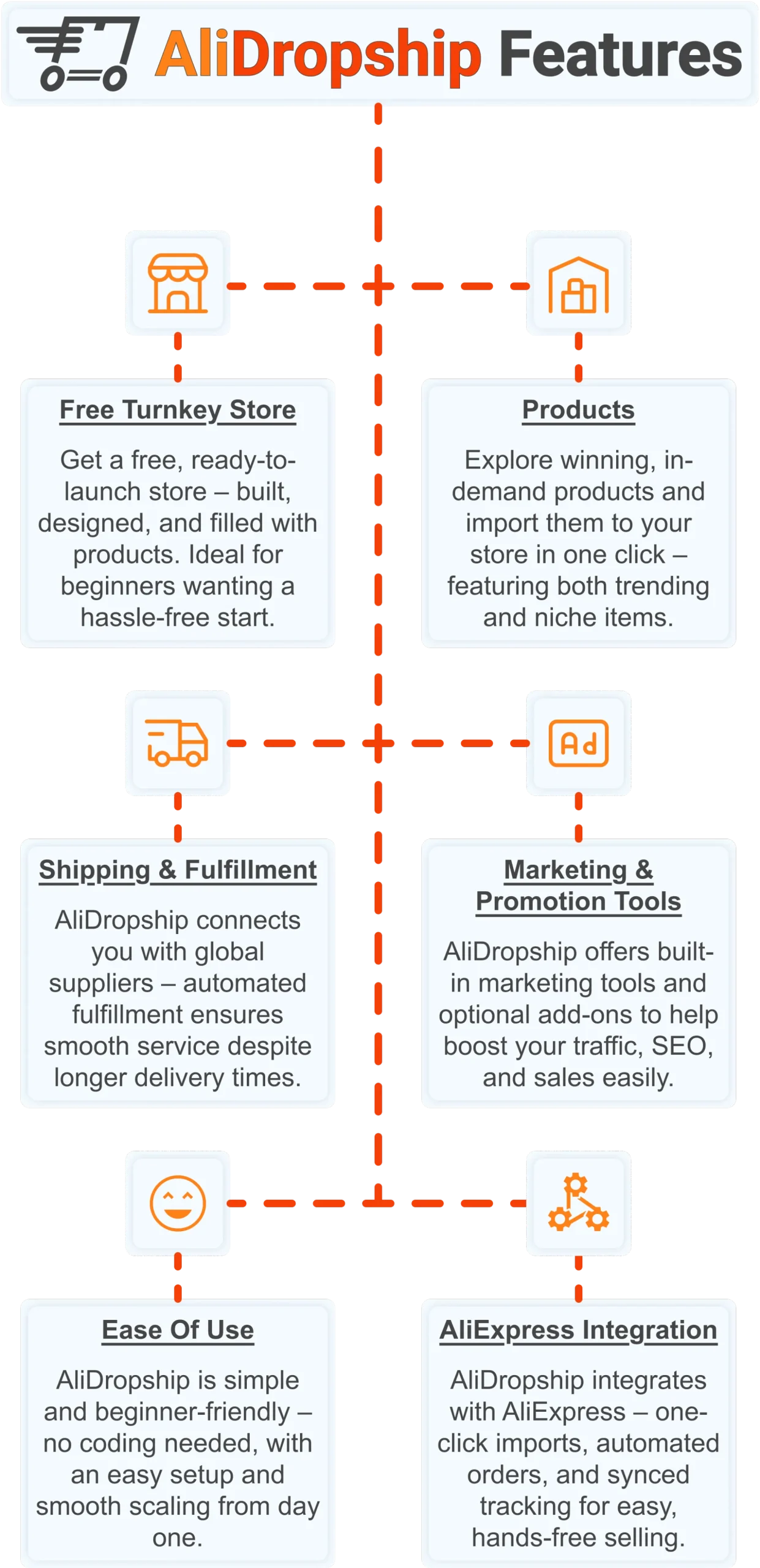
Free turnkey store ️
Get a free turnkey store – built, designed, and filled with products. Ideal for beginners wanting a hassle-free start, the store comes fully optimized to attract customers right away, saving you time on setup. Plus, it includes professional design elements to give your business a polished, trustworthy look from day one. This ready-made foundation makes it easy to move seamlessly into product selection.
Products
Once your store is set up, you can explore winning, in-demand products and import them in one click – featuring both trending and niche items. This wide selection lets you cater to diverse customer interests and test what works best. Regular updates ensure you always have fresh products, keeping your store competitive and relevant. With great products in place, smooth shipping becomes the next essential step.
Shipping & fulfillment
AliDropship connects you with global suppliers, and automated fulfillment ensures seamless order processing despite international delivery times. Customers receive real-time tracking updates, which builds confidence and trust in your store. Once shipping is handled reliably, you can focus on promoting your store and attracting traffic.
Marketing & promotion tools
To maximize sales, AliDropship offers built-in marketing tools and optional add-ons that help boost traffic, SEO, and conversions. From email campaigns and discounts to social media integration, these tools empower you to reach and retain customers without needing prior marketing experience. With promotion strategies in place, managing your business becomes simpler and more efficient.
Ease of use
AliDropship is beginner-friendly – no coding needed, with an intuitive dashboard that guides you through every step. Easy setup and smooth scaling let you expand your store without stress. As your business grows, adding new features, products, and marketing campaigns remains hassle-free, giving you more time to focus on sales.
AliExpress integration
Finally, AliDropship integrates seamlessly with AliExpress, enabling one-click imports, automated orders, and synced tracking. Your inventory stays up-to-date with the latest products and prices, while automated order processing frees you from manual tasks. Combined with the turnkey setup, reliable shipping, and built-in marketing tools, this integration ensures your dropshipping business is fully equipped for growth and success.
Frequently Asked Questions
What is affiliate marketing and how does it work?
Affiliate marketing is a performance-based income model where you earn a commission for sending paying customers to a company through a unique tracking link. Most affiliate programs use browser cookies to track referrals, typically for 30 to 90 days after someone clicks your link. Affiliate marketing generates over 17 billion dollars in revenue every year, with a growing share going to everyday people working from home. Beginners can realistically earn 30 to 80 dollars per day within 60 to 90 days of consistent effort.
How much can you realistically earn from affiliate marketing?
Blog and SEO content typically earns 50 to 500 dollars per month for beginners, scaling to 2000 to 10000 dollars or more monthly for established sites. YouTube reviews can bring in 100 to 1500 dollars per month with 5000 to 20000 subscribers in a commercial niche. Email newsletters with an engaged list of 5000 or more subscribers can generate 200 to 3000 dollars monthly. For a beginner putting in 10 to 15 hours per week, a realistic 90-day target is 30 to 80 dollars per day rather than the 10000 dollar monthly figures often seen in case studies.
Which affiliate programs pay the best commissions in 2026?
Amazon Associates pays 1 to 10 percent depending on category and works well for physical product bloggers and reviewers due to high trust and conversion rates. ShareASale commissions vary by merchant from 5 to 30 percent, making it strong for bloggers in fashion, home, and finance niches. SaaS direct programs like Semrush and HubSpot pay 20 to 40 percent in recurring commissions, considered the gold standard since you earn every month a referred customer stays subscribed. Amazon Associates has a 24 hour cookie window, one of the shortest in the industry, so pairing it with a longer-cookie program helps capture delayed buyers.
What are the best traffic strategies for affiliate marketing content?
SEO is the highest-ROI long-term traffic source, with commercial-intent keywords like product review or product versus product converting at 2 to 5 times the rate of purely informational queries. New sites typically take 4 to 6 months to gain meaningful search rankings, so patience is required. Pinterest functions as a visual search engine, and a single well-designed pin can drive traffic for 12 to 18 months after publishing. YouTube SEO can double affiliate click volume from a single piece of content when a review video ranks on both Google and YouTube for the same term.
What legal disclosure rules apply to affiliate marketers?
The FTC in the US requires affiliates to disclose relationships clearly and conspicuously, meaning a statement at the top of any article, video description, or social post that it contains affiliate links. Non-disclosure can result in fines and removal from affiliate programs, and most other countries have similar requirements. Practices to avoid entirely include writing fake or inflated reviews, using cookie stuffing, and promoting products never actually used or researched. Some affiliate programs also prohibit PPC bidding on their brand keywords, and violating these terms can result in account termination and forfeiture of unpaid commissions.
Affiliate marketing builds income slowly, but a dropshipping store gives you a direct sales channel that earns from day one. Get your free turnkey store and start selling today.
 Previous post
