 ‧ Agnes Kazaryan ‧
October 15, 2026
 188 ‧
 0
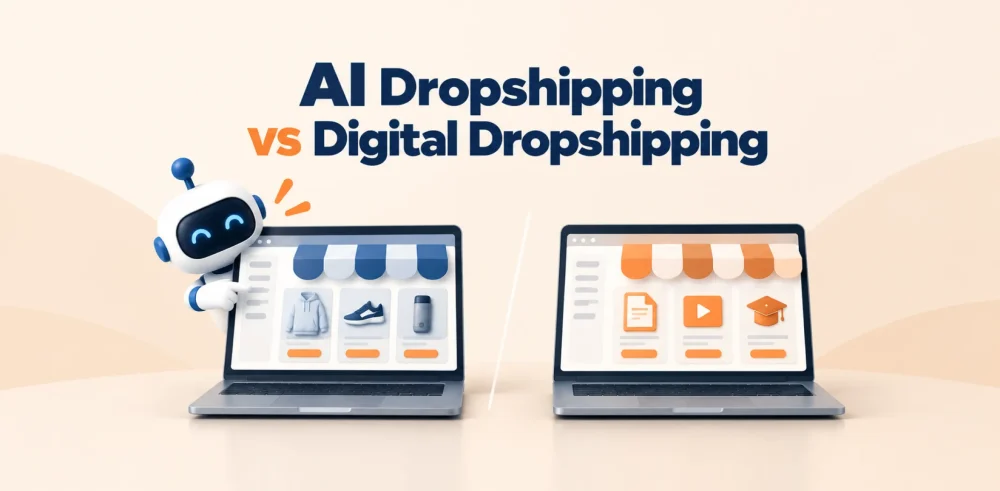
AI dropshipping vs digital dropshipping sounds like a choice between two different businesses. It is not quite that. One term describes the tools you use. The other describes what you sell. The two can overlap, and that overlap is where most of the confusion comes from.
Here is the short version. AI dropshipping means using AI to build and run a store. Digital dropshipping means selling digital products, such as templates, guides, or courses, instead of physical goods. You can do either one without the other, or both at once.
Quick Answer: AI dropshipping vs digital dropshipping is not a head-to-head choice. AI describes the tools, and digital describes the product. A store can use both, one, or neither, so compare them on costs, risks, and how much work you want to do yourself.
This guide compares them side by side, shows where they overlap, and gives you a simple way to decide which setup fits you.
What are AI dropshipping and digital dropshipping?
AI dropshipping
AI dropshipping is dropshipping where AI tools help with parts of the work. Depending on the provider, that can mean store setup, product research, product descriptions, ad copy, or ad creatives. You still choose what to sell, check the numbers, and approve what goes live. The products can be physical or digital.
Digital dropshipping
Digital dropshipping means selling digital products without making them yourself. Guides describe products such as e-books, templates, courses, software, and design assets that customers receive right after paying. There is no stock to hold and nothing to ship. Instead of a supplier sending a box, the product source gives you a license to sell the file.
How both compare with traditional dropshipping
Traditional dropshipping sells physical goods that a supplier ships to your customer. That brings shipping times, returns, and supplier problems. Digital dropshipping removes those. AI dropshipping does not change them by itself, because it only changes how the store gets built and run.
Why does this matter in 2026? AI has made stores faster to build, and digital products have made stores simpler to run. People often mix the two ideas together, so any AI dropshipping vs digital dropshipping comparison needs clear definitions to be fair.
How much can you realistically earn?
The product type affects margin per sale and risk. AI mostly affects how much time the setup takes. The table below shows illustrative margin ranges per sale for three setups, all before ads.
Margin per sale is only the starting point. Ads, plan costs, platform fees, and license costs all come out of it, and some stores may never cover their costs. Using AI can save you setup time, but it does not raise the margin on a product. Use the ranges to compare setups, not to predict your results.
Be careful with any comparison that shows only one side of the numbers. A page that praises digital products or AI tools without showing the full costs is not giving you what you need to decide.
These figures are illustrative ranges, not typical results or guarantees. Individual results vary and depend on the work you put in.
Explore the bundle and see whether it fits the way you want to start.
AI dropshipping vs digital dropshipping side by side
This table compares the two ideas on the factors that matter most when you are choosing. Keep in mind that they sit on different axes, so some rows will look like a comparison of tools against products.
The first two rows explain why this comparison confuses people. AI dropshipping tells you how a store is run, and digital dropshipping tells you what it sells. The other rows show where the practical differences start: shipping, costs, and risks.
Where the two ideas overlap
The clearest overlap is an AI-built store that sells digital products. AI sets up the store, writes the copy, and helps run the ads. The catalog is digital, so delivery is automatic. Some offers are built this way, and they are the reason many people wonder about AI dropshipping vs digital dropshipping in the first place.
The overlap works in both directions. AI dropshipping tools can also help you create or edit digital products, such as checklists or templates. If you do that, remember what the US Copyright Office said in January 2025: prompts alone do not give a person enough control to count as the author of an AI output. Purely AI-generated products may not be protected from copying, while human selection, arrangement, and editing can add protection.
Pro Tip: If you use AI to draft a digital product, edit it by hand and keep a record of your changes. That makes the product better and easier to defend.
What digital dropshipping adds and what it changes
What it adds
- No stock or shipping: Nothing to store, pack, or send, and no supplier delays.
- Instant delivery: Customers get the product right after paying, and location matters less than with physical goods.
- A wide choice of products: Templates, printables, guides, courses, software, and design assets.
What it does not change
- The need to market: Guides on the topic point out that digital products do not market themselves, so ad and content costs still apply.
- License rules: Resale rights vary. Some licenses allow reselling a product as it is, and others allow edits or rebranding. Breaking the terms can lead to legal problems.
- Refund requests: Some guides say digital products have fewer returns, but buyers can still ask for refunds and dispute charges.
- Tax rules: Digital products can be taxed differently from physical goods, depending on the state.
Important note: Read the license for every digital product before you sell it, and keep proof of what you bought and the terms that came with it.
Your next step
Two ideas in one setup
Review what the bundle includes, then decide whether it is the right fit for you.
What AI adds and what it does not change
What it adds
- Faster setup: AI store builders can create a storefront from a short description.
- Faster content: Product descriptions, emails, and social posts can be drafted for you to edit.
- More testing: AI can produce more ad creatives and variations to test.
What it does not change
- Ad prices: Platforms still charge for every click or impression, whether a person or an AI wrote the ad.
- Product quality and demand: AI cannot make buyers want a weak product.
- Accuracy: AI can write text that sounds right and is wrong, so a person has to check it.
- The sales pitch around it: The FTC has acted against AI store programs that made big claims about what their AI could do.
How to choose between them
When you weigh AI dropshipping vs digital dropshipping, it helps to ask two questions instead of one, because they sit on different axes. First, what do I want to sell? Second, how much do I want AI to do?
- If you want no shipping and fewer moving parts: A digital catalog is the simpler path. Check licenses, tax rules, and refund terms first.
- If you want physical products: You can still use AI tools, but plan for supplier checks, shipping times, returns, and duties.
- If you want the least technical work: Look for an AI-built setup where you approve what the AI creates instead of building it yourself.
- If you want full control over the product: Plan to create or heavily edit your own digital products, and treat AI as a drafting tool.
Whatever you choose, run a break-even check before you spend: price minus product cost, minus fees, minus ad cost per sale, compared with your monthly plan. If the numbers do not work on paper, neither idea will fix them.
Legal and ethical considerations
Both ideas come with rules. For digital products, the biggest are licenses and honest marketing.
What to avoid
- Reselling digital products beyond what the license allows
- Passing off someone else’s work as your own
- Fake or misleading reviews, including reviews written by AI to sound like real customers
- Income claims or “this store makes X” stories that suggest typical results
- Publishing AI-written claims that you have not checked
What to do instead
- Read each license and keep proof of purchase and terms
- Edit AI-written content so that every claim is accurate
- Show the full price, fees, and refund policy before the buyer pays
- Check how your state taxes digital products and physical goods
Key principle: Sell only what you have the right to sell, and say only what you can prove.
Final thoughts: how to decide between the two
So, which wins in the AI dropshipping vs digital dropshipping debate? Neither, because they answer different questions. AI tells you how the store gets built and run. Digital tells you what it sells. Pick the product type that fits your budget and risk tolerance, then decide how much of the work you want AI to handle.
- Complete beginner: A digital catalog with an AI-built setup keeps the workload small. Run the break-even check and read every term before you pay.
- Intermediate or part-time: Test one product type at a time, and track margin after ads and fees. Results can take 60–90 days or longer, so plan around that.
- Advanced or full-time goal: Mix both on purpose. Use AI to save time on research, copy, and creatives, and own your product sourcing, licenses, and customer care.
Check the offer page for current terms.
AliDropship: Your complete all-in-one solution for starting an online business in 2026
If you want the simplest possible way to start an online business – especially if you’re brand new – AliDropship remains one of the most beginner-friendly platforms available in 2026. AI configures your store, stocks it with 60+ digital products, and sets up your first ads, so you can get started without any tech skills. You approve, and the AI does the setup work.
AI builds your store ️
Your store is configured, designed, and stocked before you log in for the first time. You pick a domain from the list at signup, and it stays free for as long as you subscribe, with hosting and SSL included. There is no theme to choose, nothing to install, and no niche to guess at. The store is mobile-ready, so you can run it from your phone. With the store ready, the next step is the products.
60+ digital products, pre-loaded
Your store arrives with 60+ digital products already loaded across several niches – guides, courses, checklists, and online tools. They carry a 50–70% margin per sale, after order fees and before ad spend and your monthly plan, with no per-unit cost. You do not need to create or source anything. If you want more, you can add products from a catalog of 100+ AI toolkits, which build a personalized plan, script, or guide for each buyer on the spot. Each toolkit is a paid add-on, charged separately from your plan.
Instant digital delivery ⚡
Everything you sell is digital, so delivery is instant and automatic after each purchase. There is no inventory to hold, no shipping to arrange, and no returns to manage. Each processed order carries an order fee, so it is worth factoring that into your numbers. With delivery handled, you can focus on bringing customers to your store.
AI-run ads
The AI writes the ad copy, generates the creatives, and launches your campaigns across Google, Instagram, TikTok, and Amazon, then adjusts spend based on what is converting. You approve the direction, and the AI handles the platforms and the copy. The bundle includes a $40 ads credit to get started, and once the ads are on, your store can start selling the same day. With promotion covered, the rest of the platform stays simple to run.
Support from day one
AliDropship is built for beginners – no coding and no tech skills needed. A Personal Business Growth manager, a real person who knows your store, helps with strategy and onboarding questions for as long as you subscribe. You also get a 30-minute one-to-one priority setup call with a specialist, plus access to an AI Winning Products database that shows which products are moving, at what margin, and against how much competition. As your business grows, you can add products and adjust your ad budget at your own pace.
What it costs
Here is the full picture, so there are no surprises. The trial is free for 14 days, with full access and nothing locked. Your subscription is not billed until day 15, and if you cancel before then, you pay no subscription fee. After the trial, the monthly plan is $39/month (about $1.30 a day). Beyond your $40 ads credit, ad spend is paid separately, from $10 to $50 per day, and you set the budget. Order fees are charged on each processed order, and each AI toolkit you add is a paid add-on. Results vary, and what you earn depends on the products you choose, your ad budget, and the effort you put in.
Seeing the two ideas in one real offer can make the comparison clearer. Open the offer page and check what is included, what the AI handles, and what it costs.
Frequently asked questions
What is the difference between AI dropshipping and digital dropshipping?
AI dropshipping describes how you run a store, with AI tools helping with setup, copy, creatives, or ads. Digital dropshipping describes what you sell, which is downloadable products such as templates, guides, courses, or design assets. The two are not opposites, and a store can use AI to sell digital products. Physical products can also be sold with AI tools, but they add shipping and supplier risks.
Is digital dropshipping cheaper to start than traditional dropshipping?
It often needs less money upfront, because there is no stock, packaging, or shipping. Costs still include ads, platform fees, payment fees, and any license or product fees. For the AliDropship AI Dropshipping Bundle, which sells digital products, the plan is 39 dollars per month after a 14-day trial, and ad spend beyond the included 40 dollar credit runs 10 to 50 dollars per day. Cancel before day 15 and you pay no subscription fee.
Can you combine AI dropshipping and digital dropshipping?
Yes. A store can use AI to build pages, write copy, and run ads while selling digital products that are delivered automatically. This removes shipping and stock, but it does not remove costs, because ads, fees, and plan costs still apply. Check the license terms for every digital product before you sell it.
What are the risks of dropshipping digital products?
License limits are the main risk, because resale rights vary and breaking them can cause legal problems. Some buyers will still ask for refunds, and digital files can be copied or shared without permission. Digital products do not market themselves, so ad and content costs still apply. Keep proof of your license and a clear refund policy.
Which is better for beginners, AI dropshipping or digital dropshipping?
It depends on your budget and your comfort with risk. Digital products remove shipping and stock, and AI tools reduce the technical work, so combining the two can lower the workload. Plan to test for 60 to 90 days or longer before judging results. Read the terms and costs of any offer before you pay.
 Previous post
