 ‧ Agnes Kazaryan ‧
April 06, 2025
‧ Agnes Kazaryan ‧
April 06, 2025  4513 ‧
 0
0
Most people searching for AliDropship vs Shopify already have a gut feeling one of them is better – they just want someone to confirm it with actual numbers. So here it is up front: if you are starting from zero, AliDropship is the faster, cheaper, and simpler path to a live dropshipping store.
If you already have ecommerce experience and want maximum flexibility, Shopify has its place. The difference comes down to what you are paying for and how quickly you want to see results.
Quick Answer: AliDropship is a purpose-built dropshipping system that includes a 14-day free trial, then a simple $39 per month subscription covering your store, hosting, product importing, order automation, and marketing tools with no transaction fees. Shopify is a general ecommerce builder that requires third-party apps and additional monthly costs to reach the same functionality.
This comparison covers everything that matters – setup, features, real costs, shipping options, and who each platform actually suits. Read it once and you will know exactly which one to pick.
What is AliDropship vs Shopify – and why does the difference matter?
These two platforms are often mentioned in the same breath, but they were built for fundamentally different purposes. That context shapes almost every practical decision you make as a store owner.
AliDropship is a complete dropshipping ecosystem built from the ground up for one job: helping people launch and run a dropshipping store without needing technical knowledge, a developer, or a stack of third-party tools. When you sign up for the free trial, your store is built and hosted for you, products are already loaded, and every core function – importing, ordering, tracking, marketing – runs inside one dashboard. After the trial, the store continues at just $39 per month.
Shopify is a general ecommerce platform. It powers millions of online stores worldwide and is genuinely impressive as a builder – but it was not designed specifically for dropshipping. To run a dropshipping operation on Shopify, you need to layer on apps like DSers, Spocket, or similar tools. Each one costs extra, lives in its own dashboard, and needs its own configuration. That is manageable if you know what you are doing, but for anyone new to ecommerce it adds real friction before you can make your first sale.
Why this works in 2026: The dropshipping market is more competitive than it has ever been, and getting to market fast matters. An all-in-one system removes the setup friction that causes most new sellers to stall before they see a single order come in.
How much can you realistically earn with each platform?
Your platform choice does not determine how much money you make – your niche, your products, and your marketing effort do. But your platform does affect how quickly you get started and how much of your revenue you actually keep. Here is how the two compare across realistic earning scenarios.
These figures are realistic for sellers putting in consistent effort over 60–90 days. Neither platform guarantees income – results depend on niche selection, product quality, and how much you invest in marketing. That said, lower overhead on AliDropship means more revenue stays with you as you scale, which is a real advantage. The 14-day free trial also means you can test everything at zero risk.
One note on earning expectations: Most new dropshippers see their first meaningful sales in weeks 4–8, not days. Your platform affects how smoothly you get through that learning period – not whether you can succeed at all.
Setup and getting started: Where the gap shows up first
This is where the AliDropship vs Shopify comparison becomes immediately practical. Setup experience is the first thing you will feel, and it sets the tone for everything that follows.
AliDropship setup
When you sign up for AliDropship’s free trial, your store is built for you. Hosting is included, the domain is sorted, the design is ready, and products are already loaded into your niche store. You are not staring at a blank screen wondering where to begin.
The technical foundation is completely in place from day one. You move straight into customising your pricing rules, refining your product selection, and thinking about how to drive traffic. For someone with no prior ecommerce experience, this removes an enormous amount of friction from the early stages.
Shopify setup
Shopify gives you a clean, professional interface – but it is a blank canvas. You choose a theme (premium ones cost extra), install a dropshipping app, connect your payment processor, configure shipping zones, and set up everything yourself. None of that is impossible, but there are multiple points where beginners hit a wall and lose momentum.
If you want to dropship specifically from AliExpress, you also need to install and configure a separate app like DSers – which adds another layer of setup before your first product is even live.
Product importing and inventory management
How easily you can add and manage products affects how quickly you can test new items and respond to trends. This is a day-to-day operational difference, not just a setup one.
AliDropship product importing
AliDropship includes a Chrome extension that lets you import any AliExpress product into your store in one click – images, variations, descriptions, and pricing all come across automatically. Global pricing rules can be set once and applied consistently, keeping your margins stable without manual adjustments. Inventory and price syncing happen in the background, so you are far less likely to sell an out-of-stock item or unknowingly price a product at a loss when a supplier changes their cost.
Shopify product importing
Shopify has no native AliExpress import tool. You need a third-party app – most commonly DSers – to handle product importing, inventory syncing, and order routing. DSers has a free tier, but full automation requires a paid plan. You also end up managing two separate dashboards, which creates friction. Keeping inventory accurate across both systems requires more active attention on your part.
Order fulfilment and automation
Order automation is one of the biggest time-savers in any dropshipping operation. The more automated your fulfilment is, the more bandwidth you have for marketing and growing your store rather than manually processing orders.
AliDropship order automation
When a customer places an order in your AliDropship store, the system automatically routes it to the supplier. Tracking information syncs back to your store and is shared with the customer without any manual steps on your end. This works whether you are fulfilling through AliExpress suppliers or through Sellvia’s US-based fulfilment network. The entire flow runs inside one platform – no switching between tools, no sync errors between separate systems.
Shopify order automation
Shopify can automate order fulfilment, but the level of automation depends entirely on which apps you are using and how well they are configured. Apps like DSers do a reasonable job, but they add cost and can occasionally have sync issues. If you are using multiple fulfilment sources, keeping everything running smoothly requires more oversight. Advanced automation features on most Shopify-compatible apps are locked behind higher-tier paid plans.
Shipping speed and fulfilment options
Shipping is a direct driver of customer satisfaction, repeat purchases, and review scores. Long delivery windows hurt conversion rates and increase refund and chargeback requests – which is why your fulfilment options matter more than many new sellers realise.
AliDropship shipping
AliDropship gives you two fulfilment paths. Standard AliExpress fulfilment covers global audiences and is the default for most products. For sellers targeting US customers specifically, AliDropship integrates with Sellvia – a US-based fulfilment network that delivers orders significantly faster than standard international shipping. This is built in and does not require any extra setup or additional subscription.
Shopify shipping
Shopify supports a wide range of shipping integrations, including US-based suppliers through apps like Spocket or CJdropshipping. These options work, but each comes with its own subscription cost and setup requirements. Many Shopify sellers still end up relying on suppliers shipping from China, which means slower delivery for US and European customers. Achieving reliably fast domestic shipping on Shopify requires more research, more app management, and higher ongoing costs.
Hosting and platform ownership
Where your store lives – and how much control you have over it – affects both your daily experience and your long-term security as a business owner.
AliDropship hosting
Hosting is included in your AliDropship subscription. Because the platform is built on WordPress, you retain full ownership of your store data and have complete control over your site’s structure, design, and functionality. You are not locked into a closed ecosystem. If you ever want to expand your setup, the entire WordPress plugin library is available to you. For the vast majority of dropshippers, the included hosting is fast, secure, and maintained without any input from you.
Shopify hosting
Shopify also includes hosting, but it is a closed proprietary system. Your store lives entirely within Shopify’s infrastructure, and you cannot migrate to another hosting provider if you ever want to. Customisation is limited to what Shopify’s ecosystem allows. For advanced sellers who want deep technical control – custom server configurations, specific hosting optimisations, or full backend access – Shopify’s closed architecture can feel restrictive over time.
Payment processing and transaction fees
This is one of the most financially significant differences between the two platforms – especially once your store is generating consistent sales. The fees you pay per transaction compound quickly at scale.
AliDropship payments
AliDropship supports all major global payment gateways including PayPal and Stripe, and also offers its own payment system. There are no additional transaction fees charged by AliDropship for using a third-party gateway. You keep 100% of what your payment processor pays out. At a store doing $10,000 in monthly revenue, that difference alone can be worth $50–$200 per month compared to Shopify.
Shopify payments and fees
Shopify offers its own payment solution – Shopify Payments – which works well if you are in a supported country. The catch comes when you use a third-party gateway like PayPal or Stripe: Shopify charges an additional transaction fee on top of whatever your payment provider charges. That fee ranges from 0.5% to 2% depending on your plan.
Important: Shopify Payments is not available in all countries. Sellers in unsupported regions are automatically subject to transaction fees with no workaround available.
Marketing tools and analytics
A great store with no traffic makes no money. Built-in marketing tools save time and budget, especially in the early months when every dollar spent matters.
AliDropship marketing
AliDropship includes email marketing, discount and coupon creation, abandoned cart recovery, SEO optimisation settings, and a detailed analytics dashboard covering traffic, sales performance, and product-level data – all included in your subscription with no extra installs. Optional paid add-ons are available for sellers who want advanced automation on platforms like Facebook, Google, TikTok, and Amazon, but these are genuinely optional rather than required to run a functional marketing operation.
Shopify marketing
Shopify includes basic marketing features – discount codes, a simple email tool, and a clean analytics dashboard. For anything more sophisticated – automated email sequences, advanced abandoned cart flows, detailed SEO control, or upsell tools – you need to visit the Shopify App Store. Most of those apps cost $10–$50 per month each. It is not unusual for a moderately active Shopify store to be paying $80–$150 per month in marketing app subscriptions before spending a dollar on actual advertising.
Pricing breakdown: What each platform actually costs
Understanding the full cost of each platform – not just the headline plan price – is essential for protecting your margins as you grow. The numbers below reflect real-world setups, not just entry-level plans.
AliDropship offers a 14-day free trial, then a single subscription of $39 per month. This covers your store, hosting, product importing, order automation, and all core marketing tools. There are no transaction fees, no mandatory app purchases, and no surprise costs as your order volume grows. The price you see when you sign up is the price you pay. The free trial lets you test everything at zero risk.
Shopify’s base plan starts at a lower headline number, but that rarely reflects what you will actually spend once your store is operational. Here is how the costs typically stack up for a basic dropshipping setup:
- Shopify base plan: $39/month
- Dropshipping app (DSers paid tier or similar): $15–$30/month
- Email marketing app: $20–$50/month
- SEO app: $10–$30/month
- Abandoned cart recovery app: $10–$25/month
- Transaction fees if not using Shopify Payments: 0.5%–2% per sale
A conservative total puts a fully functional Shopify dropshipping setup at $100–$175 per month before transaction fees. For a beginner trying to keep costs low while testing products, that gap is significant. AliDropship’s free trial means you can validate your business before paying a cent.
Important note: Premium Shopify themes are not included in any plan. Free themes are functional but limited – many sellers end up spending $150–$350 on a premium theme as a one-time cost on top of their monthly bills.
Legal and ethical considerations for dropshippers in 2026
Whichever platform you choose, running a dropshipping store comes with responsibilities that are worth understanding before you launch. These are not optional extras – they protect your business, your customers, and your payment processing accounts.
Be accurate about shipping times
One of the most common problems in dropshipping is misleading shipping expectations. If products are shipping from overseas suppliers and delivery takes 2–4 weeks, your store should say so clearly. Hiding this information leads to chargebacks, negative reviews, and potential account restrictions with your payment processor. AliDropship’s integration with Sellvia significantly reduces this risk for US-focused stores by enabling faster domestic fulfilment from day one.
Respect supplier and platform terms
AliExpress and Shopify both have terms of service that govern how their platforms can be used. Review these before you launch. Specific product categories – electronics, supplements, cosmetics, and certain branded goods – carry additional compliance requirements in many markets. Selling counterfeit or grey-market products is a serious risk regardless of which platform you are using.
Handle customer data properly
If you are selling to customers in the EU or California, GDPR and CCPA compliance is not optional. Both AliDropship (via WordPress) and Shopify give you the tools to implement proper cookie consent, privacy policies, and data handling procedures. Make sure these are in place before you drive traffic to your store.
Key principle: A sustainable dropshipping business is built on honest product listings, accurate shipping information, and genuine customer service – not on shortcuts that generate short-term sales at the cost of long-term trust.
Which platform is right for you?
There is no single right answer for every person. Here is an honest breakdown based on where you are starting from and what you are trying to achieve.
Complete beginner: AliDropship is the clearer choice. The store is built for you, the tech is handled, and you can focus entirely on learning how to market and sell rather than how to configure plugins and manage app integrations. The 14-day free trial means zero upfront risk, and the $39/month fee after is simple and predictable.
Intermediate / part-time seller: If you have already run a store on another platform and are comfortable with ecommerce tools, either platform can work. AliDropship still offers a cost and simplicity advantage, but experienced sellers may appreciate the wider app ecosystem Shopify provides for specific use cases – multichannel selling, custom checkout flows, or connecting with specific fulfilment partners.
Full-time income goal: For anyone aiming to build a full-time dropshipping income, cost control matters enormously as you scale. AliDropship’s flat $39/month fee becomes increasingly advantageous as order volume grows, because you are not paying per-transaction fees or stacking app subscriptions. The built-in automation also means you can handle more orders without adding overhead.
In short – for most people starting out in 2026, especially those who want to test dropshipping quickly, keep costs low, and avoid a steep technical learning curve, AliDropship is the stronger starting point. Shopify remains a capable platform, but it requires more investment to reach the same level of functionality that AliDropship provides from day one.
AliDropship: Your complete all-in-one solution for starting dropshipping in 2026
If you want the simplest possible way to start dropshipping – especially if you are brand new – AliDropship remains one of the most beginner-friendly tools available in 2026. It brings together store creation, product imports, automation, and marketing into a single streamlined system designed to help you launch quickly and grow confidently. Try it free for 14 days, then pay just $39 per month.
Free turnkey store trial ️
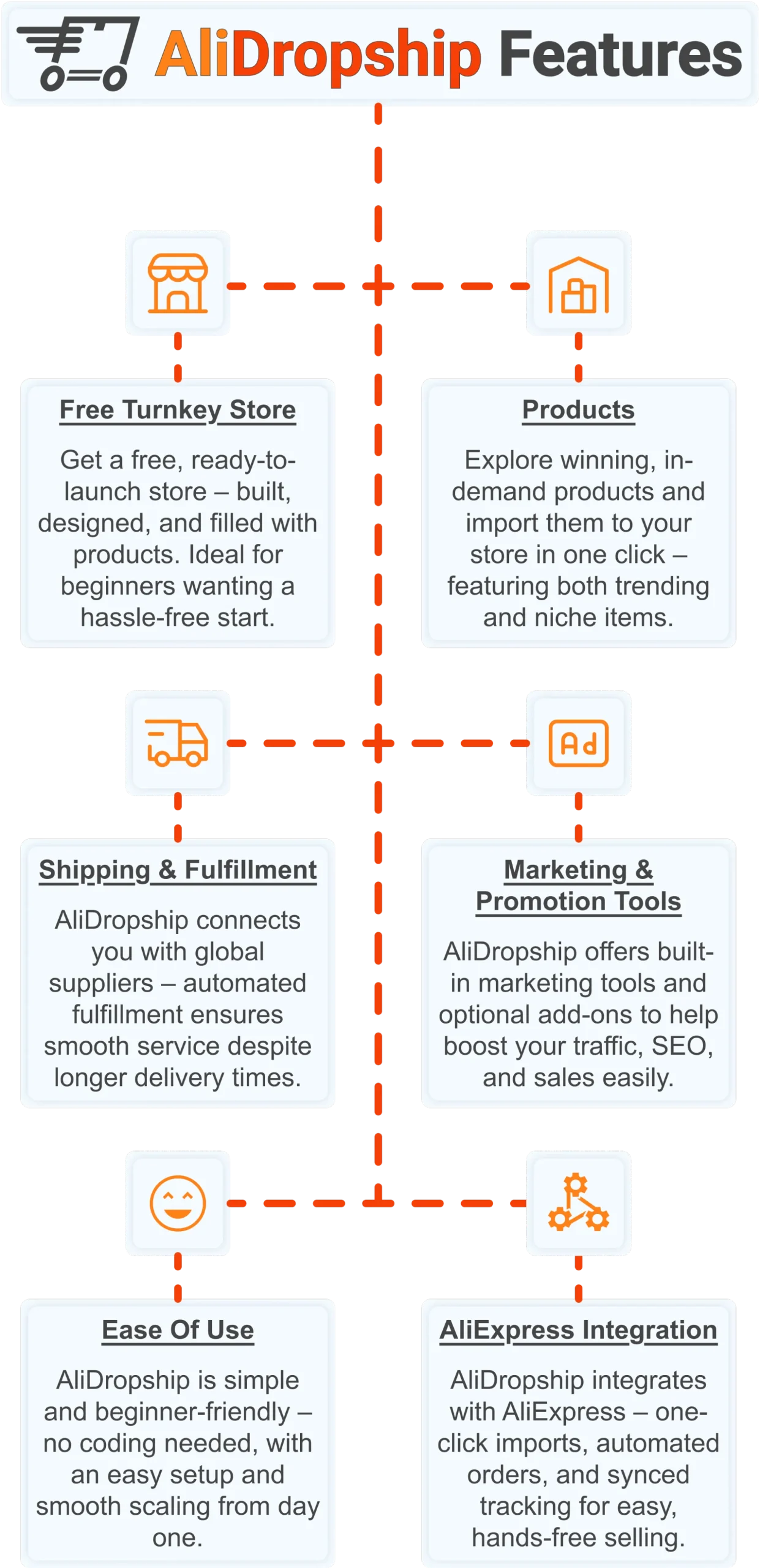
Get a turnkey store free for 14 days – built, designed, and filled with products. Ideal for beginners wanting a hassle-free start, the store comes fully optimized to attract customers right away, saving you time on setup. Plus, it includes professional design elements to give your business a polished, trustworthy look from day one. After 14 days, the store continues at just $39 per month.
Products
Once your store is set up, you can explore winning, in-demand products and import them in one click – featuring both trending and niche items. This wide selection lets you cater to diverse customer interests and test what works best. Regular updates ensure you always have fresh products, keeping your store competitive and relevant. With great products in place, smooth shipping becomes the next essential step.
Shipping & fulfillment
AliDropship connects you with global suppliers, and automated fulfillment ensures seamless order processing despite international delivery times. Customers receive real-time tracking updates, which builds confidence and trust in your store. Once shipping is handled reliably, you can focus on promoting your store and attracting traffic.
Marketing & promotion tools
To maximize sales, AliDropship offers built-in marketing tools that help boost traffic, SEO, and conversions. From email campaigns and discounts to social media integration, these tools empower you to reach and retain customers without needing prior marketing experience or extra app subscriptions. With promotion strategies in place, managing your business becomes simpler and more efficient.
Ease of use
AliDropship is beginner-friendly – no coding needed, with an intuitive dashboard that guides you through every step. Easy setup and smooth scaling let you expand your store without stress. As your business grows, adding new features, products, and marketing campaigns remains hassle-free, giving you more time to focus on sales.
AliExpress integration
Finally, AliDropship integrates seamlessly with AliExpress, enabling one-click imports, automated orders, and synced tracking. Your inventory stays up-to-date with the latest products and prices, while automated order processing frees you from manual tasks. Combined with the turnkey setup, reliable shipping, and built-in marketing tools, this integration ensures your dropshipping business is fully equipped for growth and success.
Frequently Asked Questions
How much does AliDropship cost compared to Shopify?
AliDropship offers a 14 day free trial, then a single subscription of 39 dollars per month covering the store, hosting, product importing, order automation, and marketing tools with no transaction fees. Shopify’s base plan also starts at around 39 dollars per month, but a fully functional dropshipping setup typically costs 100 to 175 dollars per month once app subscriptions are added. Those extra Shopify costs usually include a dropshipping app at 15 to 30 dollars per month, an email marketing app at 20 to 50 dollars per month, and an SEO app at 10 to 30 dollars per month. Premium Shopify themes are not included in any plan and often cost 150 to 350 dollars as a one-time purchase.
Does AliDropship or Shopify charge transaction fees?
AliDropship charges no additional transaction fees when using a third-party payment gateway, meaning sellers keep 100 percent of what their payment processor pays out. Shopify charges an extra transaction fee of 0.5 to 2 percent on top of whatever a third-party gateway like PayPal or Stripe already charges, unless a seller uses Shopify Payments directly. Shopify Payments is also not available in all countries, meaning sellers in unsupported regions face transaction fees with no workaround. At a store doing 10,000 dollars in monthly revenue, this fee difference alone can be worth 50 to 200 dollars per month.
Do you need a separate app to import AliExpress products on Shopify?
Yes, Shopify has no native AliExpress import tool, so sellers need a third-party app, most commonly DSers, to handle product importing, inventory syncing, and order routing. DSers has a free tier, but full automation requires a paid plan on top of the base Shopify subscription. AliDropship instead includes a Chrome extension that imports any AliExpress product in one click, including images, variations, descriptions, and pricing. Inventory and price syncing on AliDropship also happen automatically in the background without a second dashboard to manage.
Which platform offers faster shipping for dropshipping stores?
AliDropship integrates with Sellvia, a US based fulfillment network, giving sellers targeting US customers significantly faster delivery than standard international shipping, built in at no extra cost. Shopify supports similar US based fulfillment options through apps like Spocket or CJdropshipping, but each comes with its own separate subscription cost and setup requirements. Many Shopify sellers still end up relying on suppliers shipping from China, which means slower delivery for US and European customers. Achieving reliably fast domestic shipping on Shopify generally requires more research and higher ongoing costs than on AliDropship.
Who owns the store data on AliDropship versus Shopify?
AliDropship is built on WordPress, so sellers retain full ownership of their store data and complete control over their site’s structure, design, and functionality. Shopify hosting is a closed proprietary system, meaning a store lives entirely within Shopify’s infrastructure and cannot be migrated to another hosting provider. AliDropship sellers can also access the entire WordPress plugin library if they want to expand their setup later. Shopify’s closed architecture can feel restrictive over time for advanced sellers who want deep technical control such as custom server configurations or full backend access.
When it comes to AliDropship vs Shopify, the choice comes down to how much time and money you want to spend before your first sale. Claim your 14-day free trial today and start with everything already in place.
 Previous post
