 ‧ Agnes Kazaryan ‧
March 21, 2026
‧ Agnes Kazaryan ‧
March 21, 2026  1280 ‧
 0
0
Most people searching for the best online business to start spend more time researching than actually doing anything. That’s partly because the options are overwhelming – and partly because most comparison guides bury the honest answer under layers of hype.
Here it is upfront: the best online business for most people in 2026 is ecommerce – specifically dropshipping. It combines a low startup cost, a realistic income ceiling, and genuine long-term automation potential in a way that no other model matches for beginners. But the right choice still depends on where you are right now, and this guide will help you figure that out.
Quick Answer: The best online business to start in 2026 depends on your budget, skills, and goals – but dropshipping and ecommerce consistently rank first for scalability, low barriers to entry, and long-term income potential compared to freelancing, affiliate marketing, and digital products.
What follows is a plain-English breakdown of every major online business model – how each works, what it actually takes, and honest earning benchmarks so you can pick the one that fits your real situation.
What is an online business – and why does the model matter?
An online business is any venture that generates revenue primarily through the internet. That covers a wide range: a solo freelancer billing $50/hour, a dropshipping store processing 200 orders a week, a blogger earning ad revenue, or a consultant charging $2,000/month retainers. The internet is the channel – the model is the actual structure you build on top of it.
Here’s the part most beginner guides skip: the model matters more than the niche. Two people can start an online business in 2026, pick completely different structures, and end up with entirely different income ceilings, time commitments, and growth paths five years down the line. A freelance writer trades hours for dollars with no passive upside. A dropshipping store owner, once operational, can process 50 orders on a Wednesday without lifting a finger.
Understanding the mechanics of each model before you commit is the difference between building something that compounds over time and spinning your wheels for a year. In 2026, ecommerce alone is projected to surpass $6.5 trillion globally – the opportunity is real, but only if you’re building the right structure for your goals.
How much can you realistically earn from an online business?
Let’s be direct. Online business income varies enormously based on model, effort, and how long you’ve been at it. The table below gives you an honest benchmark across the most popular options:
These ranges reflect typical active earners – not outliers. The upper figures require sustained effort, smart product or content selection, and at least 60–90 days of consistent work before results become predictable.
One note on the $10,000+ figure: The upper range for ecommerce is real but requires genuine commitment – consistent product testing, some marketing spend, and a willingness to treat it like a business rather than a hobby. Most new store owners see their first meaningful sales within 30–60 days, with $500–$2,000/month being a realistic milestone in the first six months of full-time effort.
Product-based online businesses: the strongest models for scalability
Dropshipping
Dropshipping is consistently ranked among the best online business models for beginners because it removes the biggest traditional barrier to ecommerce: inventory. You run an online store, market products, and when a customer buys, your supplier ships directly to them. You never touch the stock, and you never pay for a product until it’s already sold.
The margin per order is typically 20–40%, and with the right niche and a bit of paid or organic traffic, hitting $50–$150/day within the first 90 days is a realistic target. What makes it stand out is the scalability – once your store is converting, adding more products or running ads doesn’t require proportionally more time from you.
Getting started involves choosing a niche, setting up a store (platforms like AliDropship reduce this to a single day), importing products, and driving traffic through SEO, social media, or ads. The technical setup is no longer a barrier.
Earning potential: $500–$10,000+/month depending on niche, ad spend, and product testing consistency.
Why this works in 2026: Global ecommerce is still growing at double digits, and AI-assisted product research and marketing tools make it easier than ever for solo operators to compete with larger brands.
Print on demand
Print on demand (POD) is a variation of dropshipping where you sell custom-designed products – t-shirts, mugs, phone cases, tote bags – and a third-party supplier prints and ships each order after it’s placed. There’s no inventory risk and a very low startup cost.
The trade-off is margin. POD products typically carry thinner returns than standard dropshipping – often $5–$15 per item – and the market is highly competitive in broad categories. Success depends heavily on strong design work and targeting underserved niches rather than competing on generic trends everyone else is already selling.
Platforms like Printful and Printify integrate easily with Shopify or Etsy, so the technical setup is manageable. The real challenge is differentiation.
Earning potential: $100–$2,000/month for most operators; higher with strong branding and SEO-driven organic traffic.
Selling digital products
Digital products – ebooks, templates, Notion dashboards, Lightroom presets, spreadsheet tools – are created once and sold repeatedly with no inventory or shipping cost. That makes them attractive as a near-passive income source once the product is built and the traffic pipeline is in place.
The challenge is the creation phase. You need a product good enough to sell at $10–$50, and then you need a consistent audience to sell it to. Most successful digital product creators already have an email list, a YouTube channel, or a strong social following before launching.
Important note: Without an existing audience, digital products can take 6–12 months to generate meaningful revenue. They are not a fast path to income for most beginners starting from scratch.
Earning potential: $200–$3,000/month once traffic is established; significantly lower in the first six months.
Service-based online businesses: fastest path to income
Freelancing
Freelancing is the fastest path to earning money online from scratch – especially if you already have a marketable skill like writing, graphic design, web development, video editing, or social media management. Platforms like Upwork, Fiverr, and Toptal connect you with clients globally, and experienced freelancers charge anywhere from $30–$150/hour depending on the skill and niche.
The core limitation is that freelancing is an active income model. The moment you stop working, income stops. It doesn’t scale the way a product business does, and high-earning freelancers typically spend a significant portion of their time on client management and admin – not just the work itself.
That said, for someone who needs online income within the next 30 days and has a sellable skill, freelancing is the most reliable short-term option available.
Earning potential: $500–$5,000/month for most active freelancers; $8,000–$15,000/month for senior specialists with an established client base.
Consulting and coaching
If you have deep expertise in a field – business strategy, marketing, fitness, career development, finance – you can package that knowledge as consulting or coaching. Rates are typically higher than freelancing: $100–$500/hour for consulting, or $500–$3,000/month for ongoing coaching retainers.
The barrier is positioning. Clients pay premium rates for demonstrated results and a clear track record. Building that reputation online requires consistent content marketing, case studies, and social proof – which takes time to develop. Consulting is one of the better online business models for people transitioning out of a corporate role and leveraging existing industry expertise. It’s a harder path for someone starting completely from scratch.
Earning potential: $2,000–$10,000+/month for established consultants; very low in the first 6–12 months for those building from zero.
Content and audience-based online businesses: long game only
Affiliate marketing
Affiliate marketing means earning a commission by promoting other people’s products. You produce content – blog posts, YouTube videos, comparison pages, email newsletters – and include affiliate links. When a reader clicks and buys, you earn anywhere from 3–50% depending on the program and product type.
It’s one of the most commonly recommended home-based business ideas online, and for good reason: done well, affiliate sites generate genuinely passive income. But the timeline is difficult for beginners. Most affiliate sites take 9–18 months of consistent content production before they generate meaningful traffic and revenue. Amazon Associates, ShareASale, and individual brand programs are the standard starting points. High-value niches – software, finance, health – offer the best commission rates.
Earning potential: $100–$500/month in year one for most beginners; $2,000–$10,000+/month for established sites with strong domain authority.
Blogging and content creation
A blog or YouTube channel can generate income through display ads, affiliate links, sponsorships, and product sales – but it’s the slowest online business model to monetize. Most bloggers earn less than $100/month in their first year, and building to a full-time income typically requires 18–36 months of consistent publishing.
Content creation works best as a traffic channel that feeds other revenue streams – affiliate products, a digital product store, or an ecommerce shop – rather than as a standalone income source. Treating it purely as an ad revenue play requires enormous traffic volumes (100,000+ monthly visitors) before the numbers make sense.
Earning potential: $50–$500/month in early stages; $3,000–$10,000/month for high-traffic sites with diversified monetization.
Legal and ethical considerations for online business owners
Every online business model has grey areas and outright traps. Here are the most common ones that cost beginners significant time and money.
Register your business properly
Even a small online business run from home needs to handle the basics: registering as a sole trader or LLC depending on your country, tracking income for tax purposes, and using proper terms of service and privacy policies on any storefront or website. Skipping these steps early creates bigger headaches later – particularly as revenue grows and tax authorities start paying attention.
Key principle: Treat your online business like a real business from day one – the legal foundation costs very little to set up and protects you as you scale.
Don’t fake reviews or inflate claims
Faking product reviews, inflating testimonials, or making unsubstantiated income claims violates platform terms of service, consumer protection laws in most jurisdictions, and will ultimately damage your reputation. Real reviews from real customers – earned over time – are the only sustainable social proof strategy. Platforms like Trustpilot and Google Reviews actively flag and remove fake activity, and repeat violations can get your account permanently suspended.
Don’t spread yourself too thin at the start
A common beginner mistake is starting a dropshipping store, a blog, an affiliate site, and a freelance profile simultaneously – and making no real progress on any of them. Depth beats breadth in the early stages. Pick one model, commit to it for at least three months, and build real traction before diversifying into a second income stream.
Avoid get-rich-quick framing
No online business model is truly passive from day one. Content that promises $500/day with zero effort is almost always misleading. The right question isn’t “what’s easiest?” – it’s “what can I sustain consistently for 90 days?” Pick the model that fits your actual schedule and real resources, not the one that sounds most effortless in a YouTube thumbnail.
Final thoughts: which online business model is best for you?
Comparing models side by side is useful, but the right choice still comes down to where you are right now. Here’s a practical breakdown by reader profile.
Complete beginner
If you have no existing audience, no specialist skills to sell, and limited startup capital, dropshipping is the clearest path. The barrier to entry is low, the learning curve is manageable, and tools like AliDropship reduce the technical setup to hours rather than weeks. Expect 60–90 days before you see consistent sales, and focus on one niche rather than spreading across multiple products at once.
Intermediate – you have a skill and need income fast
Freelancing is the fastest bridge to online income if you already have something marketable – writing, design, coding, video, translation. Start on Upwork or Fiverr, build your first few reviews, and use the income to fund a parallel ecommerce project. Running both side by side is a smart strategy: freelancing pays the bills while your store gains momentum.
Advanced – building for long-term passive income
If your goal is an online business that eventually runs with minimal daily involvement, ecommerce and dropshipping remain the strongest combination of scalability and automation available to most people. Affiliate marketing is a close second, but requires a much longer time horizon before it produces meaningful returns.
Key principle: Passive income is built through active effort first. There is no model – dropshipping included – that delivers results without an initial investment of time, testing, and iteration. What changes is the ceiling and the long-term time-to-effort ratio.
You have capital and want to scale quickly
If you have $1,000–$5,000 to invest and want to accelerate results, ecommerce with a paid traffic strategy – Facebook or TikTok ads – gives you the fastest feedback loop. You can test products, identify winners, and scale ad spend on what converts, compressing months of organic growth into weeks. Combined with a ready-built store and a solid product catalogue, this is the fastest route to a full-time ecommerce income in 2026.
AliDropship: Your complete all-in-one solution for starting dropshipping in 2026
If you want the simplest possible way to start dropshipping – especially if you’re brand new – AliDropship remains one of the most beginner-friendly tools available in 2026. It brings together store creation, product imports, automation, and marketing into a single streamlined system designed to help you launch quickly and grow confidently.
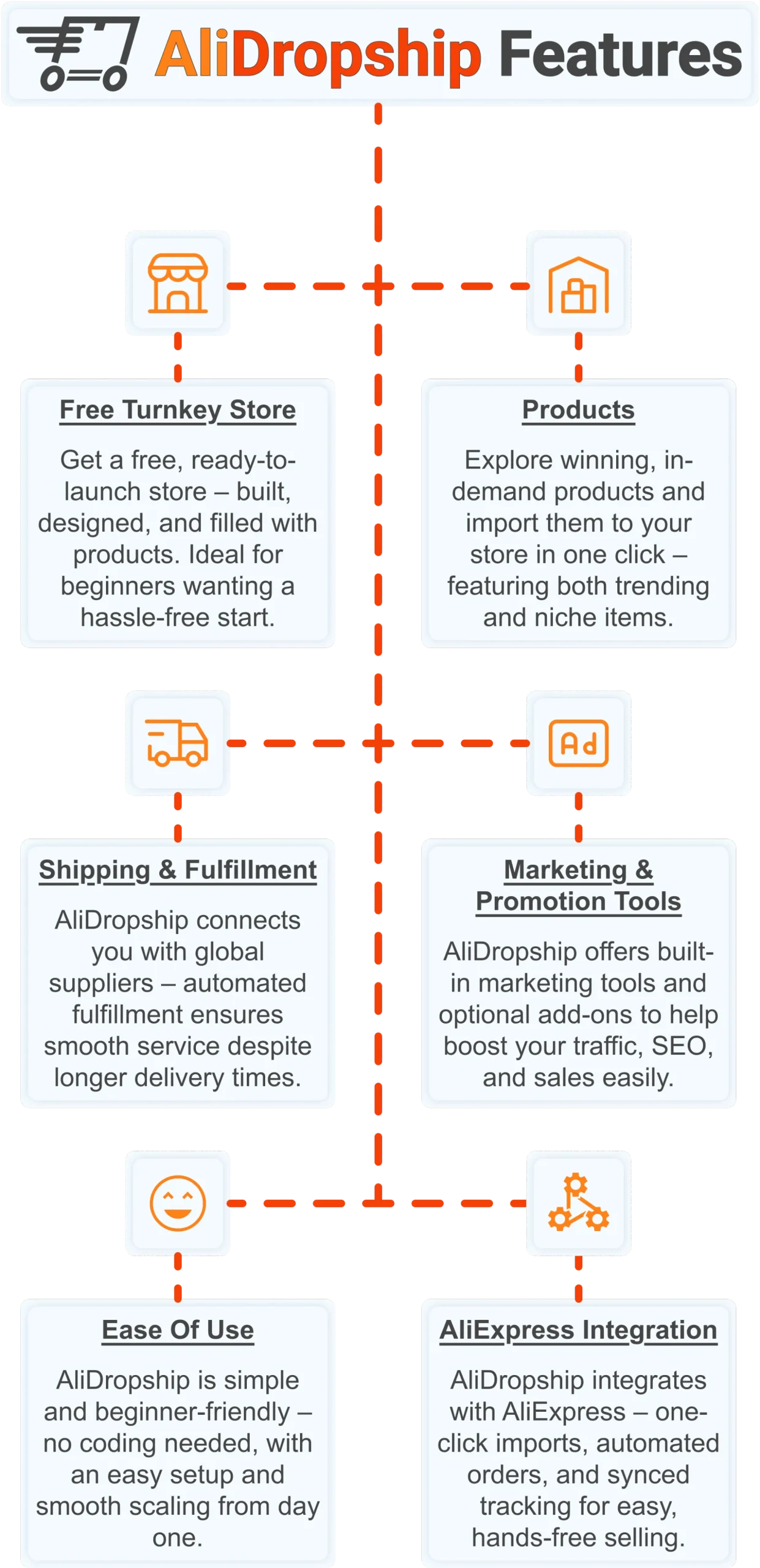
Free turnkey store ️
Get a free turnkey store – built, designed, and filled with products. Ideal for beginners wanting a hassle-free start, the store comes fully optimized to attract customers right away, saving you time on setup. Plus, it includes professional design elements to give your business a polished, trustworthy look from day one. This ready-made foundation makes it easy to move seamlessly into product selection.
Products
Once your store is set up, you can explore winning, in-demand products and import them in one click – featuring both trending and niche items. This wide selection lets you cater to diverse customer interests and test what works best. Regular updates ensure you always have fresh products, keeping your store competitive and relevant. With great products in place, smooth shipping becomes the next essential step.
Shipping & fulfillment
AliDropship connects you with global suppliers, and automated fulfillment ensures seamless order processing despite international delivery times. Customers receive real-time tracking updates, which builds confidence and trust in your store. Once shipping is handled reliably, you can focus on promoting your store and attracting traffic.
Marketing & promotion tools
To maximize sales, AliDropship offers built-in marketing tools and optional add-ons that help boost traffic, SEO, and conversions. From email campaigns and discounts to social media integration, these tools empower you to reach and retain customers without needing prior marketing experience. With promotion strategies in place, managing your business becomes simpler and more efficient.
Ease of use
AliDropship is beginner-friendly – no coding needed, with an intuitive dashboard that guides you through every step. Easy setup and smooth scaling let you expand your store without stress. As your business grows, adding new features, products, and marketing campaigns remains hassle-free, giving you more time to focus on sales.
AliExpress integration
Finally, AliDropship integrates seamlessly with AliExpress, enabling one-click imports, automated orders, and synced tracking. Your inventory stays up-to-date with the latest products and prices, while automated order processing frees you from manual tasks. Combined with the turnkey setup, reliable shipping, and built-in marketing tools, this integration ensures your dropshipping business is fully equipped for growth and success.
Frequently asked questions
What is the best online business to start in 2026?
The best online business to start in 2026 depends on your budget, skills, and goals, but dropshipping and ecommerce consistently rank first for scalability and low barriers to entry. Global ecommerce is projected to surpass 6.5 trillion dollars in 2026, showing the scale of opportunity available. The margin per dropshipping order is typically 20 to 40 percent, and hitting 50 to 150 dollars per day within the first 90 days is a realistic target with the right niche. Most new store owners see their first meaningful sales within 30 to 60 days, with 500 to 2000 dollars per month being a realistic milestone in the first six months.
How much money can you realistically earn from an online business?
Dropshipping and ecommerce can reach 500 to 10000 dollars or more per month, though the upper figure requires consistent product testing and marketing spend. Freelancing typically earns 500 to 5000 dollars per month for most active freelancers, rising to 8000 to 15000 dollars per month for senior specialists with an established client base. Affiliate marketing ranges widely from 100 to 5000 dollars or more per month depending heavily on the content phase and audience size. Blogging and content creation is the slowest to monetize, with most bloggers earning less than 100 dollars per month in their first year.
How does dropshipping compare to other product based online businesses?
Dropshipping carries margins of 20 to 40 percent per order and can reach 500 to 10000 dollars or more per month depending on niche and ad spend. Print on demand typically carries thinner margins of just 5 to 15 dollars per item, earning 100 to 2000 dollars per month for most operators. Selling digital products can generate 200 to 3000 dollars per month once traffic is established, but without an existing audience the process can take 6 to 12 months to become meaningful. Print on demand and digital products both depend heavily on differentiation and existing traffic, while dropshipping scales more directly through paid or organic marketing.
What legal and ethical rules should online business owners follow?
Registering as a sole trader or LLC and tracking income for tax purposes are basic requirements even for a small online business run from home. Faking product reviews or inflating income claims violates platform terms of service and consumer protection laws in most jurisdictions, and platforms like Trustpilot actively flag and remove fake activity. A common beginner mistake is starting a dropshipping store, a blog, an affiliate site, and a freelance profile all at once and making no real progress on any of them. Content promising 500 dollars per day with zero effort is almost always misleading, since no online business model is truly passive from day one.
Which online business model is best for a complete beginner?
Complete beginners with no existing audience, no specialist skills, and limited startup capital should start with dropshipping, since the barrier to entry is low and platforms like AliDropship reduce technical setup to hours rather than weeks. A realistic expectation is 60 to 90 days before seeing consistent sales, with focus placed on one niche rather than spreading across multiple products. Freelancing is a faster bridge to income for someone who already has a marketable skill such as writing, design, or coding, with rates ranging from 30 to 150 dollars per hour. Running freelancing and a dropshipping store side by side is a smart strategy, since freelancing pays the bills while the store gains momentum.
Dropshipping is the best online business model available to most people in 2026 – and AliDropship gives you everything you need to launch in a single day. Claim your free turnkey store and $100 gift voucher and start building today.
 Previous post
