 ‧ Agnes Kazaryan ‧
March 14, 2026
‧ Agnes Kazaryan ‧
March 14, 2026  819 ‧
819 ‧
 0
0
Most people searching “digital entrepreneur” already know they want to build something online. What they do not know is which model to pick – and that decision matters more than almost anything else you will do in your first year. Pick the wrong one for your situation and you will spend months grinding toward results that were never realistic for where you started.
This guide breaks down the five main business models used by digital entrepreneurs in 2026, gives you real examples of each, and helps you match the right model to your actual goals – not the highlight-reel version you see on social media.
Quick answer: A digital entrepreneur builds income-generating systems online rather than trading time for a wage. The five most proven models in 2026 are dropshipping, digital products, affiliate marketing, freelancing, and SaaS – each with a distinct effort-to-income curve. Your starting capital, time availability, and skill set determine which one fits best right now.
What is a digital entrepreneur?
A digital entrepreneur is someone who builds and operates a business primarily through digital channels – websites, online marketplaces, and software platforms – rather than a physical storefront or office. The category is broad. Ecommerce store owners, course creators, affiliate publishers, SaaS founders, and solo freelancers all qualify.
What separates a digital entrepreneur from someone with a side hustle is intention. A side hustle is transactional – you trade time for money in a defined, repeatable way. A digital entrepreneur builds systems, audiences, or products that generate value beyond the hours they personally put in. That shift in mindset – from earning to building – is the real distinction.
In 2026, the barrier to entry has never been lower. You can launch an ecommerce store without inventory, sell a course without a studio, or ship a software tool without writing backend code. Lower barriers also mean more competition, which makes choosing the right model and executing it consistently more important than it has ever been.
How much can a digital entrepreneur realistically earn?
Earnings vary enormously depending on the model, the niche, and the effort invested. The table below compares the five main business models on effort and realistic monthly income – not ceiling figures pulled from success stories, but ranges for operators who treat their business seriously over a 6–12 month period.
The most important thing this table shows is the difference between active and passive income curves. Freelancing pays fastest but caps at your available hours. Dropshipping and digital products take longer to gain momentum but scale without proportional effort. SaaS has the highest ceiling but also the longest and most expensive runway to profitability.
One note on these figures: The upper ranges assume a functioning audience, a proven offer, or an established ad strategy – typically built over 60–90 days of consistent work at minimum. Month one rarely looks like month six.
Ecommerce and dropshipping
What it is
Ecommerce is the sale of physical or digital products through an online store. Dropshipping is a specific fulfilment model within ecommerce where you sell products without holding inventory – your supplier ships directly to your customer. As a digital entrepreneur running a dropshipping store, your focus is product selection, marketing, and customer experience. Warehousing and logistics are handled by suppliers.
Real examples
Thousands of independent stores on WooCommerce and Shopify operate on this model. A common example is a niche home decor store sourcing from AliExpress suppliers and driving traffic through Pinterest and Google Shopping.
Another is a pet accessories brand dropshipping from domestic suppliers while building a loyal Instagram following. The niche is almost irrelevant – the model works across categories when product-market fit is right.
How to get started
The fastest path into dropshipping in 2026 is a turnkey store paired with a reliable sourcing tool. You do not need to build from scratch – pre-built solutions let you launch a functional, product-stocked store in a single day. After launch, your main job is traffic generation: paid ads, SEO content, or social media depending on your budget and strengths.
Earning potential: $500–$5,000+ per month within 60–90 days of consistent marketing, depending on niche competitiveness and ad spend.
Digital products
What it is
Selling digital products means creating – or curating – files, guides, templates, or tools that customers download immediately after purchase. No shipping, no inventory, no fulfilment delay. Every sale after the first is effectively pure margin. For a digital entrepreneur who wants the closest thing to truly passive income, this is the most accessible starting point.
Real examples
Etsy sellers listing Canva templates, Notion dashboards, and printable planners make up one of the fastest-growing segments of the digital economy. Independent creators on Gumroad sell everything from photography presets to coding cheat sheets. What these businesses share is low overhead, high margin, and a product that can be sold an unlimited number of times without additional cost.
How to get started
The traditional path requires you to create every product yourself, which takes time and creative energy. A faster alternative is launching a store pre-stocked with ready-made digital products – that way you can focus on marketing and customer acquisition from day one rather than spending weeks on product creation. This is particularly useful if your goal is to test the model before committing fully.
Earning potential: $300–$4,000+ per month once an audience or search traffic is established, typically within 60–120 days of active promotion.
Why this model suits most beginners
Unlike physical ecommerce, digital products carry zero fulfilment risk. A file that fails to download can be re-sent in seconds. A refund costs you nothing except the sale. And because there is no supplier relationship to manage, your entire operational focus can go on marketing – which is where most of the real leverage in digital entrepreneurship sits anyway.
Affiliate marketing
What it is
Affiliate marketing is a performance-based model where a digital entrepreneur earns a commission for referring customers to another company’s product or service. You do not own the product, handle customer service, or process payments. Your job is to create content or run campaigns that generate qualified clicks – and collect a percentage of every resulting sale.
Real examples
Review sites comparing web hosting providers, VPN services, or credit cards earn commission on every signup generated through their links. YouTube channels reviewing tech gadgets and including Amazon affiliate links in descriptions represent another major format.
Niche blogs targeting specific hobbies – gardening, hiking, home brewing – are among the most durable affiliate businesses because they attract highly targeted, purchase-ready audiences.
How to get started
You need three things: a content platform (blog, YouTube channel, or newsletter), a traffic source (SEO, social, or paid), and an affiliate programme relevant to your niche. Amazon Associates, ShareASale, and direct brand programmes are the most common starting points.
The model is slow to monetize – most affiliate sites take 6–12 months to generate meaningful revenue from organic search – but the income, once established, is highly passive.
Earning potential: $200–$3,000+ per month for content-based affiliates after 6–12 months of consistent publishing. High-ticket affiliate programmes can push this significantly higher for experienced operators.
Freelancing and consulting
What it is
Freelancing is the sale of your skills or expertise directly to clients on a project or retainer basis. Consulting is the more senior version – you advise businesses rather than execute tasks. Both are active income models: your revenue is directly tied to your time. But they offer the fastest path to meaningful income for a digital entrepreneur with an existing skillset.
Real examples
A graphic designer serving SaaS startups through Upwork, a copywriter retained by three ecommerce brands simultaneously, a marketing consultant running a weekly advisory call at $2,000 per month – these are all functioning freelance or consulting businesses in 2026. Platforms like Toptal, Contra, and LinkedIn have made it easier than ever to connect with well-paying clients without cold outreach.
How to get started
Define your service clearly, set a rate that reflects your market (not your confidence level – these are different things), and reach out to your existing network before touching any platform. Your first client will almost always come from someone you already know. After that, case studies and referrals compound faster than any platform algorithm.
Earning potential: $1,500–$8,000+ per month for established freelancers. Most skilled operators can hit $2,000 within their first 30–60 days if they pitch consistently.
The core tradeoff
Freelancing and consulting are the fastest models to generate cash – but they do not scale without hiring. Every hour you sell is an hour you cannot get back. The savviest digital entrepreneurs use freelancing as a funding mechanism: earn well while building a product or ecommerce business in parallel, then transition when the passive income catches up.
SaaS and micro-SaaS
What it is
Software as a Service (SaaS) means building a product that customers pay for on a recurring subscription basis. Micro-SaaS is the lean version – a small, focused tool solving one specific problem for a defined audience, usually built and run by one or two people. The appeal is obvious: recurring revenue, high margins, and near-unlimited scalability.
Real examples
Tools like Bannerbear (automated image generation) and dozens of smaller utilities found on Product Hunt and in indie hacker communities are all micro-SaaS businesses. They typically charge $9–$99 per month and serve niches too small for enterprise software to bother with – which is exactly where the opportunity lies.
How to get started
No-code and low-code platforms like Bubble, Glide, and Webflow have made it possible to ship a functional SaaS product without writing backend code. The harder challenge is not building – it is finding a problem specific enough to solve, a market large enough to sustain growth, and the patience to iterate through early churn.
SaaS is a long game. Most micro-SaaS products take 6–18 months to reach meaningful monthly recurring revenue.
Earning potential: $0–$10,000+ per month – but expect 12–18 months before profitability is consistent. This is the highest-ceiling model on this list and the one with the longest ramp.
Legal and ethical considerations for digital entrepreneurs
Regardless of which model you choose, a few legal and ethical principles apply universally. Ignoring them early can create problems that are expensive and time-consuming to fix later.
What to avoid
Fake reviews are one of the most common mistakes new digital entrepreneurs make – and one of the most consequential. Platforms including Amazon, Trustpilot, and Google actively detect and penalise review manipulation. A single enforcement action can delist your product or permanently damage your domain reputation.
Misrepresenting income in marketing – showing screenshots of a single exceptional day as a typical result – exposes you to FTC action in the US and equivalent regulators elsewhere. In affiliate marketing, failing to disclose your relationship with brands you recommend is a legal requirement in most jurisdictions, not just a best practice.
Grey-area tactics like cookie stuffing or scraping competitor content may generate short-term gains but almost always result in programme termination and potential legal liability.
Key principle: Build your digital entrepreneur business on tactics you would be comfortable explaining publicly – because eventually, you will have to.
What to do instead
Register a legitimate business entity early – even a sole proprietorship or LLC costs very little and provides meaningful protection. Use proper affiliate disclosure language on every piece of content that contains referral links.
Collect only the customer data you actually need, and have a privacy policy that reflects how you use it. These are not obstacles to growth – they are the infrastructure that allows you to grow without looking over your shoulder.
How to choose the right business model for your goals
There is no universally correct answer – but there is a correct answer for where you are right now. Here is an honest breakdown by reader profile.
Complete beginner
If you are brand new to digital entrepreneurship with limited capital and no established audience, your best starting point is either dropshipping or digital products. Both have low barriers to entry, established supplier ecosystems, and clear learning paths.
Digital products have a slight edge for true beginners because there is no supplier relationship to manage and no risk of fulfilment issues. A pre-built store stocked with ready-made products removes the creative and technical friction entirely.
Intermediate or part-time operator
If you already have some income from a job or side project and are building your digital business in the margins of your day, affiliate marketing or a digital product store are the best fits. Both generate income that compounds over time rather than demanding your immediate presence.
A well-written affiliate article keeps earning for years. A digital product listed correctly on the right platform sells without your involvement. The compounding effect of consistent content or catalogue growth is where the real leverage is for part-time operators.
Advanced operator with a full-time goal
If you are ready to go full-time and have the runway to sustain 12–18 months without immediate profitability, SaaS – particularly micro-SaaS in a niche you understand well – is worth serious consideration.
If you want faster returns at scale, a hybrid model combining ecommerce with content-driven affiliate revenue is one of the most durable structures a digital entrepreneur can build. Both channels reinforce each other: the ecommerce store drives product searches, the content drives organic traffic, and the two compound together over time.
Creative or educator
If your background is in teaching, writing, design, or any other knowledge-based discipline, digital products are the most natural fit. You already have the raw material – your expertise and existing assets. The challenge is packaging and distribution. Platforms like Gumroad, Payhip, and pre-built digital product stores solve the distribution side, leaving you free to focus on what you are already good at.
AliDropship: Your complete all-in-one solution for starting dropshipping in 2026
If you want the simplest possible way to start dropshipping – especially if you’re brand new – AliDropship remains one of the most beginner-friendly tools available in 2026. It brings together store creation, product imports, automation, and marketing into a single streamlined system designed to help you launch quickly and grow confidently.
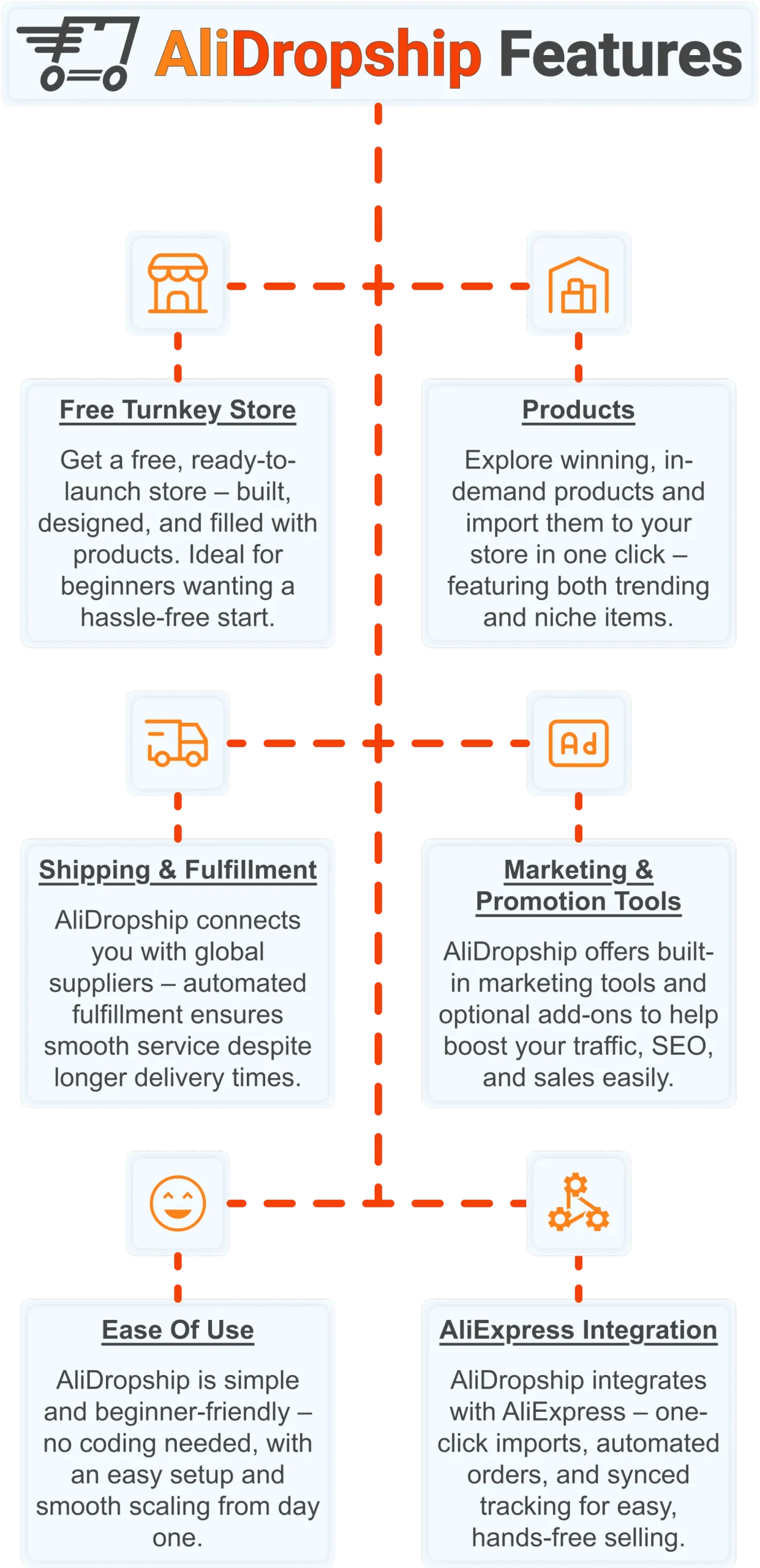
Free turnkey store ️
Get a free turnkey store – built, designed, and filled with products. Ideal for beginners wanting a hassle-free start, the store comes fully optimized to attract customers right away, saving you time on setup. Plus, it includes professional design elements to give your business a polished, trustworthy look from day one. This ready-made foundation makes it easy to move seamlessly into product selection.
Products
Once your store is set up, you can explore winning, in-demand products and import them in one click – featuring both trending and niche items. This wide selection lets you cater to diverse customer interests and test what works best. Regular updates ensure you always have fresh products, keeping your store competitive and relevant. With great products in place, smooth shipping becomes the next essential step.
Shipping & fulfillment
AliDropship connects you with global suppliers, and automated fulfillment ensures seamless order processing despite international delivery times. Customers receive real-time tracking updates, which builds confidence and trust in your store. Once shipping is handled reliably, you can focus on promoting your store and attracting traffic.
Marketing & promotion tools
To maximize sales, AliDropship offers built-in marketing tools and optional add-ons that help boost traffic, SEO, and conversions. From email campaigns and discounts to social media integration, these tools empower you to reach and retain customers without needing prior marketing experience. With promotion strategies in place, managing your business becomes simpler and more efficient.
Ease of use
AliDropship is beginner-friendly – no coding needed, with an intuitive dashboard that guides you through every step. Easy setup and smooth scaling let you expand your store without stress. As your business grows, adding new features, products, and marketing campaigns remains hassle-free, giving you more time to focus on sales.
AliExpress integration
Finally, AliDropship integrates seamlessly with AliExpress, enabling one-click imports, automated orders, and synced tracking. Your inventory stays up-to-date with the latest products and prices, while automated order processing frees you from manual tasks. Combined with the turnkey setup, reliable shipping, and built-in marketing tools, this integration ensures your dropshipping business is fully equipped for growth and success.
Frequently Asked Questions
What is a digital entrepreneur?
A digital entrepreneur is someone who builds and operates a business primarily through digital channels like websites, online marketplaces, and software platforms rather than a physical storefront. The 5 most proven models in 2026 are dropshipping, digital products, affiliate marketing, freelancing, and SaaS, each with a distinct effort-to-income curve. What separates a digital entrepreneur from someone with a side hustle is building systems, audiences, or products that generate value beyond hours personally worked. Your starting capital, time availability, and skill set determine which model fits best right now.
How much money can a digital entrepreneur realistically earn?
Dropshipping shows realistic monthly earnings of 500 to 5000 dollars or more, while digital products typically earn 300 to 4000 dollars or more once an audience is established. Freelancing and consulting can reach 1500 to 8000 dollars or more per month, since it is an active model that pays fastest but caps at available hours. SaaS and micro-SaaS have the highest ceiling at 0 to 10000 dollars or more, but typically require 12 to 18 months before profitability becomes consistent. Most of these upper ranges assume 60 to 90 days of consistent work at minimum before results appear.
How does dropshipping work for a digital entrepreneur?
Dropshipping is a fulfilment model within ecommerce where a digital entrepreneur sells products without holding inventory, since suppliers ship directly to the customer. A common example is a niche home decor store sourcing from AliExpress suppliers and driving traffic through Pinterest and Google Shopping. The fastest path into dropshipping in 2026 is a turnkey store paired with a reliable sourcing tool, letting a beginner launch a functional store in a single day. Earning potential typically runs 500 to 5000 dollars or more per month within 60 to 90 days of consistent marketing.
Why do digital products suit beginner digital entrepreneurs?
Digital products carry zero fulfilment risk since a failed download can be re-sent in seconds and a refund costs nothing beyond the sale itself. Etsy sellers listing Canva templates, Notion dashboards, and printable planners represent one of the fastest-growing segments of the digital economy. A pre-built store stocked with ready-made digital products removes creative and technical friction, letting a beginner focus on marketing from day one. Earning potential for digital products typically runs 300 to 4000 dollars or more per month within 60 to 120 days of active promotion.
What legal risks should digital entrepreneurs be aware of?
Fake reviews are actively detected and penalized by platforms including Amazon, Trustpilot, and Google, and a single enforcement action can delist a product or damage domain reputation permanently. Misrepresenting income in marketing, such as showing a single exceptional day as a typical result, exposes a digital entrepreneur to FTC action in the US and equivalent regulators elsewhere. In affiliate marketing, failing to disclose relationships with recommended brands is a legal requirement in most jurisdictions, not just a best practice. Grey-area tactics like cookie stuffing or scraping competitor content almost always result in program termination and potential legal liability.
Every business model in this guide requires time to build – but a pre-built store removes the biggest obstacle any new digital entrepreneur faces: getting started. Claim your free store today and launch your digital entrepreneur journey with everything already in place.
 Previous post
