 ‧ Agnes Kazaryan ‧
March 15, 2026
‧ Agnes Kazaryan ‧
March 15, 2026  589 ‧
589 ‧
 0
0
Most online stores have a traffic problem that is not really a traffic problem. Studies consistently show the average ecommerce conversion rate sits somewhere between 1% and 4% – which means for every 100 visitors landing on your store, up to 99 of them could be leaving without buying a single thing. That gap almost always comes down to one thing: a leaking ecommerce conversion funnel.
Quick Answer: An ecommerce conversion funnel is the path a visitor takes from first discovering your store to completing a purchase. Optimizing each stage – awareness, interest, decision, and action – is how you turn more visitors into paying customers without needing more traffic.
Whether you are launching your first dropshipping store or already generating some sales and wondering why they feel inconsistent, understanding your conversion funnel is the single highest-leverage thing you can do in 2026. This guide breaks down each stage, what is actually happening there, and the specific moves you can make right now to plug the leaks.
What is an ecommerce conversion funnel?
An ecommerce conversion funnel is the structured sequence of steps a potential customer moves through before completing a purchase. The word “funnel” is deliberate – you start with a wide pool of people who become aware of your store, and by the time you reach the purchase stage, a much smaller but far more committed group actually converts. The goal of funnel optimization is to widen the bottom without necessarily pouring more into the top.
The classic model breaks into four core stages:
- Awareness – a potential customer discovers your store or product for the first time, typically through search, social media, or paid advertising.
- Interest – they engage with your content, browse product pages, or explore your category listings.
- Decision – they evaluate your product against alternatives, check reviews, confirm shipping details, and weigh up the price.
- Action – they add to cart, proceed through checkout, and complete the purchase.
In practice, most modern ecommerce funnels also include a fifth stage – retention – which covers post-purchase engagement, repeat orders, and long-term customer value. Ignoring existing customers is one of the most common and costly mistakes store owners make, so we will cover that stage too.
What makes the funnel model so useful is that it gives you a diagnostic framework. Strong traffic but low add-to-cart rates? The problem is at the Interest or Decision stage. Healthy add-to-cart rates but high cart abandonment? The problem is at the Action stage. Knowing where people drop off tells you exactly where to focus your energy instead of guessing.
How much can you realistically earn by optimizing your conversion funnel?
This is where the numbers get genuinely motivating – because unlike increasing traffic, which costs money, improving your conversion rate costs nothing but time and focused attention.
The table above assumes an average order value of $30–$60, which is typical for a general niche dropshipping store. The key takeaway: doubling your conversion rate from 1% to 2% doubles your revenue from the same traffic – without a single extra dollar spent on ads.
One note on the ceiling figures: A 4%+ conversion rate is achievable but not overnight. Most stores see meaningful improvement within 60–90 days of consistent funnel work. Targeting 2–3% as a realistic 90-day goal is a solid benchmark for a new or recently launched store.
The other factor worth understanding is compounding. A store earning $1,500 per month at 1% that reinvests in better product photography, sharper copy, and email recovery sequences can realistically reach $3,000–$5,000 per month within six months – same traffic, same products, better funnel.
Stage 1 – awareness: Getting the right people into your funnel
The awareness stage is where your ecommerce conversion funnel begins, and it sets the quality of everything that follows. The most common mistake new store owners make here is chasing raw traffic volume without thinking about relevance. Sending 10,000 unqualified visitors into a funnel will almost always underperform 1,000 highly targeted ones.
Organic search and SEO
SEO remains one of the highest-quality awareness channels for ecommerce in 2026. When someone searches “best wireless earbuds under $50” and lands on your store, they arrive with purchase intent already built in – your funnel starts closer to the bottom than it ever would with a cold social media impression.
Focus on long-tail, commercial-intent keywords rather than broad category terms. A blog post targeting “best minimalist wallets for men 2026” will convert far better than trying to rank for “wallets.” Use your blog to capture informational searches, then internal-link those posts to your product pages to move readers naturally down the funnel.
Why this works in 2026: Google continues to prioritize helpful, experience-backed content. Stores publishing genuinely useful buying guides are consistently outranking thin affiliate-style content across competitive niches.
Paid social and search ads
Paid advertising accelerates the awareness stage significantly, but it requires disciplined targeting to be cost-effective. Facebook and Instagram ads work well for visually driven impulse-purchase products – jewelry, home décor, novelty items. Google Shopping ads tend to perform better for products people are actively searching for with clear purchase intent.
Narrow your targeting by interest stacking – combining a broad interest (e.g., “fitness”) with a behavioral signal (e.g., “engaged shoppers”) typically produces better click-through rates and lower cost-per-click than broad targeting alone. Always test two or three creative variants per ad set and cut underperformers within 72 hours of launch.
Organic social and content marketing
Short-form video on TikTok, Instagram Reels, and YouTube Shorts has become a significant awareness driver for ecommerce stores in 2026. The algorithm-driven discovery model means your content can reach cold audiences without any ad spend – as long as it hooks viewers in the first two seconds.
Product demonstration videos consistently outperform static image posts. Show the product solving a real problem, not just sitting against a white background. User-generated content and unboxing-style videos tend to generate the highest organic reach because they feel authentic rather than promotional.
Earning potential: A store with a consistent organic social presence generating 5,000–10,000 monthly visitors from content alone can expect 50–400 orders per month depending on niche and conversion rate.
Stage 2 – interest: Turning browsers into engaged visitors
Once someone lands on your store, the interest stage begins immediately. You have roughly 3–5 seconds to communicate value before a first-time visitor decides whether to keep exploring or hit the back button. This stage is almost entirely controlled by your store design, product presentation, and first-impression clarity.
Homepage and category page optimization
Your homepage is not your most important conversion page – but it is your most important trust page. It needs to communicate three things instantly: what you sell, why your store is worth buying from, and what the visitor should do next.
A cluttered homepage with no clear hero message is one of the most common interest-stage killers. Lead with a single headline stating your value proposition (not your store name), a prominent hero image showing products in real-world use, and visible trust signals above the fold – reviews, guarantee badges, and secure checkout icons. Keep your main navigation to five items or fewer; too many options create decision paralysis.
Product page optimization
For most ecommerce stores, the product page is where the interest-to-decision transition happens. A visitor landing on a product page is already partially interested – your job is to sustain and deepen that interest until they are ready to act.
Multiple high-quality images from different angles are non-negotiable. Include at least one lifestyle shot showing the product in real-world use. Short product videos (15–30 seconds) showing the item being used can increase add-to-cart rates by 30–40% on pages where video is added.
Avoid manufacturer-copied descriptions – they damage both SEO rankings and conversion rates. Write around the customer benefit rather than the product feature. Instead of “Made from 304 stainless steel,” try “Stays rust-free for years, even with daily use.” Lead with the strongest benefit, follow with supporting details, and close with a subtle urgency or social proof element.
Site speed and mobile experience
Page load speed is an interest-stage variable most store owners underestimate. A 1-second delay in mobile load time reduces conversions by up to 20%, and in 2026, mobile accounts for over 70% of ecommerce traffic globally. A slow or poorly formatted mobile experience is a direct revenue leak.
Compress all product images to WebP format before uploading, use a lightweight theme with minimal unnecessary scripts, and run your store through Google PageSpeed Insights at least once a month. A target of under 2.5 seconds for first contentful paint on mobile is a realistic benchmark for a well-optimized store.
Stage 3 – decision: Removing every reason not to buy
The decision stage is where most ecommerce sales are won or lost. A visitor here is genuinely considering your product – but they are also actively looking for reasons to hesitate. Your job is to eliminate those reasons one by one.
Trust signals and social proof
Trust is the single biggest decision-stage variable. A first-time visitor to your store has no existing relationship with your brand and no prior evidence that you will deliver what you promise. Social proof bridges that gap.
Verified customer reviews are the most powerful trust signal available. Aim for a minimum of 10–20 reviews per product before actively pushing paid traffic to that page. Even a 4.2-star average with a genuine mix of positive and constructive feedback outperforms a suspicious 5.0 with only a handful of identical-sounding comments – real buyers know what authentic reviews look like.
Money-back guarantees, secure checkout badges, and clear return policies reduce purchase anxiety significantly. Position these close to your “Add to Cart” button – not buried in the footer. A visible “30-day hassle-free returns” statement near the CTA can lift conversion rates by 5–10% on its own.
Pricing and urgency tactics
Pricing strategy at the decision stage is about perceived value as much as actual price. Showing a compare-at price (original vs. sale) increases perceived value even when the discount is modest. Anchoring an expensive item next to a mid-range option makes the mid-range feel like the smart, rational choice – a classic technique used across virtually every high-converting product page.
Urgency works, but only when it is real. Fake countdown timers that reset on every page load are increasingly recognized by savvy shoppers, and they damage trust far more than they help conversion. Legitimate urgency signals – limited stock indicators based on actual inventory, flash sales with genuine end times, or real-time “X people viewing this” counters – maintain credibility while still motivating action.
Important note: Dark patterns like fake scarcity or manufactured social proof may produce short-term lifts but consistently damage long-term brand trust and repeat purchase rates. Avoid them entirely.
Abandoned cart recovery
Cart abandonment rates average around 70% across ecommerce globally – meaning roughly 7 out of every 10 shoppers who add something to their cart never complete the purchase. Recovering even a fraction of that is one of the highest-ROI activities in funnel optimization.
A three-email abandoned cart sequence – sent at 1 hour, 24 hours, and 72 hours after abandonment – is the industry standard. The first email is a simple reminder. The second introduces a soft incentive such as free shipping or a small discount. The third creates gentle urgency around stock or offer expiry. Stores with a well-structured recovery sequence typically recapture 5–15% of abandoned carts, which at scale translates to significant monthly revenue.
Stage 4 – action: Making checkout frictionless
A visitor who reaches the checkout page is as close to a sale as you can get without the money actually arriving in your account. Checkout abandonment – which averages around 25% even after cart abandonment is accounted for – is almost always caused by friction: too many steps, unexpected costs, or a lack of payment options.
Checkout page optimization
Every additional field in a checkout form is a potential drop-off point. Only ask for what you genuinely need to process and ship the order. Guest checkout should always be available – forcing account creation at checkout is one of the top reasons customers abandon the process, according to research from the Baymard Institute, which consistently places forced account creation in the top five checkout abandonment causes.
Unexpected shipping costs at checkout are the single most cited reason for abandonment globally. Display estimated shipping costs on the product page, or offer free shipping above a minimum order threshold that works for your margins. A “free shipping over $35” threshold, for example, typically increases both conversion rate and average order value simultaneously.
Offer at least three payment methods: credit/debit card, PayPal, and one buy-now-pay-later option such as Klarna or Afterpay. BNPL options have shown consistent conversion rate lifts of 20–30% on higher-ticket items because they reduce the psychological barrier of a larger upfront payment. Apple Pay and Google Pay are increasingly expected on mobile checkout flows in 2026.
Post-purchase confirmation and onboarding
The moment after a purchase is completed is one of the most underused opportunities in ecommerce. A well-designed order confirmation page and follow-up email can do three things at once: reinforce the buyer’s decision (reducing post-purchase doubt), set clear expectations around shipping and delivery, and introduce your next purchase opportunity – whether that is a related product recommendation, a loyalty program, or a referral incentive.
Stage 5 – retention: The funnel does not end at the sale
Most ecommerce guides treat conversion as the finish line. It is not – it is the starting line for the most profitable part of the funnel. Repeat customers cost 5–7 times less to convert than new ones and tend to spend more per order as their trust in your store grows. Research from Bain and Company suggests a 5% increase in customer retention can increase overall profitability by 25–95%.
Email marketing and post-purchase sequences
Post-purchase email flows are the highest-ROI retention tool available to ecommerce stores. A well-structured sequence typically includes a delivery confirmation with a tracking link, a product review request sent 7–10 days after delivery, a “customers who bought this also love” recommendation email, and a re-engagement email 30–45 days after purchase. Stores that run structured post-purchase sequences consistently see repeat purchase rates 30–50% higher than those relying on broadcast campaigns alone.
Loyalty programs and referrals
A simple points-based loyalty scheme – even one where customers earn store credit rather than complex reward tiers – increases repeat purchase frequency noticeably. Referral programs that incentivize both the referrer and the new customer tend to outperform one-sided incentives. The key is to make the mechanics obvious and the reward feel genuinely worthwhile, not tokenistic.
Legal and ethical considerations for conversion optimization
Conversion rate optimization exists on an ethical spectrum. Some tactics – urgency, social proof, smart pricing – are entirely legitimate and widely used. Others cross into manipulation, and beyond the moral dimension, they carry real legal risk depending on your market.
Key principle: If a tactic would feel deceptive to a customer who discovered how it worked, it is a dark pattern – and in markets like the EU, UK, and increasingly the US, these are subject to consumer protection enforcement.
What to avoid absolutely:
- Fake countdown timers that reset on each page load or per session
- Fabricated review counts or star ratings
- Fake “X people viewing this” counters not based on real data
- Hidden fees that only appear at the final checkout step
- Pre-checked upsell boxes that charge customers without clear consent
What to do instead:
- Use real low-stock indicators based on actual inventory levels
- Display genuine customer reviews, including mixed feedback
- Show all costs – including shipping – as early in the funnel as possible
- Make opt-in and upsell boxes unchecked by default
Ethical funnels are not just morally sound – they are also more durable. Stores built on genuine trust have higher repeat purchase rates, better review scores, and lower refund rates than those that rely on manipulation to convert.
How to choose your optimization focus by experience level
Not every funnel lever is equally accessible depending on where you are in your ecommerce journey. Here is how to prioritize based on your current stage.
For a complete beginner, focus entirely on the Interest and Action stages before anything else. Get your product pages right – clear images, benefit-led descriptions, trust badges, and a frictionless checkout. Do not spend money on ads until your store can convert organic or referral traffic reliably. A baseline conversion rate of 1–1.5% from your first 500 visitors is a reasonable starting point to optimize from.
For an intermediate or part-time operator, your priority should be the Decision stage. Set up an abandoned cart recovery email sequence, add product reviews to your top-selling items, and audit your checkout for unnecessary friction. Improving your conversion rate from 1% to 2% on an existing traffic base will have a more immediate revenue impact than any new traffic channel.
For someone with a full-time goal, the Retention stage is where your focus should be. Build out post-purchase email flows, introduce a loyalty or referral mechanism, and start testing systematic improvements to your highest-traffic product pages. A store generating $4,000–$8,000 per month with a 3%+ conversion rate is typically one strong retention strategy away from becoming genuinely scalable.
Wherever you are starting, the principle is the same: fix the stage where people are dropping off before pouring more traffic into the top of the funnel. The ecommerce conversion funnel rewards methodical improvement far more reliably than volume alone.
AliDropship: Your complete all-in-one solution for starting dropshipping in 2026
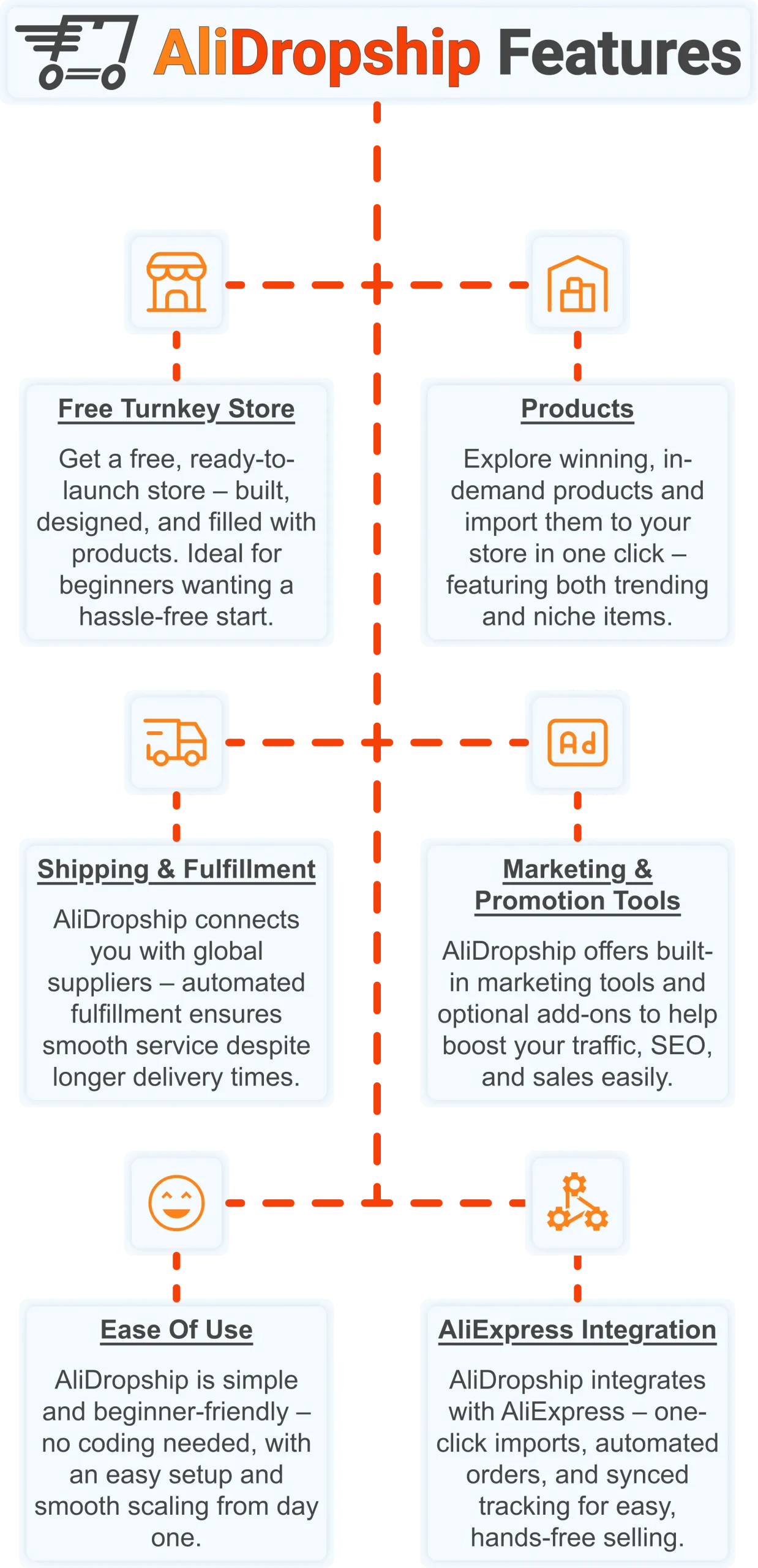
If you want the simplest possible way to start dropshipping – especially if you’re brand new – AliDropship remains one of the most beginner-friendly tools available in 2026. It brings together store creation, product imports, automation, and marketing into a single streamlined system designed to help you launch quickly and grow confidently.
Free turnkey store ️
Get a free turnkey store – built, designed, and filled with products. Ideal for beginners wanting a hassle-free start, the store comes fully optimized to attract customers right away, saving you time on setup. Plus, it includes professional design elements to give your business a polished, trustworthy look from day one. This ready-made foundation makes it easy to move seamlessly into product selection.
Products
Once your store is set up, you can explore winning, in-demand products and import them in one click – featuring both trending and niche items. This wide selection lets you cater to diverse customer interests and test what works best. Regular updates ensure you always have fresh products, keeping your store competitive and relevant. With great products in place, smooth shipping becomes the next essential step.
Shipping & fulfillment
AliDropship connects you with global suppliers, and automated fulfillment ensures seamless order processing despite international delivery times. Customers receive real-time tracking updates, which builds confidence and trust in your store. Once shipping is handled reliably, you can focus on promoting your store and attracting traffic.
Marketing & promotion tools
To maximize sales, AliDropship offers built-in marketing tools and optional add-ons that help boost traffic, SEO, and conversions. From email campaigns and discounts to social media integration, these tools empower you to reach and retain customers without needing prior marketing experience. With promotion strategies in place, managing your business becomes simpler and more efficient.
Ease of use
AliDropship is beginner-friendly – no coding needed, with an intuitive dashboard that guides you through every step. Easy setup and smooth scaling let you expand your store without stress. As your business grows, adding new features, products, and marketing campaigns remains hassle-free, giving you more time to focus on sales.
AliExpress integration
Finally, AliDropship integrates seamlessly with AliExpress, enabling one-click imports, automated orders, and synced tracking. Your inventory stays up-to-date with the latest products and prices, while automated order processing frees you from manual tasks. Combined with the turnkey setup, reliable shipping, and built-in marketing tools, this integration ensures your dropshipping business is fully equipped for growth and success.
Every stage of the ecommerce conversion funnel – from awareness to retention – becomes significantly easier when your store is built on a platform designed to handle all of it. Get your free turnkey AliDropship store today and start converting traffic into real revenue.
Frequently asked questions
What is an ecommerce conversion funnel?
An ecommerce conversion funnel is the structured sequence of steps a potential customer moves through before completing a purchase, from awareness to interest, decision, and action. Studies consistently show the average ecommerce conversion rate sits somewhere between 1 and 4 percent. That means for every 100 visitors landing on a store, up to 99 could leave without buying anything. Most modern funnels also include a fifth stage, retention, which covers post-purchase engagement and repeat orders.
How much can optimizing a conversion funnel realistically increase revenue?
With 5,000 monthly visitors, a 1 percent baseline conversion rate generates an estimated 500 to 1,500 dollars in monthly revenue. Optimizing to 2.5 percent can produce 1,250 to 3,750 dollars, while a well-optimized 4 percent or higher rate can generate 2,000 to 6,000 dollars from the same traffic. Doubling a conversion rate from 1 to 2 percent doubles revenue without a single extra dollar spent on ads. Most stores see meaningful improvement within 60 to 90 days of consistent funnel work.
What causes the most cart and checkout abandonment in ecommerce?
Cart abandonment rates average around 70 percent globally, meaning roughly 7 out of every 10 shoppers who add something to their cart never complete the purchase. Unexpected shipping costs at checkout are the single most cited reason for abandonment worldwide. Forced account creation is consistently placed among the top five checkout abandonment causes according to research from the Baymard Institute. A three-email abandoned cart sequence sent at 1 hour, 24 hours, and 72 hours typically recaptures 5 to 15 percent of abandoned carts.
How important are product page details like images and video for conversions?
Multiple high-quality images from different angles are considered non-negotiable for product pages, along with at least one lifestyle shot showing real-world use. Short product videos of 15 to 30 seconds showing the item being used can increase add-to-cart rates by 30 to 40 percent on pages where video is added. A 1-second delay in mobile load time reduces conversions by up to 20 percent, and mobile now accounts for over 70 percent of ecommerce traffic globally. A target of under 2.5 seconds for first contentful paint on mobile is a realistic benchmark for a well-optimized store.
Why does customer retention matter as much as the initial sale?
Repeat customers cost 5 to 7 times less to convert than new ones and tend to spend more per order as their trust in a store grows. Research from Bain and Company suggests a 5 percent increase in customer retention can increase overall profitability by 25 to 95 percent. Stores that run structured post-purchase email sequences consistently see repeat purchase rates 30 to 50 percent higher than those relying on broadcast campaigns alone. A well-structured sequence typically includes a delivery confirmation, a review request sent 7 to 10 days after delivery, and a re-engagement email 30 to 45 days after purchase.
 Previous post
