 ‧ Agnes Kazaryan ‧
March 23, 2026
‧ Agnes Kazaryan ‧
March 23, 2026  554 ‧
554 ‧
 0
0
Email marketing delivers an average of $36–$42 back for every $1 spent. No other ecommerce channel comes close. Yet most store owners either skip it entirely or send the same generic blast to everyone on their list and wonder why the results are flat.
If you run an online store – or you are planning to launch one – getting your email marketing right early is one of the highest-leverage moves you can make. This guide covers email marketing best practices specifically for ecommerce: how to build a list worth having, what to send, when to send it, and how to know whether it is actually working.
Quick Answer: The most effective email marketing best practices for ecommerce are building a permission-based list, segmenting by behavior, automating key flows like welcome sequences and cart abandonment, and tracking revenue per email alongside open and click rates to improve over time.
Whether you are starting from zero or tightening up a strategy that already exists, the practices below are grounded in what actually moves revenue – not just vanity metrics.
What is email marketing for ecommerce?
Email marketing for ecommerce is the practice of using targeted email campaigns to attract, convert, and retain customers for an online store. Unlike general brand newsletters, ecommerce email is tied directly to customer behavior – what someone browsed, what they added to a cart, what they bought, and how long ago they last purchased something.
It covers the full customer lifecycle: from the first welcome email a new subscriber receives, through post-purchase follow-ups, seasonal promotions, re-engagement campaigns for inactive subscribers, and loyalty rewards for repeat buyers. Done well, much of it runs on autopilot through automation – your store earns email revenue even when you are not actively working.
The reason email consistently outperforms most other channels comes down to ownership. You own your list. If a social platform changes its algorithm or shuts down, your audience there disappears overnight. With email, that list is yours regardless of what happens elsewhere. For ecommerce store owners building long-term businesses, that is a genuinely valuable asset.
How much can email realistically earn for your store?
Results depend on list size, product type, and how well your flows are set up. Industry benchmarks give a useful baseline for what to expect at each stage of growth.
These figures assume a competent email strategy – segmentation in place, a welcome sequence and cart abandonment flow active, and regular campaign sends. A cold list with no automation will produce far less. Most new store owners see meaningful email revenue within 60–90 days of launching their first flows, provided they are actively growing their list in parallel.
One note on the upper figures: High-end numbers assume consistent traffic, a healthy sender reputation, and a tested product catalog. Start with the fundamentals and revenue will scale with your list.
List building best practices
Your list is the foundation of your entire email program. A small, engaged list built on genuine opt-ins will always outperform a large one bought or cobbled together from dubious sources. These are the practices that build the right kind of list.
Use a lead magnet that actually matches your store
A pop-up that says “Subscribe to our newsletter” converts at around 1–2%. A pop-up offering a 10% discount on a first order, a free product guide, or early access to new arrivals converts at 4–8% or higher. The difference is value. Every sign-up form on your store should give the visitor a clear, specific reason to hand over their email address – and that reason should be directly tied to what your store sells.
For a general-product dropshipping store, a percentage discount works well. For a niche store – say, pet accessories or home fitness – a free buying guide or product comparison tool often outperforms a discount because it builds trust before asking for a sale.
Place sign-up forms where they convert
Exit-intent pop-ups – triggered when a visitor moves their cursor toward the browser tab – consistently outperform timed pop-ups. They appear at the exact moment someone is about to leave, which creates a natural last-chance dynamic. Beyond exit intent, embed sign-up forms in your footer, on product pages below the fold, and on your checkout confirmation page to capture buyers who did not opt in earlier.
Important note: Never add customers to your marketing list without explicit consent. In most markets this is not just bad practice – it violates regulations like GDPR in Europe and CAN-SPAM in the US. Always use a clearly labeled opt-in checkbox at checkout.
Keep the sign-up flow frictionless
Ask for an email address only on initial sign-up forms – not a name, phone number, and date of birth. Every additional field you add reduces your conversion rate. You can collect more data later through preference centers or post-purchase surveys, once you have already earned the subscriber’s trust.
Use double opt-in for list hygiene
Double opt-in – where the subscriber confirms their address by clicking a link in a confirmation email – produces a smaller list but a significantly cleaner one. Confirmed subscribers show higher open rates, lower spam complaint rates, and better long-term engagement. If you are sending to a European audience, double opt-in also simplifies GDPR compliance considerably.
Email automation best practices
Automated flows are the highest-ROI part of any ecommerce email program. They run continuously in the background, triggered by subscriber behavior, without manual input once they are live. Getting these right before you focus on campaigns is the single most impactful thing you can do.
Welcome sequence
Your welcome sequence is the most-read set of emails you will ever send. Open rates on welcome emails average 50–60%, compared to 20–25% for standard campaign sends. A solid ecommerce welcome sequence runs 3–5 emails over 7–10 days and covers: a warm introduction to your brand, your best-selling or most-reviewed products, social proof such as customer reviews or ratings, and a reminder of the sign-up incentive if it has not been used yet.
Do not use the welcome sequence purely to push discounts. Use it to establish what your store is about and why the subscriber should stay on your list. Stores that lead with trust in the welcome sequence see 20–30% higher lifetime customer value compared to those that lead purely with promotions.
Cart abandonment flow
On average, 70% of online shopping carts are abandoned before checkout. A cart abandonment sequence – typically 2–3 emails over 24–48 hours – recovers a meaningful portion of that lost revenue. The first email goes out within 1 hour of abandonment and simply reminds the customer what they left behind. The second, sent 12–24 hours later, can add a time-limited incentive. The third, if needed, reinforces urgency or flags low stock.
Cart abandonment flows typically generate 5–15% of total store revenue for stores that have them active, making this the single highest-impact automation to set up first.
Post-purchase sequence
The period immediately after a purchase is the highest-trust window in any customer relationship. A post-purchase sequence should include: an order confirmation (transactional), a shipping update, a delivery confirmation with usage tips or product care information, and a review request 7–10 days after estimated delivery. This sequence reduces support tickets, increases review count, and primes the customer for a second purchase.
Why this works in 2026: Repeat customers spend an average of 67% more than first-time buyers. The post-purchase sequence is the lowest-cost way to move first-timers toward that second purchase.
Win-back campaign
Subscribers who have not opened or clicked an email in 90–180 days are considered inactive. A win-back sequence of 2–3 emails – starting with a “we miss you” angle, followed by a strong incentive, and ending with a clear stay-or-unsubscribe choice – reactivates a portion of them and cleanly removes the rest. Keeping inactive subscribers on your list hurts deliverability, so win-back campaigns are as much a list hygiene practice as they are a revenue tactic.
Campaign and content best practices
Beyond automated flows, regular campaign emails keep your list warm and drive predictable revenue spikes around promotions, new arrivals, and seasonal moments. These are the practices that separate average campaign performance from genuinely strong results.
Segment before you send
Sending the same email to your entire list is one of the most common ecommerce email mistakes. Segmented campaigns – targeted to a specific subset of your list based on purchase history, location, product interest, or engagement level – outperform unsegmented sends by 14–25% in open rate and up to 100% in click-through rate, according to Mailchimp benchmark data.
Basic segments to start with: new subscribers (first 30 days), past buyers, high-value customers (top 20% by spend), and inactive subscribers. Even splitting your list this simply will produce noticeably better results than blasting everyone with the same message.
Write subject lines that earn the open
Subject lines determine whether your email gets opened or ignored. The highest-performing ecommerce subject lines are specific, curiosity-driven, or create a sense of urgency – without spam triggers like excessive capitals or multiple exclamation marks. Keep subject lines under 50 characters for mobile readability. Test two versions using A/B splits and let your platform send the winner automatically.
Preview text – the snippet that appears next to the subject line in most inboxes – is equally important and consistently overlooked. Write it as a continuation of the subject line, not a repetition of it.
Optimize send timing for your specific audience
Industry averages suggest Tuesday through Thursday, between 10 AM and 2 PM in the subscriber’s local time zone, produce the highest open rates for ecommerce. But averages are not your audience. After 3–4 months of sending, check your platform’s engagement data by day and time, then shift your schedule toward when your specific subscribers actually open. Klaviyo, Omnisend, and Mailchimp all offer send-time optimization that does this automatically.
Keep email design clean and product-focused
Ecommerce emails perform best when they are visually clean, load quickly, and make the product the hero. Use a single-column layout for mobile readability. Limit your color palette to your brand colors. Every email should have one primary CTA – a single clear action you want the reader to take – with secondary CTAs kept minimal and visually subordinate. Emails that try to promote five products with equal emphasis consistently underperform focused single-product or single-category sends.
Email marketing metrics you actually need to track
Open rates alone are not enough. A healthy ecommerce email program is measured across a set of metrics that together tell you whether your emails are reaching people, engaging them, and converting them into buyers. Revenue per email is the number that matters most.
Revenue per email (RPE) is the most important single metric for ecommerce. It accounts for list size, engagement, and conversion in one number, making it easy to compare the performance of different campaigns and flows over time. If your RPE is consistently below $0.05, something in the funnel – subject line, content, offer, or landing page – needs fixing before you scale your list further.
Email deliverability: What it is and why it matters
You can write the best email in your niche, but if it lands in the spam folder it earns nothing. Deliverability is the measure of whether your emails actually reach the inbox – and it is determined by a combination of technical setup, sender reputation, and ongoing list hygiene.
Technical setup
Three DNS records protect your sender identity and tell receiving mail servers that your emails are legitimate: SPF (Sender Policy Framework), DKIM (DomainKeys Identified Mail), and DMARC (Domain-based Message Authentication, Reporting, and Conformance). Every major email platform – Klaviyo, Omnisend, ActiveCampaign – provides step-by-step instructions for setting these up on your sending domain. Do not skip this step. Stores that skip it experience significantly higher spam placement rates, particularly since Gmail and Outlook tightened their bulk sender requirements in 2024.
Important: Never send marketing emails from a free Gmail or Outlook address. Always use a branded domain email (yourname@yourstorename.com) to protect your sender reputation and avoid automatic spam filtering.
Sender reputation and warm-up
When you start sending from a new domain, mailbox providers have no history of your behavior. Sending 10,000 emails on day one from a cold domain will almost certainly result in poor inbox placement. Instead, warm up gradually – start with 200–500 sends per day to your most engaged subscribers, increase volume by 20–30% every few days, and monitor your spam complaint rate closely throughout. Most email platforms have built-in warm-up tools or clear guidance for this process.
List hygiene
A clean list outperforms a large one every time. Remove hard bounces immediately – they damage sender reputation with every send. Suppress chronic non-openers (180+ days of no engagement) before running re-engagement campaigns, and remove any subscriber who goes through a win-back sequence without responding. Using a list verification tool like NeverBounce or ZeroBounce before your first large send to a cold list is worth the cost – it removes invalid addresses before they can hurt your reputation.
What to avoid in ecommerce email marketing
A lot of email marketing advice focuses on what to do. Equally important is knowing what actively damages your program – especially as a newer sender building reputation from scratch.
Purchased or scraped email lists
Buying an email list is one of the fastest ways to destroy your sender reputation before you have even built it. Purchased lists are filled with invalid addresses, spam traps, and people who never asked to hear from you. Spam complaint rates from cold purchased lists routinely exceed 2–5% – far above the 0.1% threshold that triggers blacklisting at major mailbox providers. There is no shortcut here. Build your list organically, one genuine opt-in at a time.
Key principle: Every subscriber on your list should have explicitly chosen to receive email from your store. No exceptions.
Sending without segmentation
Sending a promotion for winter coats to subscribers in Florida in July is a fast path to unsubscribes. Sending a re-order campaign to someone who bought three days ago is similarly tone-deaf. Poor segmentation is not just an engagement problem – it signals to mailbox providers that your content is not relevant to your audience, which over time degrades your sender score. Even basic behavioral segmentation (buyers vs. non-buyers, recent vs. inactive) makes a measurable difference.
Ignoring mobile optimization
More than 60% of emails are opened on mobile devices. An email that renders perfectly in desktop Gmail and breaks into unreadable columns on an iPhone is losing more than half its potential conversions before anyone reads a single word. Use a single-column layout, keep body text font sizes at 14px minimum, and test every template on both desktop and mobile before activating any automation or sending any campaign.
Misleading subject lines
Subject lines that promise something the email does not deliver – “Your order has shipped” for a promotional email, or “Re: our conversation” for cold outreach – generate short-term opens and long-term unsubscribes and spam complaints. Your deliverability and list health are worth far more than a temporary open rate spike. Write subject lines that are honest, specific, and relevant to what is actually inside the email.
Choosing the right email platform for your store
The platform you build on matters because it determines what automations are available to you, how well it integrates with your store, and how much complexity you can handle as you scale. Three platforms dominate ecommerce email in 2026.
Klaviyo
Klaviyo is the most powerful ecommerce-native email platform available. It integrates deeply with Shopify, WooCommerce, and most major ecommerce platforms, pulling in real-time data on customer behavior, purchase history, and product interactions. Its segmentation and automation capabilities are unmatched at its price point, which starts free for up to 250 contacts and scales with list size. The learning curve is steeper than alternatives, but for stores with serious email revenue goals, it is the standard choice.
Omnisend
Omnisend is built specifically for ecommerce and is slightly easier to use than Klaviyo while covering all the core automation flows. It also includes SMS marketing in the same platform, making it a strong option for stores that want to run email and text campaigns from a single dashboard. Pricing is competitive, with a free tier supporting up to 250 contacts and 500 emails per month.
Mailchimp
Mailchimp is the most widely known email platform globally and a reasonable starting point for brand-new store owners who want a beginner-friendly interface. Its ecommerce automation features are less sophisticated than Klaviyo or Omnisend, and pricing becomes less competitive at higher list sizes. That said, for a store in its first 3–6 months with a small list, Mailchimp’s free tier (up to 500 contacts) provides enough to run a welcome sequence and basic campaigns.
Final thoughts: Where to start with email marketing
Email marketing is not complicated, but it does reward consistency and patience. The fundamentals – a clean list, a solid welcome sequence, an active cart abandonment flow, and regular segmented campaigns – account for the vast majority of email revenue for ecommerce stores. Everything else is optimization on top of that foundation.
Here is a simple starting point based on where you are right now.
Complete beginner: Pick a platform (Mailchimp or Omnisend for simplicity), set up a sign-up form with a lead magnet offer on your store, and build a 3-email welcome sequence. Do not overthink it at this stage – getting something live and collecting subscribers is more valuable than a perfect strategy sitting in a document. Review your open and click rates after 30 days and adjust from there.
Intermediate – some subscribers, inconsistent sends: Audit what you already have. Is your welcome sequence live and tested? Is cart abandonment active? If either of those is missing, build them before adding any new campaigns. Then commit to a consistent cadence – one campaign email per week minimum – and start basic segmentation between buyers and non-buyers. That shift alone will improve your revenue per email noticeably within 60 days.
Advanced – solid list, looking to scale: Focus on deepening segmentation using RFM modeling (recency, frequency, monetary value), A/B testing subject lines and send times systematically, and building out a post-purchase upsell sequence. At this stage, email should represent 25–40% of your total store revenue. If it is below that, the gap is almost always in automation depth or segmentation quality rather than list size.
Email marketing in 2026 is more competitive than it was five years ago. But stores that treat it seriously – building lists ethically, automating key touchpoints, and sending relevant content to the right segments – are generating consistent, compounding returns that most paid channels simply cannot match.
AliDropship: Your complete all-in-one solution for starting dropshipping in 2026
If you want the simplest possible way to start dropshipping – especially if you’re brand new – AliDropship remains one of the most beginner-friendly tools available in 2026. It brings together store creation, product imports, automation, and marketing into a single streamlined system designed to help you launch quickly and grow confidently.
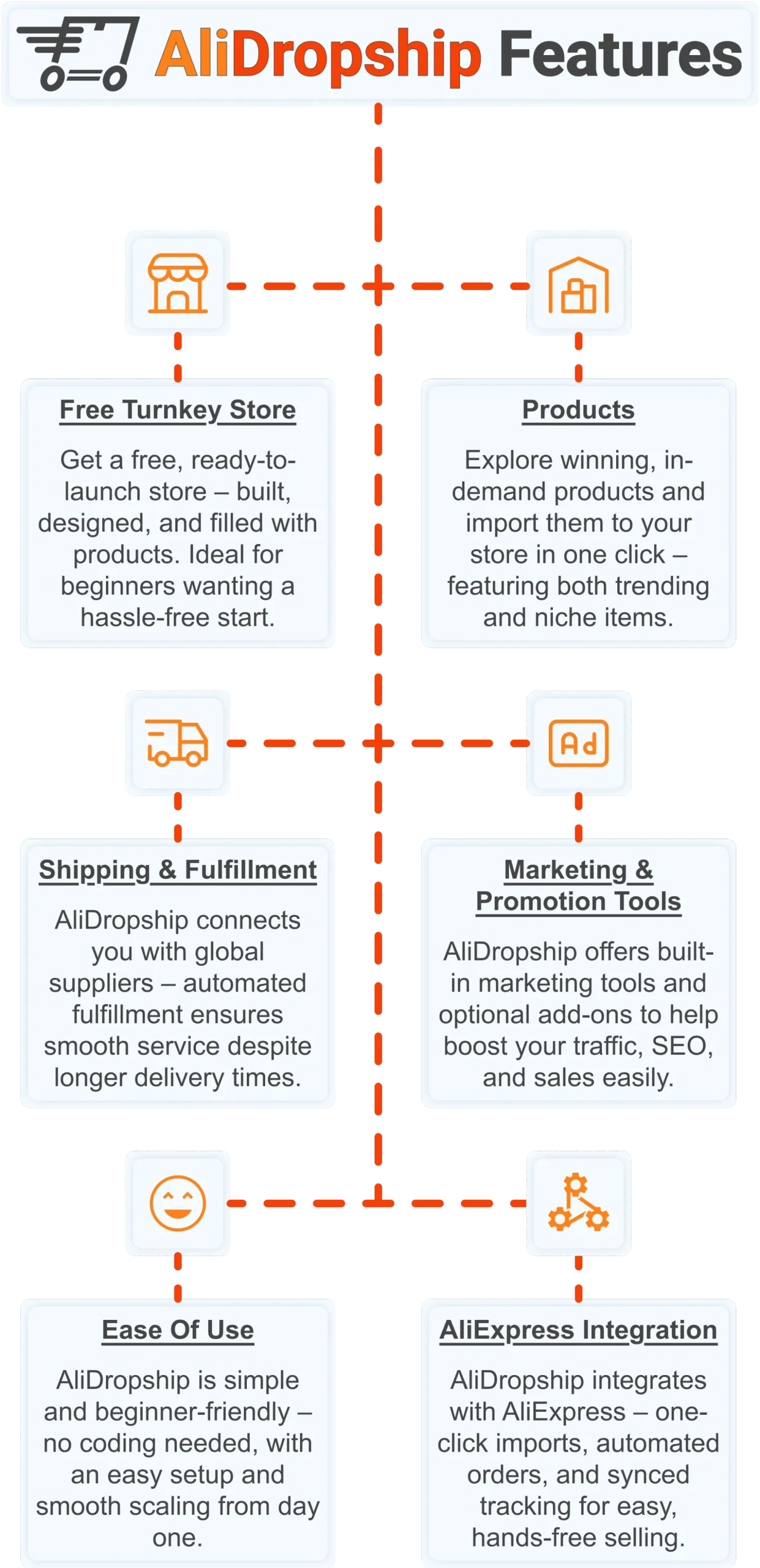
Free turnkey store ️
Get a free turnkey store – built, designed, and filled with products. Ideal for beginners wanting a hassle-free start, the store comes fully optimized to attract customers right away, saving you time on setup. Plus, it includes professional design elements to give your business a polished, trustworthy look from day one. This ready-made foundation makes it easy to move seamlessly into product selection.
Products
Once your store is set up, you can explore winning, in-demand products and import them in one click – featuring both trending and niche items. This wide selection lets you cater to diverse customer interests and test what works best. Regular updates ensure you always have fresh products, keeping your store competitive and relevant. With great products in place, smooth shipping becomes the next essential step.
Shipping & fulfillment
AliDropship connects you with global suppliers, and automated fulfillment ensures seamless order processing despite international delivery times. Customers receive real-time tracking updates, which builds confidence and trust in your store. Once shipping is handled reliably, you can focus on promoting your store and attracting traffic.
Marketing & promotion tools
To maximize sales, AliDropship offers built-in marketing tools and optional add-ons that help boost traffic, SEO, and conversions. From email campaigns and discounts to social media integration, these tools empower you to reach and retain customers without needing prior marketing experience. With promotion strategies in place, managing your business becomes simpler and more efficient.
Ease of use
AliDropship is beginner-friendly – no coding needed, with an intuitive dashboard that guides you through every step. Easy setup and smooth scaling let you expand your store without stress. As your business grows, adding new features, products, and marketing campaigns remains hassle-free, giving you more time to focus on sales.
AliExpress integration
Finally, AliDropship integrates seamlessly with AliExpress, enabling one-click imports, automated orders, and synced tracking. Your inventory stays up-to-date with the latest products and prices, while automated order processing frees you from manual tasks. Combined with the turnkey setup, reliable shipping, and built-in marketing tools, this integration ensures your dropshipping business is fully equipped for growth and success.
Frequently Asked Questions
What are the most important email marketing best practices for ecommerce?
The most effective email marketing best practices are building a permission based list, segmenting by behavior, automating key flows like welcome sequences and cart abandonment, and tracking revenue per email. Email marketing delivers an average of 36 to 42 dollars back for every 1 dollar spent, making it the highest return channel in ecommerce. Segmented campaigns outperform unsegmented sends by 14 to 25 percent in open rate and up to 100 percent in click through rate. Most new store owners see meaningful email revenue within 60 to 90 days of launching their first automated flows.
How much revenue can email marketing realistically generate for a store?
A newly launched store with 0 to 500 subscribers can typically expect 50 to 300 dollars in monthly email revenue. Growing stores with 500 to 5000 subscribers usually see 300 to 2500 dollars monthly, while established stores with 5000 to 20000 subscribers can reach 2500 to 12000 dollars. These figures assume a competent strategy is in place, including segmentation, an active welcome sequence, and a working cart abandonment flow. A cold list with no automation in place will produce far less revenue than these benchmarks suggest.
What is a cart abandonment email flow and how effective is it?
A cart abandonment flow is a sequence of typically 2 to 3 emails sent over 24 to 48 hours to customers who added items to their cart without completing checkout. About 70 percent of online shopping carts are abandoned before checkout, making this one of the most valuable automations a store can set up. The first email goes out within 1 hour of abandonment, while the second can add a time limited incentive 12 to 24 hours later. Cart abandonment flows typically generate 5 to 15 percent of total store revenue for stores that have them active.
How often should you send marketing emails without hurting deliverability?
Deliverability depends more on list hygiene and technical setup than sending frequency alone, with unsubscribe rates ideally staying below 0.5 percent and spam complaints below 0.1 percent. New senders should warm up gradually, starting with 200 to 500 sends per day and increasing volume by 20 to 30 percent every few days. Purchased or scraped email lists routinely produce spam complaint rates of 2 to 5 percent, far above the 0.1 percent threshold that triggers blacklisting at major providers. For an intermediate store, committing to at least one segmented campaign email per week tends to improve revenue per email within about 60 days.
Which email marketing platform is best for an ecommerce store?
Klaviyo is considered the most powerful ecommerce native platform, integrating deeply with Shopify and WooCommerce with a free tier for up to 250 contacts. Omnisend is built specifically for ecommerce and includes SMS marketing in the same dashboard, with a free tier supporting up to 250 contacts and 500 emails per month. Mailchimp is the most widely known option and a reasonable starting point for brand new store owners, offering a free tier of up to 500 contacts. The right choice generally depends on list size and how much automation complexity a store owner is ready to manage.
Email marketing is only as powerful as the store behind it – and with AliDropship, that store is already built, stocked, and ready to grow. Get your free turnkey store today and start building the email list that drives consistent sales.
 Previous post
