 ‧ Agnes Kazaryan ‧
March 14, 2026
‧ Agnes Kazaryan ‧
March 14, 2026  627 ‧
627 ‧
 0
0
More than 2.7 billion people bought something online in 2024 – and that number keeps climbing. If you have been thinking about starting an online store, or expanding what you already sell, the biggest question is always the same: what should you actually sell?
Getting this right from the start saves you months of wasted effort and puts real money on the table faster. Choosing high demand products to sell is not about chasing viral trends – it is about finding categories with staying power, genuine buyer intent, and room for new sellers to compete.
Quick Answer: The most high demand products to sell online in 2026 include health and wellness items, home improvement tools, pet products, sustainable goods, and digital accessories – categories driven by lasting consumer behaviour rather than short-lived fads.
This guide walks you through the top product categories, breaks down earning potential honestly, and helps you figure out which approach fits your situation – whether you are a complete beginner or already testing the ecommerce waters.
What are high demand products to sell?
High demand products are items that consistently attract buyer interest, generate regular search volume, and convert well across ecommerce platforms. The key distinction is consistency – these are not viral novelties that spike for two weeks before disappearing. They are products rooted in ongoing consumer needs, lifestyle shifts, or practical problems people need to solve.
In 2026, the definition has expanded. High demand no longer just means “sells a lot” – it also means sustainable margins, repeat purchase potential, and strong social proof. Buyers are more research-savvy than ever. They check reviews, compare prices, and look for credibility signals before clicking buy.
Identifying popular items to sell requires balancing three signals: search trend data (what people are actively looking for), marketplace performance (what is already converting on Amazon, Etsy, and similar platforms), and social engagement (what products are gaining traction on TikTok, Instagram, and Reddit communities). A product ticking all three boxes is almost always a strong candidate.
How much can you realistically earn?
Earnings vary widely depending on your product category, traffic source, and how much effort you put into your store. The table below gives you an honest breakdown across the most common selling methods so you can set realistic expectations before investing time and money.
Dropshipping via AliDropship offers the lowest barrier to entry and the most scalable ceiling. Amazon FBA and handmade selling require more upfront capital or time but can generate strong returns for committed sellers.
One note on the ceiling figures: the higher daily numbers assume established stores with repeat customers and optimised ad spend. As a starting point, focus on hitting your first $30–$50 day before planning for $200. The most sustainable approach is picking a product category you can genuinely learn about – because product knowledge and audience trust compound over time.
Top high demand product categories for 2026
These categories have earned their place through sustained marketplace performance, growing search interest, and genuine repeat-purchase behaviour. Each one offers multiple entry points depending on your budget and platform of choice.
Health, wellness, and self-care
Consumer spending on health and wellness has grown every year for the past decade, and 2026 is no exception. This is one of the most reliable high demand product categories available to online sellers. Buyers in this space are motivated, educated, and willing to pay for quality.
Supplements and vitamins
Protein powders, collagen supplements, magnesium gummies, and adaptogens like ashwagandha continue to dominate health searches. The repeat-purchase cycle is built in – customers who find a supplement they like come back monthly. Margins depend heavily on branding; white-label options exist for sellers wanting to build their own line.
Earning potential: $40–$150/day for established supplement stores with a defined niche audience.
Why this works in 2026: Wellness culture has moved from niche interest to mainstream habit. Health communities on Reddit and TikTok create constant organic discovery for supplement brands.
Skincare and beauty tools
Gua sha tools, LED face masks, microneedle rollers, and glass-skin serums are among the most searched beauty items online. This category blends impulse buying with results-based loyalty. Sellers who focus on a specific skin concern – acne, anti-ageing, or hyperpigmentation – consistently outperform generalist beauty stores.
Earning potential: $30–$100/day for niche beauty stores with an active Instagram or Pinterest presence.
Fitness equipment and accessories
Resistance bands, kettlebells, foam rollers, and portable pull-up bars remain consistently popular items to sell year-round. The home gym trend accelerated dramatically and has not reversed. Accessories in the $15–$60 range convert especially well because the barrier to purchase is low while the perceived value is high.
Earning potential: $25–$80/day for fitness accessory stores with strong product photography.
Home improvement and smart living
People are investing more in their living spaces than at any point in recent memory. Post-pandemic nesting behaviour has evolved into a permanent lifestyle shift toward home comfort and functionality – and that means sustained demand for products that make homes smarter, more organised, or simply more enjoyable to be in.
Smart home devices
Smart plugs, LED strip lights with app control, video doorbells, and voice-compatible switches are among the most gifted and self-purchased tech products of 2026. The category benefits from strong unboxing culture on YouTube and TikTok, driving organic discovery without heavy ad spend.
Earning potential: $40–$120/day for smart home accessory stores targeting tech-curious homeowners.
Organisational and storage products
Aesthetic storage solutions – stackable containers, drawer organisers, closet systems, and under-bed storage bags – perform exceptionally well on visual platforms like Pinterest and Instagram. This category has an unusually high save-to-purchase conversion rate, meaning buyers often return weeks later to complete a purchase they bookmarked earlier.
Earning potential: $20–$70/day with strong seasonal peaks in January and August.
Kitchen gadgets and tools
Air fryer accessories, silicone utensil sets, meal prep containers, and niche cooking tools generate consistent food-adjacent traffic. Recipe content on social media naturally leads buyers toward the tools used. Sellers who create or curate recipe content alongside products dramatically outperform those listing products alone.
Earning potential: $30–$90/day for kitchen accessory stores with active social media or recipe blog traffic.
Pet products
Pet ownership rates hit record highs in 2023 and 2024, and pet owners consistently spend more per purchase than almost any other consumer group. The emotional driver – caring for an animal – removes typical price sensitivity. Sellers in this space benefit from repeat purchases, gifting behaviour, and very high brand loyalty once trust is established.
Pet accessories and toys
Slow feeder bowls, interactive puzzle toys, window-mounted cat hammocks, and leash accessories are perennial bestsellers. The variety within this subcategory means there is always a new product to test without rebuilding your store from scratch.
Earning potential: $30–$100/day for pet accessory stores with a loyal, repeat-buying customer base.
Pet grooming supplies
Grooming tools – deshedding brushes, pet-safe shampoos, nail grinders, and grooming gloves – share the same repeat-purchase dynamic as supplements. Owners groom their pets regularly, and trusted products stay in the cart permanently. The category also sees strong gift purchase behaviour around holidays.
Earning potential: $20–$60/day with consistent seasonal demand and strong repeat-purchase rates.
Sustainable and eco-friendly products
Sustainability has shifted from a premium feature to a purchase requirement for a growing segment of consumers. Products marketed as sustainable are growing at roughly twice the rate of their conventional equivalents – and this is not a passing trend. It reflects a fundamental behaviour shift, especially among millennial and Gen Z shoppers who actively share products they believe in.
Reusable everyday items
Reusable water bottles, stainless steel straws, beeswax wraps, bamboo toothbrushes, and compostable bags are consistently popular items to sell. These products attract environmentally-conscious buyers who are happy to pay a premium and spread the word on social media.
Earning potential: $20–$70/day for sustainable product stores with community-driven marketing.
Zero-waste personal care
Shampoo bars, solid conditioners, refillable deodorants, and package-free skincare are gaining shelf space in mainstream retail – which means online demand is growing even faster. Subscription models work especially well here because buyers already plan to use the products regularly and prefer to avoid plastic packaging.
Earning potential: $25–$80/day, with subscription revenue creating predictable monthly income.
Digital accessories and tech peripherals
The global consumer electronics accessories market continues to grow steadily, driven by new device releases and the universal need to protect, charge, and enhance existing gadgets. This category requires relatively low per-unit investment and offers strong gifting crossover – making it one of the most accessible high demand product niches for new sellers.
Phone cases and device protection
Custom phone cases, MagSafe accessories, tempered glass protectors, and wireless chargers are perennial top sellers because new phone models generate automatic refresh demand. Sellers who time their product listings around major phone releases can capture a concentrated surge of buyer intent.
Earning potential: $25–$80/day for phone accessory stores targeting specific device ecosystems.
Work-from-home and productivity tools
Ergonomic desk accessories, monitor stands, cable management systems, ring lights, and webcam covers remain high demand products because remote and hybrid work is now a permanent fixture for a significant portion of the global workforce. Buyers in this category are motivated by productivity and comfort – two things they will consistently invest in.
Earning potential: $30–$90/day for WFH accessory stores with content marketing tied to remote work communities on Reddit and LinkedIn.
How to validate a product before you sell it
Knowing which broad categories perform well is useful – but before committing to a specific product, run it through a quick validation process. This takes an afternoon and can save you weeks of selling something that looks promising on paper but underperforms in practice.
Check search volume and trend direction
Use Google Trends to see whether interest in your product has been growing or declining over the past 12 months. A flat or gently growing trend is fine. A sharp spike with a steep drop signals a fad. Stable, gradual growth over 24 or more months is the ideal signal for a genuinely high demand product you can build a business around.
Review marketplace competition and pricing
Search your product on Amazon and look at the review counts on the top three listings. Products with 100–2,000 reviews in those top positions indicate healthy demand without extreme saturation. If every top result has 50,000+ reviews, you are entering a category dominated by established brands with large advertising budgets – and carving out space will be a much harder fight.
Look for social proof and community discussion
Search your product on Reddit using the format “product name + reddit” to find genuine user discussions. Real buyer conversations on subreddits like r/BuyItForLife or category-specific communities tell you far more about actual purchase motivation than any sales data tool. If people are talking about it unprompted, that is a strong signal of real intent.
Test with a small order before scaling
If your validation checks out, run a small ad test or order a minimal batch before committing significant budget. Real-world data – actual click-through rates, conversion rates, and return rates – is more valuable than any research tool output. This one step prevents most of the costly mistakes new sellers make.
Tips for turning popular items to sell into consistent income
Picking the right products is only one part of the equation. How you sell matters just as much. These practical approaches apply regardless of which category you choose.
Focus on a niche, not a department store
Sellers who specialise in a specific audience or problem consistently outperform those with broad, unfocused catalogues. A store built around “apartment-friendly fitness equipment” will convert better than a general sports store because it speaks directly to a defined buyer with a specific need. Specificity builds trust – and trust drives sales.
Use supplier relationships to protect your margins
Price competition is brutal in commodity categories. The sellers who sustain strong margins are those with exclusive supplier deals, private-label arrangements, or bundling strategies that make direct price comparison difficult. Even small differentiation creates loyal customers who do not shop purely on price.
Invest in product photography early
High-quality images are the single most underrated conversion lever for online stores. Image quality consistently affects purchase decisions more than price in mid-range product categories. If your photography looks low-effort, buyers assume the product is too – regardless of how good it actually is.
Build a content strategy around the problem your product solves
The most cost-effective traffic for product stores comes from content – blog posts, YouTube videos, TikTok reviews, or Pinterest boards built around the specific pain point your product addresses. A single well-ranking article or video can drive consistent sales for years without ongoing ad spend.
Prioritise customer retention from day one
Acquiring a new customer costs five to seven times more than selling to an existing one. From your very first sale, collect email addresses, send order follow-ups, and create a reason for buyers to return. Even a simple post-purchase email sequence with a discount code dramatically improves lifetime value.
Pro Tip: Set up an abandoned cart email sequence before you start driving traffic. You will recover 5–15% of carts that would otherwise leave without purchasing.
Legal and ethical considerations when selling online
Ecommerce is a legitimate business and should be run like one. A few critical rules protect you legally and build the long-term brand trust that makes your store genuinely valuable over time.
What to avoid absolutely
Selling counterfeit goods – replica branded products, fake designer items, or unlicensed character merchandise – carries significant legal risk and will get your store banned from every major platform. Even if a supplier offers them, your store is liable for what you list.
Fake reviews, review manipulation schemes, and artificially inflated ratings violate platform terms of service and, in many jurisdictions, consumer protection law. The short-term boost is not worth the permanent account suspension.
Important: Unsubstantiated health claims on supplements or wellness products can trigger regulatory action. Stick to benefit-based language that does not make medical claims your product cannot legally support.
What to do instead
Source products from verified suppliers, use authentic customer reviews, comply with platform advertising guidelines, and keep your product descriptions accurate. This sounds basic – but most sellers who build lasting stores do exactly this, nothing more complicated than running an honest business.
Key principle: Sustainable ecommerce income comes from genuine value – real products that solve real problems for real customers who choose to come back.
Final thoughts: How to choose the right product for you
The best high demand product to sell is not always the trendiest one. It is the one that aligns with your knowledge, your available time, and how you want to run your business. Here is a practical breakdown by reader profile.
Complete beginner
Start with a dropshipping model in a category you already have some interest in – pet products, home organisation, or fitness accessories are all strong starting points. Dropshipping removes the inventory risk and lets you test multiple products quickly. Focus on one niche, one platform, and one traffic source until you are consistently profitable before expanding.
Intermediate / part-time seller
If you are already making some sales and want to scale, focus on conversion optimisation and customer retention rather than constantly chasing new products. Improve your product pages, build an email list, and test paid ads with a small daily budget – $5–$15/day – on your best performers. Incremental improvement here compounds faster than launching new stores.
Advanced / full-time goal
If you are aiming for full-time ecommerce income in the $3,000–$6,000+/month range, treat product selection as an ongoing process rather than a one-time decision. Use data from your existing sales to identify what your specific audience buys repeatedly, then expand within that proven demand rather than pivoting to entirely new categories.
The ecommerce space in 2026 rewards sellers who combine genuine product knowledge with consistent marketing effort.
AliDropship: Your complete all-in-one solution for starting dropshipping in 2026
If you want the simplest possible way to start dropshipping – especially if you’re brand new – AliDropship remains one of the most beginner-friendly tools available in 2026. It brings together store creation, product imports, automation, and marketing into a single streamlined system designed to help you launch quickly and grow confidently.
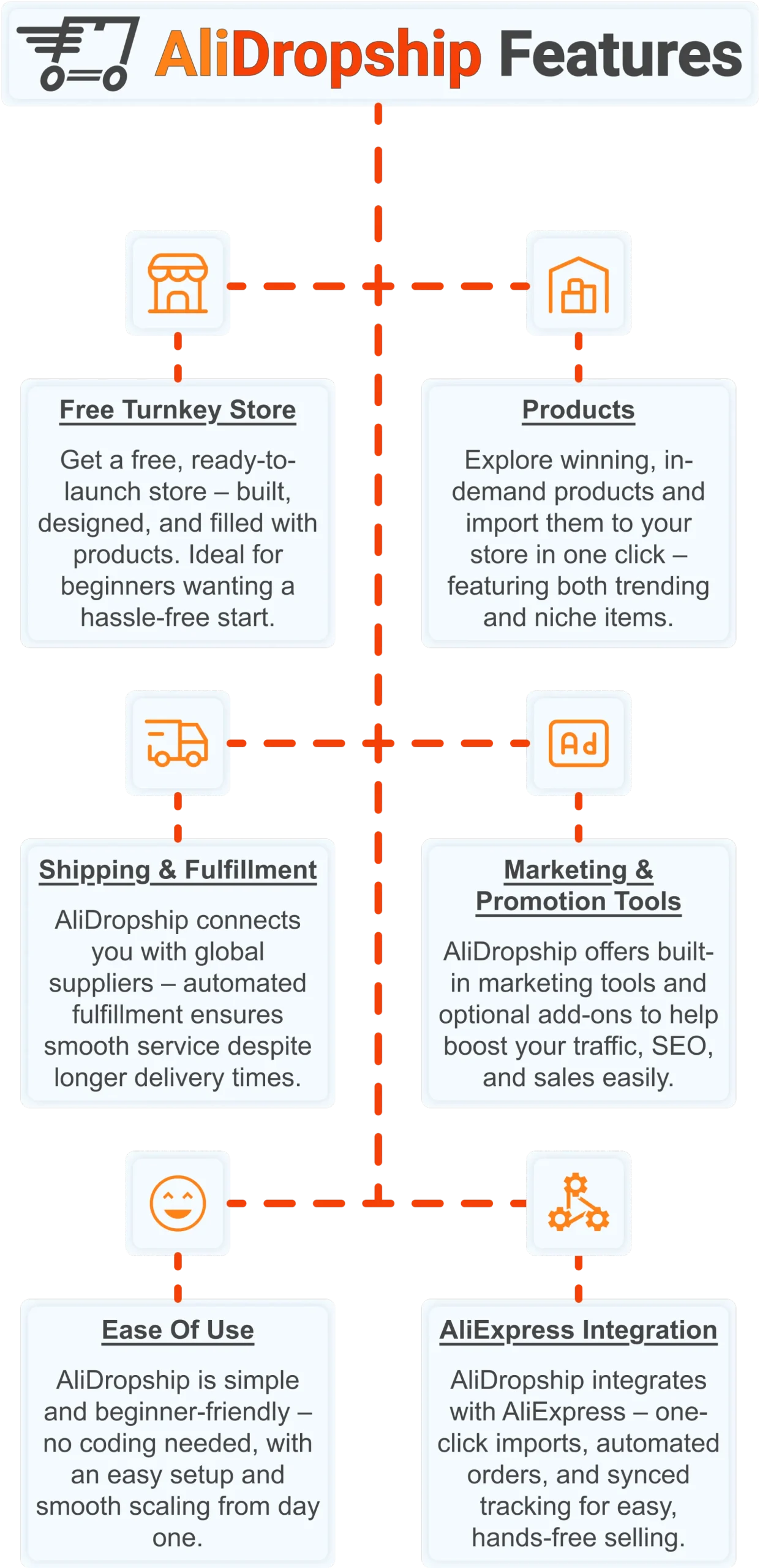
Free turnkey store ️
Get a free turnkey store – built, designed, and filled with products. Ideal for beginners wanting a hassle-free start, the store comes fully optimized to attract customers right away, saving you time on setup. Plus, it includes professional design elements to give your business a polished, trustworthy look from day one. This ready-made foundation makes it easy to move seamlessly into product selection.
Products
Once your store is set up, you can explore winning, in-demand products and import them in one click – featuring both trending and niche items. This wide selection lets you cater to diverse customer interests and test what works best. Regular updates ensure you always have fresh products, keeping your store competitive and relevant. With great products in place, smooth shipping becomes the next essential step.
Shipping & fulfillment
AliDropship connects you with global suppliers, and automated fulfillment ensures seamless order processing despite international delivery times. Customers receive real-time tracking updates, which builds confidence and trust in your store. Once shipping is handled reliably, you can focus on promoting your store and attracting traffic.
Marketing & promotion tools
To maximize sales, AliDropship offers built-in marketing tools and optional add-ons that help boost traffic, SEO, and conversions. From email campaigns and discounts to social media integration, these tools empower you to reach and retain customers without needing prior marketing experience. With promotion strategies in place, managing your business becomes simpler and more efficient.
Ease of use
AliDropship is beginner-friendly – no coding needed, with an intuitive dashboard that guides you through every step. Easy setup and smooth scaling let you expand your store without stress. As your business grows, adding new features, products, and marketing campaigns remains hassle-free, giving you more time to focus on sales.
AliExpress integration
Finally, AliDropship integrates seamlessly with AliExpress, enabling one-click imports, automated orders, and synced tracking. Your inventory stays up-to-date with the latest products and prices, while automated order processing frees you from manual tasks.
Combined with the turnkey setup, reliable shipping, and built-in marketing tools, this integration ensures your dropshipping business is fully equipped for growth and success.
Frequently asked questions
What are high demand products to sell and how are they identified?
High demand products are items that consistently attract buyer interest, generate regular search volume, and convert well across ecommerce platforms rather than spiking briefly like a viral novelty. More than 2.7 billion people bought something online in 2024, and that number keeps climbing every year. Identifying these products requires balancing three signals, including search trend data, marketplace performance on platforms like Amazon and Etsy, and social engagement on TikTok and Reddit. A product ticking all three of these boxes is almost always a strong candidate for a new store.
How much money can you realistically earn selling high demand products?
Dropshipping through a platform like AliDropship offers the lowest barrier to entry, earning 30 to 200 dollars or more per day once established. Amazon FBA requires more upfront capital but can generate 50 to 300 dollars per day with capital invested. Print on demand earns less on average, around 5 to 40 dollars per day for passive stores. As a starting point, sellers should focus on hitting their first 30 to 50 dollar day before planning for figures closer to 200 dollars.
Which product categories are considered high demand in 2026?
Supplements and vitamins such as protein powders and collagen earn 40 to 150 dollars per day for established stores with a defined niche audience. Smart home devices including smart plugs and video doorbells earn 40 to 120 dollars per day for stores targeting tech curious homeowners. Pet accessories and toys such as slow feeder bowls and puzzle toys earn 30 to 100 dollars per day for stores with a loyal repeat buying customer base. Work from home and productivity tools like ergonomic desk accessories earn 30 to 90 dollars per day for stores with content marketing tied to remote work communities.
How do you validate a high demand product before committing to sell it?
Use Google Trends to check whether interest has been growing or declining over the past 12 months, since stable gradual growth over 24 or more months is the ideal signal. Search the product on Amazon and check review counts on the top three listings, since 100 to 2000 reviews indicates healthy demand without extreme saturation. Search Reddit using the product name plus the word reddit to find genuine unprompted user discussions that reveal real purchase motivation. Testing with a small ad budget or a minimal order batch before scaling provides real world data that prevents most costly mistakes new sellers make.
What legal and ethical rules apply when selling high demand products online?
Selling counterfeit goods such as replica branded products or unlicensed character merchandise carries significant legal risk and will get a store banned from every major platform. Fake reviews and review manipulation schemes violate platform terms of service and, in many jurisdictions, consumer protection law. Unsubstantiated health claims on supplements or wellness products can trigger regulatory action, so sticking to benefit based language that does not make medical claims is essential. Sourcing from verified suppliers and using authentic customer reviews are the basic practices that build the long term trust a lasting store depends on.
You now know exactly which high demand products to sell in 2026 – the only step left is building the store that sells them. Get your free AliDropship store and start earning today.
 Previous post
