 ‧ Agnes Kazaryan ‧
March 24, 2026
‧ Agnes Kazaryan ‧
March 24, 2026  741 ‧
741 ‧
 0
0
More people are running profitable businesses from their kitchen tables, spare bedrooms, and home offices than at any point in history. According to the U.S. Small Business Administration, over 50% of all small businesses in the United States are home-based – and that number has been climbing steadily since 2020.
If you have been searching for home based business ideas that are realistic, honest, and actually worth your time in 2026, you are in the right place. The good news: you do not need a big budget, a business degree, or years of experience to get started. Many of the best small business ideas from home require nothing more than a laptop, a reliable internet connection, and a clear sense of direction.
Quick answer: The strongest home based business ideas in 2026 include dropshipping, freelance services, online tutoring, content creation, and digital product sales. Each suits a different skill set and time commitment, with earning potential ranging from $300 to $5,000+ per month depending on effort and model.
The challenge is cutting through the noise – because for every legitimate opportunity, there are five vague promises that waste your time. This guide covers the most viable options in honest detail: what each one involves, how much you can realistically earn, and how to get started without overcomplicating things.
What are home based business ideas?
A home based business is any commercial activity you run primarily from your home – either fully online or with customers and suppliers you never need to meet in person. The category has expanded dramatically over the past decade. What used to mean selling crafts at a market or offering local bookkeeping services now includes global ecommerce stores, remote consulting practices, and content businesses reaching hundreds of thousands of people worldwide.
In 2026, the defining characteristic of a strong home based business is low overhead. You are not paying for office space, commuting, or retail inventory (in most cases). That lowers your financial risk considerably compared to a traditional setup and gives you flexibility that a salaried job simply cannot match.
The best work from home business ideas share a few traits: they are scalable (you can grow without proportionally increasing your costs), they have genuine market demand, and they are something you can sustain for more than three months without burning out. That last point matters more than most people admit when they are first starting out.
How much can you realistically earn from a home based business?
Earnings vary enormously depending on the model you choose, the hours you put in, and how long you have been at it. The table below gives you an honest snapshot of the most popular home based business models – not best-case figures, but what real operators report after 6–12 months of consistent effort.
These figures reflect what is achievable for someone working consistently – not the viral success stories you see on social media. Most home based businesses take 60–90 days to generate their first meaningful revenue, and 6–12 months of sustained effort before income becomes reliable.
One note on the upper figures: The ceiling numbers above are real, but they represent operators who have refined their systems, built an audience, or run paid advertising. If you are starting from scratch, plan your first few months around learning and testing – not hitting the top number straight away.
Ecommerce and product businesses
Dropshipping
Dropshipping is one of the most accessible online business from home models available in 2026. You sell products through your own online store, but a third-party supplier handles inventory and shipping directly to your customer. You never touch the physical product. Your job is to find winning products, build a store that converts, and drive traffic.
The startup cost is low – you can launch a basic dropshipping store for under $100 if you are resourceful – and the margin on individual products typically runs between 20% and 50%. Platforms like AliExpress provide access to millions of products, and tools like AliDropship automate the order and fulfillment process so your involvement is minimal once things are running.
Earning potential: $500–$5,000+ per month after 60–90 days of consistent store optimization and traffic building.
Why this works in 2026: Consumer comfort with online shopping has never been higher, and the tools for launching and automating a store have become dramatically more accessible for non-technical founders.
Selling handmade or private label products
If you make something – candles, jewellery, skincare, ceramics, clothing – platforms like Etsy and Shopify give you a direct route to paying customers without needing a retail space. Private label takes this a step further: you source a generic product from a manufacturer, brand it as your own, and sell it at a premium. Both models reward creativity and attention to product quality.
Margins vary widely. Handmade products can carry 60–70% gross margin, but your time is factored in. Private label typically runs 30–50% after sourcing and shipping costs. The real leverage comes when you build a recognisable brand and a strong repeat-purchase rate.
Earning potential: $300–$3,000+ per month depending on product demand and marketing consistency.
Print-on-demand
Print-on-demand lets you sell custom-designed products – t-shirts, mugs, phone cases, posters – without holding any inventory. Services like Printful or Printify integrate with Shopify or Etsy and print and ship each order automatically when a customer buys. Your role is to design the products and market the store.
This is a genuinely low-risk entry point for a product-based home business. There is no upfront inventory cost, and you can test dozens of designs quickly. The trade-off is that margins are thinner than dropshipping or private label – typically $5–$15 per sale – so volume matters more here.
Earning potential: $200–$1,500 per month for a part-time operator; $3,000+ for someone running it full-time with paid ads.
Service-based home businesses
Freelance writing and content creation
Businesses of every size need written content – blog posts, website copy, email sequences, product descriptions, social media posts, white papers. If you write well and can communicate ideas clearly, freelance writing is one of the fastest small business ideas from home to start earning from. Platforms like Upwork, Contently, and direct outreach all work as client acquisition channels.
Rates vary by niche and experience. General web content might start at $0.05–$0.10 per word for beginners, but specialist writers in finance, SaaS, health, or legal routinely charge $0.20–$0.50 per word or $100–$300 per article. Getting to $2,000–$3,000 per month as a freelance writer is realistic within 6 months if you are consistent and specialize in a niche.
Earning potential: $800–$4,000 per month with a focused niche and 3–5 regular clients.
Graphic design and visual branding
Every new business needs a logo, brand colours, social media templates, and marketing materials. If you have design skills – or are willing to learn tools like Canva Pro, Adobe Illustrator, or Figma – this is a consistently in-demand service. You can find clients on Fiverr or 99designs when starting out, then transition to direct clients and retainer work as your portfolio grows.
Retainer-based design work is the goal: recurring monthly contracts with clients who need ongoing visual assets. A single retainer client paying $500–$1,500 per month can anchor your income while you build out the rest of your client list.
Earning potential: $600–$3,500 per month depending on client mix and whether you have retainer contracts.
Virtual assistant services
Virtual assistants (VAs) handle administrative, operational, or specialist tasks remotely for business owners and entrepreneurs who need support but do not want to hire full-time staff. Common tasks include inbox management, scheduling, research, data entry, customer service, and social media management. Specialised VAs handling bookkeeping, podcast editing, or paid advertising command higher rates.
General VA work pays $15–$25 per hour on platforms like Belay or Time Etc. Specialised VAs can earn $35–$75 per hour. The model scales modestly unless you move into running a VA agency, but it provides stable, predictable income with relatively low overhead.
Earning potential: $600–$2,500 per month at 15–25 hours per week.
Online tutoring and coaching
If you have expertise in a subject – academic, professional, or personal development – online tutoring and coaching is one of the most straightforward work from home business ideas available. Academic tutors work through platforms like Tutor.com or Wyzant. Language tutors do well on iTalki or Preply. Business and life coaches typically work through their own website or direct referrals.
One-on-one rates for academic tutoring run $25–$75 per hour. Professional or executive coaches can charge $100–$300 per hour. The real leverage in coaching is moving from one-on-one sessions to group programmes or recorded courses, which dramatically improves your time-to-income ratio.
Earning potential: $400–$2,500 per month for tutors; $1,000–$5,000+ for coaches who productize their knowledge.
Digital and content-based home businesses
Selling digital products
Digital products – templates, spreadsheets, ebooks, presets, Notion dashboards, Canva kits, courses – are among the highest-margin home based business ideas available. You create the product once and sell it repeatedly with zero marginal cost per sale. Platforms like Gumroad, Etsy (for digital downloads), and Teachable handle payment and delivery automatically.
The challenge is discoverability. Without an existing audience or SEO strategy, sales are slow at first. But once a product gains traction through organic search, social sharing, or an email list, it can generate genuinely passive income. A well-positioned Etsy digital template, for example, can earn $200–$800 per month with no ongoing work once listed.
Earning potential: $300–$4,000+ per month once you have a catalogue of 5–10 products and a consistent traffic source.
Blogging and niche content sites
A niche content site monetized through display advertising (via Mediavine or Raptive), affiliate links, or sponsored content is a long-term play – but the payoff for those who stick with it is significant. Sites earning $1,000–$5,000 per month are common in competitive niches; in less competitive areas, a well-built site can hit those figures faster.
The honest timeline here is 12–18 months before you see meaningful revenue from SEO-driven content. That makes it a poor choice if you need income quickly, but an excellent choice if you want an asset that generates income with minimal maintenance long-term.
Earning potential: $200–$500 per month after 12 months; $1,000–$5,000+ after 24–36 months for a site with 100+ strong articles.
YouTube and social media content
Content creators on YouTube, TikTok, and Instagram can earn through ad revenue, brand sponsorships, affiliate links, and direct product sales. The barrier to entry is low – a smartphone and decent lighting are enough to start. The barrier to income is higher. YouTube ad revenue requires 1,000 subscribers and 4,000 watch hours, and brand deals typically only arrive after you have a track record.
Creators earning $3,000–$10,000+ per month are typically combining multiple streams: ads, one or two sponsor deals, and their own products or services. That takes time, but the audience you build becomes a durable asset that pays dividends long after the initial content effort.
Earning potential: $100–$500 per month in year one; $1,000–$8,000+ from year two onward for creators who publish consistently and diversify revenue.
Legal and ethical considerations for home based businesses
Running a legitimate home based business means operating within the rules – both legally and ethically. This is not just about avoiding fines; it is about building something that lasts and that you can be genuinely proud of.
What to register and declare
In most countries, you are required to register your business once it generates income above a certain threshold. In the US, that typically means registering as a sole proprietor or LLC, obtaining any necessary local business licenses, and reporting your income on your annual tax return. In the UK, registering as self-employed with HMRC is required once you earn above the trading allowance (currently £1,000 per year).
Important note: Even if your home business earns a small amount initially, keeping clean financial records from day one saves you significant stress when your income grows.
What to avoid
There are several grey-area or outright problematic practices that new home business owners sometimes stumble into. These include: selling counterfeit or trademarked goods without authorisation, making unsubstantiated income claims in your marketing, buying fake reviews for your Etsy shop or Amazon listing, and misrepresenting the origin or quality of dropshipped products.
None of these are worth the short-term gain. Platforms like Etsy, Amazon, and Shopify suspend accounts for policy violations – often without warning. Google penalises sites that engage in deceptive practices. And your reputation in a niche community, once damaged, is very hard to rebuild.
What to do instead
Compete on genuine quality: better product photos, honest descriptions, faster response times, and real customer reviews earned organically. These practices compound over time. A shop with 200 authentic five-star reviews built over 18 months will consistently outperform a newer shop that tried to shortcut the process.
Key principle: Build your home business on the foundation of a real product or service that genuinely helps people – everything else follows from that.
How to choose the right home based business for you
The best home based business idea is the one that fits your skills, schedule, and financial goals – not the one with the highest theoretical ceiling. Here is a quick framework by reader profile.
Complete beginner
If you have no existing skills to monetize and limited funds, dropshipping or print-on-demand are your most accessible entry points. Both require minimal upfront investment, have guided setup processes, and have large communities on Reddit (r/dropship, r/Entrepreneur) where you can learn from real operators. Start with one product category, keep your ad spend conservative in the first 30 days, and treat the early period as a learning phase.
Intermediate or part-time
If you have 10–20 hours per week to invest and some professional skills to offer, freelancing in your area of expertise is the fastest route to income. Writing, design, marketing, bookkeeping, social media management – these all have active job markets on platforms like Upwork and Contra. Run it part-time alongside your existing income while building a client base, then reassess after 3–6 months of consistent billing.
Advanced or full-time goal
If your goal is to replace a full-time salary within 12 months, you need a model with genuine scaling potential. Ecommerce – whether through dropshipping, private label, or a branded niche store – is the strongest candidate. The combination of a global customer base, automation tools, and compounding traffic means your ceiling is genuinely open-ended. A store generating $3,000 per month at month six is not unusual for operators who commit fully and follow proven processes.
Passive income focus
If your goal is income that works without your active involvement, digital products and ecommerce stores with automated fulfillment are the clearest paths. A dropshipping store running on AliDropship, for example, handles order processing automatically once your products and marketing are in place. The “passive” label takes 6–12 months of active work to earn, but the resulting system is genuinely low-maintenance.
The home based business landscape in 2026 is more accessible than it has ever been. Tools that once required a development team or a large budget are now available to anyone with a browser and a few hours of setup time. The operators who succeed are not those with the most resources – they are those who pick a direction, start before they feel ready, and stay consistent for longer than most people manage.
AliDropship: Your complete all-in-one solution for starting dropshipping in 2026
If you want the simplest possible way to start dropshipping – especially if you’re brand new – AliDropship remains one of the most beginner-friendly tools available in 2026. It brings together store creation, product imports, automation, and marketing into a single streamlined system designed to help you launch quickly and grow confidently.
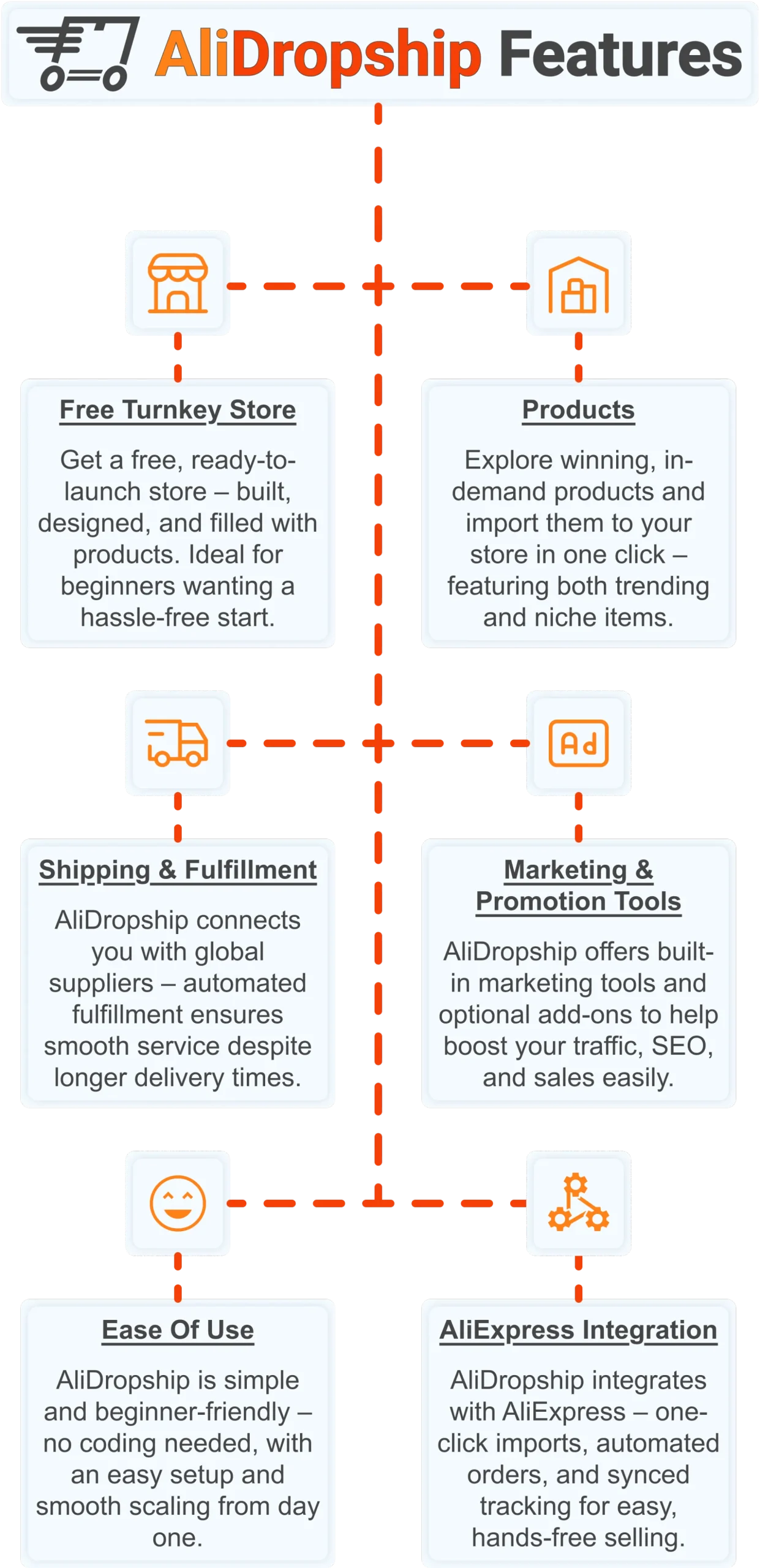
Free turnkey store ️
Get a free turnkey store – built, designed, and filled with products. Ideal for beginners wanting a hassle-free start, the store comes fully optimized to attract customers right away, saving you time on setup. Plus, it includes professional design elements to give your business a polished, trustworthy look from day one. This ready-made foundation makes it easy to move seamlessly into product selection.
Products
Once your store is set up, you can explore winning, in-demand products and import them in one click – featuring both trending and niche items. This wide selection lets you cater to diverse customer interests and test what works best. Regular updates ensure you always have fresh products, keeping your store competitive and relevant. With great products in place, smooth shipping becomes the next essential step.
Shipping & fulfillment
AliDropship connects you with global suppliers, and automated fulfillment ensures seamless order processing despite international delivery times. Customers receive real-time tracking updates, which builds confidence and trust in your store. Once shipping is handled reliably, you can focus on promoting your store and attracting traffic.
Marketing & promotion tools
To maximize sales, AliDropship offers built-in marketing tools and optional add-ons that help boost traffic, SEO, and conversions. From email campaigns and discounts to social media integration, these tools empower you to reach and retain customers without needing prior marketing experience. With promotion strategies in place, managing your business becomes simpler and more efficient.
Ease of use
AliDropship is beginner-friendly – no coding needed, with an intuitive dashboard that guides you through every step. Easy setup and smooth scaling let you expand your store without stress. As your business grows, adding new features, products, and marketing campaigns remains hassle-free, giving you more time to focus on sales.
AliExpress integration
Finally, AliDropship integrates seamlessly with AliExpress, enabling one-click imports, automated orders, and synced tracking. Your inventory stays up-to-date with the latest products and prices, while automated order processing frees you from manual tasks. Combined with the turnkey setup, reliable shipping, and built-in marketing tools, this integration ensures your dropshipping business is fully equipped for growth and success.
Of all the home based business ideas in this guide, a fully built ecommerce store with automated fulfillment is the one that puts the least distance between you and your first sale. Claim your free AliDropship store and your $100 voucher and start selling today.
Frequently asked questions
What are the best home based business ideas to start in 2026?
The strongest options include dropshipping, freelance services, online tutoring, content creation, and digital product sales. Each suits a different skill set and time commitment, with earning potential ranging from 300 to 5,000 dollars or more per month depending on effort and model. Over 50 percent of all small businesses in the United States are home based, according to the U.S. Small Business Administration. Most home based businesses take 60 to 90 days to generate their first meaningful revenue.
How much money can you realistically make from a home based business?
Dropshipping typically earns 500 to 5,000 dollars or more per month, while freelance services generate 800 to 4,000 dollars per month. Online tutoring brings in 400 to 2,500 dollars per month, and digital products can reach 300 to 4,000 dollars or more per month once a catalogue is established. Most models require 6 to 12 months of sustained effort before income becomes reliable. These figures reflect consistent operators, not viral success stories seen on social media.
Is dropshipping a good home based business idea compared to freelancing?
Dropshipping can be launched for under 100 dollars and typically earns 500 to 5,000 dollars or more per month after 60 to 90 days of consistent store optimization and traffic building. Margins on individual dropshipped products typically run between 20 and 50 percent. Freelance writing can reach 800 to 4,000 dollars per month with a focused niche and 3 to 5 regular clients, but it trades time directly for money. Dropshipping has a more open-ended ceiling since it does not require trading additional hours for additional income once systems are automated.
How much can freelance writing or graphic design earn as a home based business?
General web content writing starts at 0.05 to 0.10 dollars per word for beginners, while specialist writers in finance, SaaS, or health routinely charge 0.20 to 0.50 dollars per word or 100 to 300 dollars per article. Reaching 2,000 to 3,000 dollars per month as a freelance writer is realistic within 6 months with consistency and niche specialization. Graphic design retainer clients paying 500 to 1,500 dollars per month can anchor a designer’s income while building out a broader client list. Overall, freelance services can generate 800 to 4,000 dollars per month with a focused niche and steady client base.
What legal steps are needed before starting a home based business?
Most countries require business registration once income rises above a certain threshold, typically as a sole proprietor or LLC in the United States with any necessary local business licenses. In the United Kingdom, registering as self employed with HMRC is required once earnings exceed the trading allowance, currently 1,000 pounds per year. Keeping clean financial records from day one saves significant stress even if the business earns a small amount initially. Platforms like Etsy, Amazon, and Shopify suspend accounts for policy violations such as fake reviews or misrepresenting product origin, often without warning.
 Previous post
