 ‧ Agnes Kazaryan ‧
March 15, 2026
‧ Agnes Kazaryan ‧
March 15, 2026  770 ‧
770 ‧
 0
0
There are roughly 500 million search results for “how to make money online.” Most of them are written by people trying to sell you something. This one is different. You can earn real money online in 2026 – but only if you pick the right method, match it to your actual situation, and commit to consistent effort over time.
Quick answer: The most reliable ways to actually make money online include freelancing, ecommerce, content creation, and digital products – with earning potential ranging from $200/month for casual side income to $5,000–$10,000+/month for full-time operators who treat it like a real business.
The single biggest mistake people make is chasing the “fastest” method instead of the most sustainable one. This guide walks you through every major approach, what you can realistically expect to earn, and how to avoid the traps that keep most people stuck.
What does it actually mean to make money online?
Making money online is not a single thing. It is a category that covers dozens of different business models, gig-economy platforms, creative careers, and passive income systems. What they all have in common is that the income is generated primarily through internet-connected activity – whether that is selling products, delivering a service, creating content, or building a digital asset.
In 2026, the barriers to entry are lower than they have ever been. You do not need a business degree, a large upfront budget, or a technical background to get started. What you do need is clarity about which model fits your time, skills, and financial situation – and the patience to build it properly rather than expecting instant results.
The methods in this guide are all legitimate and have verifiable track records. Each one has real people earning real income from it right now. The differences come down to startup requirements, effort level, earning ceiling, and how long it typically takes to see meaningful results.
How much can you realistically earn online?
This is where most articles mislead you. They show you the ceiling – the 1% who earn six figures – without telling you what the typical experience looks like. Here is an honest breakdown by method and effort level.
Survey and task apps are included for completeness, but they are pocket money – not income. The real online earning opportunities sit in the top four rows, and they all reward consistency over time.
One note on the ceiling figures: the upper ranges assume full-time effort, a 6–12 month ramp-up period, and ongoing optimization. Most part-time starters can realistically expect $300–$800/month within their first 60–90 days if they follow a proven system rather than experimenting from scratch.
Active income methods: Get paid for your time and skills
Freelancing
Freelancing is the fastest way to actually make money online if you already have a marketable skill – writing, graphic design, web development, video editing, social media management, or anything else businesses need. Platforms like Upwork, Fiverr, and Toptal connect you with clients globally, and the barrier to entry is simply creating a strong profile and landing your first review.
The realistic path looks like this: your first 30 days are spent building profiles, applying to lower-budget jobs to gather reviews, and sharpening your offer. By day 60–90, a consistent freelancer with a clear niche and solid samples can realistically earn $800–$2,000/month part-time. Full-time experienced freelancers in technical fields – web development, SaaS copywriting, UX design – regularly reach $4,000–$8,000/month.
The main limitation is that freelancing scales with your time. You can raise your rates, but you can only bill so many hours. This is why many freelancers eventually move toward productized services, agencies, or passive income streams alongside their client work.
Earning potential: $500–$8,000/month depending on skill set, niche, and hours committed.
Online tutoring and coaching
If you have genuine expertise in a subject – academic, professional, or personal development – you can monetize it directly through platforms like Preply or Teachable, or simply through Zoom calls booked via Calendly and promoted on LinkedIn or TikTok. Language tutoring, fitness coaching, career coaching, and test prep are among the fastest-growing niches right now.
Tutoring on established platforms sets your rate initially – typically $15–$40/hour for general subjects. Independent coaches working with professionals or executives can charge $100–$300/session. The key differentiator is specialization: the narrower and more results-focused your offer, the more you can charge.
Earning potential: $400–$4,000/month depending on niche, hourly rate, and weekly availability.
Remote work and virtual assistance
Not every path to online income is entrepreneurial. Remote employment and virtual assistant (VA) roles are a reliable way to earn online with more stability than freelancing. Job boards like Remote.co, We Work Remotely, and FlexJobs list thousands of fully remote positions in customer support, project management, marketing, and operations.
VA work in particular is accessible with minimal prior experience. You handle administrative tasks – inbox management, scheduling, data entry, research – for busy entrepreneurs or small businesses. Rates start at $15–$20/hour and climb to $30–$50/hour for specialized VAs with ecommerce, bookkeeping, or tech skills.
Why this works in 2026: Remote work has become the default for a growing share of knowledge-work roles. Companies are actively recruiting remote talent globally, making this a stable income path with real career progression – not just a stopgap.
Passive and scalable income methods: Build once, earn repeatedly
Ecommerce and dropshipping
Ecommerce is consistently one of the highest-ceiling ways to actually make money online – and dropshipping in particular has made it accessible to people with zero inventory budget. With dropshipping, you sell products through your own online store. When an order comes in, your supplier ships it directly to the customer. You never touch the product.
The model works because startup costs are minimal compared to traditional retail, and you can test dozens of products without committing to bulk stock. Platforms like AliDropship make this even more accessible by automating product imports, order fulfillment, and price syncing – so you spend your time on marketing and customer experience, not logistics.
Realistic early earnings look like $300–$800/month within the first 60–90 days for store owners who focus on marketing from day one. Stores that gain traction typically reach $2,000–$5,000/month by the 6-month mark, and a well-optimized store with winning products can scale to $10,000–$15,000+/month over 12–18 months.
Why this works in 2026: Global ecommerce revenue crossed $6 trillion in 2024 and continues growing. Consumers are more comfortable buying online than ever, and niche stores with strong branding consistently outperform generic marketplaces.
Selling digital products
Digital products – ebooks, templates, presets, courses, printables, and software tools – are one of the most scalable online income models because you create the product once and sell it unlimited times with zero fulfillment cost. Platforms like Gumroad, Etsy (for digital downloads), Teachable, and Podia make it straightforward to set up a storefront and start selling.
The challenge is discoverability. Without an existing audience or strong SEO presence, your product will not sell itself. Successful digital product creators typically spend 3–6 months building an audience – on Pinterest, TikTok, YouTube, or via email – before their store generates consistent organic traffic. Those who start with SEO-optimized listings on Etsy or Gumroad can see first sales within 30–60 days.
Earning potential: $200–$5,000/month once distribution is established, with some top creators earning well above that through bundled offers and email funnels.
Affiliate marketing
Affiliate marketing means promoting other companies’ products and earning a commission on every sale you refer. It is one of the oldest online income models and still highly effective when done with a content-first approach. You do not need your own product – just an audience and a platform: a blog, YouTube channel, newsletter, or social media account.
The most successful affiliates work in specific niches – personal finance, software tools, health and fitness, travel – and build genuine authority before monetizing. Commission rates vary widely, from 3–8% on physical products (Amazon Associates) to 20–40% on SaaS subscriptions or digital courses. A mid-size blog with 30,000 monthly visitors in a profitable niche can realistically earn $1,000–$3,000/month from affiliate income alone.
Pro Tip: Focus your affiliate efforts on recurring commission programs – subscription software, membership platforms – rather than one-time purchase commissions. A single referred customer who stays subscribed for 12 months generates far more value than a single product sale.
Earning potential: $100–$5,000+/month depending on niche, traffic volume, and commission structure.
Content creation (YouTube, blogging, newsletters)
Content creation is a long game – but it is also one of the few online income models where your earnings can genuinely compound over time. A YouTube video published today can earn ad revenue for 5+ years. A well-ranking blog post can generate affiliate income for years without additional effort. A newsletter list becomes a direct asset you own outright.
The realistic timeline: most YouTube channels take 12–18 months to hit monetization thresholds (1,000 subscribers, 4,000 watch hours). Blogs typically need 6–12 months of consistent publishing before meaningful organic traffic arrives. This is why content creation works best as a parallel income stream rather than a primary source of income during the first year.
Once established, income is diversified – ad revenue, sponsorships, affiliate links, digital products, and paid memberships can all stack on top of each other from a single content platform.
Earning potential: $100–$10,000+/month once an audience is established, with top creators earning significantly more through brand deals and owned products.
What to watch out for: Scams, grey areas, and bad advice
For every legitimate way to actually make money online, there are five variations of it being sold as a “system,” a “course,” or a “proven blueprint” by someone who earns from teaching it rather than doing it. Here is how to tell the difference.
Red flags that signal a scam or unrealistic scheme
The classic red flags have not changed much: income screenshots with no context, guaranteed results claims, “one weird trick” framing, and heavy emphasis on recruiting others rather than selling actual products. Multi-level marketing structures, paid survey programs promising full-time income, and “passive income” systems that require buying expensive training upfront are all worth treating with serious skepticism.
Key principle: If the primary way you make money is by recruiting others to join the system, it is not a business – it is a pyramid structure. Avoid these regardless of how polished the surface presentation looks.
Grey areas you should understand before getting involved
Some online money-making methods are legal but ethically questionable or reputationally risky. Fake reviews, paid engagement schemes, black-hat SEO, and arbitrage methods that exploit platform loopholes can generate short-term income – but they result in account bans, refund disputes, and reputational damage that takes far longer to recover from than the earnings were worth.
Important: Amazon, eBay, Etsy, Google, and most major ad platforms actively enforce against manipulative tactics. The short-term gain is rarely worth a permanent account suspension.
What legitimate online income actually looks like
Real online income comes from delivering genuine value – whether that is a useful product, a skilled service, quality content, or a well-curated recommendation. The methods in this guide all fit that description. They require real work, have real timelines, and produce real results for people who stick with them consistently.
How to choose the right method for your situation
The best way to actually make money online is the one that matches your current resources – not the one with the highest theoretical ceiling. Here is a breakdown by reader profile.
Complete beginner with limited time (under 10 hours/week)
If you are brand new and can only commit a few hours a week, the most realistic starting points are freelancing (if you have a transferable skill) or a dropshipping store using a done-for-you platform. Freelancing gets you earning fastest because you are monetizing skills you already have. A turnkey dropshipping store is the better long-term play because it builds an asset rather than trading time for money.
Avoid making content creation your primary strategy at this stage – the return on effort takes too long relative to your available hours.
Intermediate: some online experience, 10–20 hours/week available
At this stage, combining methods starts to make sense. A dropshipping store generating $500–$1,500/month can run in the background while you build a content channel or develop a digital product. The key is not spreading yourself too thin – pick two complementary methods that share an audience rather than three unrelated ones.
Affiliate marketing stacked on top of a blog or YouTube channel is a natural combination. Ecommerce paired with social media content creation is another – your content drives traffic directly to your store.
Advanced: ready to go full-time or already earning online
If you are already earning part-time income online and want to scale to full-time, the lever is almost always systematization – automating or outsourcing the repetitive parts of your operation so you can focus on growth. Dropshipping stores at this level are often semi-automated through platforms like AliDropship, allowing the owner to focus entirely on marketing and product selection rather than order management.
At this stage, diversification matters. A single-source income is fragile. Building a second or third revenue stream from your existing audience or store traffic – email marketing, upsells, complementary product lines – is the standard playbook for operators crossing $5,000–$10,000/month.
Practical tips for making online income work long-term
Pick a niche before picking a platform
The biggest mistake new online earners make is platform-hopping – spending weeks on Fiverr, then switching to blogging, then trying YouTube, never giving any one method long enough to produce results. The fix is deciding on your niche first: the audience you want to serve and the type of value you will deliver. Then choose the platform that reaches that audience most effectively.
Treat your first 90 days as a learning investment
Whatever method you choose, your first three months are unlikely to be profitable – and that is completely normal. The goal in the first 90 days is not to maximize revenue but to build the foundation: your profile, your product listings, your content rhythm, your first customer relationships. The income follows once that foundation is in place.
Reinvest early earnings into growth
When you start generating income online, the temptation is to treat it as spending money immediately. The operators who scale fastest are the ones who reinvest the first $500–$2,000 back into their business – paid ads, better tools, outsourced tasks – rather than spending it. This compounds your growth rate significantly in months 3–6.
Document what works from day one
Keep a running log of what is working and what is not – which products sell, which content gets traffic, which client types are the best fit. This becomes invaluable data when you are ready to scale or delegate tasks to a VA or team member. Online businesses that grow beyond $5,000/month almost always have a documented system behind them, not just a founder doing everything from memory.
Protect your income by diversifying your streams
A single platform dependency is one of the biggest risks in online business. If your entire income depends on one marketplace algorithm, one ad account, or one affiliate program, a single policy change can wipe your revenue overnight. Build toward owning your audience – through an email list, a standalone store, or direct client relationships – rather than renting access to it through a third-party platform.
AliDropship: Your complete all-in-one solution for starting dropshipping in 2026
If you want the simplest possible way to start dropshipping – especially if you’re brand new – AliDropship remains one of the most beginner-friendly tools available in 2026. It brings together store creation, product imports, automation, and marketing into a single streamlined system designed to help you launch quickly and grow confidently.
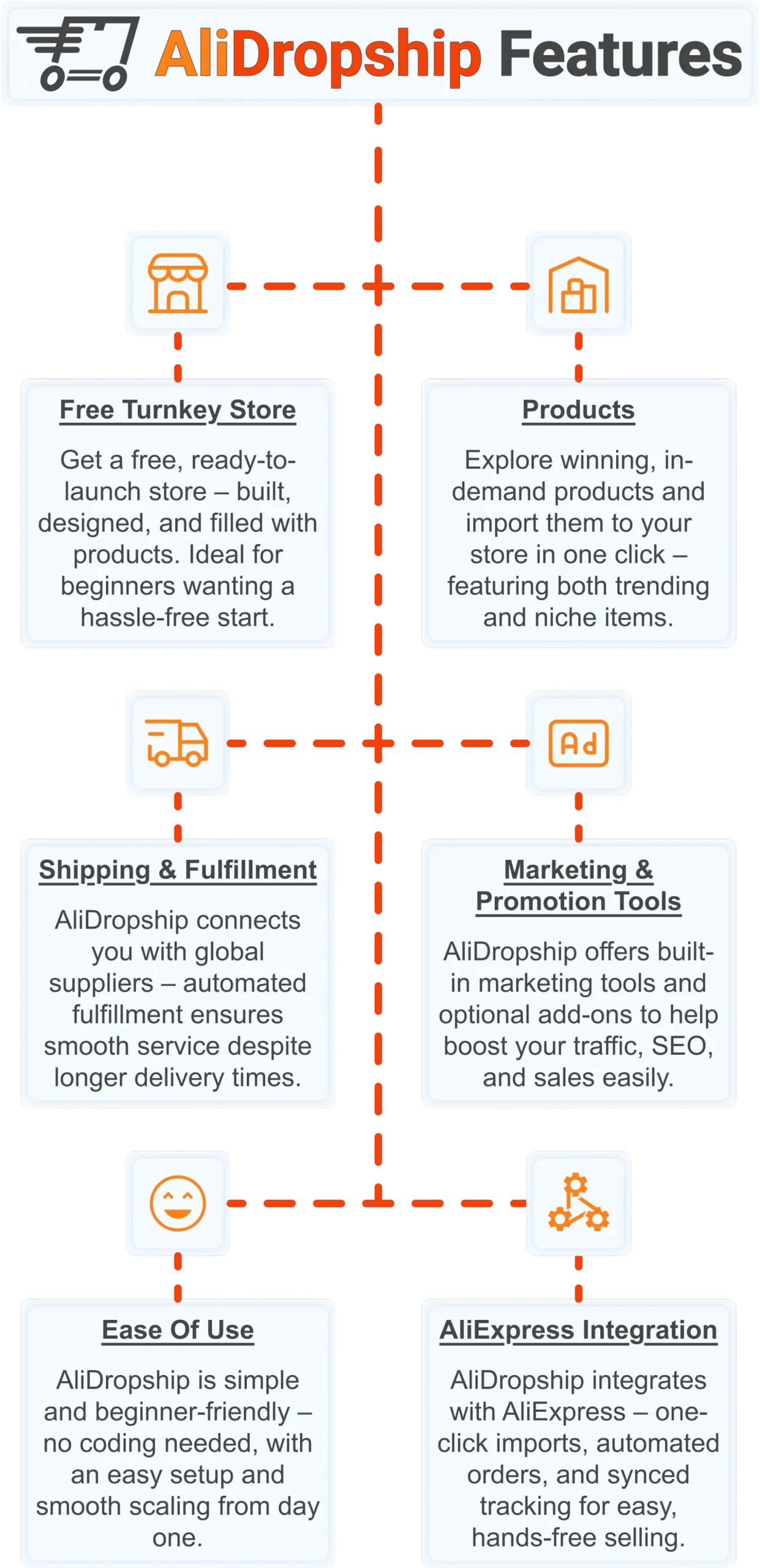
Free turnkey store ️
Get a free turnkey store – built, designed, and filled with products. Ideal for beginners wanting a hassle-free start, the store comes fully optimized to attract customers right away, saving you time on setup. Plus, it includes professional design elements to give your business a polished, trustworthy look from day one. This ready-made foundation makes it easy to move seamlessly into product selection.
Products
Once your store is set up, you can explore winning, in-demand products and import them in one click – featuring both trending and niche items. This wide selection lets you cater to diverse customer interests and test what works best. Regular updates ensure you always have fresh products, keeping your store competitive and relevant. With great products in place, smooth shipping becomes the next essential step.
Shipping & fulfillment
AliDropship connects you with global suppliers, and automated fulfillment ensures seamless order processing despite international delivery times. Customers receive real-time tracking updates, which builds confidence and trust in your store. Once shipping is handled reliably, you can focus on promoting your store and attracting traffic.
Marketing & promotion tools
To maximize sales, AliDropship offers built-in marketing tools and optional add-ons that help boost traffic, SEO, and conversions. From email campaigns and discounts to social media integration, these tools empower you to reach and retain customers without needing prior marketing experience. With promotion strategies in place, managing your business becomes simpler and more efficient.
Ease of use
AliDropship is beginner-friendly – no coding needed, with an intuitive dashboard that guides you through every step. Easy setup and smooth scaling let you expand your store without stress. As your business grows, adding new features, products, and marketing campaigns remains hassle-free, giving you more time to focus on sales.
AliExpress integration
Finally, AliDropship integrates seamlessly with AliExpress, enabling one-click imports, automated orders, and synced tracking. Your inventory stays up-to-date with the latest products and prices, while automated order processing frees you from manual tasks. Combined with the turnkey setup, reliable shipping, and built-in marketing tools, this integration ensures your dropshipping business is fully equipped for growth and success.
If you have been researching how to actually make money online, dropshipping with AliDropship is one of the most complete starting points available in 2026. Get your free turnkey store and a $100 voucher to launch today.
Frequently asked questions
What are the most reliable ways to actually make money online in 2026?
The most reliable ways to actually make money online include freelancing, ecommerce, content creation, and digital products. Earning potential ranges from about 200 per month for casual side income to 5,000 to 10,000 or more per month for full-time operators treating it like a real business. Freelancing tends to produce income fastest since it monetizes skills a person already has, while ecommerce and content creation take longer but build a lasting asset. Most part-time starters following a proven system can realistically expect 300 to 800 per month within their first 60 to 90 days.
How much can you realistically earn making money online?
Realistic earnings depend on the method, the effort level, and how long the person sticks with it. Freelancing in writing, design, or development can generate 500 to 8,000 per month, while ecommerce and dropshipping range from 300 to over 15,000 per month depending on scale. Content creation on YouTube or a blog spans 100 to over 10,000 per month, but usually needs 12 to 18 months to reach meaningful audience thresholds. Survey and task apps are included for completeness only, since they typically generate just 20 to 100 per month.
Is dropshipping a good way to actually make money online?
Yes, dropshipping is one of the higher-ceiling ways to actually make money online because startup costs are minimal and inventory is never purchased upfront. Platforms like AliDropship automate product imports, order fulfillment, and price syncing, which frees up time for marketing and customer experience instead of logistics. Realistic early earnings fall between 300 and 800 per month within the first 60 to 90 days, with stores that gain traction reaching 2,000 to 5,000 per month by the six month mark. Global ecommerce revenue crossed 6 trillion in 2024, which continues to support strong demand for niche online stores.
How much can affiliate marketing and digital products earn online?
Affiliate marketing commission rates typically range from 3 to 8 percent on physical products through programs like Amazon Associates, up to 20 to 40 percent on SaaS subscriptions or digital courses. A mid-size blog with 30,000 monthly visitors in a profitable niche can realistically earn 1,000 to 3,000 per month from affiliate income alone. Digital products such as ebooks, templates, and courses can generate 200 to 5,000 per month once distribution channels are established. Discoverability is the main hurdle, since successful creators typically spend 3 to 6 months building an audience before consistent organic sales appear.
What scams or red flags should I watch for when making money online?
Warning signs of a scam include income screenshots shown without context, guaranteed results claims, and heavy emphasis on recruiting others rather than selling an actual product. If the primary way a program makes money is through recruiting new members, it functions as a pyramid structure regardless of its branding. Grey area tactics such as fake reviews, paid engagement schemes, and black hat SEO can produce short-term income but commonly lead to permanent account bans on platforms like Amazon, eBay, and Etsy. Legitimate online income instead comes from delivering real value through a product, service, or piece of content over a sustained period of time.
 Previous post
