 ‧ Agnes Kazaryan ‧
March 15, 2026
‧ Agnes Kazaryan ‧
March 15, 2026  601 ‧
601 ‧
 0
0
More than 31% of Americans now tune into a podcast every single week – and that number keeps climbing year on year. Podcasting is one of the few content formats where one person with a halfway-decent microphone can build a loyal audience of thousands, earn a real side income, and eventually run a full media business from home. If you’ve been thinking about how to create a podcast but weren’t sure where to begin, this guide covers everything from your first episode idea to the moment you go live on Spotify and Apple Podcasts.
Quick answer: To create a podcast, you need a clear topic, a USB microphone, free recording software, a podcast hosting account, and a plan to submit your RSS feed to the major directories. Most first episodes can be recorded, edited, and published within a weekend for under $100.
One honest caveat before we dive in: building an audience takes time. Expect 3–6 months before listener numbers start to feel meaningful, and 6–12 months before monetization becomes realistic. That’s not a reason to wait – it’s a reason to start now so the clock is already ticking.
What is a podcast?
A podcast is an on-demand audio show – and increasingly, a video show – made up of episodes that listeners can stream or download whenever they want. Unlike traditional radio, there’s no fixed broadcast schedule. You publish when you’re ready, and subscribers automatically get new episodes through apps like Spotify, Apple Podcasts, or YouTube Music.
The word itself comes from iPod + broadcast, which gives you a sense of how long the format has been around. But despite being almost two decades old, podcasting is growing faster now than at any point in its history. There are roughly 2 million active podcasts today compared to over 600 million blogs – and that gap in competition is one of the strongest arguments for starting a podcast in 2026 rather than yet another written content channel.
Podcast formats run from solo commentary (just you and a mic) to interview shows, co-hosted conversations, narrative storytelling, and roundtable discussions. The format you pick will shape your equipment needs, your production schedule, and how your audience grows. There is no universally best format – the best one is the one you can maintain consistently week after week.
Why this works in 2026: Podcast ad spending is growing faster than overall digital advertising, and platforms like Spotify have lowered their monetization thresholds – so even small, targeted shows can start earning sooner than they could two or three years ago.
How much can you realistically earn from a podcast?
Before you invest serious time and money in a show, it helps to understand what the earning ceiling looks like at different stages. Here’s a realistic breakdown by method.
Most shows in their first year earn somewhere between $0 and $500 per month – and that’s completely normal. Shows hitting 5,000–20,000 downloads per episode typically earn $50–$200 per episode from ads or sponsorships. The range of 50,000–100,000 downloads per episode is where podcasting starts to look like a real business, with monthly income consistently in the $1,000–$5,000 range from combined revenue streams.
One note on ceiling figures: The viral success stories – Joe Rogan, Diary of a CEO – represent less than 1% of active shows. Realistically, consistent ad revenue starts when you hit 5,000 downloads per episode, which typically takes 6–18 months of regular publishing. Full-time podcast income almost always comes from stacking streams: ads, affiliate links, memberships, and a product or service tied directly to your niche.
How to create a podcast: The step-by-step process
Creating a podcast breaks down into a clear sequence of decisions and actions. Work through each step and you’ll have a live show faster than you’d expect.
Step 1: Define your concept and format
Before touching any gear, answer four questions: What is your show about? Who is it for? What format suits you? And why are you starting it? This sounds basic, but skipping it is the single most common reason podcasts die before episode ten.
Choose your niche
The strongest podcast topics sit at the intersection of something you genuinely know, something you can talk about without running dry, and something a real audience is actively searching for. Broad topics like “health” or “business” are extremely competitive. A narrower focus – personal finance for freelancers, fitness for people over 50, ecommerce tips for side hustlers – gives you a much better chance of standing out and building a loyal audience quickly. Browse podcast directories or use a tool like AnswerThePublic to spot gaps in your chosen space before committing to a direction.
Pick your format
The four most common formats are solo commentary (just you and the mic), interview-style (you bring in guests), co-hosted (two or more regular hosts), and narrative or storytelling. Solo shows give you complete control and require the least coordination, but they demand confident and well-prepared delivery. Interview shows tend to grow faster because guests often share their episode with their own audience. Co-hosted shows feel natural and conversational, but scheduling can become a real headache. Pick the format you can actually sustain week after week – not the one that sounds the most impressive.
Plan your first ten episodes
Set a timer for five minutes and write down ten episode ideas without overthinking it. If you struggle to reach ten, the niche may be too narrow. If ten comes easily, you have a show. This exercise also helps you confirm whether your topic has enough depth to sustain a long-running series before spending a single dollar on equipment.
Step 2: Choose your equipment
Audio quality is the single most important technical factor in podcast retention. Listeners will forgive average content or a slow intro, but they’ll leave within seconds if the audio sounds hollow, echoey, or distorted. You don’t need professional studio gear – but you do need a microphone that does its job.
Microphone options by budget
For beginners spending under $100, the Samson Q2U ($60) and the Audio-Technica ATR2100x-USB ($99) are both solid dynamic microphones with USB connections. Dynamic mics are recommended over condenser mics for home recording because they reject background noise far more effectively. If you’re ready to invest a little more, the Shure MV7 ($249) is a professional dynamic mic built specifically for podcasters, with both USB and XLR outputs. One mic to avoid: the Blue Yeti. It’s a condenser mic that picks up way too much room noise in untreated spaces.
Headphones and acoustic treatment
A pair of closed-back headphones prevents audio bleed when you’re monitoring your recordings. Any mid-range pair in the $30–$80 range works fine for this. For the room itself, you don’t need to soundproof anything. Recording in a space with soft furnishings – bookshelves, thick curtains, carpet – dramatically reduces echo. A closet lined with hanging clothes is a surprisingly effective makeshift recording booth.
Step 3: Record and edit your episodes
With your equipment in place, you need recording software and an editing workflow. The good news is that the best tools for beginners are either free or very cheap.
Recording software
Audacity is free, open-source, and used by roughly one in four podcasters. It handles everything a beginner needs – noise reduction, EQ, compression, and normalization. GarageBand is the Mac equivalent with a more intuitive interface. If you want an all-in-one tool that handles recording, editing, and publishing in one place, Alitu simplifies the entire production process and works well even for non-technical creators. For remote interviews specifically, Riverside.fm records both participants in studio-quality audio regardless of internet connection – which matters because using Zoom or Skype for guest recordings often produces noticeably degraded audio.
How to edit a podcast episode
Edit in two passes. First pass: focus on content. Cut sections that ramble, remove long pauses, and tighten the overall structure. Second pass: address audio issues – background hum, clicking sounds, breath pops, uneven volume levels. This order matters because cleaning up audio in sections you later delete is wasted time. Add a short intro with royalty-free music (Epidemic Sound and Free Music Archive are both reliable sources), set consistent volume levels across the episode, and export as a high-quality MP3.
Script vs. outline
Most experienced podcasters recommend a short outline or cue cards rather than a full word-for-word script. A full script tends to produce wooden, over-rehearsed delivery. An outline keeps your episode structured and on time without losing the natural, conversational tone that podcast listeners actually want. Aim for episodes between 20 and 45 minutes – that range fits the listening habits of most commuters and gym-goers.
Step 4: Set up podcast hosting and distribution
A podcast hosting platform stores your audio files and generates the RSS feed that podcast directories read. You can’t publish directly to Apple Podcasts or Spotify from your hard drive – you need a hosting account in between.
Choosing a hosting platform
Buzzsprout, Transistor, and RSS.com are the three most popular options for new shows. Buzzsprout has a beginner-friendly dashboard and a free 90-day trial. Transistor suits creators running multiple shows or who need detailed analytics. RSS.com offers a free tier that’s genuinely usable for a new podcast. Spotify for Creators (formerly Anchor) is free and has a built-in distribution pipeline, but gives you less control over your data. One thing to avoid: free platforms that insert their own ads into your episodes. That undermines your ability to monetize with your own sponsors down the line.
Submitting to directories
Once your hosting account is live and your RSS feed is generated, submit your show to Apple Podcasts, Spotify, and YouTube Music as a minimum. These three platforms account for the vast majority of global podcast listening. Most hosting platforms have built-in integrations that automate the submission process. After initial approval – which typically takes 24–72 hours on Apple Podcasts – new episodes you upload will automatically appear in all directories without any further action from you.
Podcast artwork and show description
Your cover art is the first thing potential listeners see in a directory. Apple Podcasts recommends 3,000 x 3,000 pixels at 72 DPI, saved as a JPG or PNG. Keep it simple, readable at thumbnail size, and clearly relevant to your niche. Your show description should open with a single clear sentence explaining what your podcast is about and who it’s for – because Apple Podcasts uses both the title and description fields for search.
Podcast monetization methods compared
Most podcasters who earn meaningful income don’t rely on a single revenue stream. Here’s how the main methods compare across realistic timelines and effort levels.
Affiliate marketing is the easiest method to start from day one because it has no minimum audience size. Simply recommend tools you actually use – your hosting platform, your microphone, your editing software – and include affiliate links in your show notes. Even at $20–$60 per month in the early stages, that income compounds as your audience grows.
How to grow your podcast audience
Publishing consistently is the single most powerful growth lever available to a new podcaster. Irregular episode schedules confuse subscribers and hurt your ranking in directory algorithms. Pick a cadence you can realistically maintain – weekly is ideal, bi-weekly is acceptable, monthly is too infrequent for meaningful audience growth – and hold to it.
Cross-promotion and guest appearances
Appearing as a guest on other podcasts in your niche is one of the fastest growth methods available. When you’re introduced to an established show’s audience, a percentage of those listeners will follow you back. Target shows that are one or two tiers above your current size – they’re reachable, the audience overlap is high, and the credibility transfer is worth more than a spot on a completely unrelated show.
Create a podcast website
A dedicated website gives you SEO real estate that podcast directories can’t offer. Publish detailed show notes for every episode – timestamps, key takeaways, links, and a full or partial transcript. Google indexes this content, and over time it drives search traffic that compounds with every new episode you publish. WordPress on Bluehost is the most cost-effective setup and gives you full control over your analytics and email list.
Repurpose your audio into other content
Every episode you record can become five or six other pieces of content with minimal extra effort. A 40-minute episode can be cut into short audiograms for Instagram and TikTok, turned into a blog post from the transcript, broken into pull quotes for LinkedIn, and clipped into YouTube Shorts. Tools like Descript and Headliner make repurposing fast even without any video editing experience.
Optimise your episode titles for search
Episode titles are searchable on Spotify and Apple Podcasts in the same way that blog titles are searchable on Google. Use specific keywords in your titles – not generic labels like “Episode 12” or “Interview with [name]”, but specific questions your target listener is actually typing. A title like “How to create a podcast for free in 2026” outperforms “My podcasting journey” in every directory ranking system.
Legal and ethical considerations for podcasters
Starting a podcast looks low-risk on the surface, but there are a few legal areas worth understanding before you publish anything publicly.
Music and copyright
Using commercial music – even for a brief intro – without a license is copyright infringement. Spotify and Apple Podcasts have removed episodes for unlicensed music. Use royalty-free music from services like Epidemic Sound, Artlist, or Free Music Archive. Both Epidemic Sound and Artlist offer subscription plans specifically covering podcast use.
Guest releases and interview consent
If you record guests, get a simple written confirmation that they consent to being recorded and that you own the right to publish and monetize the content. A short email confirmation works fine in most situations. Never publish a recording of a phone or video call without the other person’s knowledge – laws on this vary by state and country, and the consequences can be serious.
Key principle: Always disclose paid sponsorships, affiliate links, and any commercial relationships to your listeners – this is required under FTC guidelines in the US and equivalent consumer protection laws in most other countries.
Defamation and fair comment
Expressing opinions about businesses, products, or public figures is generally protected as fair comment. Making false statements of fact about identifiable private individuals is not. If your podcast covers reviews, investigative topics, or commentary on real-world events, run anything sensitive past a basic legal review before hitting publish.
Which approach works best for your situation
Not every aspiring podcaster starts from the same point. Here’s a practical breakdown by experience level.
Complete beginner
Start with the Samson Q2U microphone ($60), Audacity for recording and editing, and Spotify for Creators as your free hosting platform. Choose a solo or co-hosted format to avoid the scheduling complexity of interview shows. Commit to publishing ten episodes before you evaluate your results – most shows find their voice around episode five or six, and most new listeners don’t discover a show until it already has a backlog worth bingeing.
Intermediate / part-time
If you already have some content creation experience, invest in better audio (Shure MV7), a paid hosting platform like Buzzsprout, and start doing outreach for guest appearances on other shows in your niche. Add affiliate marketing from episode one and build an email list through your podcast website. Email remains the most reliable owned-audience channel you can develop alongside a show – and it will matter a lot when you’re ready to launch a product.
Advanced / full-time goal
If you’re building toward a full-time income from podcasting, treat it as a media business from day one. Diversify your revenue streams – combine ads, a Patreon membership tier, an email list, and a digital product or coaching offer tied directly to your niche. Podcast advertising becomes meaningful at 5,000+ downloads per episode, but the real leverage is combining that ad income with a product that converts your most engaged listeners into paying customers. Shows earning $4,000–$10,000 per month typically have 20,000+ downloads per episode and at least two or three active revenue streams running in parallel.
AliDropship: Your complete all-in-one solution for starting dropshipping in 2026
If you want the simplest possible way to start dropshipping – especially if you’re brand new – AliDropship remains one of the most beginner-friendly tools available in 2026. It brings together store creation, product imports, automation, and marketing into a single streamlined system designed to help you launch quickly and grow confidently.
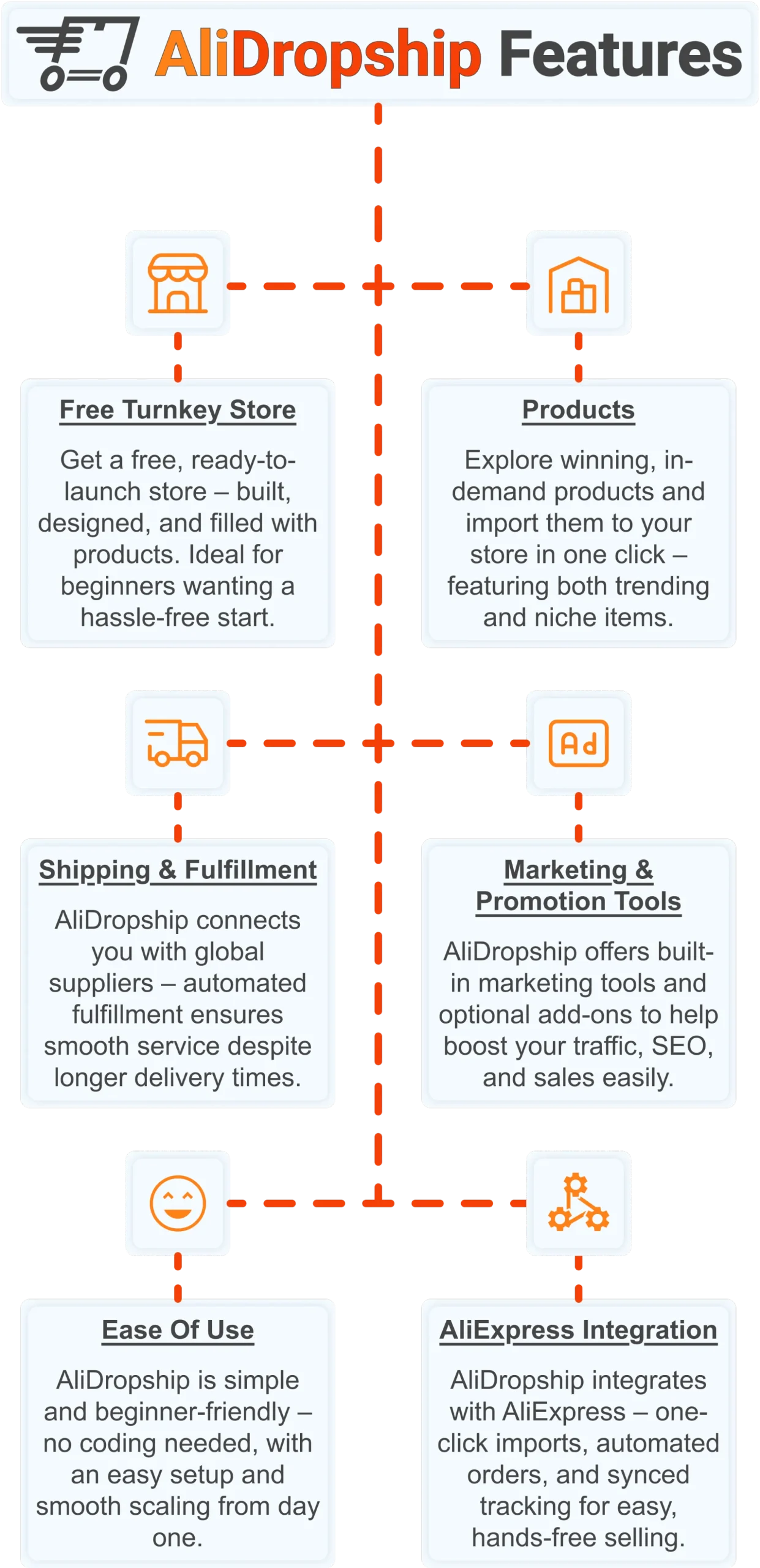
Free turnkey store ️
Get a free turnkey store – built, designed, and filled with products. Ideal for beginners wanting a hassle-free start, the store comes fully optimized to attract customers right away, saving you time on setup. Plus, it includes professional design elements to give your business a polished, trustworthy look from day one. This ready-made foundation makes it easy to move seamlessly into product selection.
Products
Once your store is set up, you can explore winning, in-demand products and import them in one click – featuring both trending and niche items. This wide selection lets you cater to diverse customer interests and test what works best. Regular updates ensure you always have fresh products, keeping your store competitive and relevant. With great products in place, smooth shipping becomes the next essential step.
Shipping & fulfillment
AliDropship connects you with global suppliers, and automated fulfillment ensures seamless order processing despite international delivery times. Customers receive real-time tracking updates, which builds confidence and trust in your store. Once shipping is handled reliably, you can focus on promoting your store and attracting traffic.
Marketing & promotion tools
To maximize sales, AliDropship offers built-in marketing tools and optional add-ons that help boost traffic, SEO, and conversions. From email campaigns and discounts to social media integration, these tools empower you to reach and retain customers without needing prior marketing experience. With promotion strategies in place, managing your business becomes simpler and more efficient.
Ease of use
AliDropship is beginner-friendly – no coding needed, with an intuitive dashboard that guides you through every step. Easy setup and smooth scaling let you expand your store without stress. As your business grows, adding new features, products, and marketing campaigns remains hassle-free, giving you more time to focus on sales.
AliExpress integration
Finally, AliDropship integrates seamlessly with AliExpress, enabling one-click imports, automated orders, and synced tracking. Your inventory stays up-to-date with the latest products and prices, while automated order processing frees you from manual tasks. Combined with the turnkey setup, reliable shipping, and built-in marketing tools, this integration ensures your dropshipping business is fully equipped for growth and success.
If you’re already putting in the work to build an online presence through podcasting, adding a dropshipping store is one of the most natural next steps toward a full online income. Get your free turnkey store with a $100 voucher and see how fast it can be to launch.
Frequently Asked Questions
What equipment do you need to create a podcast?
To create a podcast, you need a clear topic, a USB microphone, free recording software, a podcast hosting account, and a plan to submit your RSS feed to directories. Beginners can start with the Samson Q2U microphone at 60 dollars or the Audio-Technica ATR2100x-USB at 99 dollars. Most first episodes can be recorded, edited, and published within a weekend for under 100 dollars. Dynamic mics are recommended over condenser mics because they reject background noise far more effectively.
How much can you realistically earn from a podcast?
Earnings depend heavily on download numbers and how many revenue streams a show combines. Most shows in their first year earn between 0 and 500 per month, which is completely normal. Shows hitting 5000 to 20000 downloads per episode typically earn 50 to 200 per episode from ads or sponsorships. Shows reaching 50000 to 100000 downloads per episode can see monthly income between 1000 and 5000 from combined revenue streams.
How long does it take to grow a podcast audience?
Building an audience genuinely takes time, with 3 to 6 months typically needed before listener numbers start to feel meaningful. Consistent ad revenue usually starts once a show hits 5000 downloads per episode, which can take 6 to 18 months of regular publishing. Publishing on a consistent schedule, ideally weekly, is the single most powerful growth lever available to a new podcaster. Roughly 31 percent of Americans now tune into a podcast every single week.
How can a podcast be monetized?
Affiliate marketing is the easiest method to start from day one since it has no minimum audience size requirement. Podcast advertising typically pays 15 to 30 dollars per 1000 downloads for a 60 second slot once a show reaches 5000 or more downloads per episode. Listener memberships through platforms like Patreon usually see around 2 percent of listeners subscribe. Digital products and courses tend to be the highest margin option but generally take 6 to 12 months to build.
What legal issues should podcasters be aware of?
Using commercial music without a license, even for a brief intro, counts as copyright infringement and has led to episode removals on Spotify and Apple Podcasts. Guests should give simple written confirmation that they consent to being recorded and to having the content published and monetized. Paid sponsorships and affiliate relationships must be disclosed to listeners under FTC guidelines in the US and equivalent laws elsewhere. Making false statements of fact about identifiable private individuals is not protected as fair comment.
 Previous post
