 ‧ julia.nenyukova ‧
March 09, 2026
‧ julia.nenyukova ‧
March 09, 2026  1785 ‧
 0
0
Pinterest has over 500 million monthly active users – and a significant share of them are actively planning purchases. That makes it one of the most underused income platforms available today. Unlike Instagram or TikTok, where content disappears within hours, a well-optimized pin can continue driving traffic for months, sometimes years, after you first publish it.
Quick Answer: You can make money on Pinterest through affiliate marketing, product sales, sponsored pins, digital products, or by using Pinterest as a traffic channel for your dropshipping store. Realistic monthly earnings range from $200 to $3,000+ depending on the method you choose and how consistently you show up.
That said, honesty matters here. None of these methods produce results from minimal effort in a few days. Pinterest rewards consistency and quality over volume. Most people who build a real income on the platform do so over 60–90 days of regular pinning – at which point the compounding effect kicks in and organic traffic starts to grow on its own.
This guide covers every practical approach to how to make money on Pinterest: what each method involves, what you can honestly expect to earn, and how to choose the right path based on where you’re starting from.
What is making money on Pinterest – and why it works in 2026
Pinterest occupies a unique position among social platforms. Users don’t come here to scroll mindlessly or follow friends’ updates. They arrive with intent – searching for ideas, products, recipes, home inspiration, and purchases they’re actively considering.
That purchase intent is what makes Pinterest so valuable for anyone looking to generate income online. You’re not competing for attention against viral clips or celebrity gossip. You’re placing relevant content in front of people who are already in a discovery-to-buy mindset.
In 2026, Pinterest has also expanded its commerce infrastructure significantly. Product pins now support direct checkout links, affiliate links are natively supported within the platform, and creator monetization tools have matured considerably. You don’t need a massive following to start earning – you need a focused niche and a consistent publishing approach.
Why this works in 2026: Pinterest’s search-based discovery model gives your content a far longer shelf life than feed-based platforms. A single well-optimized pin can drive traffic and commissions for 12–24 months. Combined with a user base that’s heavily purchase-oriented, the platform converts exceptionally well for product-related content.
How much can you realistically earn on Pinterest?
Before committing to any monetization strategy, it helps to have honest expectations. Here’s a breakdown of what’s achievable across different methods and effort levels.
These figures assume consistent activity and at least a basic content strategy. Beginners typically land at the lower end during the first 60–90 days, with most creators reaching the higher numbers after 6–12 months of building their Pinterest presence.
One note on these figures: They reflect realistic outcomes based on typical results – not guarantees. Your niche, content quality, product selection, and how well you optimize for search all directly affect where in the range you land.
Affiliate marketing on Pinterest: the easiest entry point
Affiliate marketing is the most accessible way to make money on Pinterest because it requires no product of your own, no website, and no significant upfront cost. You join an affiliate program, get a unique referral link, create pins featuring those products, and earn a commission whenever someone clicks through and buys.
How to get started
Begin by choosing a niche that naturally performs well on Pinterest. Home decor, wellness, fashion, DIY crafts, and food consistently attract large, engaged audiences. Then join a relevant affiliate program – Amazon Associates and ShareASale are among the most beginner-friendly options, with thousands of products to choose from.
Once you have your affiliate links, create visually strong pins with clear, keyword-optimized descriptions that include your link. The key is matching the product to a specific audience need – not simply pinning items at random and hoping for clicks.
Why Pinterest is particularly well-suited to affiliate marketing
Creating pins is fast – you can produce 5–10 per day using free tools like Canva. More importantly, those pins stay indexed and searchable for a long time. A product pin created today could still generate affiliate commissions in 18 months, without any additional effort on your part.
Pinterest also supports affiliate links directly within pins, so you don’t need a blog or landing page to start earning. That removes the biggest barrier most beginners face.
Earning potential: $200–$1,500/month with a focused niche and 3–6 months of consistent activity.
Important: Always disclose affiliate relationships clearly in your pin descriptions. Pinterest’s terms require it, and the FTC has explicit guidelines on affiliate disclosure in the US. A simple phrase like “this pin contains affiliate links” in your description is sufficient – and it builds the trust that drives long-term conversions.
Selling products on Pinterest: why dropshipping is a natural fit
If you want a more scalable income model, selling physical products through Pinterest is where the real earning potential opens up. And for most people without a large upfront budget, dropshipping is the practical way to do it.
What dropshipping actually means
Dropshipping lets you sell products online without holding any inventory. When a customer places an order in your store, the supplier ships the product directly to them. You keep the margin between your selling price and the supplier’s cost. There’s no warehouse, no stock risk, and no minimum order requirement – which makes it one of the most low-barrier business models available.
How Pinterest drives dropshipping sales
Pinterest works as a powerful traffic source for dropshipping stores because its users are already in buying mode. Someone searching “rustic bedroom decor” or “minimalist kitchen gadgets” on Pinterest isn’t casually browsing – they’re looking for products to purchase. A well-optimized pin linking directly to your product page can generate consistent, cost-effective traffic that converts.
The most effective approach is treating Pinterest as your primary organic traffic channel. Create boards organized around your niche, publish pins regularly for the products in your store, and optimize your descriptions with the search terms your audience actually uses. Over time, your pins accumulate saves and impressions, building a compounding traffic stream that works around the clock.
Which niches work best for Pinterest dropshipping?
Pinterest audiences respond particularly well to visually appealing products in home decor, lifestyle accessories, beauty, and fashion. These categories have large, active audiences already searching on the platform – which makes them ideal matches for a dropshipping store using Pinterest as its main traffic source.
Earning potential: $500–$3,000+/month with a well-stocked store and 90+ days of consistent Pinterest activity.
Why this works in 2026: Pinterest’s expanded shopping features – including product pins with direct checkout links – shorten the path from discovery to purchase, reducing the friction that typically hurts ecommerce conversion rates.
Sponsored pins and digital products: two more income paths worth exploring
Sponsored pins
Once you’ve built a focused, engaged following around a specific niche, brands may start approaching you to create sponsored content. This means publishing pins that feature their products or services in exchange for a flat fee or per-sale commission.
Getting to this point takes time. Most brands look for creators with at least 5,000–10,000 engaged followers and a clearly defined niche before commissioning sponsored work. When it does happen, fees per sponsored pin can range from $300 to $2,000+, depending on your audience size and engagement rate.
If this is a goal, start building a media kit early. A simple one-pager showing your monthly impressions, engagement rate, and audience demographics gives brands the numbers they need to make a decision quickly.
Digital products
Selling digital products – printables, templates, eBooks, planners, course materials – pairs naturally with Pinterest because the platform’s discovery model keeps surfacing your content to new users over time. Unlike physical products, digital items have no fulfillment cost, so almost every sale is pure profit.
Platforms like Etsy or Gumroad make it straightforward to host and sell digital products without building your own website. Create a pin for each product, link it to your listing, and let Pinterest’s search algorithm do the discovery work.
Popular digital products on Pinterest include home organization printables, budget planners, social media templates, and recipe cards. If you’re already creating content in a niche, there’s almost certainly a digital product angle worth exploring.
Earning potential: $100–$800/month for digital products; $300–$2,000 per deal for sponsored pins, depending on your audience size and niche authority.
Pinterest ads: paying to accelerate growth
All the methods above rely on organic reach – which takes time to build. Pinterest Ads give you a way to shortcut that timeline by paying to place your pins in front of targeted audiences immediately.
Pinterest’s ad platform is less saturated than Facebook or Google, which means competition is lower and costs per click are often more favorable. For dropshipping stores and affiliate marketers with a tested offer, this can be a viable way to accelerate early-stage growth without waiting months for organic traction.
Ad formats to know
Pinterest offers several useful ad formats: Shopping Ads (ideal for product-based businesses linking directly to a product page), Carousel Ads (useful for showing multiple product variations in one unit), and Video Ads (effective for demonstrating products in use). For most beginners, Shopping Ads are the most straightforward starting point.
How to run Pinterest Ads without burning through budget
Start small. A daily budget of $5–$10 is enough to gather meaningful data on which pins perform best before scaling. Use Pinterest Analytics to track click-through rates and add-to-carts, and cut any ad that isn’t generating results after 7–10 days. Don’t scale ad spend until you have at least one consistently converting pin.
Target by keyword first – reach users who are actively searching for what you offer. Then layer in interest-based targeting once you understand which audience segments convert best for your niche.
Important: Paid ads amplify what’s already working – they won’t fix a weak product or a poorly optimized store. Make sure your organic content and landing pages are converting before committing significant budget to ads.
How to build a Pinterest presence that actually converts
Regardless of which monetization method you choose, the fundamentals of a converting Pinterest presence are the same across all of them.
Visual quality matters more than volume
Pinterest is a visual search engine. Blurry, low-contrast, or cluttered images get passed over. Invest time in creating clean, well-lit visuals with readable text overlays. Canva offers free templates built specifically for Pinterest’s vertical format – 1,000 x 1,500 px is the standard, and sticking to it keeps your pins from being cropped awkwardly in the feed.
Write descriptions for search, not for show
Pinterest indexes pin descriptions for search ranking. That means your descriptions need to include the terms your target audience is actually typing – not just clever taglines. Include your primary keyword naturally in the first sentence, add 2–3 related terms, and write in a tone that matches your niche audience. The goal is discoverability first, engagement second.
Organize boards by subtopic, not by product
Most beginners create a single board and dump everything into it. A better structure is 8–12 boards organized around specific subtopics within your niche. A home decor account might have separate boards for “minimalist living room ideas,” “small bedroom storage,” and “sustainable kitchen products.” This improves search discoverability and makes your profile genuinely useful to new visitors.
Consistency beats volume every time
Pinning 5–7 times per day consistently outperforms publishing 50 pins on one day and going silent for a week. Pinterest’s algorithm rewards regular activity. Using a scheduling tool like Tailwind to plan pins in advance helps you maintain a steady cadence without needing to be active on the platform every day.
Legal and ethical considerations when monetizing Pinterest
Making money on Pinterest is entirely legitimate – but there are clear boundaries worth knowing before you scale up.
Key principle: Transparency with your audience is not optional. If you earn commissions through affiliate links, you must disclose this in your pin descriptions. Pinterest’s own terms of service require it, and the FTC has explicit guidelines on affiliate disclosure in the US. A short, clear phrase like “this pin contains affiliate links” is all you need.
Spam pinning – publishing dozens of near-identical pins to game the algorithm – used to work, but Pinterest’s 2024–2025 algorithm updates penalized this approach heavily. The platform now prioritizes fresh, original content over volume-based tactics. This is actually good news for honest creators focused on quality over shortcuts.
Avoid using images you don’t own the rights to. Pinterest has active copyright enforcement, and using stock photography without a valid license or repinning images without attribution can result in content removal and account penalties. Stick to your own visuals, properly licensed stock photography, or images marked for commercial reuse.
On the dropshipping side, never misrepresent shipping times or product origin in your pins. Pinterest’s audience is shopping-savvy and quick to distrust – misleading claims generate chargebacks and negative reviews that damage your store’s viability far more than any short-term traffic gain is worth.
Final thoughts: which Pinterest income method is right for you?
There’s no single best way to make money on Pinterest. The right method depends on where you’re starting and what you’re building toward.
If you’re a complete beginner with no existing audience or products, affiliate marketing is the lowest-friction starting point. Pick one niche, join one affiliate program, and commit to publishing quality pins consistently for 90 days before judging results. The compounding effect is real – but it needs time to start.
If you’re at an intermediate level – maybe you have some online experience or a small following – pairing Pinterest with a dropshipping store gives you a scalable model. Pinterest handles organic discovery while your store handles conversions. Over 6–12 months, this combination can build into a reliable, growing income stream.
If your goal is a full-time income, the path typically involves combining two or more methods – using Pinterest as an organic traffic source, running targeted Pinterest Ads for your best-performing products, and building a niche audience that opens the door to sponsored content deals over time.
In all cases, the timeline is real: expect 60–90 days before you see meaningful traction, and 6–12 months before income becomes consistent. Pinterest is not a shortcut to overnight riches – but it is one of the most sustainable, low-cost traffic platforms available to online entrepreneurs in 2026.
AliDropship: Your complete all-in-one solution for starting dropshipping in 2026
If you want the simplest possible way to start dropshipping – especially if you’re brand new – AliDropship remains one of the most beginner-friendly tools available in 2026. It brings together store creation, product imports, automation, and marketing into a single streamlined system designed to help you launch quickly and grow confidently.
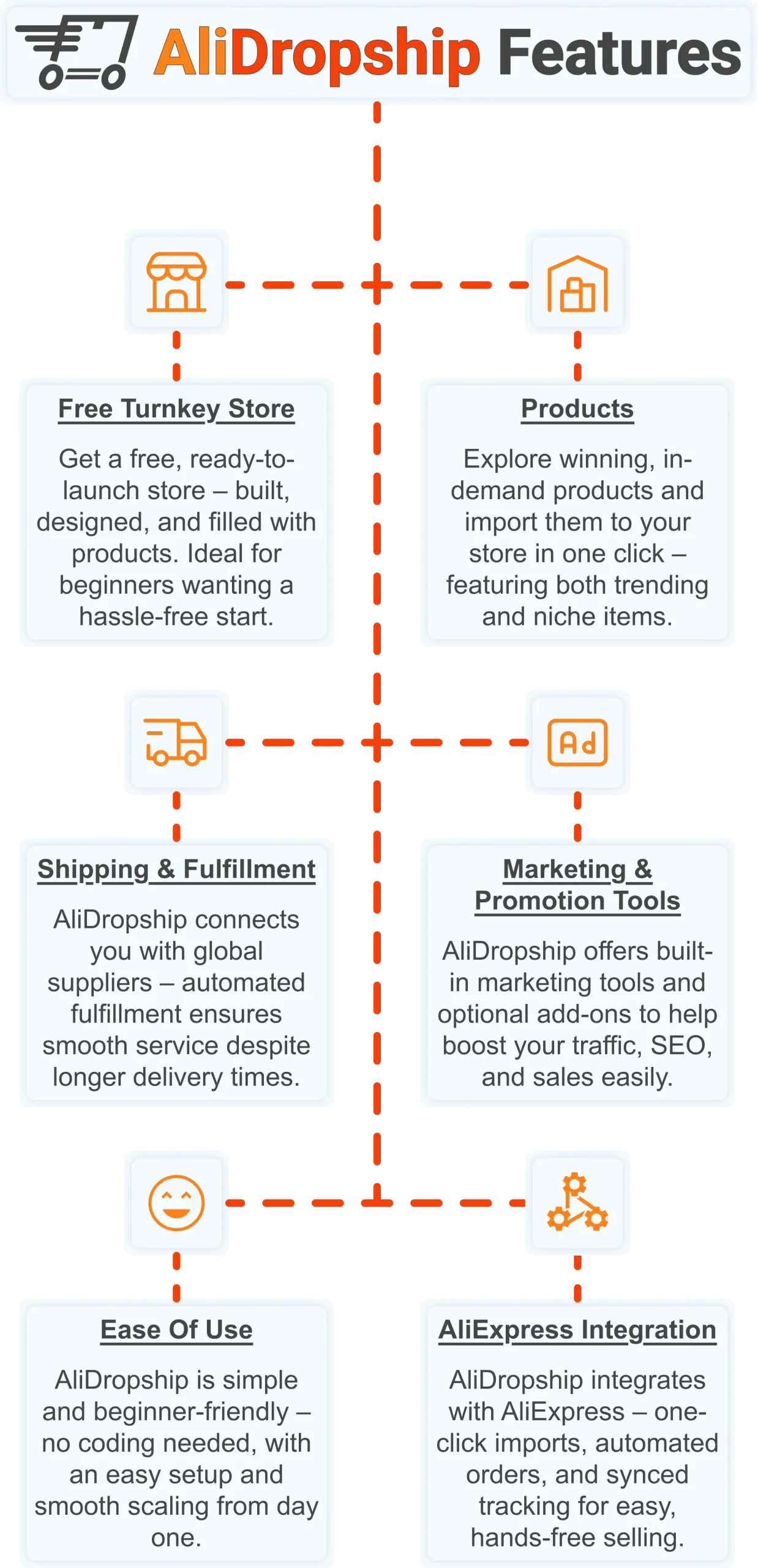
Free turnkey store ️
Get a free turnkey store – built, designed, and filled with products. Ideal for beginners wanting a hassle-free start, the store comes fully optimized to attract customers right away, saving you time on setup. Plus, it includes professional design elements to give your business a polished, trustworthy look from day one. This ready-made foundation makes it easy to move seamlessly into product selection.
Products
Once your store is set up, you can explore winning, in-demand products and import them in one click – featuring both trending and niche items. This wide selection lets you cater to diverse customer interests and test what works best. Regular updates ensure you always have fresh products, keeping your store competitive and relevant. With great products in place, smooth shipping becomes the next essential step.
Shipping & fulfillment
AliDropship connects you with global suppliers, and automated fulfillment ensures seamless order processing despite international delivery times. Customers receive real-time tracking updates, which builds confidence and trust in your store. Once shipping is handled reliably, you can focus on promoting your store and attracting traffic.
Marketing & promotion tools
To maximize sales, AliDropship offers built-in marketing tools and optional add-ons that help boost traffic, SEO, and conversions. From email campaigns and discounts to social media integration, these tools empower you to reach and retain customers without needing prior marketing experience. With promotion strategies in place, managing your business becomes simpler and more efficient.
Ease of use
AliDropship is beginner-friendly – no coding needed, with an intuitive dashboard that guides you through every step. Easy setup and smooth scaling let you expand your store without stress. As your business grows, adding new features, products, and marketing campaigns remains hassle-free, giving you more time to focus on sales.
AliExpress integration
Finally, AliDropship integrates seamlessly with AliExpress, enabling one-click imports, automated orders, and synced tracking. Your inventory stays up-to-date with the latest products and prices, while automated order processing frees you from manual tasks. Combined with the turnkey setup, reliable shipping, and built-in marketing tools, this integration ensures your dropshipping business is fully equipped for growth and success.
Frequently Asked Questions
How much money can you realistically make on Pinterest?
Realistic monthly earnings on Pinterest range from 200 to 3,000 or more depending on the method chosen and how consistently you show up. Affiliate marketing typically brings in 200 to 1,500 per month, while a dropshipping store can generate 500 to 3,000 or more per month. Beginners usually land at the lower end during the first 60 to 90 days, with most creators reaching higher numbers after 6 to 12 months. Pinterest rewards consistency and quality over volume rather than quick, one-off effort.
How does affiliate marketing work on Pinterest?
Affiliate marketing on Pinterest involves joining a program such as Amazon Associates or ShareASale, then creating pins that feature products with your unique referral link included. Pins stay indexed and searchable for a long time, so a product pin created today could still generate commissions in 18 months. Earning potential runs from 200 to 1,500 per month with a focused niche and 3 to 6 months of consistent activity. Disclosing affiliate relationships in pin descriptions is required by both Pinterest and FTC guidelines.
Why is Pinterest a good traffic source for dropshipping stores?
Pinterest works well for dropshipping because its users are already in a buying mindset when they search for specific products like rustic bedroom decor or minimalist kitchen gadgets. A well-optimized pin linking directly to a product page can generate consistent, cost-effective traffic that converts over time. Earning potential with a well-stocked store and 90 or more days of consistent activity is 500 to 3,000 or more per month. Home decor, lifestyle accessories, beauty, and fashion tend to perform particularly well as niches.
How much can you earn from sponsored pins on Pinterest?
Most brands look for creators with at least 5,000 to 10,000 engaged followers and a clearly defined niche before offering sponsored work. Fees per sponsored pin can range from 300 to 2,000 or more, depending on audience size and engagement rate. Building a simple media kit showing monthly impressions and engagement rate helps brands make decisions quickly. This income path generally takes longer to access than affiliate marketing or dropshipping since it depends on an established following.
How much should you spend on Pinterest Ads to start testing?
A daily budget of 5 to 10 dollars is enough to gather meaningful data on which pins perform best before scaling further. Ads should be tracked using Pinterest Analytics for click-through rates and add-to-carts, and any ad not generating results after 7 to 10 days should be cut. Shopping Ads are considered the most straightforward starting point for beginners with product-based businesses. Paid ads are meant to amplify what is already working organically, not fix a weak product or poorly optimized store.
Pinterest is one of the most powerful free traffic sources available to dropshipping store owners in 2026 – and pairing it with the right tools makes all the difference. Get your free AliDropship store today and start turning Pinterest traffic into real sales.
 Previous post
