 ‧ Agnes Kazaryan ‧
March 15, 2026
‧ Agnes Kazaryan ‧
March 15, 2026  738 ‧
738 ‧
 0
0
Starting a blog sounds expensive until you realize you can do it without spending a single dollar. The platforms are free, the tools are free, and the potential to earn real income is very real. But here is the honest version: most people who try to figure out how to start a blog for free and make money in a week will be disappointed. The bloggers who actually earn treat it like a business from day one.
Quick Answer: Yes, you can start a blog for free using platforms like Blogger, WordPress.com, or Wix and earn money through ads, affiliate marketing, sponsored posts, and digital products. Realistically, expect 6–12 months before consistent income arrives.
This guide walks you through every major free blogging platform, the best ways to monetize, realistic income figures, and what to watch out for along the way. Before we get into the step-by-step breakdown, it helps to understand what blogging for money actually looks like in 2026 – and why some bloggers succeed while others quietly give up after a few months.
What does it mean to start a blog for free and make money?
Blogging for money means creating written content on a website – consistently and strategically – with the goal of attracting an audience and turning that traffic into income. “For free” means doing this without paying for hosting, a domain, or premium tools at the start.
In 2026, free blogging is genuinely viable. Platforms like WordPress.com, Blogger, and Wix give you a working website in under 30 minutes – templates included, basic SEO tools included, mobile-friendly design included. The barrier to entry has never been lower.
The catch is that free plans come with real limitations: subdomain URLs (yourblog.wordpress.com instead of yourblog.com), restricted monetization options, and less long-term control over your content. These limitations matter as you grow, but they are manageable when you are just testing an idea. What makes a free blog actually profitable comes down to three things – picking a focused niche with real search demand, publishing consistently enough to build topical authority, and choosing monetization methods that match your traffic volume and audience intent.
How much can you realistically earn from a free blog?
Blogging income varies enormously depending on niche, traffic volume, and which monetization method you use. The table below gives you a realistic breakdown across the most common approaches.
Display ads pay the least per visitor but require the least ongoing effort once approved. Affiliate marketing and digital products offer better income per visit and scale more efficiently as your blog grows.
One note on these figures: The upper ranges assume 20,000–50,000 monthly page views and a monetized niche like finance, health, tech, or business. For most new bloggers, consistent income kicks in between month 9 and month 18. Full-time blogging income – around $3,000–$5,000/month – typically takes 2–3 years of sustained effort. That timeline is not a reason to avoid blogging. It is just an honest framing so you can plan accordingly and not quit too early.
Best free blogging platforms to start making money
Choosing the right platform matters more than most beginners realize. The platform you start on determines your monetization options, your URL structure, your design flexibility, and how easy it is to migrate later. Here are the main options worth your time.
Fully free platforms with solid monetization options
Blogger
Blogger is Google’s own free blogging platform and one of the oldest still running. It gives you a free subdomain (yourblog.blogspot.com), unlimited posts, and – crucially – full Google AdSense integration right out of the box. You can also connect a custom domain for free if you already own one. The interface is basic and design options are limited compared to newer platforms, but if your goal is to start earning from display ads quickly without spending anything, Blogger is one of the most direct routes available.
Earning potential: $1–$5 per 1,000 page views once AdSense is approved. Approval typically requires 20–30 published posts with original content.
WordPress.com (free plan)
WordPress.com is the hosted version of WordPress and the most widely used blogging platform in the world. The free plan gives you a yoursite.wordpress.com subdomain, a selection of themes, and basic analytics. The limitation is that WordPress.com restricts monetization on free plans – you cannot run your own ads or install third-party plugins without upgrading. However, affiliate links are allowed freely, which makes the free plan viable for affiliate marketing even before you pay anything. When you are ready to scale, migrating to self-hosted WordPress.org is straightforward.
Earning potential: Primarily through affiliate links on the free plan. Bloggers in high-intent niches like personal finance or software reviews can earn $100–$500/month at 5,000–10,000 monthly visits.
Wix
Wix offers a drag-and-drop free website builder with a built-in blog feature. The free plan includes a Wix subdomain (yoursite.wixsite.com) and access to hundreds of templates. Wix does not restrict affiliate links, and the built-in app market makes adding email capture, pop-ups, and forms easy without any technical knowledge. The free plan does display Wix ads on your site – which can feel unprofessional – but for validating a niche or building an audience before investing in a paid tier, it works.
Earning potential: Affiliate marketing and email list building are the strongest options on the free Wix plan. Expect $50–$200/month after 6–12 months with consistent content in a targeted niche.
Content platforms that pay you directly
Medium Partner Program
Medium is a writing platform that pays you directly based on how long paying Medium members spend reading your articles. There is no cost to sign up, no hosting required, and no setup complexity – you just write. The Medium Partner Program distributes a share of subscription revenue to writers proportionally. In practice, earnings are modest for most writers: roughly $0.01–$0.05 per read, with high-traffic articles occasionally earning $100–$500 in a single month. Medium also gives your content built-in distribution through its recommendation algorithm, which can help new writers reach readers faster than building a site from scratch.
Earning potential: $5–$200/month for regular writers. Viral articles can spike higher, but these are not predictable or repeatable on demand.
Substack
Substack is a newsletter-first publishing platform that lets you charge subscribers a monthly or annual fee for premium content. Starting is completely free – Substack takes a 10% cut of paid subscriptions but charges nothing upfront. For writers who want to build a direct relationship with readers, Substack is one of the most legitimate ways to make money from writing without owning a website. Many successful Substack writers started with a free newsletter to build their list, then introduced a paid tier after reaching 500–1,000 subscribers.
Earning potential: With 500 subscribers at $7/month and a 10% paid conversion rate, that is $350/month. At 5,000 subscribers with the same conversion rate, that is $3,500/month.
How to monetize your free blog: The main methods explained
Picking your monetization method before you start writing matters because it shapes what content you produce, how you structure your posts, and which platforms make the most sense for your goals.
Display advertising
Google AdSense is the most accessible ad network for new bloggers. Once your site is approved – typically after 20–30 quality posts – Google places ads automatically and you earn per 1,000 impressions or per click. In competitive niches like finance or insurance, CPMs can reach $15–$30. In general lifestyle or entertainment niches, they hover around $1–$3. The math is simple: more traffic equals more ad revenue. The downside is that display ads require significant traffic to generate meaningful income. Most bloggers need 50,000+ monthly page views before ads become their primary revenue stream.
Why this works in 2026: Google’s Helpful Content updates have raised the bar for generic articles, but blogs with real expertise and genuine audience engagement continue to rank and earn well from AdSense.
Affiliate marketing
Affiliate marketing means recommending products or services and earning a commission when your readers buy through your link. Amazon Associates, ShareASale, Impact, and individual brand programs are the most common entry points. The key to affiliate success is writing content that matches buyer intent – “best X for Y,” “X vs Y comparisons,” and “honest review of X” posts consistently outperform generic informational content for conversions. Commission rates range from 1–2% on Amazon to 20–50% on software and digital products, so niche selection matters enormously for affiliate income.
Sponsored content
Once your blog reaches a credible audience – typically 5,000–10,000 monthly readers is the minimum most brands look for – you can pitch or accept sponsored post opportunities. Brands pay you to write content that features their product or service. Rates vary: micro-niche blogs with highly engaged audiences can charge $200–$500 per post even at modest traffic levels, while larger blogs in competitive niches routinely charge $1,000–$3,000 per placement. Being transparent about sponsorships – required by the FTC – does not hurt your reputation. Readers respect honesty.
Selling digital products and online courses
Once you have an audience that trusts your expertise, selling digital products is one of the most profitable ways to monetize a blog. You create the product once and sell it repeatedly with no ongoing costs. Platforms like Gumroad, Payhip, and Podia let you list and deliver digital products for free (they take a small transaction fee). A practical ebook priced at $15–$29 on a blog with 3,000–5,000 monthly email subscribers can generate $300–$1,500/month depending on your audience relationship and content quality.
Email list monetization
Email is consistently rated as the highest-ROI marketing channel, and for bloggers it is the most resilient income source. Your email list is owned by you – unlike your Google rankings or social media following, no algorithm change can take it away. Growing your list starts with a strong lead magnet: a free resource that gives readers a reason to subscribe. Once you have 1,000+ subscribers, you can monetize through affiliate promotions, product launches, or exclusive paid newsletters. Experienced email marketers benchmark at $1/subscriber/month, meaning a list of 3,000 engaged subscribers should generate around $3,000/month when monetized effectively.
Earning potential: $30–$80/day once your list exceeds 2,000–3,000 engaged subscribers and you have a clear monetization strategy in place.
Free blogging platforms compared: Which one fits your goal?
Before choosing a platform, it helps to map your goal to the platform’s strengths. Here is a quick summary of how the main options stack up.
Blogger suits total beginners who want AdSense income with zero setup friction. WordPress.com is the stronger long-term choice if you plan to migrate to self-hosted WordPress later. Medium and Substack are ideal for writers who want a built-in audience without worrying about SEO or technical setup.
Practical tips to make money blogging faster
Platform and monetization method matter, but execution determines whether you actually earn. Here are the habits that separate bloggers who make money from those who stall out.
Pick a niche with proven monetization, not just your passion
Passion matters for consistency, but niche selection determines your earning ceiling. The most profitable free blog niches in 2026 include personal finance, software reviews, health and wellness, online business, and home improvement. These niches have high advertiser demand (which means higher AdSense CPMs), strong affiliate programs, and readers who are actively looking to buy. Use Google’s free Keyword Planner or Ubersuggest’s free tier to validate search volume before committing to a topic.
Write for search intent, not just search volume
High-volume keywords are competitive. The fastest path to early traffic is targeting long-tail keywords – three-to-five word phrases with specific intent. “Best budgeting app for freelancers” will rank faster than “budgeting app” and convert better because the reader already knows what they want. Aim for 20–30 long-tail articles before targeting broader keywords with higher difficulty scores.
Build your email list from day one
Most new bloggers wait until they have significant traffic before starting a list. This is a mistake. Even 100 engaged subscribers are more valuable than 10,000 passive page views. Add a lead magnet early – a free PDF checklist, a mini-guide, or a resource list related to your niche – and use a free tool like Mailchimp (free up to 500 subscribers) or MailerLite to manage it. Your email list will become your most reliable monetization channel as the blog grows.
Publish on a realistic but consistent schedule
Consistency beats quantity. One genuinely useful, well-researched post per week is more valuable than five rushed posts. Google’s ranking systems reward topical depth and content freshness, but they also reward sites that show consistent editorial activity over time. Set a publishing schedule you can maintain for at least six months – even if that is only two posts per month at first.
Use free SEO tools to find your best opportunities
You do not need expensive SEO tools to rank well when you are starting out. Google Search Console (free) shows you which queries are driving traffic and where you rank for target keywords. Ahrefs Webmaster Tools (free tier) gives you backlink data and basic keyword difficulty scores. AnswerThePublic’s free tier surfaces the questions real people are asking in your niche – and those questions are ready-made blog post ideas with clear search intent.
Pro Tip: After publishing each post, submit the URL directly to Google Search Console’s URL Inspection tool to request indexing. This cuts the time before Google discovers your content from weeks to days.
Legal and ethical things to get right before you monetize
Making money from a blog comes with real legal obligations. Ignoring these is not just an ethical issue – it can result in your site being penalized, your AdSense account being suspended, or FTC fines for non-disclosure.
Disclose affiliate links and sponsored content
The FTC requires bloggers in the US to disclose any financial relationship with a brand – this includes affiliate links and paid posts. The disclosure must be clear and prominent, not buried in a footer. A simple sentence at the top of any post containing affiliate links (“This post contains affiliate links. If you purchase through them, I may earn a commission at no extra cost to you.”) is legally sufficient and does not harm conversion rates.
Key principle: Transparency builds reader trust, and reader trust is what drives affiliate conversions over the long term.
Do not use unlicensed content or images
Using images without a license or reproducing content from other sites without permission creates serious copyright exposure. Stick to genuinely free image sources – Unsplash, Pexels, and Pixabay offer high-quality photos with no attribution required. For written content, original research and genuine opinions always outperform rephrased content from other sites. And Google’s ranking systems in 2026 are very good at detecting both.
Add required legal pages from day one
Before you start monetizing, add these pages to your blog: a Privacy Policy (required if you collect any user data, including via analytics or email sign-ups), a Disclaimer (required for affiliate and sponsored content), and Terms of Use. Free generators like Termly or PrivacyPolicyGenerator.info can create these pages in minutes. Missing privacy policies can get your AdSense application rejected – do not skip this step.
Which approach is right for you?
The honest answer depends on your goals, your timeline, and how much effort you are willing to put in before earning anything. Here is a practical breakdown by reader profile.
Complete beginner
If you have never published online before and want to test whether blogging suits you without risking money: start on Blogger or Medium. Blogger lets you test AdSense integration with zero technical friction. Medium gives you a built-in readership from day one. Once you have 20–30 published articles and a clearer sense of your niche, then consider migrating to self-hosted WordPress if you want full monetization control.
Intermediate – you have some content and want to earn more
If you already have a blog or social media presence with an existing audience: focus on affiliate marketing and email list building first. These two channels offer the best return per reader at moderate traffic levels. Identify the two or three products your audience is most likely to buy, apply for their affiliate programs, and write honest comparison and review content designed to rank for buyer-intent keywords.
Advanced – you want full-time income
If your goal is $3,000–$5,000/month or more from your content: a free blogging platform alone will not get you there. Self-hosted WordPress, a professional domain, and a diversified monetization stack – ads plus affiliate plus digital products plus email – are necessary at this level. The free platform is a starting point, not a long-term home for a content business. At the advanced stage, also consider whether ecommerce – which has higher income ceilings and does not depend entirely on search traffic – might be a more reliable path to the income you want.
Whichever stage you are at, the single most common mistake bloggers make is trying to earn before they have built genuine trust with an audience. Traffic without trust does not convert. Get the content right first, and the monetization follows naturally.
AliDropship: Your complete all-in-one solution for starting dropshipping in 2026
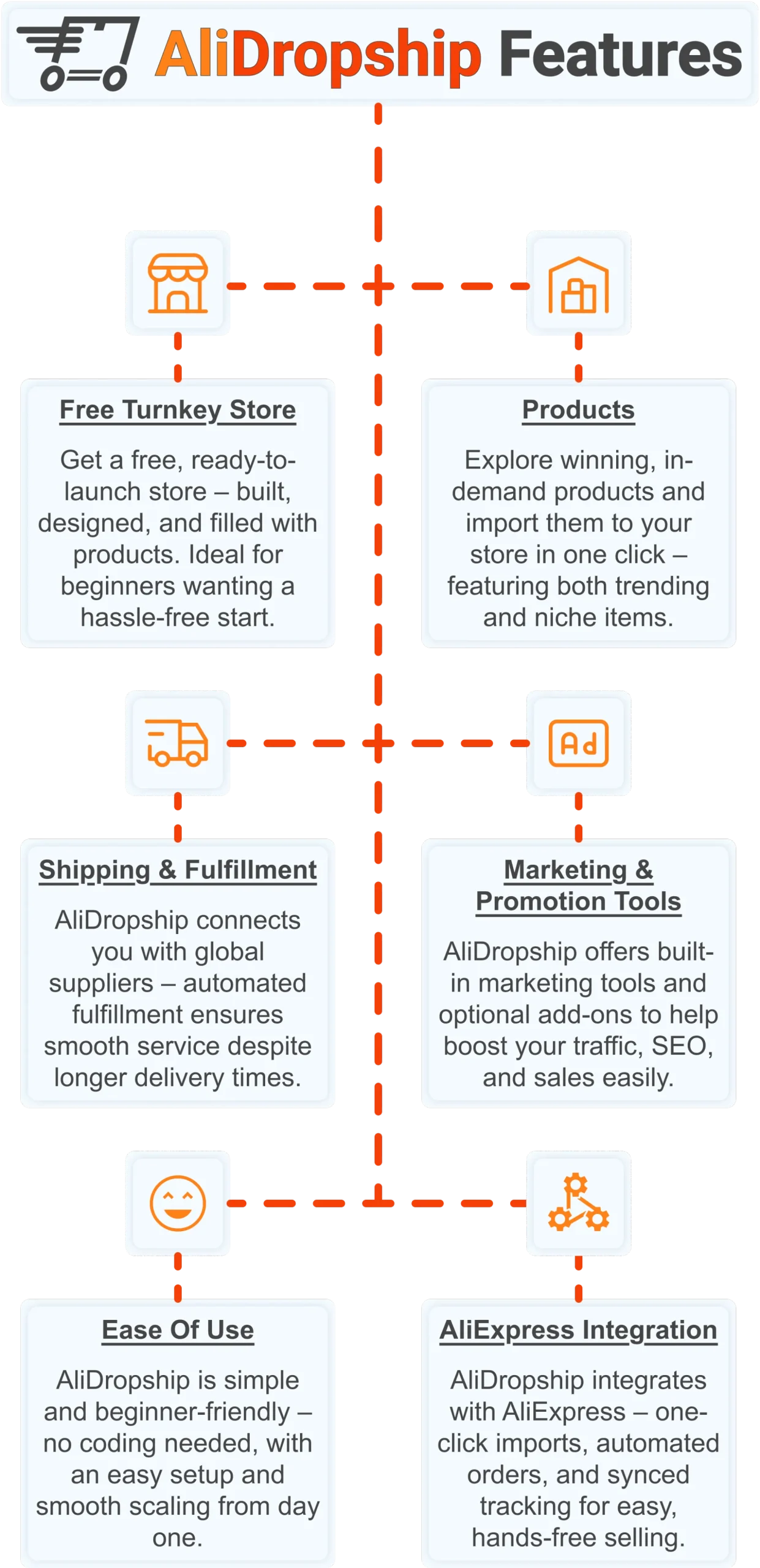
If you want the simplest possible way to start dropshipping – especially if you’re brand new – AliDropship remains one of the most beginner-friendly tools available in 2026. It brings together store creation, product imports, automation, and marketing into a single streamlined system designed to help you launch quickly and grow confidently.
Free turnkey store ️
Get a free turnkey store – built, designed, and filled with products. Ideal for beginners wanting a hassle-free start, the store comes fully optimized to attract customers right away, saving you time on setup. Plus, it includes professional design elements to give your business a polished, trustworthy look from day one. This ready-made foundation makes it easy to move seamlessly into product selection.
Products
Once your store is set up, you can explore winning, in-demand products and import them in one click – featuring both trending and niche items. This wide selection lets you cater to diverse customer interests and test what works best. Regular updates ensure you always have fresh products, keeping your store competitive and relevant. With great products in place, smooth shipping becomes the next essential step.
Shipping & fulfillment
AliDropship connects you with global suppliers, and automated fulfillment ensures seamless order processing despite international delivery times. Customers receive real-time tracking updates, which builds confidence and trust in your store. Once shipping is handled reliably, you can focus on promoting your store and attracting traffic.
Marketing & promotion tools
To maximize sales, AliDropship offers built-in marketing tools and optional add-ons that help boost traffic, SEO, and conversions. From email campaigns and discounts to social media integration, these tools empower you to reach and retain customers without needing prior marketing experience. With promotion strategies in place, managing your business becomes simpler and more efficient.
Ease of use
AliDropship is beginner-friendly – no coding needed, with an intuitive dashboard that guides you through every step. Easy setup and smooth scaling let you expand your store without stress. As your business grows, adding new features, products, and marketing campaigns remains hassle-free, giving you more time to focus on sales.
AliExpress integration
Finally, AliDropship integrates seamlessly with AliExpress, enabling one-click imports, automated orders, and synced tracking. Your inventory stays up-to-date with the latest products and prices, while automated order processing frees you from manual tasks. Combined with the turnkey setup, reliable shipping, and built-in marketing tools, this integration ensures your dropshipping business is fully equipped for growth and success.
Starting a free blog is a solid first step online – but if you want to build real income faster, ecommerce gives you a direct path to sales from day one. Get your free turnkey store and a $100 voucher to start selling today.
Frequently asked questions
Can you start a blog for free and actually make money in 2026?
Yes, you can start a blog for free using platforms like Blogger, WordPress.com, or Wix and earn money through ads, affiliate marketing, sponsored posts, and digital products. Realistically, expect 6 to 12 months before consistent income arrives. Free platforms give you a working website in under 30 minutes, complete with templates, basic SEO tools, and mobile friendly design. For most new bloggers, consistent income kicks in between month 9 and month 18.
How much can a free blog earn from display ads and affiliate marketing?
Display ads through Google AdSense typically pay 1 to 5 dollars per 1000 page views, and most bloggers need 50000 or more monthly page views before ads become a primary revenue stream. Affiliate marketing tends to pay better per visit, generating 50 to 500 dollars or more a month at around 10000 monthly visits in a strategic niche. Commission rates on affiliate programs range from 1 to 2 percent on Amazon Associates up to 20 to 50 percent on software and digital products. In competitive niches like finance or insurance, ad CPMs can reach 15 to 30 dollars.
Which free blogging platform is best for making money?
Blogger gives full Google AdSense integration out of the box, with approval typically requiring 20 to 30 published posts and earning potential of 1 to 5 dollars per 1000 page views. WordPress.com free plan restricts running your own ads but allows affiliate links, letting bloggers in high intent niches earn 100 to 500 dollars a month at 5000 to 10000 monthly visits. Wix does not restrict affiliate links and typically earns 50 to 200 dollars a month after 6 to 12 months of consistent content. Medium pays writers directly at roughly 0.01 to 0.05 dollars per read, with high traffic articles occasionally earning 100 to 500 dollars in a single month.
How much can sponsored posts and digital products earn on a blog?
Sponsored content typically requires at least 5000 to 10000 monthly readers, with micro niche blogs charging 200 to 500 dollars per post and larger blogs in competitive niches charging 1000 to 3000 dollars per placement. A practical ebook priced at 15 to 29 dollars on a blog with 3000 to 5000 monthly email subscribers can generate 300 to 1500 dollars a month. Selling digital products overall has an earning potential of 200 to 2000 dollars or more a month once launched. An email list of 3000 engaged subscribers benchmarked at 1 dollar per subscriber per month can generate around 3000 dollars a month when monetized effectively.
What legal requirements apply before monetizing a free blog?
The FTC requires bloggers in the United States to clearly disclose any financial relationship with a brand, including affiliate links and paid posts, in a prominent location rather than buried in a footer. Using images without a license or reproducing content from other sites without permission creates serious copyright exposure, so free sources like Unsplash, Pexels, and Pixabay are recommended instead. Before monetizing, a blog should include a Privacy Policy, a Disclaimer for affiliate and sponsored content, and Terms of Use, since a missing privacy policy can get an AdSense application rejected. Free generators like Termly can create these required legal pages within minutes.
 Previous post
