 ‧ Agnes Kazaryan ‧
March 14, 2026
‧ Agnes Kazaryan ‧
March 14, 2026  1159 ‧
 0
0
The global jewelry market is worth over $350 billion – and a growing share of that belongs to independent sellers working from home offices, kitchen tables, and spare bedrooms. If you have been asking yourself how to start a small jewelry business from home, the good news is that 2026 is probably the most accessible time in history to do it.
You do not need a storefront, a big production budget, or years of retail experience. You need a focused niche, a reliable source of products, and a consistent plan for getting them in front of the right buyers.
Quick answer: To start a small jewelry business from home, choose your niche and product model (handmade, dropshipping, or curated resale), set up a selling platform, price your products correctly, and build steady marketing habits. Most home jewelry sellers see their first sales within 30–60 days of launching, with early earnings typically ranging from $200–$800/month and scaling to $2,000–$5,000+/month once they have found their audience.
This guide walks through every step in order – from validating your niche and choosing your model to promoting your store and scaling beyond a side hustle. Whether you are starting from scratch or looking to turn occasional Etsy sales into something more serious, every step is here.
What is a home-based jewelry business?
A home-based jewelry business is any jewelry operation you run from your own space, without a physical retail location. That covers a lot of ground: handmade pieces crafted and sold online, curated jewelry dropshipped directly to customers from suppliers, vintage or wholesale items sourced and resold, or a hybrid of all three.
What all of these models share is that your home is your base of operations – your workshop, your storefront, and usually your photography studio at the same time.
What makes this model genuinely viable in 2026 is the infrastructure that now exists to support it. Platforms like Etsy, Shopify, and WooCommerce have removed the barrier between a home seller and a global customer base.
Payment processors, automated shipping integrations, and social commerce tools have matured to the point where a solo jewelry seller can operate with the professionalism of an established brand – because that is exactly what they are building.
Jewelry is also one of the most emotionally driven product categories online. Buyers are not purchasing a commodity – they are buying something to wear, to gift, or to mark a meaningful moment. That emotional weight creates genuine customer loyalty, strong repeat purchase rates, and organic word-of-mouth in a way that most product categories simply cannot replicate.
A clear brand identity and a consistent aesthetic can carry a small home seller much further than a generic catalogue ever could.
How much can you realistically earn from a home jewelry business?
Income from a home-based jewelry business varies based on your product model, your niche, your pricing strategy, and how much time you invest. Here is a realistic breakdown across the most common approaches:
These figures reflect active, consistent sellers – not passive income. A handmade seller listing new products weekly and promoting steadily on Pinterest can realistically reach $1,500/month within 90 days. A dropshipping store with solid product selection and a modest ad budget can exceed that within 60 days.
One note on the upper figures: The higher ranges represent sellers who have built an audience, refined their product line, and systematized operations. Getting there typically takes 6–12 months of consistent effort. Treat the lower end as your 90-day target and the upper end as your 12-month benchmark.
How to start a small jewelry business from home: Step by step
Building a profitable jewelry business from home is not complicated – but it does require working through the right steps in the right order. Here is how to do it properly, without the detours that cost most new sellers months of wasted effort.
Step 1 – Choose your niche and product model
The most common mistake new jewelry sellers make is trying to appeal to everyone. The jewelry market is heavily saturated at the generic level – you will not out-compete mass retailers by selling “pretty necklaces.” You will, however, do very well by owning a specific corner of the market with a clear point of view.
Handmade jewelry
If you have a craft skill – wire wrapping, resin casting, metalsmithing, beading – handmade is the most differentiated model available. No two pieces are identical, and buyers on Etsy and Instagram actively seek out independent makers.
The trade-off is time: you can only produce as many pieces as your hands allow, which creates a natural income ceiling unless you systematize or bring in help. Margins are strong – resin earrings costing $3 in materials can sell for $25–$45 – but your effective hourly rate can drop fast if you are not pricing for your actual time.
Earning potential: $300–$3,000/month depending on production capacity and pricing.
Dropshipping jewelry
Dropshipping removes the production constraint entirely. You curate a store of jewelry products sourced from suppliers – typically through AliExpress or a platform built on top of it – and when a customer orders, the supplier ships directly to them. You never hold inventory, never pack a box, and never worry about production capacity.
Your focus shifts entirely to product curation, store presentation, and marketing. This model scales more easily than handmade, and startup costs are significantly lower.
Earning potential: $500–$5,000+/month with consistent marketing and a well-curated product range.
Curated resale
Curated resale sits between handmade and dropshipping. You source finished jewelry from wholesale suppliers, vintage markets, or platforms like Faire and resell it through your own channels at a markup. The curation is the value – you are building a brand around a specific aesthetic or customer type, not just flipping generic products. Margins are lower than handmade but higher than most mass-market retail.
Print-on-demand jewelry
Several print-on-demand platforms now offer customizable jewelry – engraved pendants, name necklaces, birthstone rings. You upload a design, set a price, and the platform handles production and fulfillment. It is the lowest-effort entry point, though margins are thinner and differentiation is harder to achieve.
Step 2 – Research your market and nail your niche
Once you have chosen your product model, go narrow on your niche. “Minimalist gold jewelry” is a niche. “Boho crystal earrings for festival wear” is a niche. “Personalized name necklaces for new moms” is a niche. The more specific your positioning, the easier it is to find your ideal customer – and the less you need to compete on price alone.
How to validate a jewelry niche before investing
Use Etsy’s search bar to see how many listings exist for your target term – high listing counts confirm demand but also show competition levels. Check Pinterest trends for seasonal spikes in your niche. Search Reddit communities like r/jewelry and r/Etsy to see what buyers are asking for and what sellers are struggling with.
Study the top 10 Etsy sellers in your niche: read their reviews, identify what customers love, and look for the gaps and complaints that keep appearing. Those gaps are your entry point.
Jewelry niches with strong demand in 2026
- Dainty, minimalist gold-filled pieces for everyday wear
- Birthstone and personalized name jewelry targeting the gifting market
- Cottagecore and nature-inspired designs with strong Pinterest traffic
- Men’s jewelry – rings, chains, and bracelets (a fast-growing segment)
- Sustainable and recycled material jewelry for values-driven buyers
- Crystal and gemstone pieces for spiritual and wellness audiences
- Matching sets – couples jewelry, mother-daughter, best friend collections
Step 3 – Source your materials or products
For handmade sellers, sourcing quality materials at the right price is the difference between a profitable product line and one that quietly drains your margins. For dropshipping and resale sellers, supplier quality directly determines your customer satisfaction rate – and the reviews that either build or destroy your store’s reputation.
Sourcing for handmade sellers
Rio Grande, Fire Mountain Gems, and Beadaholique are well-established wholesale suppliers for metals, gemstones, findings, and beads. For resin and UV casting supplies, AliExpress offers competitive pricing when buying in volume.
Always order samples before committing to bulk – quality varies, and your brand depends on consistency. Factor in material cost, packaging, and your time when calculating the true cost of each piece.
Sourcing for dropshipping sellers
AliExpress remains the most flexible sourcing platform for jewelry dropshippers, with tens of thousands of SKUs across every niche and price point. The key is vetting suppliers carefully – look for stores with 95%+ positive feedback, verified shipping times, and detailed product photos.
Order samples of your top listings before going live. Jewelry is a tactile, wearable product: if a necklace feels cheap in your hands, it will feel cheap to your customer too.
Sourcing for curated resale
Faire is the standard wholesale platform for independent designer jewelry, with minimum orders typically around $100–$250 and generally higher aesthetic quality than mass-market alternatives. Tundra and Abound are solid alternatives. For vintage sourcing, estate sales, local markets, and thrift stores can yield strong margins – but require consistent time investment to build reliable inventory.
Step 4 – Set up your selling platform
Where you sell matters as much as what you sell. Each platform attracts a different type of buyer, charges different fees, and rewards different approaches. Most successful home jewelry businesses start on one platform and expand to two or three once they have traction.
How to sell jewelry on Etsy
Etsy is the default starting point for most home jewelry sellers – and for good reason. It has a built-in audience of buyers actively searching for handmade, unique, and personalized items. Listing fees are $0.20 per item, and Etsy takes a 6.5% transaction fee per sale plus payment processing.
To succeed on Etsy, your product photography needs to be strong, your titles need to include natural keyword variations, and your shop sections need to be logically organized. Getting your first 5–10 reviews is the hardest part – consider offering a small discount to early buyers in exchange for honest feedback.
Your own online store
Running your own store through Shopify, WooCommerce, or a platform like AliDropship gives you full control over branding, pricing, and customer data. You are not competing for visibility inside a marketplace algorithm, and you keep significantly more of each sale.
The trade-off is that you are responsible for driving your own traffic through SEO, social media, or paid ads. Most sellers find that owning their own store becomes essential once they have outgrown Etsy – or from day one if they are running a dropshipping model.
Social commerce – Instagram and TikTok Shop
Jewelry is one of the best-performing categories in social commerce. Short-form video showing the making process, unboxing experiences, or jewelry styled in real outfits consistently drives strong engagement and sales. TikTok Shop allows direct checkout inside the app, and Instagram Shopping integrates with your existing product catalog.
These channels work best as amplifiers alongside an established store – not as a standalone replacement for one.
Step 5 – Price your jewelry correctly
Underpricing is the single most common mistake new jewelry sellers make – and the one most likely to kill the business before it gains momentum. Pricing too low does not attract more buyers; it signals low quality and attracts buyers who will never pay full price for anything.
The pricing formula for handmade jewelry
A reliable starting formula: (material cost × 3) + your hourly rate for the time spent = minimum retail price. If a pair of earrings costs $4 in materials and takes 30 minutes to make, and you value your time at $20/hour, your minimum price is $22. Most established handmade sellers price at 4–5× material cost to properly account for Etsy fees, packaging, photography, and time.
Do not price against mass-market retailers – you are not competing with them. You are competing with other independent makers, and buyers in that space expect and accept a premium for quality and story.
Pricing for dropshipping and resale
For dropshipping, a 2.5–3× markup on supplier cost is a standard starting point. A necklace costing $8 from a supplier should retail at $20–$25. Factor in platform fees, any ad spend, and packaging before setting final prices.
For curated resale, keystone pricing (2× wholesale cost) is the industry standard – a piece you buy for $15 wholesale should retail for $30. Always build in enough room to run occasional promotions without cutting below your break-even point.
How to promote your home jewelry business
A great product without promotion is a well-kept secret. Marketing a home jewelry business does not require a large budget – but it does require consistency and a clear picture of where your customers spend time online.
Pinterest – the highest-converting free channel for jewelry
Pinterest drives more organic traffic to jewelry stores than almost any other free platform. Its users are in a discovery and planning mindset – looking for ideas, saving products, and clicking through to purchase. Create a business account, enable rich pins, and pin your product images consistently – 5–10 pins per day is a realistic target.
Use keyword-rich descriptions, organize boards around your niches (for example: “Minimalist Gold Jewelry,” “Crystal Earrings,” “Gifts for Her”), and link every pin directly to the relevant product page. Results compound over time – a well-maintained Pinterest account can generate hundreds of daily store visits within 6 months.
Instagram – build a brand, not just a feed
Instagram rewards visual coherence and consistency. Your grid should feel like a mood board for your brand – every image, Reel, and Story should belong to the same aesthetic world. For jewelry, that means consistent backgrounds, consistent lighting, and consistent styling across all content. Reels showing the making process or jewelry in motion consistently outperform static posts.
Aim for 4–5 posts per week and 2–3 Stories per day. Use location tags and relevant hashtags not to chase viral reach, but to be discoverable by exactly the right people.
SEO for your jewelry store
If you have your own online store, search engine optimization is the highest-ROI long-term marketing channel available. Write product descriptions that answer real buyer questions – not just “gold necklace” but “dainty gold layering necklace for everyday wear.”
Start a blog covering topics your ideal customer is already searching: “what jewelry goes with a boho wedding dress,” “how to care for gold-filled pieces,” “best jewelry gifts under $50.” Each piece of content you publish is a permanent, cost-free traffic source.
Email marketing – your most underused channel
Email converts at 2–5× the rate of social media for most product-based businesses. Collect email addresses from the start – offer a 10% discount, a free styling guide, or early access to new collections in exchange for signing up.
Send a welcome sequence, a regular newsletter, and dedicated campaigns around key gifting moments: Valentine’s Day, Mother’s Day, Christmas, and birthday season. A list of 1,000 engaged subscribers can reliably generate $500–$2,000 per campaign for a jewelry business.
Micro-influencer collaborations
You do not need influencers with millions of followers. Micro-influencers – accounts with 5,000–50,000 engaged followers in fashion, lifestyle, or wellness – often have more loyal audiences and lower costs (or will accept product gifting in exchange for an honest post).
Reach out to 10–20 accounts whose aesthetic matches yours and offer to send a piece for review. One well-matched collaboration can deliver more targeted traffic than weeks of paid ads.
Legal and ethical considerations for a home jewelry business
Starting a home-based business comes with real legal obligations – ones too many new sellers ignore until they become expensive problems. Getting this right early costs very little and saves a lot.
Business registration and taxes
Even a small jewelry business operating from home is a legal entity in most jurisdictions. In the US, you will need to register as a sole proprietor at minimum, or form an LLC for liability protection. Obtain any required local business licenses, and check whether your state requires a seller’s permit for collecting sales tax.
Keep records of all income and expenses from day one – materials, packaging, shipping, platform fees, and equipment are all typically deductible. A basic accounting tool like Wave (free) or QuickBooks Self-Employed is worth setting up immediately.
Product safety and hallmarking
Jewelry sold in the US, UK, and EU is subject to product safety regulations, particularly for items marketed to children. If you are selling children’s jewelry, be aware of lead and cadmium content restrictions under CPSIA (US) and REACH (EU).
In the UK, gold and silver pieces above certain weights must be hallmarked by an Assay Office before sale. If you are dropshipping from overseas suppliers, request compliance documentation – and never make material claims (“solid gold,” “sterling silver”) you cannot verify.
What to avoid
Do not copy another maker’s designs and sell them as your own – this is copyright infringement, and the independent jewelry community is small enough that it will damage your reputation permanently.
Do not use brand names (Pandora, Tiffany, Cartier) as keywords or in your listings to attract search traffic – this is trademark infringement regardless of intent. Do not make material claims you cannot substantiate with documentation from your supplier.
Key principle: Build your brand on what makes your jewelry genuinely yours – your aesthetic, your story, your sourcing choices. That is what creates sustainable long-term value.
How to choose your approach based on where you are starting from
Not every home jewelry business looks the same – and the right starting point depends entirely on your situation, your existing skills, and what you are trying to build.
Complete beginner
Start with one platform, one niche, and one product model. Do not try to be everywhere at once. If you have a craft skill, open an Etsy shop with 10–15 handmade listings and spend the first 60 days focused entirely on product photography and keyword optimization.
If you have no craft background, explore dropshipping – it removes the production barrier and lets you focus on the business side from day one. Set a 90-day revenue target of $300–$500 and treat everything you learn in that window as the real investment.
Intermediate – from side income to something more
If you are already making occasional sales and want to grow, the next move is building your own store alongside any marketplace presence you have. This gives you a platform you fully control, the ability to collect customer data, and room to build a real brand identity.
Start investing in email marketing and Pinterest as your primary free traffic channels. Aim to reach $1,000–$2,000/month before committing to paid advertising – organic growth teaches you what your customer actually wants before you spend money to find more of them.
Advanced – building a full-time jewelry business
At this stage, systematization is everything. If you are handmaking, document your production process and consider hiring part-time help for repetitive tasks. If you are dropshipping, diversify your supplier base and begin testing paid traffic on Meta or Pinterest Ads.
Explore the wholesale channel – selling your designs to boutiques and gift shops – as a way to move volume without depending entirely on your own marketing. Sellers who consistently reach $5,000+/month are the ones who treat their business like a business: tracking metrics, reinvesting profits, and making data-driven decisions.
Regardless of starting point, the core principle is the same: build something specific, build it well, and build it consistently. The jewelry market rewards distinctiveness and trust – and both take time to establish.
Frequently asked questions
How do you start a small jewelry business from home?
To start a small jewelry business from home, choose a niche and product model such as handmade, dropshipping, or curated resale, then set up a selling platform and build steady marketing habits. Most home jewelry sellers see their first sales within 30 to 60 days of launching. Early earnings typically range from 200 to 800 dollars per month, scaling to 2000 to 5000 dollars or more once a seller finds their audience. The global jewelry market is worth over 350 billion dollars, leaving plenty of room for independent sellers.
How much can a home jewelry business realistically earn?
Handmade or Etsy sellers typically earn 300 to 3000 dollars per month depending on production capacity and pricing. Dropshipping jewelry stores can generate 500 to 5000 dollars or more monthly with consistent marketing and a well-curated product range. Wholesale to boutiques has the highest ceiling at 1000 to 8000 dollars per month but requires significant business-to-business outreach. Reaching the upper figures in any model typically takes 6 to 12 months of consistent effort.
How should home jewelry sellers price their products?
For handmade jewelry, a reliable formula is material cost multiplied by 3 plus an hourly rate for time spent, meaning 4 dollars in materials plus 30 minutes at 20 dollars per hour gives a minimum price of 22 dollars. Most established handmade sellers price at 4 to 5 times material cost to account for fees, packaging, and photography. For dropshipping, a 2.5 to 3 times markup on supplier cost is standard, so an 8 dollar necklace should retail at 20 to 25 dollars. For curated resale, keystone pricing at 2 times wholesale cost is the industry standard.
Which marketing channels work best for a home jewelry business?
Pinterest drives more organic traffic to jewelry stores than almost any other free platform, with 5 to 10 pins per day being a realistic target. Email marketing converts at 2 to 5 times the rate of social media for product-based businesses, and a list of 1000 engaged subscribers can generate 500 to 2000 dollars per campaign. Instagram rewards visual consistency, with 4 to 5 posts per week and 2 to 3 Stories per day being a realistic cadence. Micro-influencer collaborations with accounts of 5000 to 50000 engaged followers often outperform paid ads at a lower cost.
What legal considerations apply to a home jewelry business?
In the US, even a small jewelry business operating from home typically needs to register as a sole proprietor at minimum or form an LLC for liability protection. Jewelry marketed to children is subject to lead and cadmium content restrictions under CPSIA in the US and REACH in the EU. In the UK, gold and silver pieces above certain weights must be hallmarked by an Assay Office before sale. Using brand names like Pandora or Tiffany as keywords to attract search traffic is trademark infringement regardless of intent.
AliDropship: Your complete all-in-one solution for starting dropshipping in 2026
If you want the simplest possible way to start dropshipping – especially if you’re brand new – AliDropship remains one of the most beginner-friendly tools available in 2026. It brings together store creation, product imports, automation, and marketing into a single streamlined system designed to help you launch quickly and grow confidently.
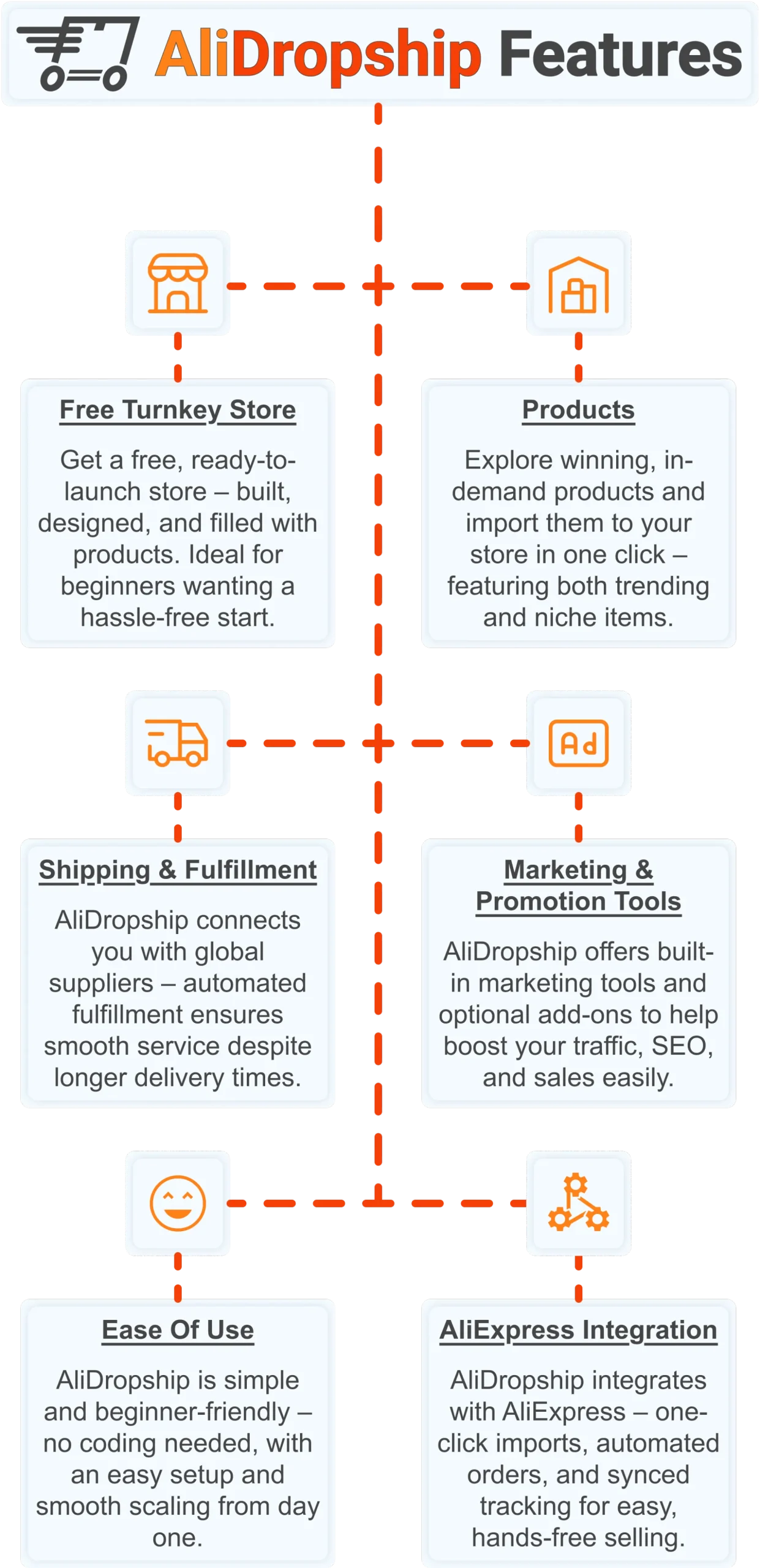
Free turnkey store ️
Get a free turnkey store – built, designed, and filled with products. Ideal for beginners wanting a hassle-free start, the store comes fully optimized to attract customers right away, saving you time on setup. Plus, it includes professional design elements to give your business a polished, trustworthy look from day one. This ready-made foundation makes it easy to move seamlessly into product selection.
Products
Once your store is set up, you can explore winning, in-demand products and import them in one click – featuring both trending and niche items. This wide selection lets you cater to diverse customer interests and test what works best. Regular updates ensure you always have fresh products, keeping your store competitive and relevant. With great products in place, smooth shipping becomes the next essential step.
Shipping & fulfillment
AliDropship connects you with global suppliers, and automated fulfillment ensures seamless order processing despite international delivery times. Customers receive real-time tracking updates, which builds confidence and trust in your store. Once shipping is handled reliably, you can focus on promoting your store and attracting traffic.
Marketing & promotion tools
To maximize sales, AliDropship offers built-in marketing tools and optional add-ons that help boost traffic, SEO, and conversions. From email campaigns and discounts to social media integration, these tools empower you to reach and retain customers without needing prior marketing experience. With promotion strategies in place, managing your business becomes simpler and more efficient.
Ease of use
AliDropship is beginner-friendly – no coding needed, with an intuitive dashboard that guides you through every step. Easy setup and smooth scaling let you expand your store without stress. As your business grows, adding new features, products, and marketing campaigns remains hassle-free, giving you more time to focus on sales.
AliExpress integration
Finally, AliDropship integrates seamlessly with AliExpress, enabling one-click imports, automated orders, and synced tracking. Your inventory stays up-to-date with the latest products and prices, while automated order processing frees you from manual tasks. Combined with the turnkey setup, reliable shipping, and built-in marketing tools, this integration ensures your dropshipping business is fully equipped for growth and success.
If you are serious about turning your interest in jewelry into a real online business, AliDropship gives you everything you need to launch without the inventory risk or technical complexity. Claim your free turnkey store today and start selling jewelry online with a $100 voucher to fuel your first steps.
 Previous post
