 ‧ Agnes Kazaryan ‧
March 13, 2026
‧ Agnes Kazaryan ‧
March 13, 2026  718 ‧
718 ‧
 0
0
Affiliate marketing is one of the most searched income models online right now – and it’s easy to see why. You don’t create a product, hold any inventory, or deal with customer support. You promote something, someone clicks your link, and when they buy, you earn a cut. That’s the whole model in a single sentence.
Quick answer: Yes, you can start affiliate marketing with no money. Free affiliate programs, free content platforms, and organic traffic mean your only real investment is time. Most beginners earn their first commission within 30–90 days of publishing content consistently.
This guide is built for people starting from zero – no existing audience, no website, and no budget for ads or paid tools. Whether you’re still figuring out what affiliate marketing actually is, or you know the basics and just want a clear action plan, you’re in the right place.
One honest note before you dive in: affiliate marketing is a long game. The people earning $2,000–$5,000 per month from it almost always started 6–12 months before those numbers showed up. Knowing that upfront helps you plan realistically – and avoid quitting right before momentum kicks in.
What is affiliate marketing?
Affiliate marketing is a performance-based earning model. You promote another company’s products or services, and every time someone makes a qualifying purchase through your unique referral link, you earn a commission. You apply to a program, get a trackable link, share it through your content, and earn when people buy.
There are four participants in how affiliate marketing works:
- The merchant – the brand or company that owns the product
- The affiliate – you, the person promoting it
- The customer – the person who clicks your link and makes a purchase
- The affiliate network – the platform connecting merchants and affiliates (Amazon Associates, ShareASale, ClickBank, and others)
In practice, affiliate marketing comes down to one thing: traffic. The more people who see your content and click your link, the more potential commissions you generate. You never handle fulfillment, returns, or customer service – your role is purely to match the right audience with the right offer.
In 2026, affiliate programs exist across virtually every category – physical products, digital downloads, software subscriptions, online courses, financial services. Some pay a flat fee per sale, others pay a percentage of the order, and some software companies pay recurring monthly commissions for as long as the referred customer stays subscribed.
Important note: Commission rates range from around 1% on certain Amazon product categories to 75% or more on digital products via platforms like ClickBank. Choosing the right program for your niche matters as much as the niche itself.
One more thing worth knowing: affiliate marketing is legal, legitimate, and used by major publishers worldwide. In the US, the FTC requires affiliates to disclose their relationship with brands whenever they promote something they could earn money from. A clear “this post contains affiliate links” notice isn’t optional – it’s a legal requirement.
How much can you realistically earn?
Income potential in affiliate marketing varies enormously depending on your niche, content method, and consistency. The figures below reflect realistic monthly earning ranges for active affiliates – not the inflated numbers you’ll find in most “passive income” content online.
These figures assume consistent output over 6–12 months. A blogger publishing twice a week will consistently outperform someone posting once a month, in virtually every niche.
One note on high-ticket affiliate marketing: High-ticket programs – those paying $500 or more per referral – can completely change the math. A single sale of a premium software subscription or online course can match an entire week of standard commission earnings. The trade-off is that high-ticket offers need more trust, deeper content, and a warmer audience before they convert consistently.
The most realistic benchmark for a beginner: expect $0–$100 in your first three months, $100–$500 by month six with consistent effort, and $500–$2,000 per month by the end of your first full year – provided you’ve chosen a viable niche and published content regularly. These aren’t guarantees; they’re what the community consistently reports as typical progression on forums like Reddit’s r/affiliatemarketing.
There’s one ceiling worth acknowledging: your affiliate income always depends on someone else’s platform, rules, and commission structures. When Amazon slashed commission rates in 2020, affiliates who had built entire income streams around those rates felt the impact immediately. Diversifying across multiple programs and traffic sources isn’t just a smart move – it’s essential.
How to start affiliate marketing with no money: step by step
You don’t need a budget to get started – but you do need a plan. These five steps cover the full process from zero to first commission, using only free tools and platforms.
Step 1: Choose a profitable niche
Your niche is the topic your content will focus on. For affiliate marketing to work, it needs two things: genuine search demand (people are actively looking for it) and available products to promote (affiliate programs exist in that space).
Strong niches in 2026 include personal finance, health and fitness, software and tech tools, home improvement, online education, and travel. Within any of these, a tighter sub-niche almost always outperforms a broad approach – “budgeting apps for freelancers” will rank faster and convert better than just “personal finance” every time.
- Pick a topic you can write or talk about for at least a year without burning out
- Confirm that affiliate programs exist in the niche before committing
- Use free tools – Google Trends, Ubersuggest, or AnswerThePublic – to validate demand
- Look for niches where buyers research before purchasing; review and comparison content performs particularly well
Earning potential: Niche selection is arguably the single biggest lever in affiliate marketing. A well-chosen niche can produce 5x the income of a poorly chosen one at identical effort levels.
Step 2: Join a free affiliate program
With a niche selected, the next step is finding programs to join. All of the options below are free to apply to and beginner-friendly – most don’t require existing traffic or an established audience to get approved.
- Amazon Associates – the largest and most accessible affiliate program in the world. Commission rates run from 1%–10% depending on category, but the sheer range of products makes it a reliable starting point for almost any niche.
- ShareASale – a large affiliate network with hundreds of merchant partners across fashion, home, finance, and more. Commission rates vary significantly by brand.
- ClickBank – specialist in digital products like ebooks, courses, and software. Commissions of 30–75% are common, making it one of the better platforms for high-ticket affiliate marketing in the digital space.
- CJ Affiliate – one of the oldest established networks, with major brand partnerships and reliable tracking.
- Impact – growing fast for SaaS and subscription products, which often pay recurring monthly commissions for the lifetime of the referred customer.
Important: Read program terms carefully before applying. Some require an active website. A free WordPress.com blog or an active YouTube channel is typically enough to qualify for most programs.
Step 3: Build a free content platform
You need somewhere to publish content and place affiliate links. Every option below costs nothing to start.
- WordPress.com blog – free to start, SEO-friendly, and gives your content a long shelf life. Ideal for product reviews, how-to guides, and comparison articles.
- YouTube channel – the second-largest search engine in the world. Video reviews, tutorials, and “best of” lists convert particularly well for affiliate commissions.
- TikTok – organic reach remains strong in 2026 for the right niches. Use your bio link strategically to direct viewers toward affiliate offers.
- Pinterest – an underrated free traffic source for lifestyle, home, food, and fashion niches. Pins have a significantly longer lifespan than standard social posts.
- Medium – a free writing platform with a built-in readership. A solid option for building initial traction while you establish a standalone blog.
The most commonly recommended starting point is YouTube or a blog, depending on whether you’re more comfortable on camera or in writing. Building an email list from day one – even a small one via Mailchimp’s free plan – gives you an audience you own regardless of algorithm changes.
Step 4: Create content that attracts buyers
Content is the engine of affiliate marketing. Without content, there are no clicks; without clicks, there are no commissions. The formats that consistently perform best for affiliate income:
- Product reviews – “Is [Product X] worth buying?” targets people already close to a purchase decision
- Comparison posts – “[Product A] vs [Product B]” captures high-intent search traffic from people evaluating their options
- Best-of lists – “Best [product category] for [use case]” performs consistently across almost every niche
- Tutorial content – how-to guides build authority and create natural opportunities to recommend products mid-article
Why this works in 2026: Search traffic converts significantly better than social traffic for affiliate marketing because people searching for product reviews are already in buying mode. A single well-ranked blog post or YouTube video on a buying-intent keyword can generate passive commission income for years after publication.
Step 5: Track results and scale what works
Once you’ve published your first 10–15 pieces of content, shift from creation mode into optimization mode. Use your affiliate dashboard and Google Search Console (both free) to identify which content is generating clicks and which keywords are driving traffic.
Double down on what’s working: publish more content in those sub-topics, deepen existing posts, and add internal links between related articles to build topical authority. As your audience grows and trust builds, introduce higher-commission programs into your mix. High-ticket affiliate marketing – with commissions of $200–$1,000+ per referral – becomes much more accessible once you’ve demonstrated credibility in your niche.
These five steps are the complete foundation for how to start affiliate marketing from zero. The process is simple – but simple is not the same as easy. Consistency over the first 6–12 months is what separates affiliates who build real income from those who quit right before momentum arrives.
Best free affiliate programs for beginners in 2026
Not every affiliate program is open to complete beginners. Some have requirements that effectively rule out people just starting out. The programs below are consistently recommended across communities like Reddit’s r/juststart and r/affiliatemarketing – they’re transparent, reliable, and free to join with no existing audience required.
Beyond these networks, direct brand programs are worth seeking out in your niche. Many software companies run in-house affiliate programs paying 20–40% recurring commissions on subscriptions – far better than what you’ll typically find through a network. These are often listed on a company’s website under a “Partners” or “Affiliates” footer link.
When evaluating any program, check three things: the commission rate, the cookie window (how long after a click a customer can still generate your commission), and the average order value. A 10% commission on a $500 product beats a 40% commission on a $10 product every time. Platforms like Teachable, Shopify, and HubSpot all pay $100–$500+ per referral – not the right starting point for day one, but worth targeting as your content authority grows.
Affiliate marketing vs dropshipping: which model fits you better?
If you’ve been exploring ways to earn money online, you’ve almost certainly come across both models. They share surface-level similarities – both can be started without a product of your own, both can be run from anywhere – but they work very differently and produce fundamentally different outcomes.
The core distinction is ownership. With affiliate marketing, you earn a commission on someone else’s sale. With dropshipping, you run your own store, set your own prices, and keep the margin after supplier costs.
Here’s how the two models compare across the metrics that matter most to beginners:
- Startup cost: Both can be started with minimal investment. Dropshipping requires a small budget for store setup; affiliate marketing can genuinely start at zero.
- Control over pricing: None with affiliate marketing – the merchant sets everything. Full control with dropshipping.
- Earning per sale: Affiliate marketing typically pays 3–50% of the product price. Dropshipping margins of 20–60% on your own pricing are achievable with the right products.
- Dependence risk: High with affiliate marketing – programs can cut commissions or shut down at any time. Lower with dropshipping, since you own the store and the customer relationship.
- Business asset value: An affiliate income stream is tied to you and your content personally. A dropshipping store is a sellable business asset that can appreciate over time.
Neither model is universally better. Affiliate marketing suits people who want to start with zero investment and are comfortable building an audience first. Dropshipping suits people who want to build and own something – a brand, a customer list, a business that grows independently of any external program’s decisions.
The two models aren’t mutually exclusive, either. Many experienced online earners start with affiliate marketing to understand traffic and content, then move into dropshipping once they know what their audience actually buys. The clearest signal you’re ready to make that move: you’ve identified a product category your audience consistently buys through your links, and you realize you could sell those products yourself at a higher margin, under your own brand.
Legal and ethical considerations
Affiliate marketing is legitimate – but it comes with real legal obligations and a few grey areas worth knowing about before you start.
Key principle: Disclose your affiliate relationships clearly, every time, from your very first link. The FTC requires it in the US, and equivalent regulations apply in the EU, UK, and Australia. A single sentence at the top of each post or in your video description is enough. Skipping this isn’t just a legal risk – it erodes the audience trust that affiliate marketing depends on.
Beyond disclosure, a few things to avoid absolutely:
- Fake reviews: Publishing positive reviews for products you haven’t personally tested, or that you have no genuine opinion on, is both unethical and increasingly penalized by search engines. Google’s helpful content updates have specifically targeted thin, opinion-free review content.
- Cookie stuffing: Artificially placing affiliate cookies on users’ browsers without a legitimate click is fraud. Programs terminate affiliates for this and it can result in legal action.
- Misleading income claims: Promoting programs by exaggerating what a typical person earns – particularly in make-money-online niches – can violate FTC guidelines and damage your audience relationship long-term.
- Spamming affiliate links: Posting affiliate links unsolicited in forums, comment sections, or social groups without value-adding context violates most platform terms of service and gets accounts banned.
What to do instead: write honest reviews of products you genuinely know, disclose your affiliate relationships upfront, and let the quality of your content do the selling. Audiences are good at detecting inauthenticity – and programs are increasingly good at detecting abuse.
How to choose your approach: recommendations by experience level
The right path through affiliate marketing – and how quickly you move into adjacent models like dropshipping – depends on where you’re starting from.
Complete beginners
If you’re starting from zero with no existing audience or platform: pick one niche, join one or two beginner-friendly programs (Amazon Associates and one network like ShareASale), and commit to a single free content platform for at least 90 days before evaluating results. YouTube and blogging are the two most reliable starting points for affiliate marketing for beginners. Don’t try to be active everywhere at once – depth on one channel beats thin presence across five, consistently. Your first goal isn’t $1,000 per month; it’s your first commission. Proof of concept comes before scale.
Intermediate / part-time earners
If you’ve already published content and earned some commissions but haven’t broken $500 per month consistently: shift focus to audience-building and program diversification. Start capturing email addresses from day one – Mailchimp is free up to 500 subscribers. Explore two or three traffic sources instead of one. Add a high-ticket affiliate program to your stack once your audience trust is established. Even one or two high-ticket conversions per month can significantly change your monthly income total without requiring more content volume.
Advanced / full-time goal
If your goal is full-time income – $3,000–$10,000+ per month – affiliate marketing alone is achievable but typically requires 18–36 months of consistent effort, diversified traffic, and often a small team of writers or editors. At this level, the ceiling becomes more visible: your income is still dependent on external programs and their terms. Many advanced earners at this stage begin building their own products or stores to own a greater share of the value they’re creating. The natural next step is a dropshipping store – an asset you control, price, and can eventually sell.
AliDropship: Your complete all-in-one solution for starting dropshipping in 2026
If you want the simplest possible way to start dropshipping – especially if you’re brand new – AliDropship remains one of the most beginner-friendly tools available in 2026. It brings together store creation, product imports, automation, and marketing into a single streamlined system designed to help you launch quickly and grow confidently.
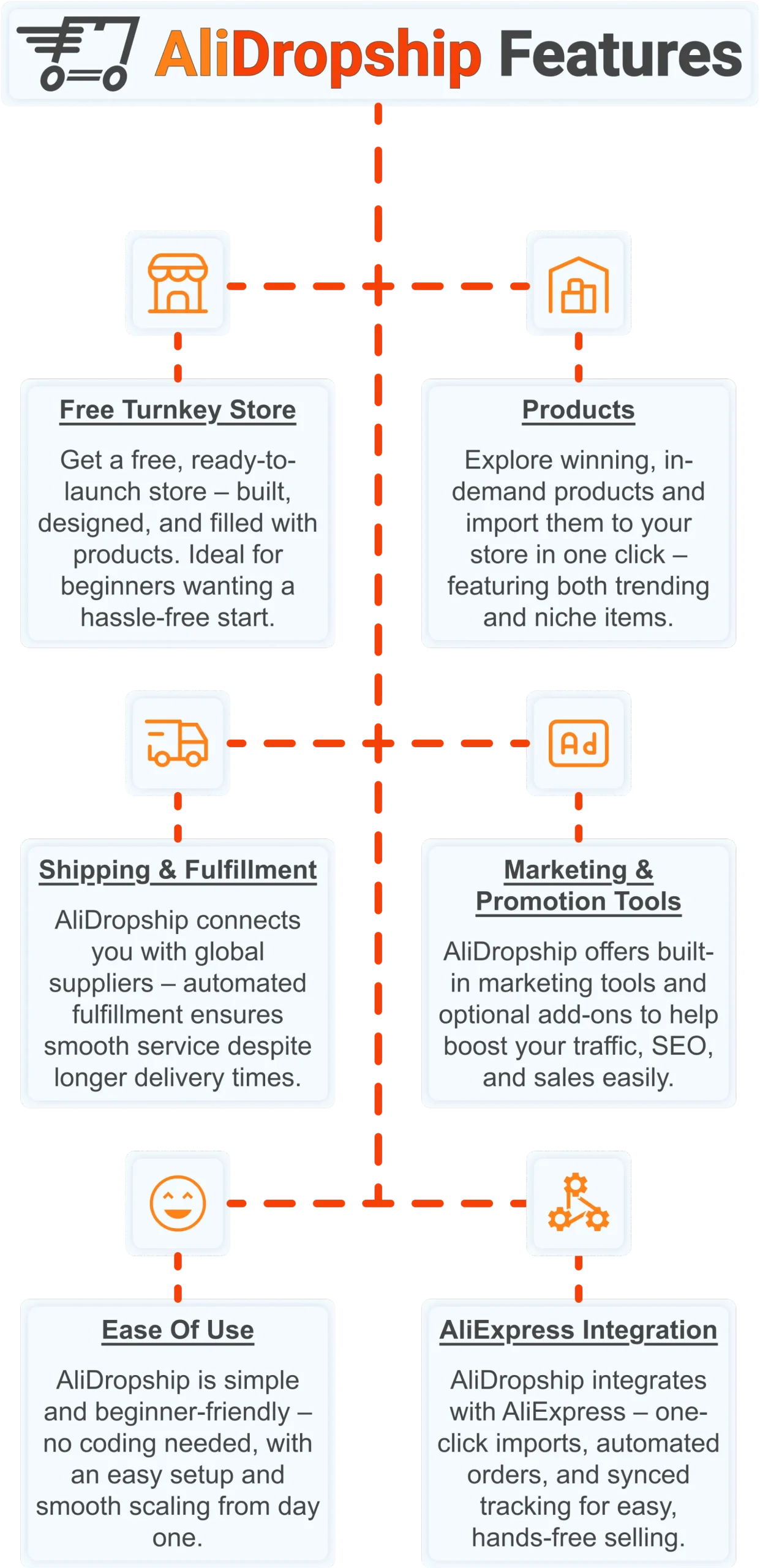
Free turnkey store ️
Get a free turnkey store – built, designed, and filled with products. Ideal for beginners wanting a hassle-free start, the store comes fully optimized to attract customers right away, saving you time on setup. Plus, it includes professional design elements to give your business a polished, trustworthy look from day one. This ready-made foundation makes it easy to move seamlessly into product selection.
Products
Once your store is set up, you can explore winning, in-demand products and import them in one click – featuring both trending and niche items. This wide selection lets you cater to diverse customer interests and test what works best. Regular updates ensure you always have fresh products, keeping your store competitive and relevant. With great products in place, smooth shipping becomes the next essential step.
Shipping & fulfillment
AliDropship connects you with global suppliers, and automated fulfillment ensures seamless order processing despite international delivery times. Customers receive real-time tracking updates, which builds confidence and trust in your store. Once shipping is handled reliably, you can focus on promoting your store and attracting traffic.
Marketing & promotion tools
To maximize sales, AliDropship offers built-in marketing tools and optional add-ons that help boost traffic, SEO, and conversions. From email campaigns and discounts to social media integration, these tools empower you to reach and retain customers without needing prior marketing experience. With promotion strategies in place, managing your business becomes simpler and more efficient.
Ease of use
AliDropship is beginner-friendly – no coding needed, with an intuitive dashboard that guides you through every step. Easy setup and smooth scaling let you expand your store without stress. As your business grows, adding new features, products, and marketing campaigns remains hassle-free, giving you more time to focus on sales.
AliExpress integration
Finally, AliDropship integrates seamlessly with AliExpress, enabling one-click imports, automated orders, and synced tracking. Your inventory stays up-to-date with the latest products and prices, while automated order processing frees you from manual tasks. Combined with the turnkey setup, reliable shipping, and built-in marketing tools, this integration ensures your dropshipping business is fully equipped for growth and success.
Frequently Asked Questions
Can you really start affiliate marketing with no money?
Yes, you can start affiliate marketing with no money by using free affiliate programs, free content platforms, and organic traffic instead of paid tools. Most beginners earn their first commission within 30 to 90 days of publishing content consistently. Free platforms like a WordPress.com blog, YouTube, TikTok, and Pinterest all cost nothing to start and can host affiliate links. Your only real investment in this model is time rather than upfront capital.
How much can beginners realistically earn from affiliate marketing?
A realistic benchmark for a beginner is 0 to 100 dollars in the first 3 months, growing to 100 to 500 dollars by month 6 with consistent effort. By the end of the first full year, many affiliates reach 500 to 2000 dollars per month if they have chosen a viable niche and published content regularly. Blogging or SEO content typically earns 200 to 2000 dollars per month, while a YouTube channel can reach 300 to 5000 dollars per month. High-ticket programs paying 500 dollars or more per referral can significantly change these numbers with fewer total sales.
What are the best free affiliate programs for beginners in 2026?
Amazon Associates is the largest and most accessible affiliate program, with commission rates running from 1 to 10 percent depending on category. ClickBank specializes in digital products like ebooks and courses, with commissions of 30 to 75 percent per sale, making it strong for high-ticket promotion. ShareASale offers commission rates that vary widely by merchant, typically 5 to 40 percent, across fashion, home, and finance categories. Impact is growing quickly for SaaS products, often paying 10 to 40 percent in recurring monthly commissions.
How is affiliate marketing different from dropshipping?
With affiliate marketing you earn a commission on someone elses sale, typically 3 to 50 percent of the product price, while the merchant controls all pricing. With dropshipping you run your own store, set your own prices, and can achieve margins of 20 to 60 percent on your own pricing. Affiliate marketing carries higher dependence risk since programs can cut commissions or shut down at any time, while a dropshipping store is a sellable business asset you fully control. Many online earners start with affiliate marketing to learn about traffic and content, then move into dropshipping once they understand what their audience buys.
What legal rules apply to affiliate marketing disclosures?
The FTC requires affiliates in the US to disclose their relationship with brands whenever they promote something they could earn money from, and equivalent regulations apply in the EU, UK, and Australia. A single clear sentence at the top of a post or in a video description is generally enough to meet this requirement. Publishing fake reviews for products never personally tested is both unethical and increasingly penalized by search engines. Cookie stuffing, or placing affiliate cookies without a legitimate click, is considered fraud and can lead to program termination or legal action.
If this guide has shown you that online income is genuinely within reach, dropshipping with AliDropship takes that potential to a completely different level – with a store you own, a brand you control, and earnings that scale with your effort. Get your free turnkey store today and start building an ecommerce business that is entirely yours.
 Previous post
