 ‧ Agnes Kazaryan ‧
March 14, 2026
‧ Agnes Kazaryan ‧
March 14, 2026  551 ‧
551 ‧
 0
0
Starting an online business in 2026 is more accessible than at any point in history. The tools are better, the entry costs are lower, and the global customer base has never been larger. But accessible does not mean automatic.
What separates people who actually earn money online from those who spend six months “planning to launch” usually comes down to one thing: a clear, step-by-step path they actually follow.
Quick answer: To start an online business, you need a viable product or service, a domain name, a hosted store, a payment processor, and a basic traffic strategy. Most people can have a functional store live within a week. Generating consistent revenue typically takes 60–90 days of focused effort.
This guide walks you through every stage – from deciding what to sell and how to set up an online store, to choosing a domain name, building traffic through SEO, and scaling toward a real income. Whether you are starting from scratch or have tried before and stalled, this is the practical breakdown you need.
What is an online business and why 2026 is a good time to start
An online business is any commercial venture that operates primarily over the internet – selling physical products, digital goods, services, or a combination of all three. The defining advantage over a traditional brick-and-mortar business is that your overhead is dramatically lower: no lease, no in-store staff, and no geographic ceiling on who can buy from you.
Global ecommerce revenue is forecast to exceed $6.9 trillion in 2026, driven by continued growth in mobile shopping, cross-border purchasing, and rising consumer comfort with buying from independent online brands.
Meanwhile, the infrastructure to run a store – hosting, payment processing, inventory sourcing, marketing automation – has consolidated into tools that a single person can operate from a laptop at home.
If you have been wondering how to start a business from home, the realistic answer is that you can build a functioning ecommerce operation with a few hundred dollars and a few weeks of focused work. The challenge is not access – it is knowing which steps to take in which order, and avoiding the detours that waste time and money.
How much can you realistically earn from an online business
This is the question everyone asks first and too few sources answer honestly. The range is genuinely wide – from a few hundred dollars a month in supplemental income to a full-time six-figure operation – and the difference almost always comes down to the model you choose, the effort you put in during the first 90 days, and how consistently you show up after that.
Here is a realistic breakdown by business model:
Dropshipping consistently sits at the top of this list for new entrepreneurs because startup cost is low, there is no inventory to manage, and the income ceiling scales with your marketing rather than your hours. A well-run dropshipping store doing $30–$80 per day in profit is a realistic 90-day goal for someone who follows a proven system.
One note on the ceiling figures: The upper ranges in the table above reflect established stores with traffic. In your first 60 days, expect to invest in setup and learning rather than collecting a salary. Treat months one and two as the cost of building a real asset.
Step 1: Choose your business model and niche
Before you register a domain or install a single plugin, you need to decide what you are selling and to whom. This decision shapes everything downstream: your platform, your supplier relationships, your pricing, and your marketing angle.
Dropshipping
Dropshipping is the most beginner-friendly model for how to start a business from home with minimal capital. You list products in your store, customers purchase them, and your supplier ships directly to the buyer. You never handle inventory. Your profit is the margin between your retail price and the supplier cost.
The key advantage is speed – you can launch a fully stocked store within days. The key challenge is differentiation, because anyone can sell the same products. Your store needs a clear niche, a polished brand, and consistent marketing to stand out. Strong niches in 2026 include home organization, pet accessories, fitness gear, and sustainable lifestyle products.
Earning potential: $500–$5,000+ per month with consistent marketing and a defined niche.
Freelance services
If you have a marketable skill – writing, design, web development, social media management, video editing – you can sell it directly to businesses or individuals online. Platforms like Upwork, Fiverr, and Toptal give you immediate access to buyers. The income ramp is faster than content-based models, but your earnings are fundamentally capped by your available hours.
Earning potential: $25–$150 per hour depending on skill and platform. Full-time equivalent: $2,000–$5,000 per month with consistent client flow.
Affiliate marketing
You promote other companies’ products through content – blog posts, YouTube videos, social media – and earn a commission on every sale made through your unique link. It requires no product creation and no customer service, but it depends entirely on building an audience first, which takes 6–18 months for most people. Commission rates range from 3% on Amazon Associates to 50%+ on software and digital products.
Earning potential: $200–$3,000 per month once content is established and driving consistent traffic. Expect a 6–12 month ramp.
Digital products
Ebooks, templates, Notion dashboards, Lightroom presets, online courses – digital products are created once and sold indefinitely with no fulfillment cost. Margins are extremely high, often 90%+, but creating something people will actually pay for requires real expertise and market research. Distribution platforms like Gumroad and Etsy Digital lower the barrier to getting started.
Earning potential: $300–$2,500 per month once the product library is built and driving consistent traffic. Expect 3–6 months before meaningful revenue.
Step 2: How to choose a domain name
Your domain name is your business address on the internet. Choosing it well is a small decision with a surprisingly large long-term impact – on brand perception, SEO, and how easily customers remember you.
Keep it short and memorable
Aim for 6–14 characters if possible. Shorter domains are easier to type, easier to say aloud, and far less likely to be misspelled. Avoid hyphens, numbers, or unusual spellings. “ShopPetPals.com” is better than “the-best-pet-accessories-store-2026.com” in every measurable way.
Match it to your niche, not your product list
Choose a name that reflects the broader category you are in rather than a single product. If your dropshipping store sells home organization products, “NeatNestHome.com” gives you room to expand into related categories. “FoldableStorageBoxes.com” locks you into one product type and signals nothing about brand identity.
Use .com where possible
Despite the proliferation of new TLDs like .shop, .store, and .co, the .com extension still carries the most default trust with consumers. If the .com version of your preferred name is taken and the acquisition price is unreasonable, your next best options are .co or country-specific TLDs if you are targeting a local market.
Check trademarks before you register
Before finalizing a name, run a quick trademark search through your country’s intellectual property office – in the US that is USPTO.gov. Registering a domain that infringes on an existing trademark can result in legal action and forced domain transfer. That is entirely avoidable with five minutes of research.
Important note: Domain registration typically costs $10–$15 per year through registrars like Namecheap, Google Domains, or GoDaddy. Do not pay premium prices for a domain unless you have strong evidence the brand equity is worth it.
Step 3: How to set up an online store
Once you have a niche and a domain name, the next question is how to create your own online store. The platform you choose determines your flexibility, your costs, and your ceiling for growth. Here is how the main options compare.
Shopify
Shopify is the dominant hosted ecommerce platform. It handles hosting, security, payment processing, and checkout flow out of the box. You design your store using a drag-and-drop editor, add products from your supplier, and configure shipping rules.
Plans start at $39 per month. The ecosystem of apps and integrations is the largest in the industry, which matters when you want to add reviews, upsells, email automation, or dropshipping supplier connections.
WooCommerce (WordPress)
WooCommerce is a free plugin that turns a WordPress site into a fully functional online store. It offers more customization than Shopify but requires more technical management – you are responsible for your own hosting, security, and plugin compatibility.
It is the right choice if you want deep control over your site structure, which matters for SEO at scale. Hosting costs run $5–$30 per month depending on your provider and traffic volume.
AliDropship (WordPress + dropshipping combined)
AliDropship builds your store on WordPress with dropshipping automation built directly in. Unlike Shopify, there are no monthly platform fees – you pay once for the plugin or receive a turnkey store built for you. This is the most cost-effective long-term setup for dropshipping specifically, and the turnkey option means the store is designed, stocked, and ready to market before you touch it.
Etsy and Amazon
Marketplace platforms like Etsy and Amazon give you access to built-in traffic, which is a genuine advantage in the early stages. The trade-off is that you do not own the customer relationship, margins are compressed by platform fees (6.5% on Etsy, 8–15% on Amazon depending on category), and you are subject to platform rule changes without notice.
Many successful sellers use marketplaces to validate products and then reinvest into an independent store.
Step 4: Payments, legal structure, and operations
A store with no payment processor is just a website. Before you drive a single visitor, you need to make sure money can actually flow through your business – and that it flows legally.
Payment processors
Stripe and PayPal are the two most widely used payment gateways for independent stores. Stripe processes credit and debit cards with a 2.9% + $0.30 transaction fee and integrates cleanly with Shopify, WooCommerce, and most other platforms. PayPal adds buyer trust and is preferred by a significant portion of shoppers, particularly internationally.
Offering both from day one removes a common checkout abandonment trigger.
Business registration
In most jurisdictions, you are legally required to register your business once it begins generating revenue. In the US, an LLC is the standard choice for small ecommerce operations. It costs $50–$500 to register depending on your state, separates your personal finances from your business liabilities, and makes tax filing significantly more straightforward.
Services like Northwest Registered Agent or ZenBusiness make the process fast and affordable.
Business bank account and accounting
Open a dedicated business bank account as soon as your LLC is registered. Mixing personal and business finances is one of the most common mistakes new entrepreneurs make – and one of the most costly when tax season arrives. Tools like Wave (free) or QuickBooks ($30 per month) handle bookkeeping and connect directly to your payment processors to automate transaction categorization.
How to get traffic to your online store
Having a store live on the internet is not the same as having a store that people visit. Traffic is the variable that determines everything – without it, even a perfectly designed store earns nothing. Here is how to build a traffic engine from the ground up.
How to improve SEO for your online store
Search engine optimization is the process of making your store rank higher in Google for relevant queries. Organic search visitors convert at 2–4x the rate of social media visitors, and unlike paid ads, the traffic does not stop when your budget runs out.
Start with keyword research. Free tools like Google Keyword Planner and Ubersuggest show you monthly search volumes and competition levels. For a dropshipping store, focus on product-intent keywords – “best minimalist wallet for men” or “foldable laundry hamper for small apartments” – rather than broad category terms. These have lower competition and attract buyers further along in the purchase decision.
Every product and category page should have a unique title tag of 50–60 characters, a meta description of 140–160 characters, and a URL slug that includes the target keyword. Product descriptions should be original – never copy the supplier’s text, which is duplicated across hundreds of other stores and actively hurts your rankings.
Write 150–300 words of original copy per product that describes the item, its use cases, and who it is for.
Your store also needs to load fast (under 3 seconds), be mobile-responsive, and use HTTPS. Install Google Search Console on day one to monitor crawl errors, index coverage, and search performance data. Submit your XML sitemap through Search Console to speed up indexing of new pages.
Why this works in 2026: Google’s ranking signals continue to reward original, helpful content. Stores with well-written product descriptions and a blog consistently outrank copy-paste competitors within 3–6 months.
Content marketing
A blog attached to your store is one of the most powerful long-term SEO tools available to ecommerce businesses. Publish 1–2 articles per week targeting informational keywords related to your niche – buying guides, roundups, how-to posts.
Each article builds topical authority, earns backlinks over time, and brings in readers who are researching before they buy. This is a 6–12 month investment, but the compounding effect is significant.
Paid traffic: getting early momentum
SEO builds durable long-term traffic but takes time. Paid advertising – specifically Meta Ads (Facebook and Instagram) and Google Shopping – can generate sales within days of launching. Start with a modest test budget of $10–$20 per day, run 2–3 ad variations, and let data guide which creatives and audiences to scale.
A common benchmark for beginner paid campaigns is a 1.5–2.5x return on ad spend in the first 30 days, with improvements as you optimize.
Email marketing
Email consistently delivers the highest ROI of any digital marketing channel – around $36 for every $1 spent according to industry benchmarks. From day one, your store should collect email addresses through a pop-up offering a discount or early access to new products.
Tools like Klaviyo and Mailchimp handle automated sequences: welcome series, abandoned cart recovery, post-purchase follow-up, and re-engagement campaigns. A list of 1,000 engaged subscribers can be worth $500–$2,000 per month in revenue.
Social media and organic content
Organic social media is not a reliable primary traffic source, but it serves an important secondary function: building brand trust. When a potential customer sees your ad and checks your Instagram profile, what they find there either reinforces or undermines their buying decision.
Aim for a consistent presence on one or two platforms – Instagram and TikTok work well for product-based businesses – posting 3–5 times per week with a mix of product content, behind-the-scenes material, and user-generated content.
Legal and ethical considerations for your online business
A sustainable online business is a legal one. The ecommerce space has more grey-area temptations than most – fake reviews, misleading ads, counterfeit products – and the consequences of crossing those lines range from account bans to legal action.
What to avoid absolutely
Do not purchase fake reviews on Amazon, Etsy, Google, or Trustpilot. Review manipulation violates every major platform’s terms of service, and the penalties range from listing removal to permanent account suspension.
The FTC in the US can also issue fines for undisclosed paid endorsements. Similarly, avoid sourcing branded or counterfeit products through AliExpress – selling items that infringe on trademarks exposes you to IP claims and store shutdown.
Key principle: If you would not want the practice described in a news article about your business, do not do it.
What to do instead
Earn reviews by delivering a genuinely good customer experience – fast response times, accurate product descriptions, honest shipping estimates, and proactive communication when something goes wrong.
Follow up with customers post-purchase via email and make it easy to leave a review. Authentic reviews from real buyers convert better than manufactured ones because they include specific details that answer other shoppers’ questions.
For advertising, follow FTC disclosure guidelines – label all sponsored content clearly and never make earnings or weight loss claims you cannot back up with evidence. Your store’s legal pages (Privacy Policy, Terms of Service, Refund Policy) should be real and accessible, not templates you copied without reading.
How to choose your path: Recommendations by reader profile
Not everyone reading this guide is in the same situation. Here is a direct recommendation based on where you are starting from.
Complete beginner
If you have never sold anything online, your priority is getting a real store live as fast as possible – not consuming more content about it. Choose dropshipping with a turnkey solution that handles setup for you.
Your first 30 days should be focused entirely on learning your platform, placing test orders, and running your first paid ads. Do not try to simultaneously start a blog, build a social following, and learn SEO. Pick one traffic channel and commit to it.
Intermediate – currently earning but stuck
If you are already making some money online – whether through freelancing, affiliate marketing, or a part-time store – the lever to pull is systemization.
What tasks are you doing manually that a tool or virtual assistant could handle? Where is your traffic coming from, and are you capturing email addresses from every visitor?
If you are not running any email automation, adding a welcome sequence and abandoned cart flow alone can increase revenue by 15–30% within 30 days.
Advanced – building toward full-time income
If your goal is to replace a full-time income through ecommerce, the path runs through product-market fit, brand differentiation, and multi-channel distribution. A store doing $30–$80 per day in profit is already a $10,000–$29,000 annual business.
Scaling beyond that requires moving from a general product catalog to a focused brand, investing in content that builds organic traffic, and potentially developing private-label products as you identify what your audience consistently buys. Global ecommerce is growing at roughly 10–12% per year – the market is not saturated, it is expanding.
AliDropship: Your complete all-in-one solution for starting dropshipping in 2026
If you want the simplest possible way to start dropshipping – especially if you’re brand new – AliDropship remains one of the most beginner-friendly tools available in 2026. It brings together store creation, product imports, automation, and marketing into a single streamlined system designed to help you launch quickly and grow confidently.
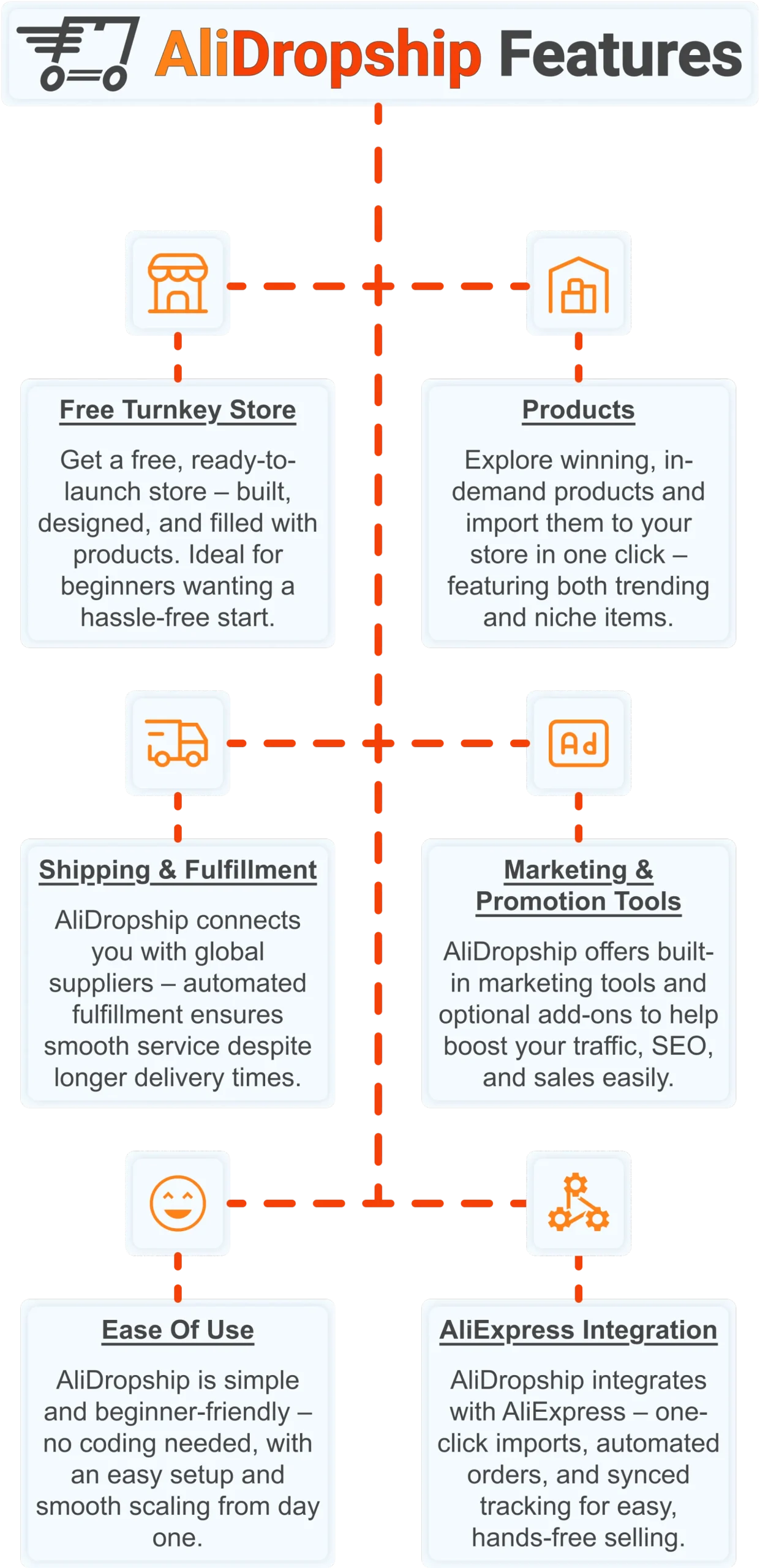
Free turnkey store ️
Get a free turnkey store – built, designed, and filled with products. Ideal for beginners wanting a hassle-free start, the store comes fully optimized to attract customers right away, saving you time on setup. Plus, it includes professional design elements to give your business a polished, trustworthy look from day one. This ready-made foundation makes it easy to move seamlessly into product selection.
Products
Once your store is set up, you can explore winning, in-demand products and import them in one click – featuring both trending and niche items. This wide selection lets you cater to diverse customer interests and test what works best. Regular updates ensure you always have fresh products, keeping your store competitive and relevant. With great products in place, smooth shipping becomes the next essential step.
Shipping & fulfillment
AliDropship connects you with global suppliers, and automated fulfillment ensures seamless order processing despite international delivery times. Customers receive real-time tracking updates, which builds confidence and trust in your store. Once shipping is handled reliably, you can focus on promoting your store and attracting traffic.
Marketing & promotion tools
To maximize sales, AliDropship offers built-in marketing tools and optional add-ons that help boost traffic, SEO, and conversions. From email campaigns and discounts to social media integration, these tools empower you to reach and retain customers without needing prior marketing experience. With promotion strategies in place, managing your business becomes simpler and more efficient.
Ease of use
AliDropship is beginner-friendly – no coding needed, with an intuitive dashboard that guides you through every step. Easy setup and smooth scaling let you expand your store without stress. As your business grows, adding new features, products, and marketing campaigns remains hassle-free, giving you more time to focus on sales.
AliExpress integration
Finally, AliDropship integrates seamlessly with AliExpress, enabling one-click imports, automated orders, and synced tracking. Your inventory stays up-to-date with the latest products and prices, while automated order processing frees you from manual tasks.
Combined with the turnkey setup, reliable shipping, and built-in marketing tools, this integration ensures your dropshipping business is fully equipped for growth and success.
Frequently Asked Questions
How much does it cost to start an online business?
You can build a functioning ecommerce operation with a few hundred dollars and a few weeks of focused work in most cases. Domain registration typically runs 10 to 15 per year through registrars like Namecheap or GoDaddy, and Shopify plans start at 39 per month. WooCommerce hosting costs 5 to 30 per month depending on your provider and traffic volume, while AliDropship charges no ongoing platform fee. Registering a US LLC adds another 50 to 500 depending on your state.
How long does it take to start an online business and see results?
Most people can have a functional store live within a week of deciding to start. Generating consistent revenue typically takes 60 to 90 days of focused effort once the store is set up. A well run dropshipping store doing 30 to 80 per day in profit is considered a realistic 90 day goal for someone following a proven system. The first 60 days are generally treated as setup and learning rather than a period for collecting steady income.
What business model is best for starting an online business from home?
Dropshipping is consistently ranked as the most beginner friendly online business model since startup cost is low and there is no inventory to manage. It can generate 500 to 5000 dollars or more per month with consistent marketing and a defined niche. Freelance services offer faster income at 25 to 150 per hour but are capped by available hours. Affiliate marketing and digital products both take 3 to 18 months to ramp up since they depend on building an audience first.
Which platform should you use to start an online business?
Shopify, WooCommerce, and AliDropship are the three most common platforms for starting an online business in 2026. Shopify plans start at 39 per month and include the largest app ecosystem for extras like reviews and email automation. WooCommerce is a free WordPress plugin but requires 5 to 30 per month in hosting and more technical management. AliDropship combines WordPress with built in dropshipping automation and charges no ongoing monthly platform fee.
How do you get traffic to a new online business?
Traffic for a new online business typically comes from a mix of SEO, paid ads, email marketing, and social media rather than one single channel. Organic search visitors convert at 2 to 4 times the rate of social media visitors, making SEO a strong long term investment. Paid ads through Meta and Google Shopping can generate sales within days using a test budget of 10 to 20 dollars per day. Email marketing delivers roughly 36 dollars in return for every 1 dollar spent, making it one of the highest ROI channels available.
If you are serious about learning how to start an online business without the technical overwhelm, AliDropship gives you a fully built store, proven products, and the automation to run it all from day one. Claim your free turnkey store and start building your ecommerce income today.
 Previous post
