 ‧ Agnes Kazaryan ‧
March 20, 2026
‧ Agnes Kazaryan ‧
March 20, 2026  522 ‧
522 ‧
 0
0
You built the store. You added the products. And then nothing happened. No traffic, no sales, no sign that anyone even knows your store exists. Sound familiar? The hard truth is that launching an ecommerce store is the easy part. Getting people to find it, trust it, and buy from it is where most new store owners get completely stuck. That is exactly where marketing for ecommerce comes in.
Quick answer: Marketing for ecommerce is the process of driving targeted traffic to an online store and converting that traffic into paying customers. It spans multiple channels – SEO, social media, email, paid advertising, and content – and works best when these channels support each other as part of a unified strategy.
The good news? You do not need a massive budget or a full marketing team to make this work. You need a clear plan, the right channels for your niche, and the consistency to see it through. This guide walks you through every major ecommerce marketing channel and explains exactly how to use each one in 2026.
Before diving into tactics, it is worth understanding what makes marketing for ecommerce different from general digital marketing – and why the stakes have never been higher for getting it right.
What is marketing for ecommerce?
Ecommerce marketing covers everything you do to attract, engage, and retain customers for an online store. Unlike brick-and-mortar retail – where foot traffic and window displays do a lot of the heavy lifting – an online store lives or dies by its digital visibility. If people cannot find your store in search results, on social feeds, or through a recommendation, they simply do not know it exists.
In 2026, the ecommerce marketing landscape is more competitive than ever – but also more accessible. Organic search alone drives 43% of all ecommerce traffic, making it the single largest acquisition channel available. That is more than paid ads, social media, email, and direct visits combined. At the same time, social commerce, AI-powered personalization, and short-form video have created entirely new ways to reach buyers who have never heard of your brand before.
Effective marketing for ecommerce works across three stages of the customer journey. First, awareness – getting in front of people who match your target buyer profile. Then consideration – giving them enough information and trust signals to choose you over a competitor. Finally, conversion – removing friction and making it easy to complete a purchase. Most ecommerce marketing failures happen because a store is focused on only one of these stages while ignoring the others.
How much can you realistically earn from an ecommerce store?
Before getting into tactics, it is worth anchoring your expectations with honest numbers. Ecommerce income varies based on niche, effort, traffic, and conversion rate – but the table below gives a realistic picture of what different levels of commitment actually produce.
These ranges apply to well-chosen niches with consistent marketing effort. Most stores begin generating their first meaningful revenue somewhere between 60 and 90 days after launch – provided they are actively building traffic from day one.
One note on the upper figures: Reaching $10,000+ per month requires sustained multi-channel effort, a proven product selection, and typically some ad spend once the organic foundation is established. These numbers are achievable – but they reflect stores that treat ecommerce as a real business, not a passive side project.
SEO: the backbone of long-term ecommerce marketing
Search engine optimization is the highest-ROI channel available to independent store owners – and it is not particularly close. Studies put SEO’s return at over 317% with a typical break-even period of around 9 months. Once your pages rank, that traffic is essentially free and compounds over time. Paid ads stop the moment you cut the budget. SEO does not.
Keyword research for ecommerce
Every effective SEO strategy starts with understanding what your potential customers are actually searching for. For ecommerce, that means targeting three types of keywords. Informational keywords (such as “best products to sell online in 2026”) pull in readers at the research stage. Commercial keywords (such as “buy wireless earbuds under $50”) attract buyers who are already close to a decision. Navigational keywords bring back existing customers who already know your brand.
Long-tail keywords deserve special attention. They account for over 91% of all web searches and convert at 2.5x the rate of broad head terms. For a new or small store, targeting long-tail phrases with clear buying intent – rather than trying to compete for massive head terms – is the fastest path to meaningful traffic.
Free tools like Google Search Console, Google Trends, and AnswerThePublic give you a solid starting point. Paid tools like Ahrefs and Semrush let you analyze competitor rankings and identify keyword gaps you can move into.
On-page SEO for product and category pages
Once you have your keywords, the work is placing them naturally in the right locations. For product pages, that means your title tag, meta description, H1, product description, image alt text, and URL slug. For category pages – which often drive more traffic than individual product pages – it means adding a short introductory paragraph with your target keyword and a clear, crawlable link structure to the products below.
Internal linking is one of the most overlooked on-page tactics in ecommerce. When you connect related blog posts to product pages and category pages to individual listings, you pass authority through your site and help search engines understand its structure. A blog post about “best home office gadgets” linking to your gadgets category page is a simple example – but done consistently across dozens of posts, the compound effect is significant.
Technical SEO basics
Technical SEO sounds intimidating, but for most ecommerce stores it comes down to a short checklist. Make sure your store loads quickly on mobile – 75% of ecommerce traffic now comes from mobile devices and Google weights mobile page speed heavily in its rankings. Use HTTPS across every page. Avoid duplicate content issues caused by faceted navigation or product variants by using canonical tags where needed. Submit a sitemap to Google Search Console and check it regularly for crawl errors.
Content marketing and blog SEO
A blog is the most powerful long-term traffic engine available to an ecommerce store. By creating genuinely helpful articles around topics your target audience is already searching for, you attract visitors at the research stage – before they are ready to buy – and build the kind of trust that converts them later. Brands like Ruggable have used this approach to generate over a million monthly organic visitors, outperforming their paid traffic by a ratio of 10 to 1.
The key is matching your content to actual search intent. If someone searches “how to set up a home office on a budget,” they want practical advice – not a product listing. Give them the advice, reference your relevant products naturally within the content, and let the relationship develop from there.
Why this works in 2026: Search engines increasingly reward content that comprehensively answers a searcher’s question. Long-form, genuinely useful articles rank higher and stay ranked longer than thin product-page content – and they build the topical authority that lifts your entire domain over time.
Social media marketing for ecommerce
Social media is where brand discovery happens in 2026. Platforms like TikTok, Instagram, and Pinterest have effectively become product search engines for millions of buyers – especially in fashion, beauty, home decor, and lifestyle categories. Done right, social media ecommerce marketing builds a community around your brand while driving consistent traffic back to your store.
Choosing the right platform for your store
Not every platform makes sense for every store. The goal is to be active where your target buyers actually spend time – not to spread yourself thin across every channel at once.
Instagram remains the strongest platform for visual product categories – fashion, accessories, beauty, food, and home goods. Its shopping features, including shoppable posts and the Instagram Shop tab, allow users to move from discovery to purchase without leaving the app. Reels get significantly more organic reach than static posts, so short video content should be the priority.
TikTok
TikTok is the fastest-growing ecommerce marketing channel right now. The TikTok Shop feature lets you embed product links directly inside videos, and the platform’s algorithm rewards content quality over follower count – meaning a brand new account with a genuinely interesting video can reach hundreds of thousands of people. Niches that perform especially well include gadgets, kitchen tools, beauty, and anything that shows a visible transformation or result.
Pinterest functions more like a visual search engine than a social network. Users come to the platform with genuine purchase intent – they are actively looking for ideas, inspiration, and products. For stores in home decor, DIY, fashion, recipes, and wellness, Pinterest is consistently one of the highest-converting traffic sources available. A well-optimized pin can also drive traffic for years, which is something an Instagram post simply cannot do.
Facebook’s organic reach for brand pages has declined, but its paid advertising platform remains the most powerful audience-targeting tool in ecommerce. Facebook groups also offer genuine community-building potential for niche stores – particularly in hobbyist, pet, fitness, and collector categories where buyers have strong shared identities.
Organic social content that actually drives traffic
The stores that grow on social media are not the ones posting the most – they are the ones posting most consistently and most relevantly. A content calendar with 3–5 posts per week beats sporadic posting every time. Mix product showcases with educational content, behind-the-scenes posts, customer testimonials, and trending audio or formats.
Social proof – real reviews, user-generated content, before-and-after results – consistently outperforms polished brand content in terms of engagement and conversions. Platforms increasingly surface content that generates saves and shares rather than just likes, so content that teaches something, solves a problem, or triggers a strong emotional response is more likely to be shared – and shared content reaches audiences who would never have found your store otherwise.
Email marketing: the highest-converting channel in ecommerce
Email consistently delivers the highest return on investment of any ecommerce marketing channel. Industry averages put email ROI at $36–$42 for every $1 spent. That figure holds up because email reaches people who have already expressed interest in your store – they opted in. You are not interrupting strangers; you are continuing a conversation with warm leads.
Building your email list
Your email list is one of the few marketing assets you actually own. Social media algorithms change, ad costs fluctuate, and organic reach can evaporate overnight. Your email list does not. Building it should start from day one of your store going live.
The most effective list-building tactics for ecommerce stores are a welcome discount (10–15% off the first order in exchange for signing up), an exit-intent popup on product and cart pages, and a spin-the-wheel or gamified opt-in on the homepage. A well-designed welcome popup converts at 3–8% of site visitors, which adds up quickly once traffic starts flowing.
Automated email sequences that drive revenue
The real power of email marketing for ecommerce lies in automation. Set these flows up once and they generate revenue continuously with no ongoing effort. The welcome series (3–5 emails over the first week after signup) introduces your brand, shares your best-selling products, and delivers the promised discount. The abandoned cart sequence (triggered 1, 4, and 24 hours after a cart is abandoned) recovers between 5–15% of otherwise lost sales – often the single highest-ROI automation available. The post-purchase sequence (triggered after a completed order) asks for a review, suggests complementary products, and begins the relationship that leads to a repeat purchase.
Broadcast campaigns and segmentation
Beyond automated flows, regular broadcast emails – sent to your full list or a specific segment – keep your brand in front of existing customers and drive repeat purchases. Weekly or bi-weekly emails work well for most stores. Segment your list by purchase history, browsing behavior, and location to make each email feel relevant rather than generic. A customer who bought winter apparel from you six months ago is a very different email recipient from someone who signed up yesterday but has never purchased.
Paid advertising for ecommerce stores
Paid ads give ecommerce stores something organic marketing cannot: immediate, controllable traffic. While SEO and content marketing build over months, a well-structured ad campaign can deliver visitors – and sales – on the first day it runs. The tradeoff is cost. If your product margins are thin or your targeting is off, paid ads burn money quickly.
Google Shopping ads
Google Shopping campaigns show your products directly in search results with an image, price, and store name – exactly when a user is searching for what you sell. The intent match is about as close to perfect as paid advertising gets. A user typing “wireless earbuds under $40” into Google and seeing your product listed is already primed to buy. Google Shopping is generally the best first paid channel for ecommerce stores selling physical products with clear search demand.
Facebook and Instagram ads
Meta’s advertising platform remains the most powerful audience-targeting tool in ecommerce. You can build custom audiences based on website visitors, email subscribers, and purchase history – then use lookalike audiences to reach new people who share characteristics with your best customers. For ecommerce stores in visual product categories, Instagram feed and story ads consistently deliver strong results. The key metrics to track are ROAS (return on ad spend) and cost per purchase. A ROAS of 2x or higher is generally a healthy baseline – meaning you are getting at least $2 back for every $1 you spend.
Retargeting campaigns
Retargeting – showing ads specifically to people who have already visited your store – is one of the most cost-efficient paid strategies available. Most ecommerce stores convert only 1–3% of visitors on the first visit. Retargeting goes after the other 97%. Users who have already seen your product page and then encounter a retargeted ad are significantly more likely to complete a purchase than cold traffic. Retargeting works across Google Display, Meta, and platforms like Pinterest and TikTok.
Influencer marketing and affiliate programs
Word-of-mouth has always been the most trusted form of marketing – and influencer partnerships are the modern, scalable version of it. In ecommerce, influencer marketing works particularly well in fashion, beauty, fitness, tech, and lifestyle niches where social proof and aspirational identity play a strong role in purchase decisions.
Working with micro-influencers
You do not need to partner with celebrities to see results. Micro-influencers – creators with 5,000 to 100,000 highly engaged followers in a specific niche – consistently deliver better conversion rates than mega-influencers with millions of passive followers. The reason is trust. A fitness creator with 20,000 dedicated followers has built a genuine relationship with that audience. When they recommend a product, their community listens in a way that a sponsored post from a celebrity simply cannot replicate.
Instagram, TikTok, and YouTube are the primary channels for influencer partnerships in ecommerce. Compensation models include flat fees, product gifting, commission-based arrangements, or a combination. For stores with limited budgets, product gifting plus a commission deal – typically 10–20% per sale tracked through a unique discount code or affiliate link – is an accessible and low-risk starting point.
Setting up an affiliate program
An affiliate program takes the influencer model and systematizes it. Rather than managing individual partnerships one by one, you open your program to anyone – bloggers, YouTubers, niche newsletter writers, comparison site owners – who wants to earn a commission by sending customers your way. You only pay when a sale is made, which makes it one of the most budget-friendly customer acquisition strategies in ecommerce.
Affiliate programs work best in niches with passionate communities – hobby products, specialized tools, wellness, and anything with a strong enthusiast base. Popular affiliate management tools include ShareASale, Refersion, and Post Affiliate Pro. Commission rates typically range from 5–25% depending on product margins and what is competitive within the niche.
Earning potential: Stores with active affiliate programs typically see 10–25% of total revenue attributed to affiliate referrals within 6–12 months of launch.
Legal and ethical considerations in ecommerce marketing
As ecommerce marketing grows more sophisticated, the legal and ethical landscape around it has tightened considerably. Getting caught on the wrong side of advertising regulations does more than create legal exposure – it can permanently damage the reputation you have worked hard to build.
What to avoid absolutely
Key principle: Every claim you make in your marketing – about product quality, delivery times, or customer satisfaction – needs to be accurate and supportable. Regulatory bodies in the US, EU, and UK have all intensified enforcement of misleading advertising standards, and platforms like Google and Meta will suspend ad accounts for deceptive claims.
Specifically: do not use fake reviews or paid testimonials that are not clearly disclosed. Do not make vague income claims without realistic qualification. Do not use dark patterns in your checkout flow – hidden fees, forced opt-ins, or countdown timers attached to non-existent scarcity. These tactics may lift short-term conversions but they generate chargebacks, complaints, and the kind of Trustpilot reviews that kill long-term growth.
What to do instead
The most effective ecommerce marketing in 2026 is built on genuine trust. Real customer reviews (solicited honestly after purchase), transparent pricing, accurate product descriptions with real photos, and clear return policies are not just ethical best practices – they are conversion drivers. Stores that display verified reviews, clear shipping timelines, and honest product information consistently outperform those that oversell and underdeliver.
For influencer and affiliate campaigns, disclose all paid partnerships clearly and consistently. FTC guidelines in the US require clear disclosure when a creator is compensated to recommend a product. Beyond compliance, disclosed partnerships actually perform better – audiences respect transparency and are more likely to act on recommendations they understand to be honest rather than disguised advertising.
How to choose your ecommerce marketing strategy
There is no single marketing strategy that works for every store owner. The right starting point depends on your experience level, available time, and how much you can invest upfront. Here is a practical breakdown by reader profile.
Complete beginner: Start with two channels only – SEO and one social platform. Pick the social platform where your target buyers actually spend time, publish consistently, and focus your SEO efforts on long-tail blog content rather than trying to rank for competitive product keywords on day one. The goal for the first 60–90 days is building a traffic foundation, not chasing immediate sales. Set up your email capture from the very start so you are growing a list while you grow your traffic.
Intermediate / part-time: If you have some marketing experience and are running your store alongside another income source, layer in email automation and a small retargeting budget once your organic traffic is generating at least 300–500 monthly visitors. Automated email flows – especially the abandoned cart sequence – will immediately improve your conversion rate from existing traffic. A retargeting campaign with a $5–$15 daily budget is enough to recover a meaningful share of visitors who left without buying.
Advanced / full-time goal: If your goal is to run ecommerce as a primary income source, you need a multi-channel approach: SEO-driven content, active social presence on two platforms, a segmented email program, Google Shopping campaigns, and ongoing influencer or affiliate relationships. The stores earning $10,000+ per month consistently are not doing one thing extremely well – they are doing five things competently. At this level, tracking your numbers (ROAS, email open rates, organic traffic trends, conversion rate by channel) is non-negotiable. You manage what you measure.
Pro Tip: Whatever your experience level, do not try to build every channel simultaneously. Each new channel takes real time to learn and optimize. Add one channel, get it working, then layer the next. Slow and systematic always beats fast and scattered in ecommerce marketing.
AliDropship: Your complete all-in-one solution for starting dropshipping in 2026
If you want the simplest possible way to start dropshipping – especially if you’re brand new – AliDropship remains one of the most beginner-friendly tools available in 2026. It brings together store creation, product imports, automation, and marketing into a single streamlined system designed to help you launch quickly and grow confidently.
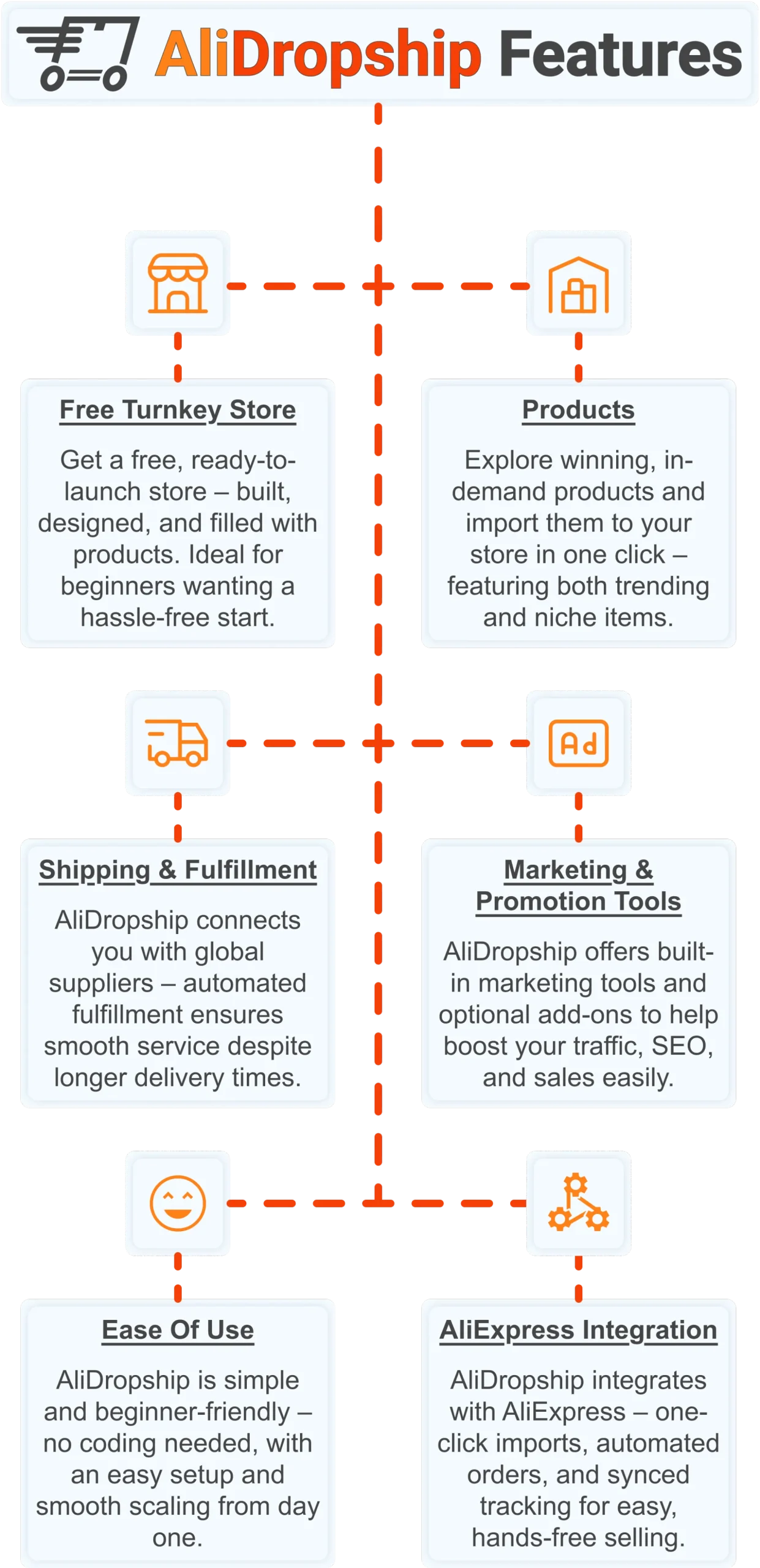
Free turnkey store ️
Get a free turnkey store – built, designed, and filled with products. Ideal for beginners wanting a hassle-free start, the store comes fully optimized to attract customers right away, saving you time on setup. Plus, it includes professional design elements to give your business a polished, trustworthy look from day one. This ready-made foundation makes it easy to move seamlessly into product selection.
Products
Once your store is set up, you can explore winning, in-demand products and import them in one click – featuring both trending and niche items. This wide selection lets you cater to diverse customer interests and test what works best. Regular updates ensure you always have fresh products, keeping your store competitive and relevant. With great products in place, smooth shipping becomes the next essential step.
Shipping & fulfillment
AliDropship connects you with global suppliers, and automated fulfillment ensures seamless order processing despite international delivery times. Customers receive real-time tracking updates, which builds confidence and trust in your store. Once shipping is handled reliably, you can focus on promoting your store and attracting traffic.
Marketing & promotion tools
To maximize sales, AliDropship offers built-in marketing tools and optional add-ons that help boost traffic, SEO, and conversions. From email campaigns and discounts to social media integration, these tools empower you to reach and retain customers without needing prior marketing experience. With promotion strategies in place, managing your business becomes simpler and more efficient.
Ease of use
AliDropship is beginner-friendly – no coding needed, with an intuitive dashboard that guides you through every step. Easy setup and smooth scaling let you expand your store without stress. As your business grows, adding new features, products, and marketing campaigns remains hassle-free, giving you more time to focus on sales.
AliExpress integration
Finally, AliDropship integrates seamlessly with AliExpress, enabling one-click imports, automated orders, and synced tracking. Your inventory stays up-to-date with the latest products and prices, while automated order processing frees you from manual tasks. Combined with the turnkey setup, reliable shipping, and built-in marketing tools, this integration ensures your dropshipping business is fully equipped for growth and success.
Frequently Asked Questions
What is marketing for ecommerce and why does it matter?
Marketing for ecommerce is the process of driving targeted traffic to an online store and converting that traffic into paying customers across channels like SEO, social media, email, and paid advertising. Organic search alone drives 43 percent of all ecommerce traffic, making it the single largest acquisition channel available, more than paid ads, social, email, and direct visits combined. Effective ecommerce marketing works across 3 stages of the customer journey: awareness, consideration, and conversion. Most failures happen when a store focuses on only one of these stages while ignoring the others.
How much can an ecommerce store realistically earn from marketing?
A part-time approach at 5 to 10 hours per week using SEO and occasional social posts typically earns 300 to 1500 dollars monthly. A semi-active approach at 15 to 20 hours weekly combining SEO, email, and social media can reach 1500 to 5000 dollars monthly. Full-time effort at 30 to 40 hours weekly with multi-channel marketing and paid ads can generate 5000 to 20000 dollars or more monthly. Most stores begin generating meaningful revenue somewhere between 60 and 90 days after launch, provided they build traffic from day one.
Why is SEO considered the backbone of ecommerce marketing?
Studies put SEO return on investment at over 317 percent, with a typical break-even period of around 9 months, and once pages rank that traffic is essentially free. Long-tail keywords account for over 91 percent of all web searches and convert at 2.5 times the rate of broad head terms. Brands like Ruggable have used blog content to generate over a million monthly organic visitors, outperforming paid traffic by a ratio of 10 to 1. Since 75 percent of ecommerce traffic now comes from mobile devices, mobile page speed is a critical technical SEO factor Google weights heavily.
How much does email marketing actually contribute to ecommerce revenue?
Email consistently delivers the highest return on investment of any ecommerce marketing channel, with industry averages putting email ROI at 36 to 42 dollars for every 1 dollar spent. A well-designed welcome popup offering a discount converts at 3 to 8 percent of site visitors, building a list quickly once traffic starts flowing. The abandoned cart sequence, triggered at 1, 4, and 24 hours after abandonment, recovers between 5 and 15 percent of otherwise lost sales. This automation is often considered the single highest-ROI email flow available to store owners.
How effective are influencer marketing and affiliate programs for ecommerce?
Micro-influencers with 5000 to 100000 highly engaged followers consistently deliver better conversion rates than mega-influencers with millions of passive followers. A common compensation model for stores with limited budgets is product gifting plus a 10 to 20 percent commission per sale tracked through a discount code or affiliate link. Setting up a formal affiliate program means you only pay when a sale is made, making it one of the most budget-friendly acquisition strategies available. Stores with active affiliate programs typically see 10 to 25 percent of total revenue attributed to affiliate referrals within 6 to 12 months of launch.
Every marketing strategy in this guide works better when it is sending traffic to a store that is already built, stocked, and ready to sell. Get your free turnkey store with a $100 voucher and start putting your marketing knowledge to work today.
 Previous post
